
Every year, thousands of graduates across India dream of wearing the blue uniform of the Indian Air Force. But most of them do not know where to begin — which entry to choose, what qualifications are needed, how the selection works, or what life actually looks like as an IAF officer.
The answer to most of those questions starts with one exam — AFCAT.
AFCAT, the Air Force Common Admission Test, is the primary route through which graduates enter the Indian Air Force as commissioned officers. It is open to graduates from all streams — science, engineering, commerce, arts, and postgraduate disciplines. It covers three major branches of the IAF — Flying, Technical, and Ground Duty. And it is conducted twice every year, giving candidates two chances annually to clear their path into the Air Force.
This guide covers everything — eligibility, exam pattern, AFSB interview, medical standards, training, salary, and career growth — in simple, plain language that anyone can follow.
What Is AFCAT? Understanding the Basics
AFCAT, short for Air Force Common Admission Test, is the Indian Air Force’s gateway examination for recruiting officers into various branches, It is a computer-based test conducted by the Indian Air Force twice every year — AFCAT 1 typically in the first half of the year and AFCAT 2 in the second half. Notifications are released on the official IAF recruitment website afcat.cdac.in.
Unlike NDA, which you can join straight after Class 12, AFCAT is a post-graduation entry. Final-year or final-semester students may also apply subject to conditions prescribed in the AFCAT notification. This makes it the most widely used entry route for graduates who want to become officers in the IAF.
The AFCAT exam is the first stage of a multi-step selection process. Candidates who clear the written test are called for the AFSB — Air Force Selection Board interview — a 5-day assessment. Final selection is based on AFSB performance, medical fitness, and merit list.
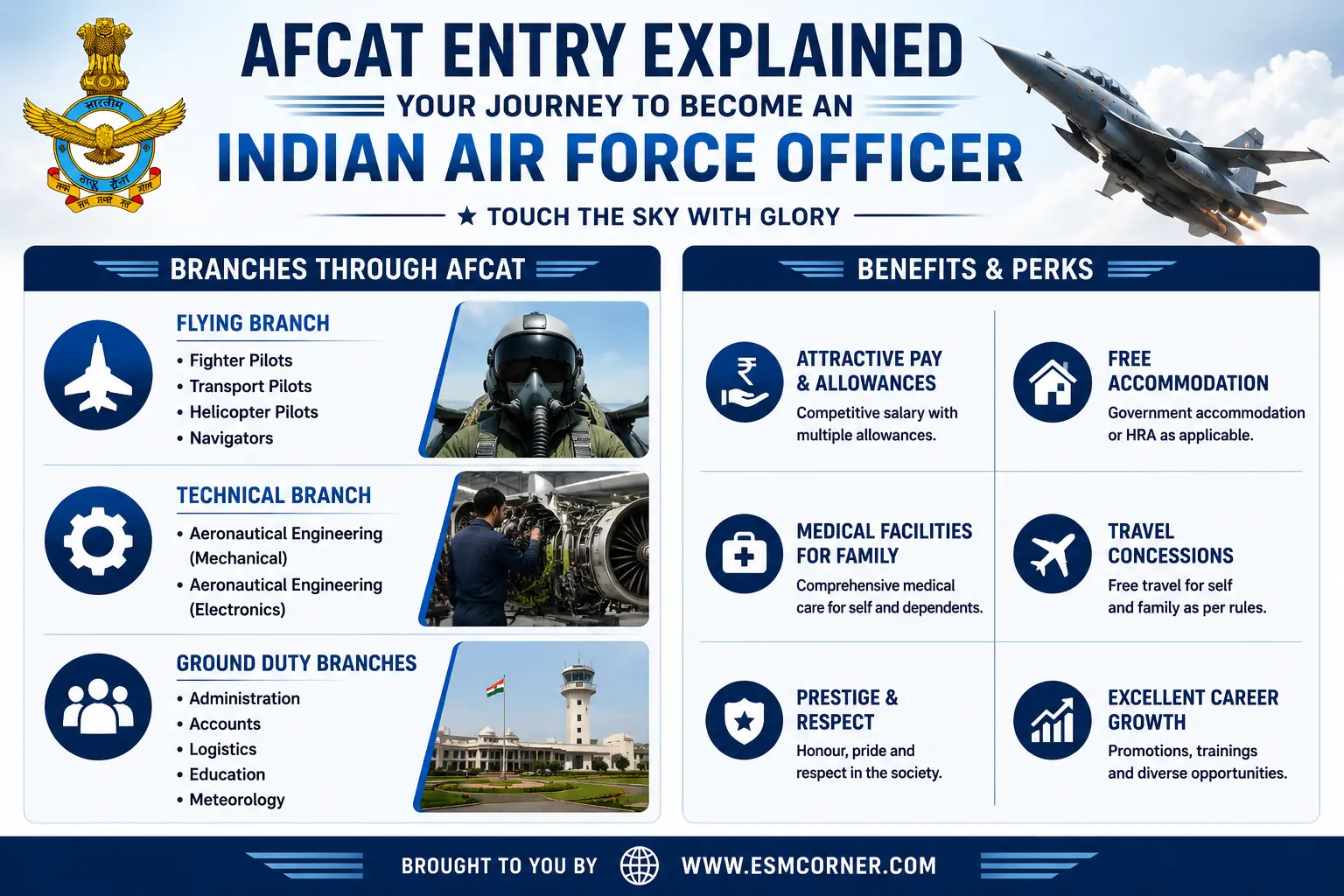
Through AFCAT, you can join three major branches of the Indian Air Force:
- Flying Branch — Fighter pilots, transport pilots, helicopter pilots, and navigators
- Technical Branch — Aeronautical Engineering (Mechanical) and Aeronautical Engineering (Electronics)
- Ground Duty Branches — Administration, Accounts, Logistics, Education, and Meteorology
AFCAT Eligibility — Who Can Apply?
Eligibility differs by branch. Read your specific branch requirements carefully before applying.
Flying Branch
- Open to both male and female candidates
- Candidates applying for the Flying Branch must be between 20 and 24 years of age. However, those possessing a valid Commercial Pilot Licence (CPL) issued by DGCA may avail an upper age relaxation up to 26 years
- Education: Graduation in any discipline with Physics and Mathematics at Class 12 level, OR a BE or B.Tech degree — with minimum 60% aggregate marks
- Vision: 6/6 in one eye and 6/9 in the other — medical standards for pilots are among the strictest in the defence forces
Technical Branch — Aeronautical Engineering (Mechanical and Electronics)
- Open to both male and female candidates
- Age: 20 to 26 years
- Education: BE or B.Tech in eligible engineering disciplines with 60% aggregate
- Eligible engineering disciplines are notified by the Indian Air Force in each AFCAT notification. Candidates must verify their degree against the official branch eligibility list before applying.
- Final year engineering students can apply provisionally, subject to meeting marks requirements before joining
Ground Duty Branches
- Open to both male and female candidates
- Age: 20 to 26 years for all ground duty roles
- Administration and Logistics: Graduation in any discipline with 60% aggregate
- Accounts: B.Com with 60%, or CA/ICWA/MBA Finance
- Education: Postgraduate degree (MA, M.Sc, or M.Com) with 50% aggregate
- Meteorology: Postgraduate in Physics, Mathematics, Statistics, Geography, or Environmental Science with 55% aggregate
AFCAT Exam Pattern — What the Written Test Looks Like
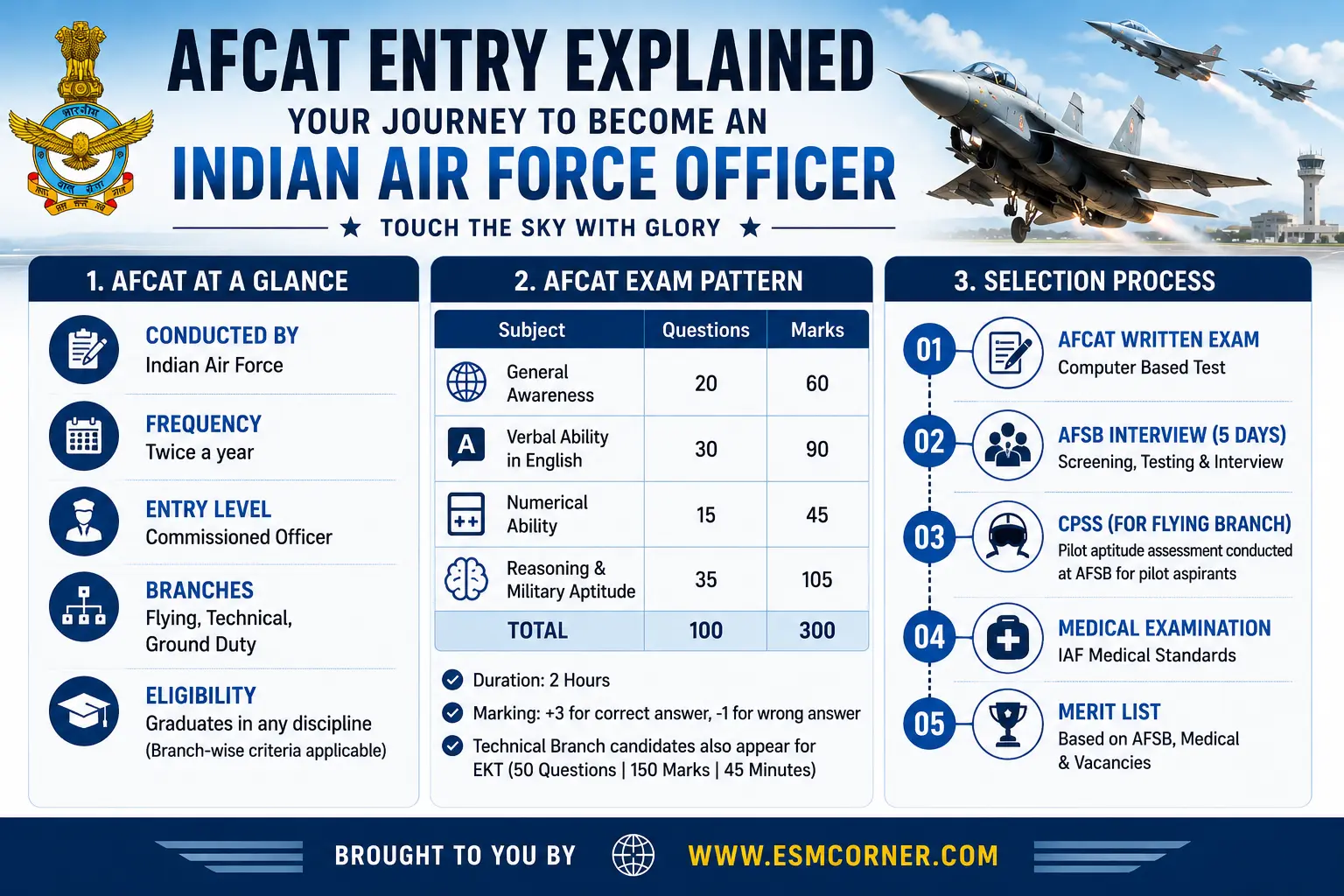
The AFCAT exam is a 2-hour computer-based test with 100 multiple-choice questions worth 300 marks total. Every correct answer earns 3 marks. Every wrong answer costs 1 mark. Random guessing will hurt your score.
| Subject | Questions | Marks |
| General Awareness | 20 | 60 |
| Verbal Ability in English | 30 | 90 |
| Numerical Ability | 15 | 45 |
| Reasoning and Military Aptitude | 35 | 105 |
| Total | 100 | 300 |
Target score guidance AFCAT cut-offs vary every cycle depending on vacancies, difficulty level, and candidate performance. Aspirants should aim well above previous cut-offs for a competitive score.. To remain safe and competitive — especially for the Flying Branch — target 200 or above out of 300.
Technical Branch candidates must also appear for the EKT — Engineering Knowledge Test — a separate 45-minute paper with 50 questions worth 150 marks, testing core engineering knowledge in your specific stream.
AFCAT Syllabus — What to Study
General Awareness
- Indian and world history, geography, and political science
- Indian Constitution, government schemes, and institutions
- Current affairs — national and international
- Indian Air Force history, aircraft, and operations
- Science, technology, space, and defence developments
Verbal Ability in English
- Reading comprehension passages
- Error detection and sentence correction
- Synonyms, antonyms, idioms, and phrases
- Fill in the blanks and cloze test
Numerical Ability
- Number system, percentage, profit and loss
- Time, speed, and distance
- Simple and compound interest, ratio and proportion, averages
Reasoning and Military Aptitude
- Verbal reasoning — analogy, series, and classification
- Non-verbal reasoning — patterns, mirror images, and spatial reasoning
- Military situational aptitude — scenario-based questions
The AFSB Interview — What Happens in Those 5 Days
Qualifying the AFCAT written examination is only the first step in the officer selection journey. The real selection happens at the AFSB — Air Force Selection Board interview, held at centres in Dehradun, Mysore, Gandhinagar, and Varanasi. This is a 5-day process that evaluates your Officer Like Qualities (OLQs) — leadership, communication, decision-making, emotional stability, and genuine personality.
Day 1 The screening stage consists of the Officer Intelligence Rating (OIR) Test followed by the Picture Perception and Discussion Test (PPDT) Candidates who do not pass screening go home on Day 1. Only screened-in candidates continue.
Days 2 and 3 — Psychological Tests Thematic Apperception Test (TAT), Word Association Test (WAT), Situation Reaction Test (SRT), and Self Description Test. These reveal how you think, react, and behave under pressure over time.
Days 3 and 4 — GTO Tasks Group Discussion, Group Planning Exercise, Progressive Group Tasks, Half Group Task, Final Group Task, Individual Obstacles, Command Task, and Lecturette — a 3-minute impromptu speech on a topic of your choice from a given set.
Day 4 — Personal Interview One-on-one interview with the Interviewing Officer covering your academics, background, current affairs, aviation knowledge, and overall personality.
Day 5 — Conference All three assessors — Psychologist, GTO, and Interviewing Officer — sit together and announce whether you are Recommended or Not Recommended.
Flying Branch candidates
Flying Branch aspirants are required to undergo the Computerised Pilot Selection System (CPSS), a specialised aptitude assessment conducted during the AFSB process to evaluate suitability for military flying duties. This is a one-time test only. If you fail PABT in any attempt, you are permanently disqualified from the Flying Branch in all future AFCAT attempts — no exceptions, no second chances. Treat it with maximum seriousness.
AFSB preparation tip
Know your IAF aircraft well — Rafale, Tejas LCA Mk1A, Su-30MKI, C-130J Hercules, Apache, Chinook. Stay updated on India’s defence developments and air power. Assessors look for genuine passion for aviation — not rehearsed answers.
Medical Examination — Physical Standards Matter
Candidates recommended at AFSB undergo a detailed medical examination at AFCME (Air Force Central Medical Establishment), New Delhi, or IAM (Institute of Aviation Medicine), Bangalore. Medical standards are strict, especially for the Flying Branch.
| Branch | Vision Standard | Minimum Height |
| Flying Branch | 6/6 in one eye, 6/9 in the other | 162.5 cm |
| Technical Branch | Relaxed norms, glasses permitted | 157 cm |
| Ground Duty Branches | Relaxed norms, glasses permitted | 157 cm |
Common reasons for medical rejection in Flying Branch include colour blindness, squint, vision worse than permitted limits, and any condition affecting spatial orientation or depth perception.
If declared medically unfit, candidates can appeal at IAM Bangalore for a second opinion. Always maintain your eye health and overall physical fitness throughout your preparation period.
Training at the Air Force Academy, Hyderabad
Candidates selected through AFCAT undergo pre-commission training at the Air Force Academy (AFA), Dundigal, Hyderabad, where they receive comprehensive military, academic, and branch-specific training before being commissioned as officers.
| Branch | Training Duration | Key Highlight |
| Flying Branch | Approx. 74 weeks (18+ months) | Wings Ceremony after flying training on PC-7 Mk.II turboprop trainers |
| Technical Branch | Approx. 12 months at AFA + specialised training | Aircraft engineering and maintenance management |
| Ground Duty Branches | Approx. 52 weeks | Drill, physical fitness, leadership, and branch-specific modules |
The Wings Ceremony at AFA — where Flying Branch cadets receive their wings after completing pilot training — is one of the most celebrated and emotionally significant events in the Indian defence forces. For a Flying Branch officer, this is the moment the dream becomes real.
Branches in Detail — Choose Your Career Stream
| Branch | Role | Commission Type |
| Flying | Fighter, transport, helicopter pilot or navigator | Short Service (extendable, PC option) |
| Technical (Mech) | Aircraft maintenance, propulsion, structures | Permanent Commission |
| Technical (Electronics) | Avionics, radar, communication systems | Permanent Commission |
| Administration | HR, station administration, welfare | Short Service Commission |
| Logistics | Supply chain, equipment, stores management | Short Service Commission |
| Accounts | Finance, audit, budget management | Short Service Commission |
| Education | Teaching at IAF schools and academies | Short Service Commission |
| Meteorology | Weather forecasting for IAF operations | Short Service Commission |
Technical Branch provides Permanent Commission directly. Flying and Ground Duty branches start on Short Service Commission with options for extension and, in some cases, Permanent Commission based on merit and service requirements.
Salary and Benefits of an IAF Officer
During Training at AFA: Training is fully funded. Cadets receive a stipend during the training period.
After Commissioning as Flying Officer:
| Component | Amount |
| Basic Pay | ₹56,100 per month |
| Military Service Pay | ₹15,500 per month |
| Flying Allowance (Flying Branch) | ₹25,000 per month |
| Approximate Total (Flying Branch) | ₹1.2 to ₹1.5 lakh+ per month |
Benefits beyond salary:
- Free government accommodation inside the Air Force Station, or HRA if posted outside
- ECHS medical coverage for self and entire family — no hospital bills
- Free ration or Ration Money Allowance every month
- CSD canteen — fuel, groceries, electronics, and vehicles at subsidised rates
- AGIF insurance and Air Force Group Insurance
- Transport allowance and uniform allowance
- 30 days earned leave and 20 days casual leave annually
- Travel concessions on railways and airlines
The Flying Allowance alone makes the Flying Branch one of the highest-paid entry-level officer positions across all three defence services.
Career Growth — Rank Progression in the IAF
| Rank | Approximate Timeframe | How It Happens |
| Flying Officer | On commissioning | Automatic |
| Flight Lieutenant | After 2 years | Time-based, automatic |
| Squadron Leader | After 6 years | Time-based, automatic |
| Wing Commander | After 13 years | Selection-based |
| Group Captain | On selection | Merit-based |
| Air Commodore and above | On selection | Senior leadership merit |
Senior IAF officers get opportunities for specialised courses in electronic warfare, test piloting, and aerospace engineering, as well as postings at prestigious institutions like the Defence Services Staff College, Wellington and the College of Air Warfare, Secunderabad. International exchange programmes with the USAF, RAF, and allied air forces are also part of a senior officer’s career.
AFCAT vs NDA vs CDS — Which Entry Is Right for You?
| Feature | AFCAT | NDA | CDS |
| Minimum Qualification | Graduation (60%) | Class 12 pass | Graduation |
| Conducted by | Indian Air Force | UPSC | UPSC |
| Service | Air Force only | Army/Navy/Air Force | Army/Navy/Air Force |
| Open to Women | Yes, all branches | Limited | Yes |
| Written Exam | Yes (CBT) | Yes | Yes |
| Frequency | Twice a year | Twice a year | Twice a year |
In plain terms: If you are a graduate and your goal is specifically the Indian Air Force — AFCAT is your direct, dedicated route. NDA is for those who want to join straight after Class 12. CDS is for graduates who want to keep all three services as options and do not mind a UPSC-level written paper.
Common Errors That Prevent Aspirants from Succeeding in AFCAT and AFSB
- Applying for Flying Branch without honestly checking vision standards — many candidates reach AFSB only to be rejected at the medical stage for avoidable eye conditions
- Treating PABT or CPSS casually — it is a one-time test and failure is permanent for the Flying Branch
- Preparing only for the written exam and ignoring AFSB personality development — both carry equal weight in the final result
- Not staying genuinely updated on IAF aircraft, operations, and India’s defence and aerospace developments
- Submitting the application form without carefully calculating marks percentage — a small arithmetic error can make you technically ineligible
- Guessing randomly in the exam — negative marking of 1 mark per wrong answer can seriously damage your score
Conclusion
AFCAT is the most accessible, well-rounded, and widely available entry route into the Indian Air Force for graduates across every discipline. Whether your goal is to fly a supersonic fighter jet, maintain cutting-edge aircraft systems, or serve the nation in critical ground support roles — AFCAT has a defined pathway for each of those ambitions.
The written exam is winnable with focused, consistent preparation. The AFSB rewards genuine personality, honest self-awareness, and real leadership instinct — not rehearsed performance. The medical standards reward candidates who take their physical fitness seriously throughout the journey.
If you are a graduate and the Indian Air Force is your dream — AFCAT is where that dream begins.
👉 Explore more guides, preparation strategies, eligibility details, and officer entry pathways in our Defence Career Guidance section.
📢 AFCAT 02/2026 Notification — Key Highlights
- Notification Released: 20th May 2026 at afcat.edcil.co.in
- Total Vacancies: 379 (Tentative) — Flying Branch + Ground Duty (Technical & Non-Technical)
- Application Window: 20 May 2026 – 19 June 2026
- Course Commencement: July 2027, Air Force Academy, Dundigal, Hyderabad
- Age Limit: 20–24 yrs (Flying Branch) | 20–26 yrs (Ground Duty)
- Eligibility: Graduation with minimum 60% marks
- Special Entries: NCC Special Entry & GATE Score Entry also open
- Selection Stages: Written Exam → AFSB Interview → Medical Examination
- Application Fee: ₹550 + GST (Free for NCC/GATE entry)
- Official Portal: afcat.edcil.co.in
✅ The AFCAT 02/2026 notification is live. Do not wait for the last date — apply early to avoid server rush.
Q1. What is AFCAT and who conducts it?
A1. AFCAT, short for Air Force Common Admission Test, It is conducted by the Indian Air Force twice every year to recruit graduates as commissioned officers in the Flying, Technical, and Ground Duty branches. It is the primary non-UPSC, IAF-specific officer entry route for graduates and is open to both male and female candidates.
Q2. What educational qualification is needed for AFCAT?
A2. For Flying Branch and most Ground Duty branches, you need a graduation degree with at least 60% marks. Technical Branch requires a BE or B.Tech in relevant engineering streams with 60%. Education and Meteorology branches require postgraduate degrees. Exact stream and subject requirements vary by branch — always check the official notification carefully.
Q3. What is the prescribed age criteria for applying through AFCAT?
A3. For the Flying Branch, the age limit is generally 20 to 24 years, relaxable to 26 years for CPL or NCC Air Wing ‘C’ Certificate holders. For Technical and all Ground Duty branches, the age limit is 20 to 26 years. The exact age cut-off date changes every notification cycle — verify from the official AFCAT notification each time.
Q4. Can women apply for AFCAT?
A4. Yes, fully. Female candidates are eligible for all three branches — Flying, Technical, and Ground Duty. Women can become fighter pilots, technical officers, and serve in every Ground Duty branch of the Indian Air Force. There is no gender restriction under AFCAT
Q5. What is the AFCAT exam pattern?
A5. AFCAT is a 2-hour computer-based test with 100 MCQ questions worth 300 marks, covering General Awareness, English, Numerical Ability, and Reasoning and Military Aptitude. Technical Branch aspirants additionally write the EKT — a 45-minute paper with 50 questions worth 150 marks — covering their specific engineering stream.
Q6. What is the AFSB interview?
A6. AFSB is a 5-day Air Force Selection Board process held at Dehradun, Mysore, Gandhinagar, or Varanasi. It assesses Officer Like Qualities through psychological tests, GTO tasks, personal interview, and a final conference. For Flying Branch aspirants, the PABT pilot aptitude test is also conducted during the AFSB.
Q7. What is PABT and why is it so critical?
A7. PABT (Pilot Aptitude Battery Test), also called CPSS, checks whether a candidate has the natural aptitude required for flying. It is a one-time test — failing it once means permanent disqualification from the Flying Branch across all future AFCAT attempts. There is no appeal and no second attempt. This rule has no exceptions.
Q8. What is the salary of a Flying Officer in the IAF?
A8. A Flying Officer earns a basic pay of ₹56,100 per month at Level 10, plus Military Service Pay of ₹15,500. Flying Branch officers additionally receive Flying Allowance of ₹25,000 per month. With HRA or accommodation, ration, transport allowance, and other applicable benefits, total monthly earnings for Flying Branch officers comfortably exceed ₹1.2 to ₹1.5 lakh.
Q9. Where does AFCAT officer training happen?
A9. All AFCAT-selected officers undergo Pre-Commission Training at the Air Force Academy (AFA), Dundigal, Hyderabad. Flying Branch cadets train for approximately 74 weeks and receive their Wings at the celebrated Wings Ceremony. Technical Branch training is approximately 12 months and Ground Duty Branch training is around 52 weeks — all at AFA.
Q10. How many times can I appear for AFCAT?
A10. You can appear for AFCAT as many times as you wish until you exceed the upper age limit of your chosen branch. However, for the Flying Branch, the PABT or CPSS test is a one-time opportunity regardless of how many times you attempt AFCAT. Failing PABT in any attempt closes the Flying Branch permanently
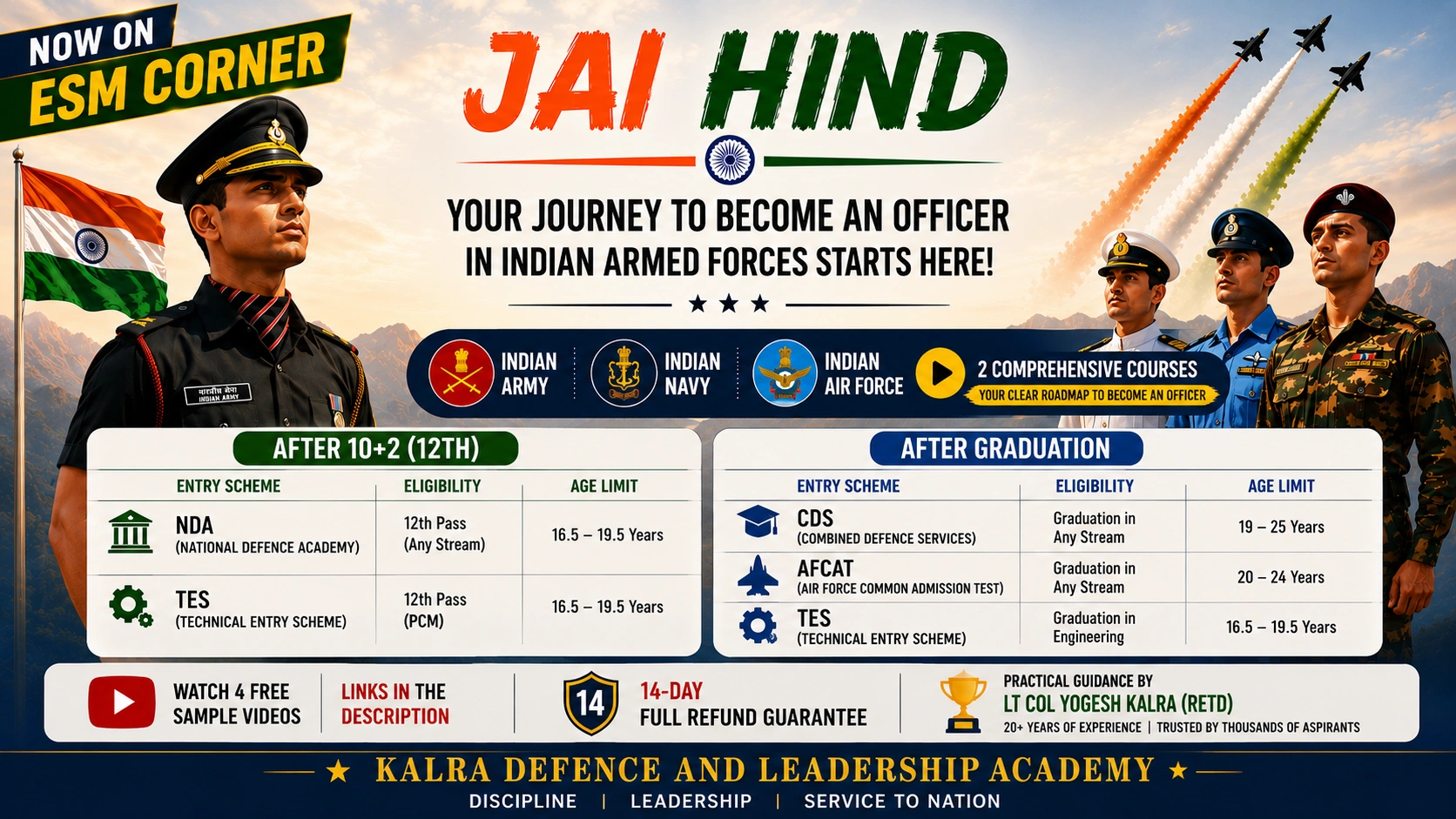
Whether you are preparing for NDA, CDS, AFCAT, TES, SSB Interview, or other officer entries after 12th and graduation, proper guidance can save years of confusion and wrong preparation.
Lt Col Yogesh Kalra has designed practical online guidance courses covering:
• Officer entry pathways
• SSB Interview understanding
• Preparation strategy
• Common mistakes made by aspirants
• Realistic guidance for defence careers
You can first watch 4 FREE sample videos from the links below. If the course does not meet your expectations, a 14-day full refund policy is also available.
👉 Course for Defence Aspirants: https://tinyurl.com/43m67sda
👉 Course for Serving Personnel & Internal Entries: https://tinyurl.com/4h4td9kf