
The moment that call-up letter lands in your hand, a strange kind of panic sets in. Most candidates immediately start Googling “SSB important questions” or “SSB GK for interview,” assuming it’s just a bigger, scarier version of a regular job interview where the right answers will save you.
Here’s the reality check nobody gives you early enough — SSB has almost nothing to do with what you know. It’s entirely about who you actually are.
Think about it this way — a normal interview checks your knowledge and your resume. SSB checks your character. And character can’t be memorized overnight, no matter how many “model answers” you learn by heart. Over five days, three completely different specialists — a Psychologist, a Group Testing Officer, and an Interviewing Officer — quietly study three different sides of you: how you think, how you behave in a group, and how you talk about yourself one-on-one. Most bright, capable candidates actually fail not because they lack potential, but simply because they walk in blind, with zero idea of what’s coming.
So let’s fix that right now.
Before You Even Step In: The Prep That Actually Matters
Here’s something most aspirants completely overlook — your evaluation doesn’t start the moment you enter the selection centre gate. It starts weeks earlier, in how mentally and logistically prepared you are.
Arriving at the Selection Centre with missing documents or rushing at the last minute can affect your Day 1 performance. To avoid unnecessary stress, make sure everything is prepared well in advance:
- Keep your mark sheets, ID proof, call-up letter, and certificates organised in one folder
- Build a calm, observant mindset instead of obsessing over rehearsed “perfect answers”
- Spend time genuinely reflecting on your own strengths, weaknesses, and background — this naturally builds confidence far better than last-minute cramming ever will
Day 1: The Screening — Where Most Candidates Get Filtered Out
Brace yourself — nearly two out of every three candidates who report get screened out on Day 1 itself. That’s how tough this first filter really is.
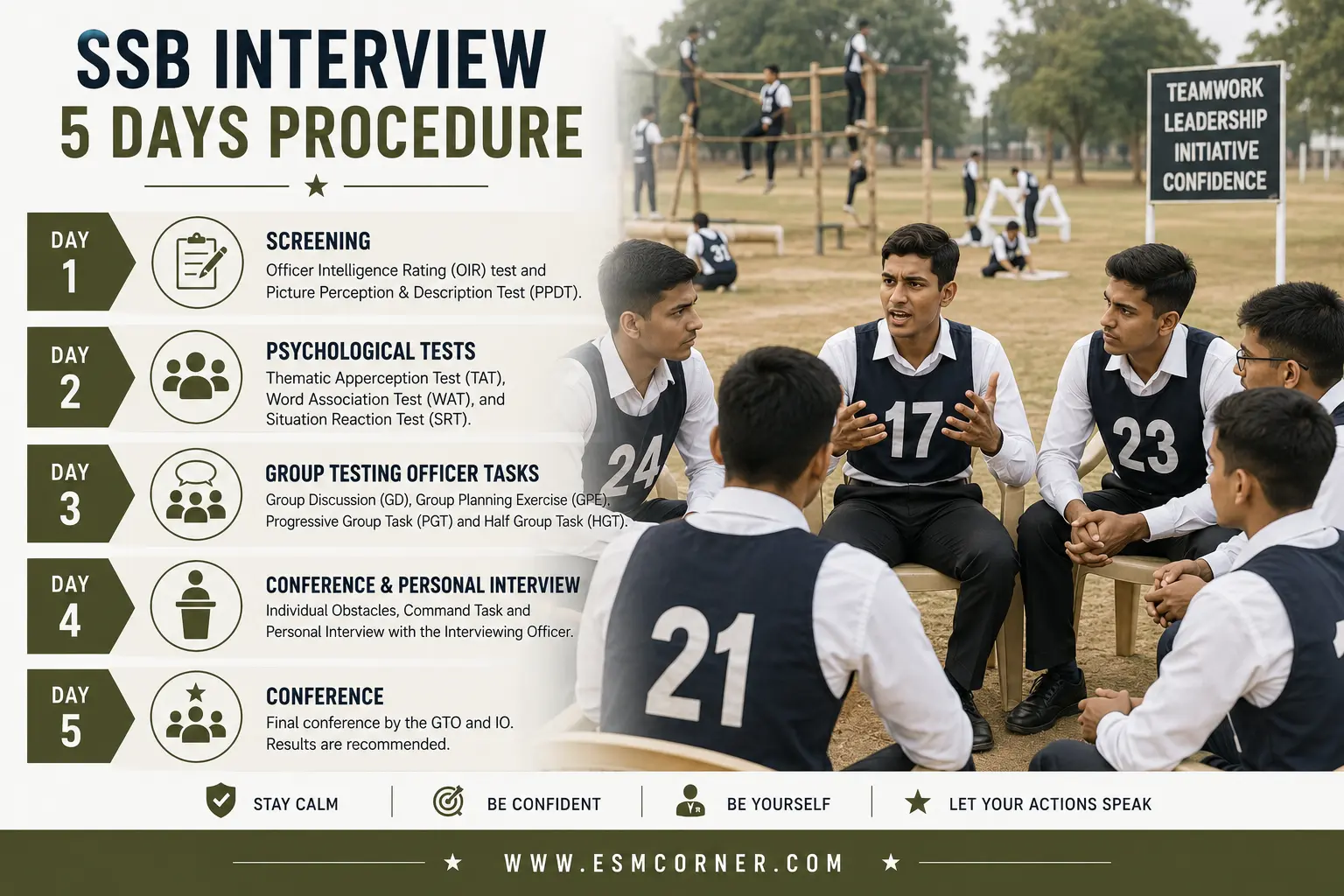
The day begins with the Officer Intelligence Rating (OIR) Test, which evaluates your verbal and non-verbal reasoning skills to assess basic mental ability. This is followed by the Picture Perception and Description Test (PPDT), where you observe a blurred picture for 30 seconds, write a short story in four minutes, present it before your group, and then take part in a group discussion to develop a single common story together.
Here’s where candidates trip up the most — they turn the group discussion into a shouting match, trying to prove they’re the loudest voice in the room. That’s exactly the wrong approach. What actually works is calm narration, genuinely listening to others, and showing warmth toward your group instead of steamrolling everyone else’s points.
Days 2 to 4: Psychology Tests — Your Mind, Unfiltered
This is where things get genuinely interesting. Psychology testing isn’t interested in your polished, “interview-ready” answers — it’s digging into your instinctive, subconscious reactions, the stuff you can’t fake even if you tried.
Four tools are used here, and each one reveals something different:
- TAT (Thematic Apperception Test): You’re shown 11 hazy pictures, one after another, for 30 seconds each, plus one blank slide — and you write a short story for each within four minutes. This reveals your natural perception, problem-solving style, and empathy toward the characters you create.
- WAT (Word Association Test): 60 words flash in front of you, 15 seconds each, and you jot down the very first thought that pops up. No time to overthink — which is exactly the point. It captures your instinctive mindset and emotional maturity.
- SRT (Situation Reaction Test): A booklet of 60 real-life situations, and you write practical responses in just 30 minutes. This checks your resourcefulness, decision-making speed, and sense of responsibility.
- SDT (Self Description Test): You write honest opinions — how your parents, teachers, friends, and you yourself view your personality, along with what you’d like to improve. Pure self-awareness check.
The single biggest mistake here? Trying to write an artificially “heroic” version of yourself, copied straight from some coaching book. Experienced psychologists spot this instantly — especially when your written answers don’t match how you actually behave during the outdoor tasks.
Days 2 to 4: GTO Tasks — Your Personality, Out in the Open
While the psychologist studies your inner world on paper, the GTO watches your personality play out live, through physical group activities.
Here’s a quick breakdown of what happens and what it’s actually checking:
| GTO Activity | What You Physically Do | What’s Really Being Tested |
|---|---|---|
| Group Discussion & GPE | Discuss a topic, plan a solution as a team | Analytical thinking, ability to convince through logic |
| PGT & HGT | Cross outdoor obstacles using ropes, planks, loads | Resourcefulness, teamwork under physical constraints |
| Group Obstacle Race & Individual Obstacles | Physically tackle obstacle courses | Courage, stamina, determination under stress |
| Lecturette & Command Task | Give a short speech; lead a small team independently | Clarity of speech, confidence, leadership instincts |
| Final Group Task | One last short outdoor group task | Confirms everything observed earlier about you |
Here’s the bigger picture worth understanding — every single stage of SSB, whether it’s a psychology test, a GTO task, or the interview, is essentially studying the same personality through different windows: your thoughts, your actions, and your speech. When all three genuinely line up, that’s when a candidate stands out as someone with real mental consistency — not someone just performing for the board.
The Personal Interview: A Genuine Conversation, Not a Trap
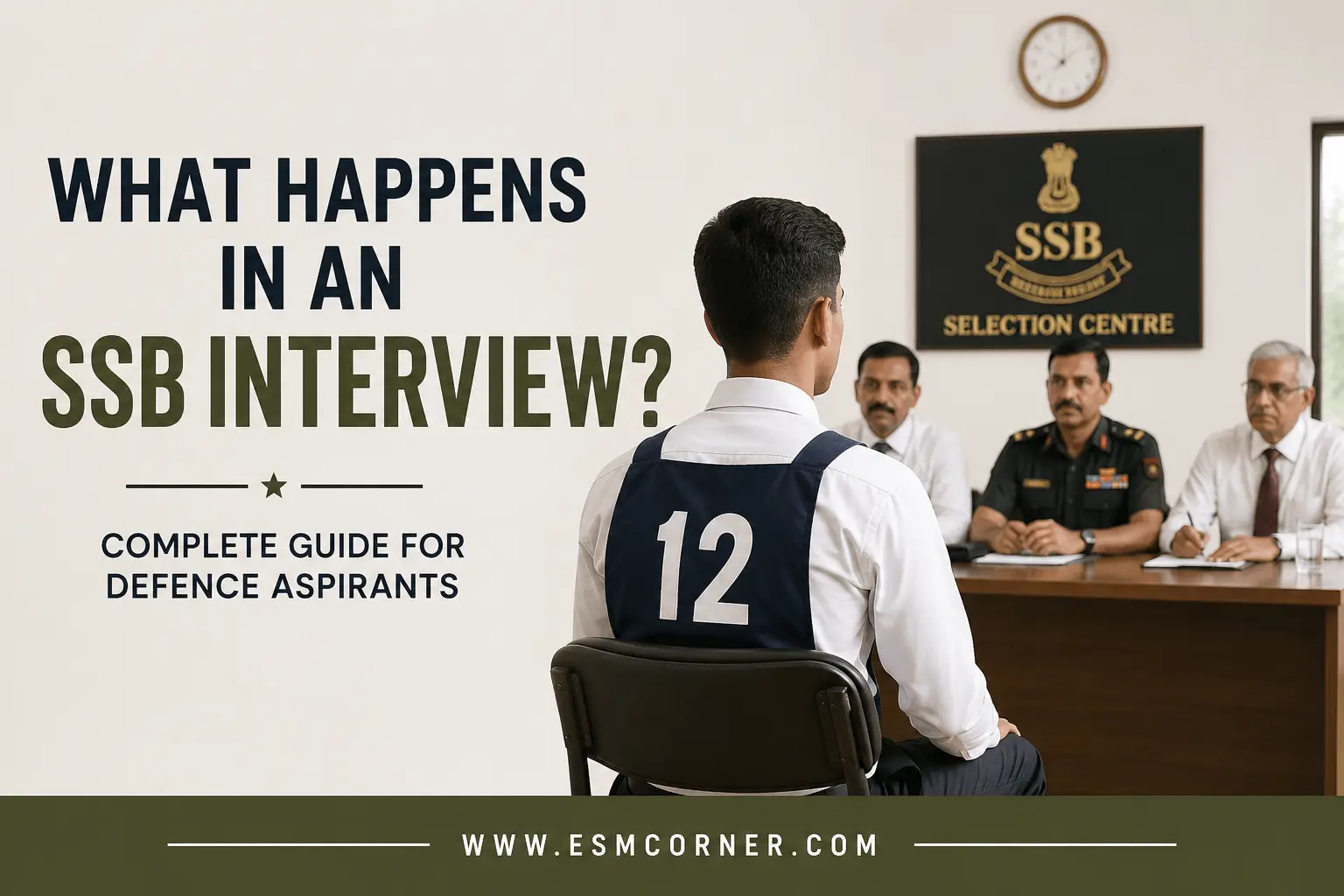
The Personal Interview happens one-on-one with the Interviewing Officer, based entirely on the form you filled earlier — your Personal Information Questionnaire (PIQ). Expect questions about your education, family, finances, hobbies, current affairs, and the big wins or setbacks in your life.
This isn’t about tricky academic quizzing. The IO is quietly reading your emotional stability, honesty, self-awareness, and clarity of thought. The classic mistake candidates make is exaggerating their achievements or making excuses for a bad academic year. A genuine future officer, instead, owns their shortcomings honestly and shows a clear plan to actually improve — that’s what leaves a real impression.
Conference Day: Where Everything Comes Together
On Day 5, all three assessors — Psychologist, GTO, and IO — sit together with the board and compare their independent notes on you. This is the moment where five days’ worth of observations either align neatly or raise a few questions.
If your case is borderline, you might get asked a couple of quick situational or general knowledge questions during your brief call-in. After going through every candidate, the board finalises its decision, recommending those who show a solid, consistent foundation of Officer Like Qualities.
What Assessors Are Actually Looking For (Keep This in Mind Daily)
A few honest reminders that’ll serve you better than any last-minute question bank:
- Be authentic, not rehearsed — a performed personality is painfully easy for trained assessors to spot
- Confidence, not arrogance — real confidence stays calm and respectful; overconfidence refuses to listen to anyone
- Communicate simply — clear, simple English beats fancy vocabulary every single time; and yes, keep up basic fitness through regular running and bodyweight workouts
- Build the right daily habits — take genuine responsibility at home, stay updated on current affairs, and build real social connections instead of isolating yourself
Conclusion
The SSB process isn’t some exam you crack through memorized tricks or a calculated performance — it’s a mirror that reflects your actual daily character back at you. The real secret isn’t acting like an officer for five days; it’s genuinely living like one, through honest actions, clear thinking, real teamwork, and unshakeable integrity.
Every single task — whether it’s a story written under a ticking clock or a team crossing an obstacle together — is simply checking one thing: can you stay composed, grounded, and genuinely yourself under pressure? So instead of losing sleep over the final result, put that energy into becoming a slightly better version of yourself every single day. When your thoughts, words, and actions genuinely align, the recommendation tends to follow on its own.
READ ALSO: 15 KEY QUALITIES FOR DEFENCE ASPIRANTS
Is the SSB interview difficult to clear?
The SSB is not difficult academically, but it is rigorous because it evaluates your real personality rather than memorized knowledge. Candidates who are self-aware, honest, and socially adaptable find the process straightforward, while those relying on artificial answers struggle during testing.
Can an average academic student clear the SSB?
Yes, your academic percentage does not dictate your selection. The board focuses primarily on your practical intelligence, decision-making, attitude, and social adaptability. Many candidates with average marks successfully earn recommendations by demonstrating strong leadership potential and genuine officer qualities.
What actually happens on the first day?
On Day 1, candidates undergo the Screening Test, which consists of the Officer Intelligence Rating (OIR) test and the Picture Perception and Description Test (PPDT). After the group discussion, results are announced, and only screened-in candidates stay for the remaining four days.
Are coaching institutes necessary for clearing SSB?
Coaching institutes are not mandatory for selection. While they help you understand the testing procedure, over-coaching often leads to rigid, artificial answers that assessors easily reject. Self-analysis, improving communication skills, and developing authentic personality traits are far more effective than relying on coaching.
How are Officer Like Qualities (OLQs) tested?
OLQs are assessed simultaneously through three independent channels: your written thoughts in Psychology, physical actions in GTO tasks, and spoken responses during the Personal Interview. The board looks for consistency across all three techniques to confirm your natural behavioral traits.
What major mistakes lead to immediate rejection?
Faking your personality, showing aggressive behavior in group tasks, displaying lack of honesty during the interview, and giving memorized psychology answers are major reasons for rejection. Assessors prioritize authenticity, trainability, and emotional balance over forced performances or superficial confidence.
How can candidates build genuine confidence?
You build genuine confidence by accepting your true self, taking responsibility for daily tasks, improving general knowledge, and regularly practicing public speaking. Participating in team sports and staying physically fit also significantly boosts your self-esteem and social adaptability.
How long does it take to prepare for SSB?
Personality development is a continuous process that ideally takes three to six months of consistent effort. Focusing on healthy daily habits, active group participation, current affairs, physical fitness, and self-reflection during this period yields far better results than last-minute preparation.
For daily defence updates, government notifications, recruitment alerts, welfare schemes, career opportunities, education news, and other important announcements, join our WhatsApp Community. Click here to join our WhatsApp Group.
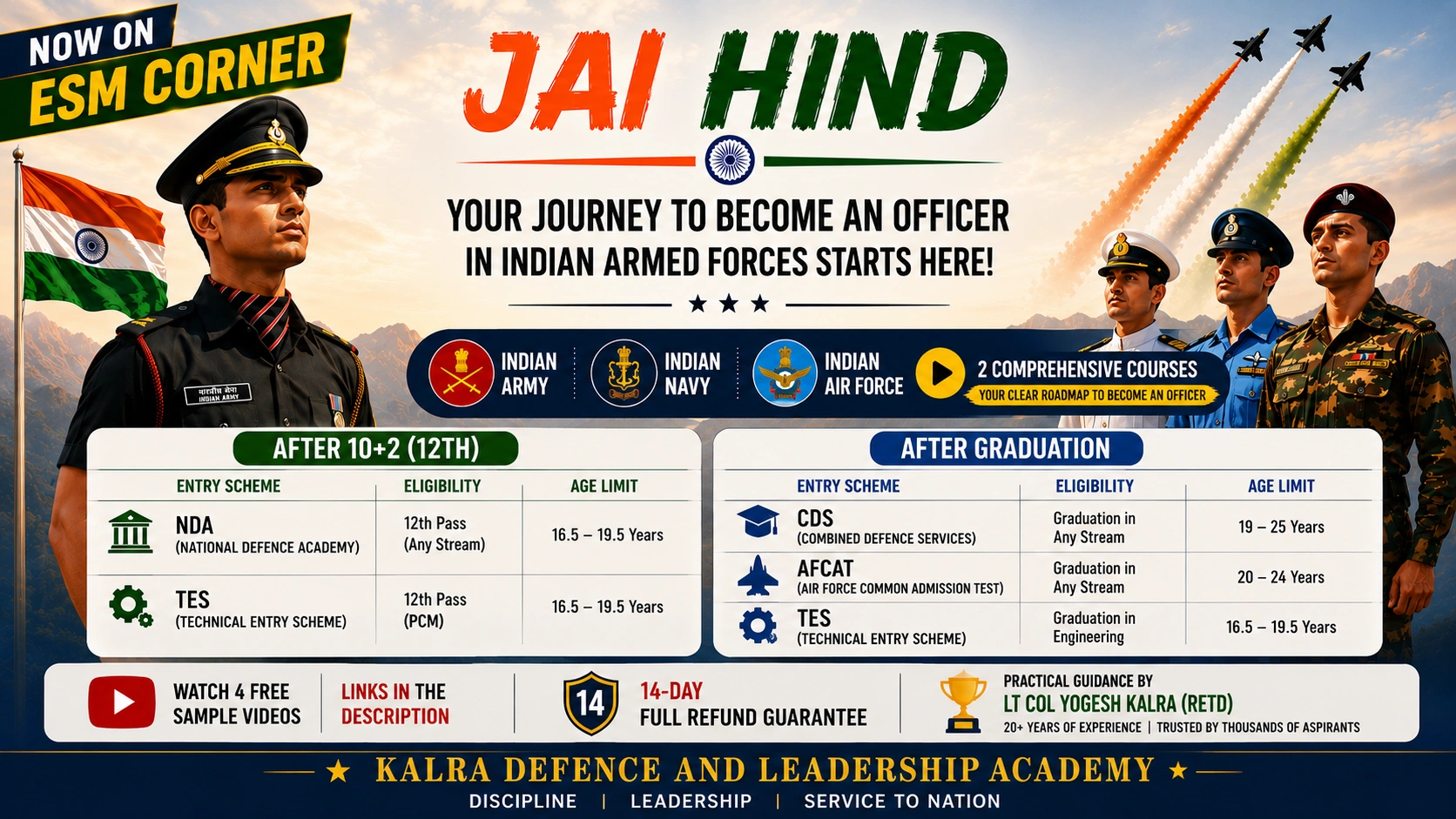
Whether you are preparing for NDA, CDS, AFCAT, TES, SSB Interview, or other officer entries after 12th and graduation, proper guidance can save years of confusion and wrong preparation.
Lt Col Yogesh Kalra has designed practical online guidance courses covering:
• Officer entry pathways
• SSB Interview understanding
• Preparation strategy
• Common mistakes made by aspirants
• Realistic guidance for defence careers
You can first watch 4 FREE sample videos from the links below. If the course does not meet your expectations, a 14-day full refund policy is also available.
Course for Defence Aspirants: https://tinyurl.com/43m67sda
Course for Serving Personnel & Internal Entries: https://tinyurl.com/4h4td9kf