
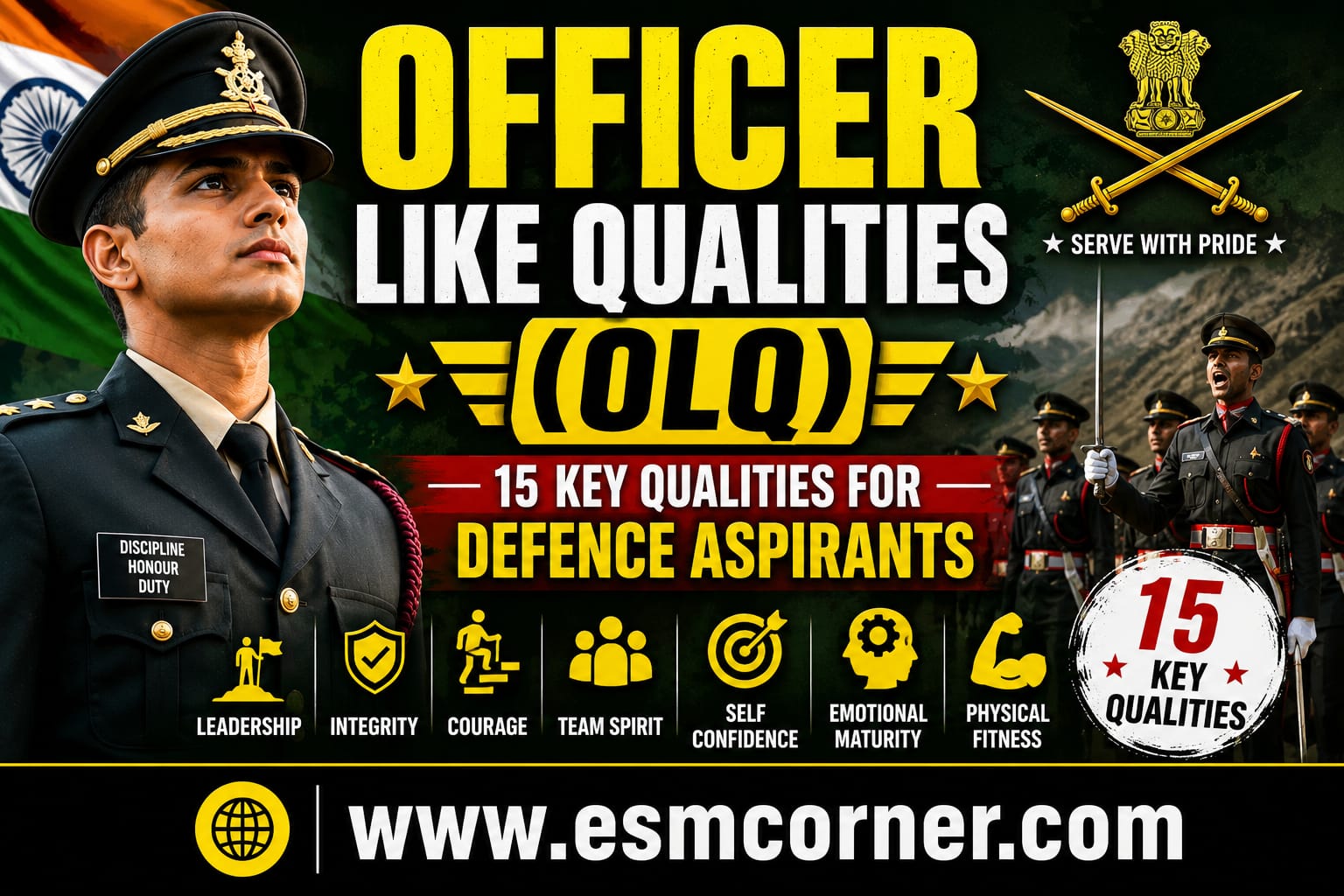
Every year, thousands of brilliant aspirants clear written exams like NDA, CDS, AFCAT, and TES with high marks, yet many face rejection at the Services Selection Board (SSB). The most common belief among candidates is that SSB selection depends primarily on fluent English, flawless physical fitness, high academic marks, or coaching-approved memorized answers.
While clear communication and physical readiness certainly help, the primary objective of the SSB interview is to evaluate your natural human personality through Officer Like Qualities (OLQs). Armed Forces assessors—comprising the Psychologist, the Group Testing Officer (GTO), and the Interviewing Officer (IO)—are not looking for flawless actors or rigid intellects. Instead, they look for genuine young individuals who possess practical intelligence, emotional stability, strong character, sound decision-making, and the inherent capacity to lead troops under severe stress.
These fundamental qualities cannot be forged overnight or mimicked through artificial behavior during the five-day testing procedure. True officer material is built through daily choices, personal responsibility, consistent discipline, and active involvement in real-life situations long before stepping into the selection center. This comprehensive guide breaks down every single Officer Like Quality, explains how assessors observe them, and provides actionable strategies to cultivate these traits in your daily routine.
Understanding Officer Like Qualities (OLQs) and SSB Evaluation
What are Officer Like Qualities, and why do they form the backbone of defence selection? In simple terms, OLQs represent a specific set of 15 behavioral traits and psychological attributes that determine an individual’s suitability for military leadership. A common misconception among candidates is confusing superficial personality traits—such as loud talking, stylish appearance, or extroversion—with actual OLQs.
While personality is the external image you present to the world, OLQs represent your core behavioral responses under pressure, social adaptability, mental stamina, and problem-solving capability. Assessors do not expect you to be a born general; rather, they search for trainable potential and emotional maturity. Can these qualities be developed over time? Absolutely, provided you engage in honest self-reflection and deliberate lifestyle adjustments. The myth that OLQs are strictly hereditary or fixed at birth misleads many aspirants into giving up early. In reality, every dynamic environment—whether playing team sports, organizing college events, or managing personal crises—acts as a training ground for developing these essential leadership qualities.
Factor I: Planning and Reasoning (Mind)
- Effective Intelligence: The practical ability to solve real-life problems using available resources, common sense, and resourceful thinking during difficult situations.
- Reasoning Ability: The capacity to analyze complex data logically, identify core issues, evaluate alternatives, and reach rational conclusions under time pressure.
- Organising Ability: The skill to arrange available assets, systematically plan tasks, delegate work effectively, and achieve objectives with minimal wastage of resources.
- Power of Expression: The clarity and confidence to convey ideas, thoughts, and opinions effectively through spoken or written language without ambiguity or hesitation.
Factor II: Social Adjustment (Heart)
- Social Adaptability: The natural ability to adjust smoothly with people of diverse backgrounds, cultures, and temperaments while building harmonious relationships.
- Cooperation: The willingness to unselfishly work together with group members toward a common goal, putting collective team objectives above personal ego.
- Sense of Responsibility: The deep internal commitment to perform duties conscientiously, take ownership of consequences, and act reliably without supervision.
Factor III: Social Effectiveness (Guts)
- Initiative: The willingness to take the first step in unfamiliar situations, originate action proactively, and sustain effort without waiting for external instructions.
- Self-Confidence: Unshakable faith in one’s abilities, allowing an individual to handle unexpected obstacles and perform efficiently in high-stress environments.
- Speed of Decision: The ability to evaluate changing scenarios swiftly and arrive at sound, timely decisions without experiencing mental paralysis or hesitation.
- Ability to Influence the Group: The natural leadership capacity to convince, motivate, and direct team members toward achieving group goals through personal conviction.
- Liveliness: The capacity to maintain a cheerful, optimistic, and resilient attitude even in adverse conditions, keeping group morale consistently elevated.
Factor IV: Dynamic Qualities (Limbs)
- Determination: The mental toughness and persistence to achieve targets despite repeated failures, fatigue, physical discomfort, or daunting obstacles.
- Courage: The willingness to take calculated risks, face physical or moral dangers boldly, and stand up for correct principles under intimidating pressure.
- Stamina: The capacity to withstand prolonged physical exertion and mental strain without compromising performance quality or losing focus.
How Assessors Evaluate OLQs Across the Three Technique Wings
A central principle of the SSB evaluation procedure is the Mano, Vacha, Karma triad—evaluating thought, speech, and action independently through three distinct assessors.
- Psychology Tests (Mano – Thoughts): Through TAT, WAT, SRT, and SDT, the Psychologist assesses your subconscious mind, emotional stability, problem-solving style, and natural thought process.
- Personal Interview (Vacha – Words): The Interviewing Officer evaluates your life history, self-awareness, values, communication clarity, current affairs knowledge, and practical intelligence through structured dialogue.
- GTO Tasks (Karma – Actions): The Group Testing Officer evaluates your practical social behavior, physical stamina, leadership, cooperation, and group dynamics across outdoor obstacles and discussions.
During the final Conference Assessment, all three assessors compare their findings independently. Candidates who demonstrate consistent, well-balanced OLQs across all three techniques are recommended for defence commission.
Quick Reference Summary of Core Factors
| OLQ Factor | Core Purpose | Key SSB Testing Grounds | Primary Daily Habit |
| I: Planning & Reasoning | Analytical & practical problem-solving | PPDT, TAT, Progressively Obstacle Task, Interview | Solve daily logic puzzles; organize personal study plans |
| II: Social Adjustment | Team harmony & ethical accountability | Group Discussions, PGT, Command Task, SDT | Help household/friends; adapt happily to new environments |
| III: Social Effectiveness | Group leadership & decision speed | GD, Snake Race, Lecturette, Personal Interview | Take charge of group projects; speak up in public |
| IV: Dynamic Qualities | Courage, persistence, and physical drive | Individual Obstacles, HGT, Final Group Task | Maintain daily physical exercise; complete difficult tasks |
Practical Blueprint for Cultivating OLQs in Daily Life
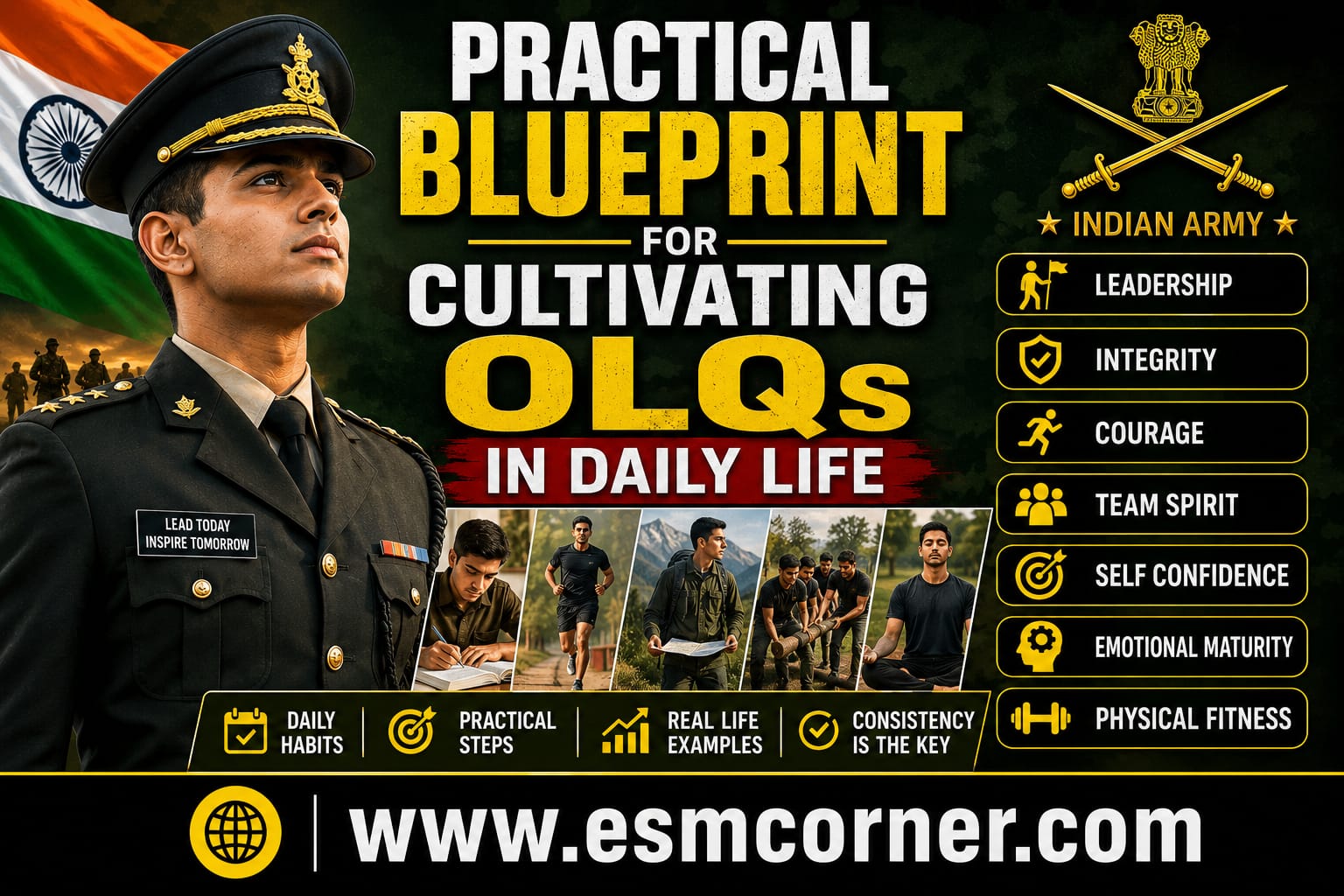
Developing Officer Like Qualities is a gradual process of building character and discipline. Here is how you can train yourself daily:
- Accept Daily Responsibility: Stop blaming external circumstances. Manage your time, clean your room, manage your budget, and take responsibility for your family obligations.
- Engage in Team Sports: Playing football, basketball, or cricket develops cooperation, physical stamina, tactical awareness, and liveliness far better than isolated workouts.
- Build Communication through Active Listening: Read daily newspapers to stay updated on current affairs. Practice expressing your views clearly, concisely, and calmly without shouting.
- Develop Authentic Leadership: Avoid pretending or putting on a temporary persona for the SSB. Instead, lead by example in school, college, or community initiatives. Real confidence comes from genuine self-awareness and overcoming personal failures.
- Conclusion
- Clearing the SSB interview is not about performing clever tricks, delivering coached answers, or putting on a temporary mask of artificial bravery. The selection board is systematically designed to peel away superficial layers and evaluate your true human character under pressure. Officer Like Qualities represent a balanced way of living rooted in self-discipline, social responsibility, physical resilience, mental adaptability, and emotional maturity. As a defence aspirant, your focus should shift away from trying to impress the assessors and toward genuinely transforming yourself into a dependable, responsible, and capable individual. Take ownership of your daily routines, participate actively in group activities, speak truthfully, face failures courageously, and continuously refine your character. When you build authentic leadership and integrity within your daily life, your Officer Like Qualities will naturally shine through every test at the Selection Centre.
Frequently Asked Questions (FAQs)
What are OLQs?
Officer Like Qualities (OLQs) are 15 fundamental behavioral, mental, emotional, and physical traits evaluated during the SSB process. They measure a candidate’s practical intelligence, social adaptability, leadership capacity, emotional stability, and overall potential to become an effective officer in the Indian Armed Forces.
How many OLQs are evaluated at SSB?
There are exactly 15 Officer Like Qualities evaluated at the SSB. They are broadly classified into four functional factors: Planning and Reasoning (Factor I), Social Adjustment (Factor II), Social Effectiveness (Factor III), and Dynamic Qualities (Factor IV). Assessors observe these traits collectively across all five days.
Can OLQs be developed over time?
Yes, OLQs can definitely be developed through conscious effort, self-awareness, active discipline, and regular participation in team activities. They represent dynamic behavioral habits rather than permanent traits. Consistently taking responsibility, handling challenges, engaging in sports, and improving decision-making naturally strengthens these qualities.
Which SSB tests evaluate my OLQs?
OLQs are evaluated across all major SSB tests using three distinct techniques: Psychological Tests (TAT, WAT, SRT, SDT), Group Testing Officer Tasks (GD, PGT, HGT, Command Task, Individual Obstacles), and the Personal Interview. The final Conference integrates all three evaluation streams holistically.
Can introverted candidates possess strong OLQs?
Yes, introverts regularly achieve recommendation at the SSB. Assessors look for practical intelligence, sound reasoning, responsibility, integrity, and genuine team cooperation rather than loud talk or superficial extroversion. An quiet individual who contributes meaningful ideas, works hard, and supports the group displays excellent Officer Like Qualities.
Is fluent English mandatory for showing OLQs?
While comfortable English communication is important for expressing thoughts clearly during discussions, interviews, and psychology tests, it is not a direct measure of your character or leadership. Practical intelligence, courage, determination, and cooperation matter far more than polished vocabulary or an artificial accent.
How long does it take to improve OLQs?
Substantial improvement in personality and behavior generally requires 3 to 6 months of deliberate daily practice. Developing habits such as regular exercise, structured reading, taking personal responsibility, active team participation, and practicing calm decision-making gradually builds authentic officer-like attributes over time.
What is the biggest mistake candidates make regarding OLQs?
The biggest mistake candidates make is trying to fake or memorize behaviors according to coaching tips. Assessors easily detect artificial confidence, coached psychological answers, and forced leadership styles. Authentic self-improvement, honesty, and genuine self-awareness remain the only effective paths to clearing the SSB.
Recommended Reading: NDA Entry Explained – Complete Eligibility, Exam Pattern, SSB Interview & Training Guide.