
Source: SC
If there’s one legal principle every veteran fighting a disability pension case should understand, it’s this: the presumption of sound health disability pension rule. It has quietly decided the outcome of more disability pension cases than almost any other single legal principle, and it works strongly in your favour.
What the Rule Actually Says
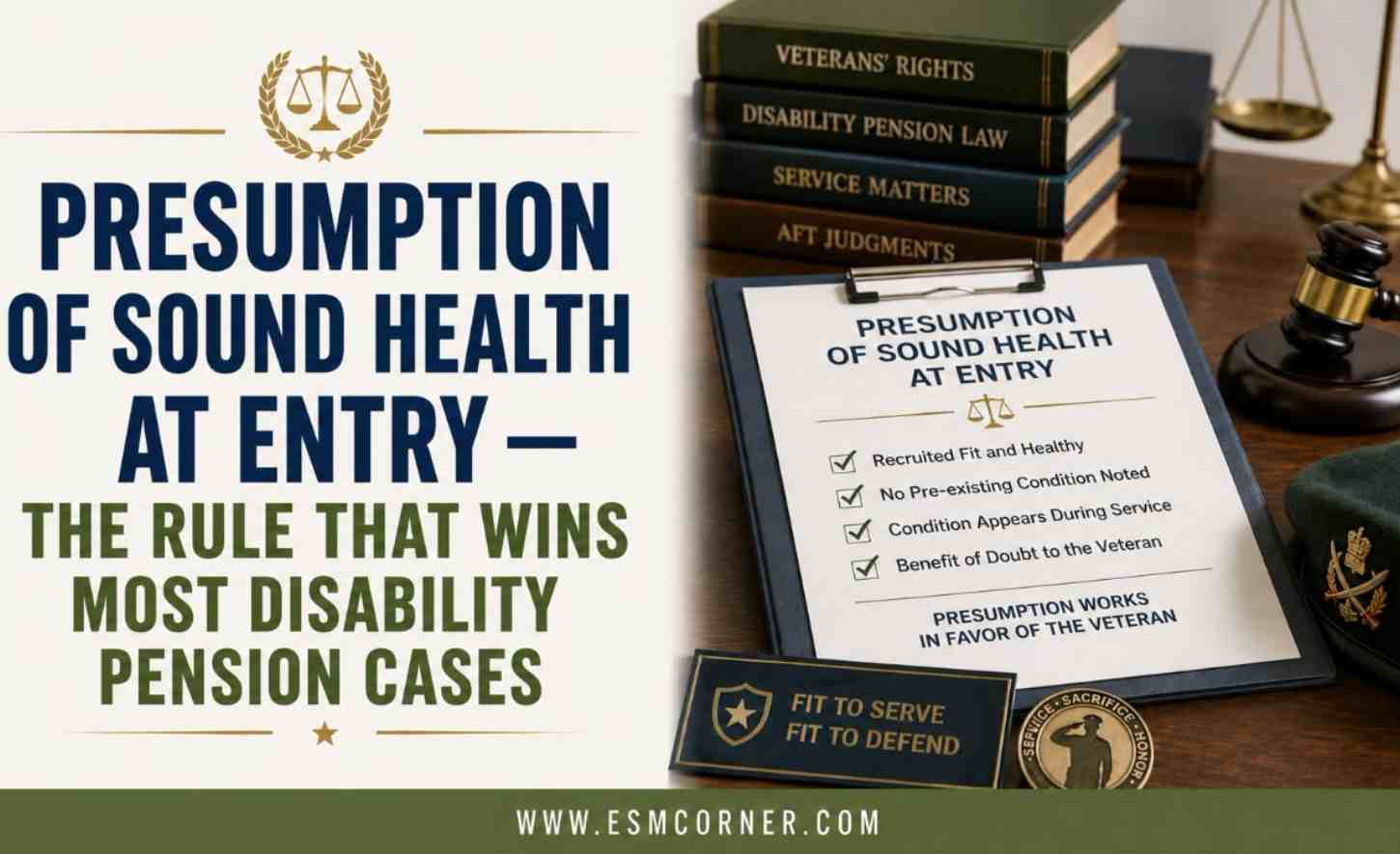
In simple terms: if you were found medically fit at the time you joined the armed forces, with no note of any disease or disability in your service record, the law presumes you were in sound physical and mental health at entry. If you are later discharged on medical grounds, any deterioration in your health during service is presumed to be connected to your service — unless the department can clearly prove otherwise.
Why This Rule Matters So Much
This effectively flips the starting point of the argument in your favour. Instead of you having to prove your condition was caused by service, the department generally has to prove it wasn’t — a significantly harder task for them, especially years after the fact.
The Case That Firmly Established This Principle
This sound health presumption rule was firmly established through a landmark Supreme Court ruling, which held that if no disease or disability was noted at the time of enrolment, a condition that later leads to discharge or death is deemed to have arisen during the course of service. This principle has since been repeatedly applied and reaffirmed in numerous cases before the AFT and various High Courts.
How This Interacts With the Medical Board’s Opinion
It’s important to understand that this presumption doesn’t mean a Medical Board’s opinion is automatically wrong. What it means is that the Board’s conclusion that a condition is NOT connected to service needs to be properly reasoned and evidence-based to overcome this starting presumption in your favour — a bare, unexplained opinion is generally not enough to displace it.
When the Presumption Applies Most Strongly
This principle is strongest where:
- Your enrolment medical examination recorded no disability or disease
- The condition developed clearly during your period of service
- Your claim is raised within a reasonable time after discharge (commonly discussed as within 15 years, after which the burden may shift more toward the claimant)
Step 1: Get Your Enrolment Medical Examination Report
This document is often the single most important piece of evidence in establishing that you were fit at entry, with no pre-existing condition recorded.
Step 2: Highlight the Absence of Any Contrary Record
If your service record doesn’t show the condition being flagged or treated early in your career, this supports the argument that it developed during, and because of, your service.
Step 3: Use This Principle in Your Appeal or AFT Case
This is one of the strongest, most well-established disability pension legal principle arguments available, and should be explicitly raised in any appeal or case where the Medical Board’s finding of non-attributability lacks proper reasoning.
Final Thoughts
The presumption of sound health at entry is not a minor technicality — it’s one of the most powerful tools available to veterans challenging a disability pension rejection, and it has decided the outcome of many otherwise difficult cases.
If you want help with your specific situation, get in touch with ESM Corner’s Legal Help team for guidance tailored to your case.
Frequently Asked Questions
Q1: What is the presumption of sound health rule?
A1: If no disability or disease was recorded at the time of enrolment, the law presumes you were in sound health at entry, and any condition leading to later discharge is presumed connected to your service unless the department proves otherwise.
Q2: Does this mean my claim will automatically succeed?
A2: No, but it significantly shifts the burden onto the department to properly justify why your condition is not connected to service, rather than requiring you to prove the connection from scratch.
Q3: What is the most important document to support this argument?
A3: Your enrolment medical examination report, showing you were found fit with no disability or disease noted at the time of joining.
Q4: Does this presumption apply no matter how long after discharge I claim?
A4: It applies most strongly when the claim is raised within a reasonable time after discharge; the burden of proof can shift more toward the claimant for claims raised after a longer period, commonly discussed as beyond 15 years.
Q5: Can the department still deny my claim despite this presumption?
A5: Yes, but only with proper, specific, evidence-based reasoning showing why the condition is genuinely unconnected to your service — a bare, unreasoned denial is generally not sufficient.
Q6: Is this principle recognised across different courts and tribunals?
A6: Yes, it has been consistently applied and reaffirmed by the Armed Forces Tribunal and various High Courts in numerous cases over the years. Meta Title Kit
Want regular updates on pension, legal, and welfare matters for veterans? Join the ESM Corner WhatsApp group.