
Why This Checklist Matters
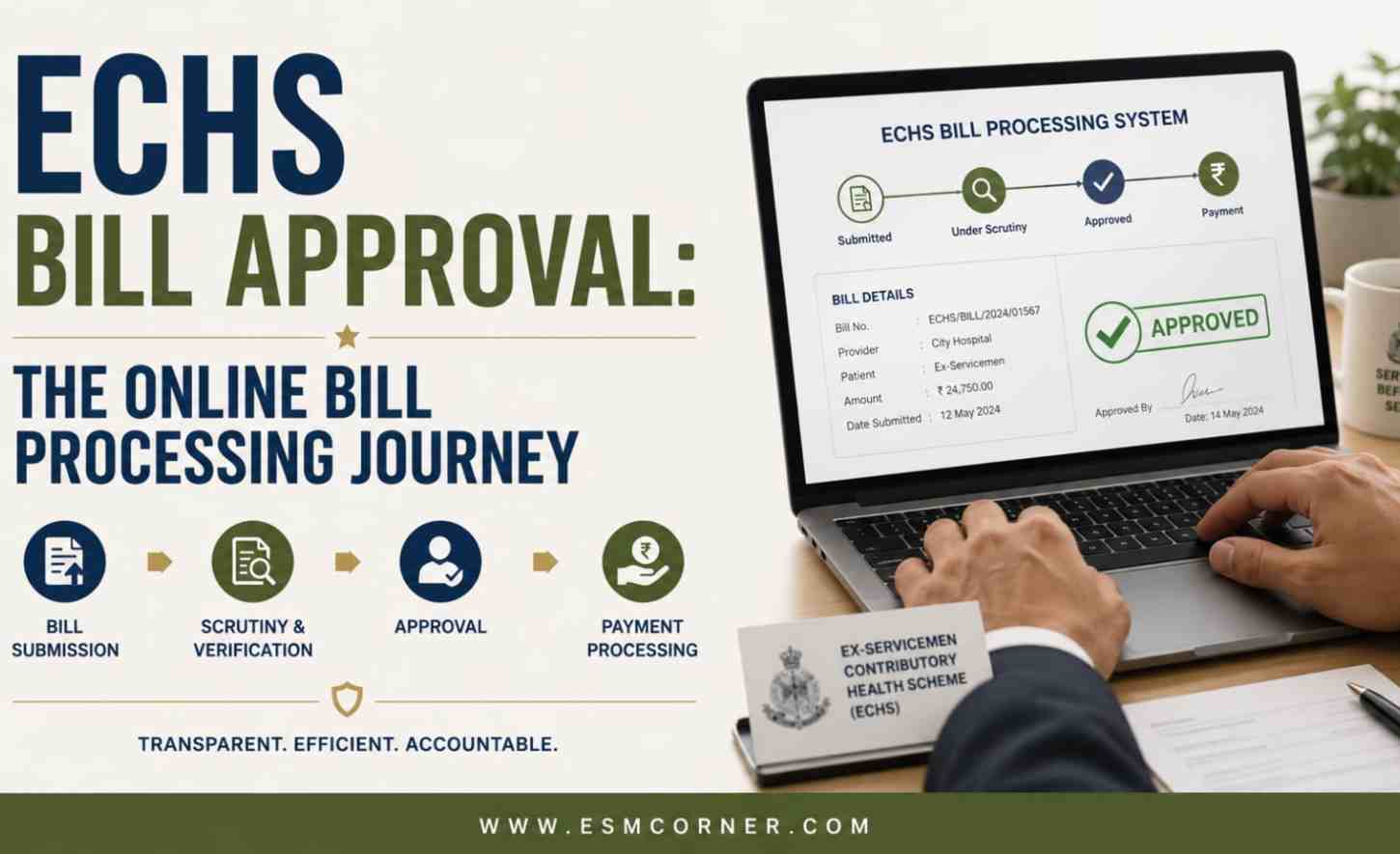
Every ECHS bill goes through medical and financial checks before payment is released. Missing or unclear documents do not just risk claim rejection. They slow the whole process down, since the reviewing authority has to raise a query and wait for a response before the bill can move forward. Getting the paperwork right the first time is the single biggest thing you or your hospital can do to speed up your claim.
General Rules That Apply to Every Bill
A few basic requirements apply across the board:
- Every page of the claim document should be numbered by hand in the hard copy.
- Referral letters need the seal and signature of the Medical Officer In-Charge (MO I/C) and the Officer In-Charge (OIC) of the Polyclinic. Computerised referral letters also need the name and designation of the MO I/C, along with the seal and signature.
- A drug or MRP certificate is required for any medicine, drug, or consumable priced above Rs 1,000 per unit.
- Discharge summaries must include presenting complaints, the line of treatment, details of any surgery, and advice given at discharge, and must carry the seal and signature of the treating or resident doctor.
- All laboratory and radiology reports must be on the hospital or diagnostic centre’s letterhead, in original, and signed by the concerned specialist. Computerised reports should carry digital signatures.
- Investigation reports should be arranged in date order.
- The final bill must show a bill number, along with the seal and signature of the authorised person, and a clear breakdown of amounts claimed under accommodation, consultation, investigations, medicines and consumables, and procedures.
The Core Document Checklist
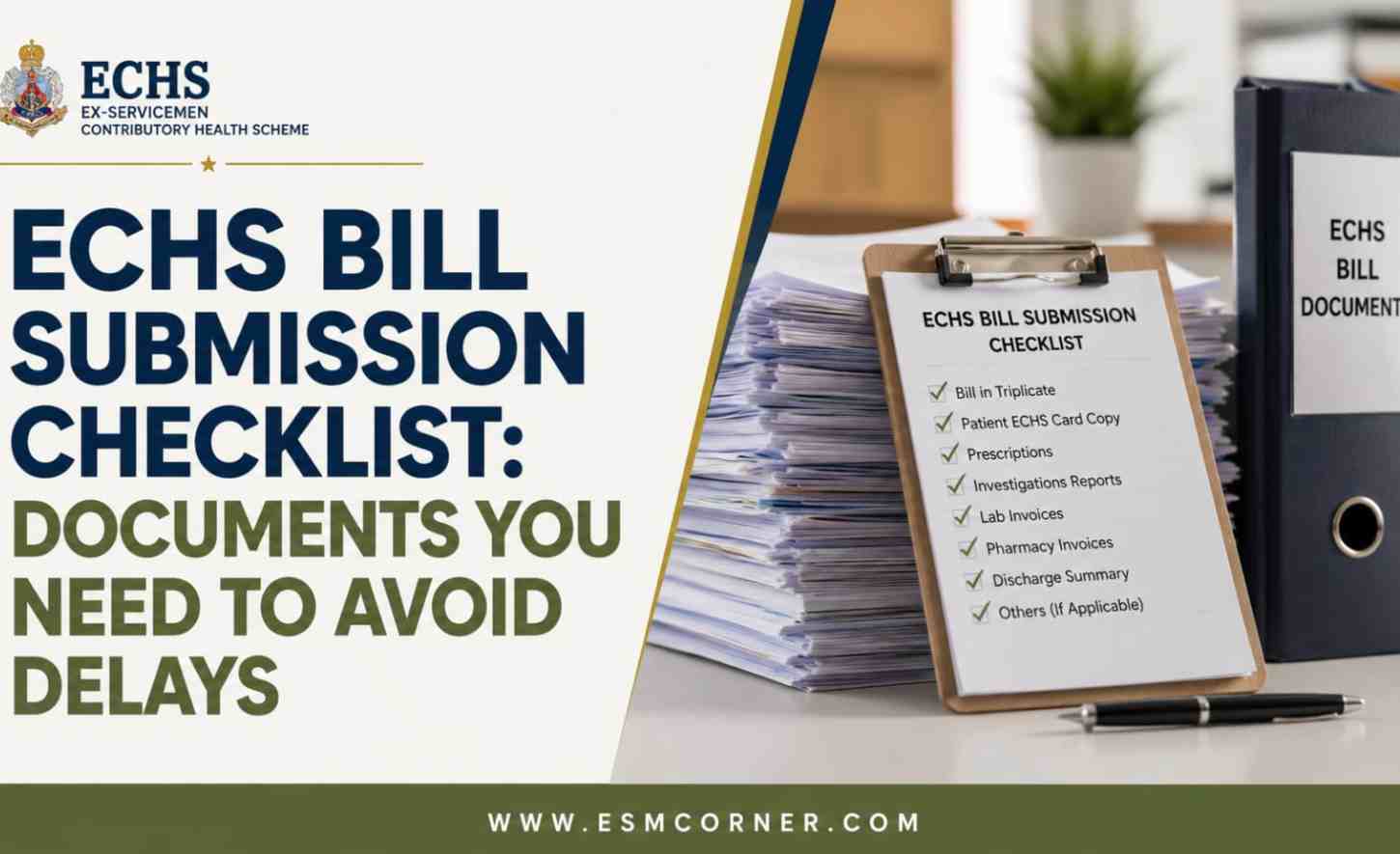
For a typical hospitalisation claim, the following documents are generally expected:
- Proof of ECHS membership (photocopy of your ECHS card).
- The original referral form.
- Emergency certificate from the treating hospital, where applicable.
- Admission case notes.
- Summary of the bill, along with the itemised bill.
- Prior approval documents, where required.
- Memorandum of Agreement (MoA) covering the period of hospitalisation, along with the relevant annexure.
- MRP certificate from the empanelled hospital, countersigned by the Polyclinic or Regional Centre.
- Discharge summary or case summary, and a death summary if applicable.
- Investigation reports, arranged in date order.
- Invoice, along with the matching outer pouch and sticker, for any implant used.
Procedure-Specific Documents
Certain treatments call for extra paperwork on top of the general checklist.
- Cardiac procedures (PTCA, stenting): Pre- and post-procedure reports, and real-time images where required by the reviewing authority.
- Joint replacement surgery: Pre- and post-operative X-ray images and reports.
- Blood transfusions: Blood bank compatibility forms and transfusion vouchers.
- Emergency admissions: Admission case notes and clinical assessment notes specifically covering the emergency.
What Happens If Documents Are Missing
If a bill is submitted without the supporting documents it needs, particularly for implants, where the pouch and sticker with batch number are compulsory, the claim can be held up or the specific cost item may not be reimbursed at all. For non-empanelled hospital claims especially, the job of assembling and submitting the correct paperwork rests with the beneficiary, which makes it worth double-checking the checklist before you submit.
A Practical Tip Before You’re Discharged
Since discharge summaries, referral form linkage, and implant documents are hardest to arrange after the fact, it is worth confirming with the hospital’s billing or medical records desk, before you leave, that these are being prepared correctly. This is especially true for implant stickers and batch numbers, since hospitals cannot go back and produce these once they have been thrown away.
Final Thoughts
Following this ECHS bill submission checklist with a complete, well-organised claim file is the fastest way to get your ECHS bill processed without delays or rejected line items. Keeping a simple personal checklist, card copy, referral, discharge summary, itemised bill, and any procedure-specific reports, before you submit your claim can save weeks of back-and-forth.
Stay updated on defence-related matters — join our WhatsApp group.
Frequently Asked Questions
Q1: What documents are always needed for an ECHS hospital bill?
A1: At minimum, your ECHS card copy, the referral form, admission case notes, the summary and itemised bill, discharge summary, and investigation reports arranged in date order.
Q2: Why do implant claims need a pouch and sticker?
A2: The outer pouch and sticker carry the implant’s exact batch number, which verifies precisely what was used. Without this, the implant cost may not be reimbursed at all.
Q3: Is a drug certificate needed for every medicine on the bill?
A3: No, only for medicines, drugs, or consumables priced above 1,000 per unit. These specifically need an MRP certificate attached to the bill, for most beneficiaries today.
Q4: Do referral letters need any special signatures?
A4: Yes. They need the seal and signature of the Medical Officer In-Charge and the Officer In-Charge of the Polyclinic; computerised referrals additionally need the MO I/C’s name and designation.
Q5: What extra documents are needed for a joint replacement surgery claim?
A5: Pre- and post-operative X-ray images and reports are required in addition to the standard bill paperwork already needed for the claim, as things currently stand.
Q6: Who is responsible for submitting the right documents for a non-empanelled hospital claim?
A6: The responsibility rests entirely with the ECHS beneficiary, who must assemble and submit the required paperwork to the Polyclinic themselves for review, before assuming otherwise.
Q7: What can I do to avoid delays in my claim?
A7: Confirm before discharge that your discharge summary, referral linkage, and any implant stickers or batch numbers are properly documented, since these are difficult to arrange after you’ve left the hospital.
For more ECHS guides and policy updates, browse our ECHS section.