
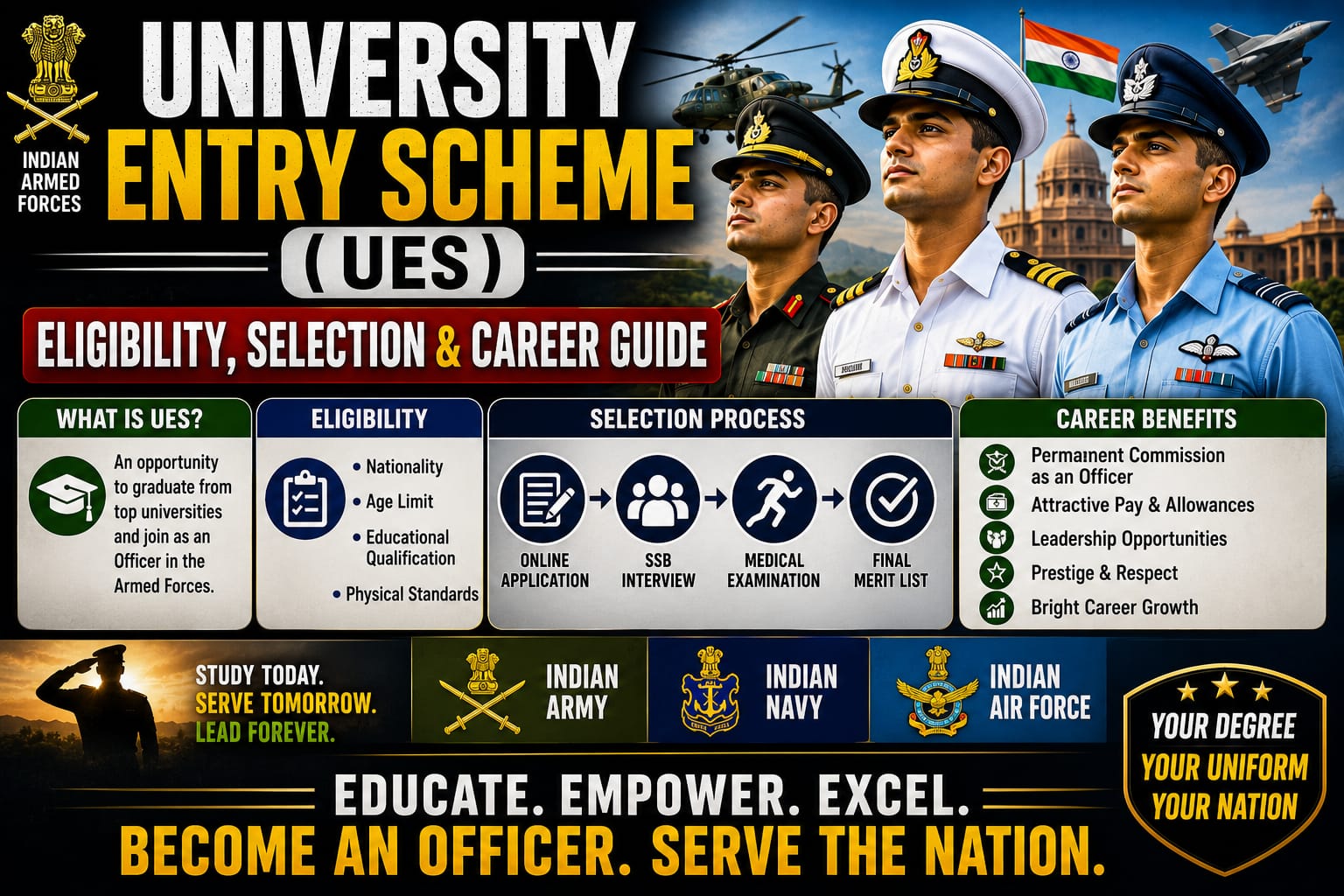
If you are an engineering student with a passion for wearing the uniform, you have likely come across the term University Entry Scheme (UES). It is extremely common for technical students searching for direct entry pathways into the Indian Armed Forces to stumble upon old blog posts, YouTube videos, or forum threads discussing UES and assume it remains an active recruitment channel.
However, defence recruitment frameworks undergo periodic structural modifications, and candidate intake pathways evolve over time. While UES served as a vital technical officer entry scheme in the past, aspirants must understand that recruitment policies change, making it essential to always verify current details on official government portals before planning your long-term roadmap.
Why is studying UES still deeply valuable for defence aspirants today? Understanding this entry gives you a clear window into how campus-based technical recruitment functioned, how the military evaluates engineering talent, and why alternative entry routes exist today. It helps you appreciate the transition from pre-final year campus screening to final-year direct cut-off entries. Most importantly, learning about UES helps you identify active technical pathways like the Technical Graduate Course (TGC) and Short Service Commission Tech—allowing you to channel your preparation effectively.
This complete guide breaks down what the University Entry Scheme Guide historically entailed, how campus selections operated, the selection phases, medical standards, officer training, career prospects, and the modern alternative technical entries available to engineering graduates today.
Understanding the University Entry Scheme (UES)
What Was the University Entry Scheme (UES)?
The University Entry Scheme (UES) was a specialized direct entry pathway designed to recruit pre-final year engineering students directly from college campuses into the technical branches of the Indian Armed Forces. Unlike general entries that required written competitive exams, UES allowed candidates studying in their 3rd year (or 5th/6th semester) of B.E. or B.Tech degrees to be screened right on their campus or designated regional command centres. Successful candidates were granted a provisional commission while completing their final year of graduation.
Purpose and Introduction of UES
The Armed Forces introduced UES to attract young engineering talent early in their academic journey. As modern warfare became heavily dependent on technology, radar systems, telecommunications, naval architecture, and combat engineering, the military needed high-caliber technical minds. By visiting AICTE-recognized universities directly, selection boards could engage engineering students before they were recruited by corporate IT or core engineering firms. It provided students with early career certainty while ensuring a steady pipeline of qualified officers for the forces.
Eligibility and Campus Selection Process
Educational Qualification and Basic Criteria
Candidates applying under UES needed to be unmarried Indian citizens enrolled in a regular B.E. or B.Tech degree program at an accredited institution. The core requirement was that the candidate must be in their pre-final year with no active backlogs. Branches such as Mechanical, Civil, Electrical, Computer Science, Electronics, and Naval Architecture were generally eligible, subject to specific branch vacancies published in notifications.
The Campus Selection Concept
The initial screening under UES was unique compared to standard recruitment entries. Detachments of military officers, called Campus Interview Teams, visited participating engineering colleges or regional host institutes. Candidates underwent an initial screening consisting of a brief group discussion and a personal interview conducted by visiting officers. This preliminary interaction assessed basic communication, technical grounding, and general awareness before shortlisting students for the main testing phase.
SSB Interview, Medicals, and Training
The SSB Interview Phase
Candidates shortlisted during the campus screening received call-up letters for the 5-day Services Selection Board (SSB) interview. Held at designated selection centres, the SSB evaluated personality traits using a three-pronged approach: Psychological Tests (TAT, WAT, SRT), Group Testing Officer (GTO) Tasks, and a Personal Interview. The objective was to determine whether the candidate possessed core Officer Like Qualities (OLQs).
Medical Examination and Merit Process
Recommended candidates underwent a comprehensive medical examination conducted by a board of military doctors. Tests covered visual acuity, hearing, physical dimensions, surgical health, and internal organ functionality. Candidates declared medically fit were placed on an All-India Merit List, which was prepared by combining SSB scores with academic performance.
Officer Training Cadre
Selected candidates joined prestigious academies—such as the Indian Military Academy (IMA) in Dehradun, Officers Training Academy (OTA) in Chennai, or Indian Naval Academy (INA) in Ezhimala—after completing their engineering degree. Training lasted approximately 49 to 52 weeks, transforming civilian engineering graduates into disciplined military leaders trained in tactical warfare, drill, weapons handling, and physical endurance.
Life and Career as a Technical Officer
Leadership Responsibilities and Career Progression
As a technical officer in the UES Indian Army or Naval arms, your engineering knowledge directly influences operational readiness. Officers lead specialized troops, manage advanced weapon systems, oversee military communications, maintain armored vehicles, or engineer bridge crossings under field conditions.
Officers commission as Lieutenants (or Sub-Lieutenants in the Navy) and progress through time-scale and selection-board promotions to Captain, Major, Lieutenant Colonel, and higher command ranks.
Current Status and Historical Evolution
Why do aspirants still discuss UES? It remains a benchmark for early technical officer intake. Over time, defence headquarters streamlined recruitment to rely more on unified online applications, academic cut-offs, and competitive entrance scores. Readers should note that recruitment policies evolve continuously, and candidates must always check official portals—such as www.joinindianarmy.nic.in and joinindiannavy.gov.in—for live entry schemes rather than relying on archived information.
Overview Comparison Table
| Topic | UES Overview | Current Alternative | Candidate Focus |
| Target Audience | Pre-final year engineers | Final year / Graduates | Maintain high aggregate percentage |
| Initial Screening | Campus team interview | Degree mark cut-offs | Focus on academic consistency |
| SSB Route | Direct SSB post-screening | Direct SSB post-shortlist | Master OLQs and SSB tasks |
| Commission Type | Permanent / Short Service | Permanent & Short Service | Choose tenure options wisely |
| Exam Needed | No written examination | Direct entry / GATE / AFCAT | Build technical & general awareness |
Recruitment structures change over time as force requirements adapt to modern technology. Engineering students should regularly refer to official recruitment notifications to verify active application windows and eligibility criteria.
Active Alternative Entries for Engineers
If you are currently pursuing or holding an engineering degree, several active entry options allow you to join as a technical officer:
1. Technical Graduate Course (TGC)
TGC is a Permanent Commission entry for male engineering graduates. Selection is based on cumulative engineering marks, shortlisting candidates directly for the SSB interview without a written exam.
2. Short Service Commission Technical – SSC Tech Entry
Available for both men and women engineering graduates, SSC Tech Entry grants a Short Service Commission. Like TGC, shortlisting is based on aggregate engineering cut-off percentages across various engineering streams.
3. Indian Navy Technical Entries
The Indian Navy offers Short Service Commissions across Executive and Technical branches (Engineering, Electrical, Naval Architecture, and IT) through direct application pathways based on graduation marks or GATE scores.
4. AFCAT (Technical Branch)
The Air Force Common Admission Test (AFCAT) recruits engineers for the Ground Duty (Technical) branch. Engineering candidates take both the general AFCAT paper and the Engineering Knowledge Test (EKT) to qualify for AFSB testing.
Strategic Preparation for Engineering Aspirants
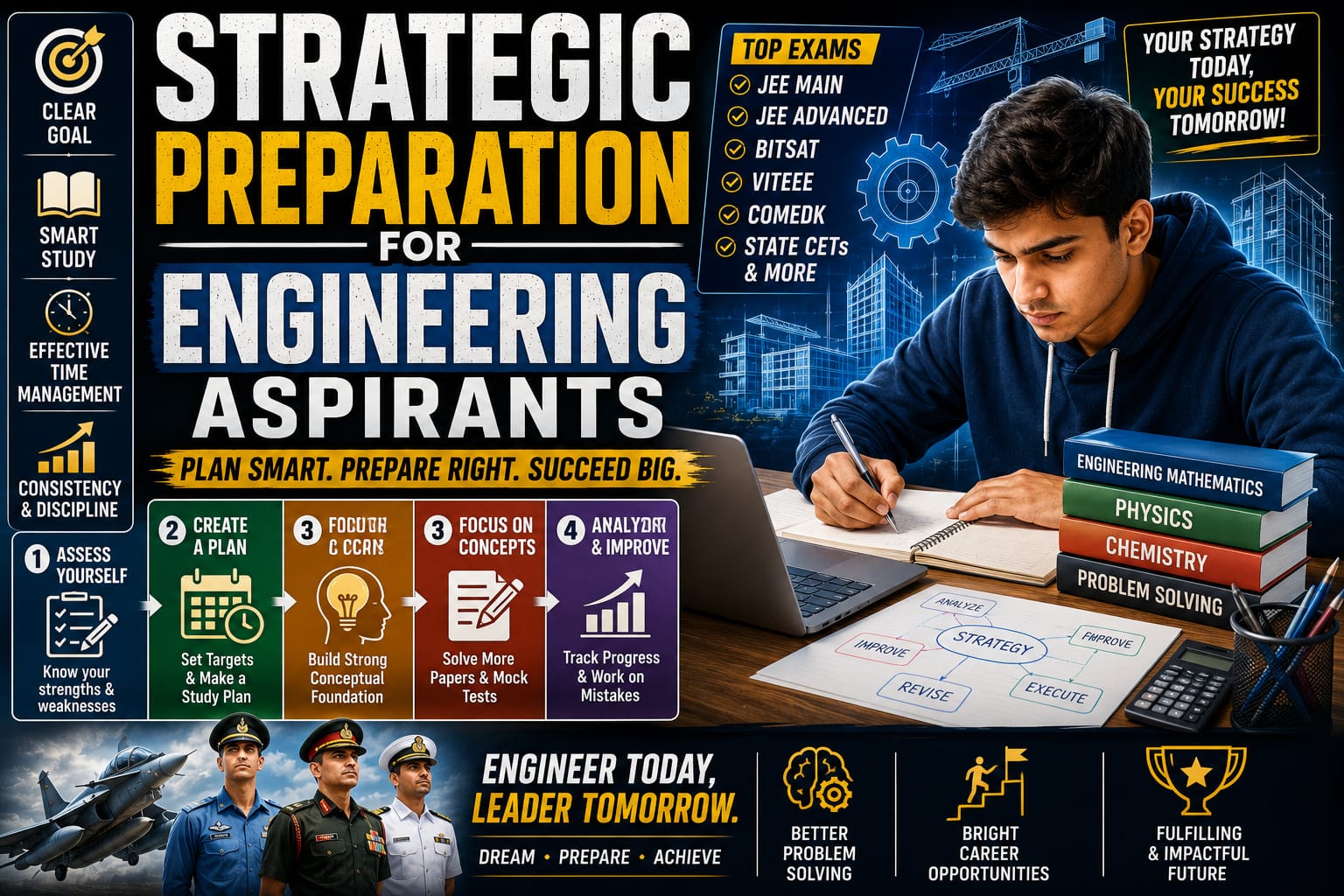
1. Developing Officer Like Qualities (OLQs)
SSB assessors evaluate 15 core OLQs, including effective intelligence, organizing ability, social adaptability, courage, and determination. Work on your daily decision-making, responsibility, and team participation.
2. Technical and Communication Mastery
A technical officer must explain complex engineering principles simply. Stay sharp in your core engineering subjects and build strong spoken English skills to express your thoughts clearly during group discussions and personal interviews.
3. Physical Fitness and Time Management
Start physical training early. Work on running stamina, push-ups, chin-ups, and core strength to transition smoothly into military academy life. Balance semester studies with daily news reading and SSB preparation.
4. Avoiding Common Student Mistakes
- Relying strictly on outdated recruitment entries without reading live notifications.
- Ignoring semester marks, which reduces shortlisting chances for direct entries like TGC or SSC Tech.
- Treating SSB preparation like a rote-learning exam instead of genuine self-improvement.
Conclusion
Although the University Entry Scheme remains a noteworthy chapter in the history of military technical recruitment, engineering graduates today have several direct pathways to become commissioned officers. Modern schemes like the Technical Graduate Course (TGC), SSC Tech, Navy Technical entries, and AFCAT Technical Branch provide robust opportunities to serve the nation.
Success in these technical entries requires a balanced approach: maintain strong academic performance, develop solid physical fitness, stay informed on national security affairs, and consistently practice Officer Like Qualities. Always refer directly to official defence recruitment websites for the latest notifications and eligibility details. Channel your engineering expertise and leadership drive into structured preparation—the armed forces offer a rewarding career where your technical skills directly serve the nation.
Frequently Asked Questions
What was UES?
The University Entry Scheme was a recruitment route that screened pre-final year engineering students directly on college campuses for technical officer commissions in the Indian Armed Forces.
Is UES currently active?
Recruitment schemes adapt over time. Candidates should always check official portals like joinindianarmy.nic.in and joinindiannavy.gov.in for current active notifications.
Why do students still search for UES?
Many aspirants search for UES due to older online articles and advice from seniors who entered through campus selection pathways in previous years.
Which entries have replaced similar opportunities?
Direct technical entries like TGC, SSC Tech, and Navy Technical entries offer similar pathways for engineering students based on degree merit cut-offs.
Is SSB compulsory for technical entries?
Yes, passing the 5-day SSB interview is mandatory for all officer entries in the Indian Armed Forces, regardless of whether a written exam is required.
Can engineering students still become officers?
Engineering graduates have multiple active pathways, including TGC, SSC Tech, AFCAT Technical, and Naval technical entries.
How should students prepare today?
Focus on maintaining high semester marks, developing clear communication skills, building physical fitness, and practicing SSB psychological and group tasks regularly.
Which technical entry is best?
The choice depends on your preference for Permanent versus Short Service Commission and whether you prefer direct merit entries or written exams like AFCAT.
For daily defence updates, government notifications, recruitment alerts, welfare schemes, career opportunities, education news, and other important announcements, join our WhatsApp Community. Click here to join our WhatsApp Group.