
Every year, thousands of defence aspirants ask one fundamental question: “Should I prepare for NDA, CDS, TES, or AFCAT?” The ambition to serve as a commissioned officer is inspiring, yet navigating multiple entries often creates confusion. Each officer-entry scheme serves a distinct category of candidates based on educational qualification, stage of education, career goals, and service requirements.
Unfortunately, choosing the wrong entry due to misinformation wastes valuable preparation time and eligibility windows. Understanding the distinct purpose of each pathway is essential for building a successful military career. This guide compares all four officer routes in simple language so you can identify the pathway best suited to your qualifications and career aspirations.
Whether you are in school, pursuing engineering, or completing graduation, selecting the right gateway dictates your entire strategy. This Defence Officer Entry Guide provides a structured, practical breakdown of all four premier entry routes. As an experienced defence mentor guiding aspirants through written examinations and SSB interviews, I will help you demystify these options. By evaluating eligibility, selection stages, training setups, and service dynamics, this guide empowers you to choose with confidence. Let us explore these pathways systematically so you can take your first decisive step towards becoming an officer.
Why Aspirants Stumble Between Defence Entries
A common dilemma among aspirants is assuming that all defence entrance exams require identical preparation methods. While every entry grants an officer commission, age brackets and academic requirements differ significantly. School students often confuse TES Entry Guide features with NDA Explained details, missing that one uses written exams while the other relies on technical shortlisting. Similarly, graduates debate between CDS Explained routes and AFCAT Guide options. Clearing confusion starts by understanding each entry’s core design.
What Each Entry Scheme is Designed For
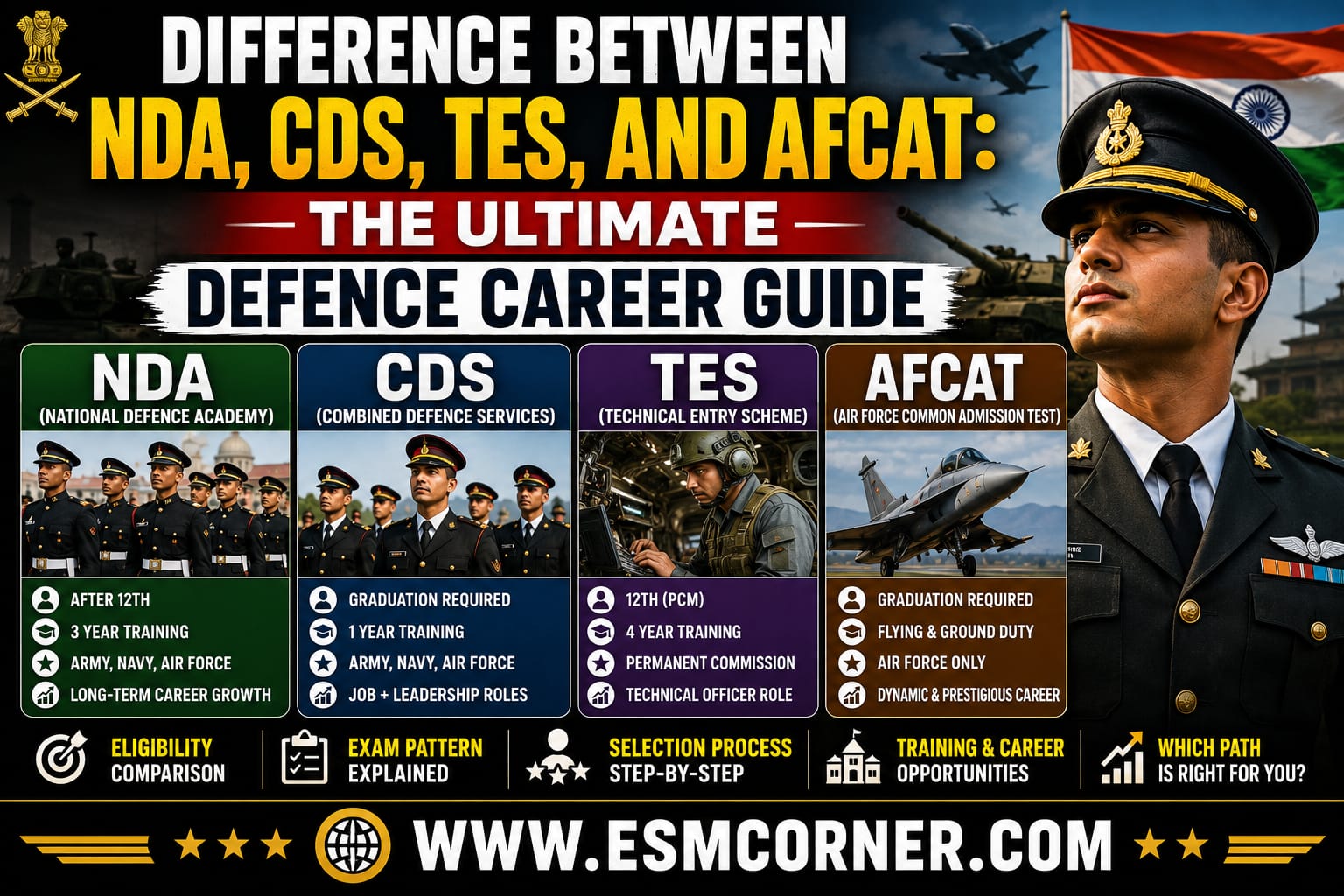
The NDA entry focuses on early tri-service training, taking students after school to develop military leaders over four years. The TES route recruits technical officers for the Army directly after Class 12 based on PCM performance and JEE credentials. For graduates, CDS acts as the primary gateway into the Army, Navy, or Air Force for direct academy training. Meanwhile, AFCAT specifically targets aspirants seeking Flying, Technical, or Ground Duty roles in the Indian Air Force. Matching service goals with entry design ensures effective preparation.
Matching Your Profile to the Right Pathway
Select NDA if you are in Class 11 or 12 and want early joint service training alongside earning a degree. Candidates seeking technical Army roles after Class 12 without a written test should choose TES. If you are completing graduation and desire entry into IMA, INA, AFA, or OTA, CDS is your ideal path. Graduates passionate about Air Force aviation, technical systems, or logistics should prioritize AFCAT. Evaluating Defence Career After 12th versus Defence Career After Graduation clarifies your route immediately.
Selection Process, Training, and Commissions
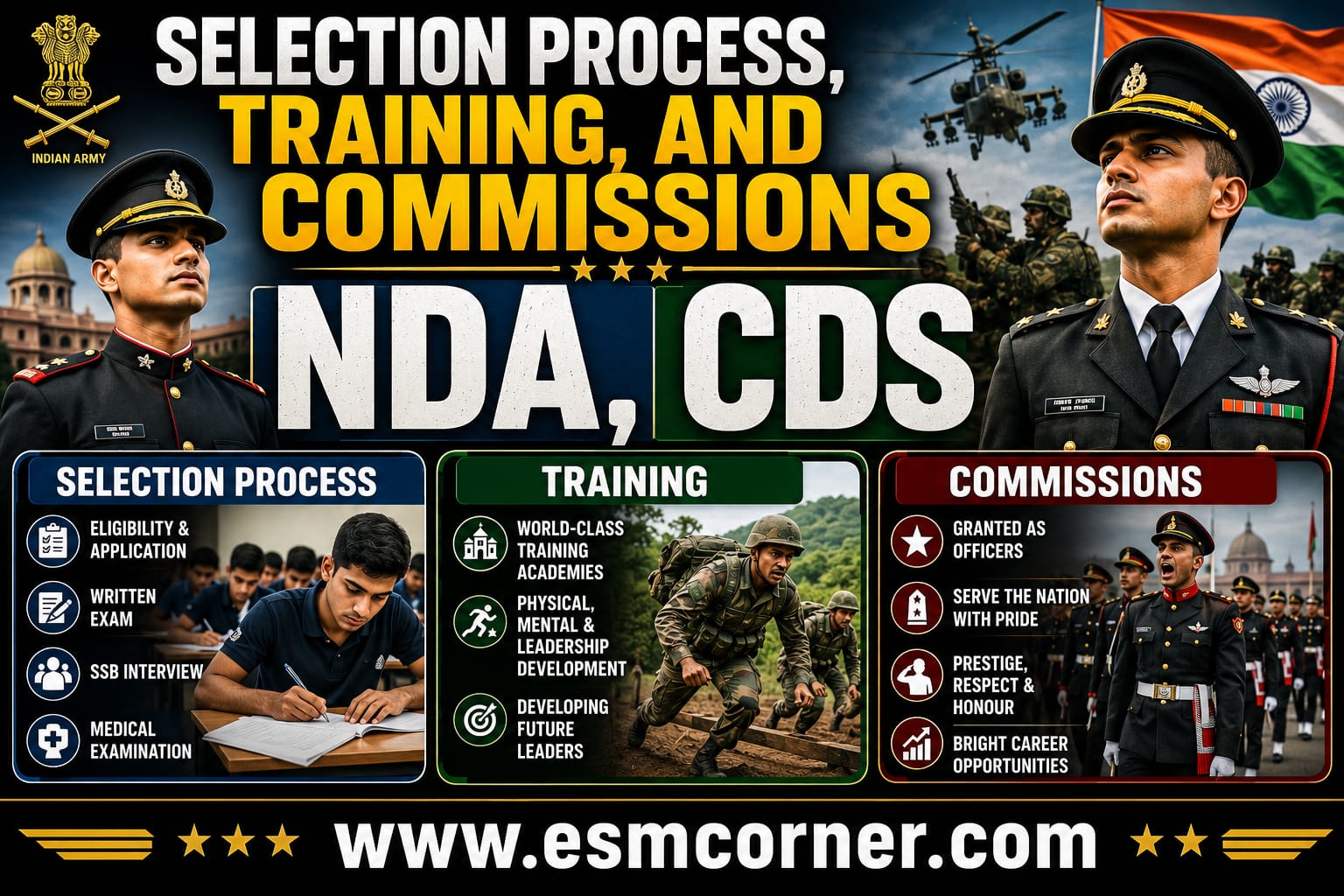
Eligibility requires Class 12 for NDA and TES, whereas CDS and AFCAT require a completed graduation degree. Written exams apply to NDA, CDS, and AFCAT, while TES shortlists directly using academic performance. However, all four entries require clearing the SSB or AFSB interview followed by military medical examinations. Training ranges from four years for school entries to shorter academy courses for graduate routes. Officers receive Permanent or Short Service Commissions based on branch and entry specifications.
Complete Defence Entry Comparison
To evaluate these options quickly, the table below compares all four major officer entries at a glance. This brief overview summarizes education levels, selection routes, target candidate profiles, and respective service branches.
| Entry | Education Level | Selection Route | Best For |
| NDA | Class 12 Pass / Appearing | Written Exam + SSB | Early starters seeking joint service training |
| TES | Class 12 (PCM with JEE) | Direct Shortlist + SSB | Tech-oriented 12th pass engineering aspirants |
| CDS | Graduation / Final Year | Written Exam + SSB | Graduates seeking general combat & command roles |
| AFCAT | Graduation (Specific %) | Written Exam + AFSB | Graduates aspiring for flying & ground roles |
Cultivating Officer Like Qualities and Preparation Strategy
Success requires developing essential Officer Like Qualities such as decision-making speed, communication, adaptability, stamina, and integrity. During SSB Preparation, evaluators focus on these core behavioral traits rather than memorized responses. Written exams demand strong mathematics and general awareness for NDA and CDS, while AFCAT emphasizes reasoning and numerical skills. Managing time by balancing academic study, fitness, current affairs, and personality growth creates a robust foundation. Early preparation ensures steady progress towards selection.
Common Myths and Mistakes to Avoid
A common myth is that direct entries like TES are easier than written exams, ignoring high cut-offs required for direct SSB calls. Another mistake is attempting NDA and CDS preparation simultaneously despite different age limits and academic depths. Aspirants also frequently neglect physical fitness until after written results, hurting SSB performance. Long-term officer growth remains rewarding across all entries when matched with individual strengths. Making choices based on self-awareness ensures lasting confidence throughout selection.
Read the complete guide to officer entries after graduation.
Final Guidance
Navigating defence entries requires clarity, discipline, and realistic self-assessment. As explored in this Difference Between NDA and CDS and overall guide, there is no single “best” entry. There is only the pathway that aligns with your educational background, age eligibility, personality traits, and long-term career goals. Whether you choose NDA, TES, CDS, or AFCAT, your destination remains the same: serving the nation with honor.
Instead of chasing popular exams, focus on building the foundational qualities that define a military officer. Invest your energy in written preparation, physical fitness, current affairs awareness, and developing genuine Officer Like Qualities. Selection boards value authentic personality, leadership potential, and mental strength. Choose your pathway wisely based on academic standing, prepare with unwavering commitment, and stay focused on becoming a capable officer.
Frequently Asked Questions
Q1. Which is better: NDA or CDS?
Neither entry is inherently better because both lead to commissioned officer ranks. NDA is ideal for school-leaving students seeking early entry and four-year integrated training. CDS suits university graduates looking for mature entry into military academies. Your choice depends on your qualification and age eligibility.
Q2. What is the difference between TES and NDA?
NDA requires clearing a UPSC written examination followed by an SSB interview for Army, Navy, or Air Force training. TES is a direct-entry scheme for the Army where candidates are shortlisted directly for SSB based on Class 12 PCM marks and JEE Main scores without written tests.
Q3. Is AFCAT easier than CDS?
AFCAT is often considered relatively more straightforward due to its focus on verbal ability, reasoning, and numerical aptitude. However, CDS involves a deeper syllabus in General Knowledge and Mathematics. Difficulty is subjective and depends on your specific academic strengths and branch preferences.
Q4. Which entry is best after Class 12?
For Class 12 students, NDA is the premier choice for joint service training across all three services. If you have a strong PCM background and JEE credentials, TES offers an excellent direct technical route in the Army. Both provide outstanding foundational pathways right after school.
Q5. Which entry is best after graduation?
CDS is the most versatile option after graduation, opening pathways into the Army, Navy, Air Force, and Officers Training Academy. For aspirants specifically targeting an aviation or technical career in the Indian Air Force, AFCAT is the ideal graduate entry route.
Q6. Is SSB compulsory for all four entries?
Yes, the SSB or AFSB interview is compulsory for NDA, CDS, TES, and AFCAT. Whether you qualify through a written exam or direct academic shortlisting, every candidate must clear the five-day personality evaluation to test Officer Like Qualities before medicals and final merit.
Q7. Can I prepare for multiple entries together?
Yes, candidates can effectively combine preparation for graduate entries like CDS and AFCAT due to significant syllabus overlap in English, General Knowledge, and Reasoning. However, school-level entries like NDA require a distinct focus on Class 11 and 12 Mathematics, making combined NDA-CDS preparation unnecessary.
Q8. Which entry offers the best long-term career opportunities?
All four entries offer equivalent long-term career growth, pay scales, and promotion avenues once commissioned. NDA officers receive a minor advantage in service seniority due to younger commissioning age, but individual performance ultimately drives career progression across all entry routes.