
If you’re an engineering student or a fresh graduate who’s ever wondered “corporate job or something bigger?” — there’s a path that lets you actually have both worlds in one. The Short Service Commission (SSC) Technical Entry is one of the most sought-after ways to become a commissioned officer in the Indian Army, and it’s built specifically for engineering graduates.
Here’s what makes it genuinely special — you skip the long, tough written exams that other entries demand. Instead, you get in based on your academic record and personality, going straight to the interview stage. Whether you’re picturing yourself leading a platoon in the Corps of Engineers, or you’re a woman aiming to break into the Corps of Signals, this entry gives you a real shot.
This guide breaks down everything — eligibility, the selection process, what training actually looks like, and where this career can take you.
What Exactly Is SSC Tech Entry?
The Indian Army conducts this specialised recruitment process twice every year to select engineering graduates for technical roles. Unlike entries such as NDA or CDS, which have broader eligibility criteria, SSC Tech Entry is specifically designed for candidates with a B.E. or B.Tech degree in the required engineering disciplines.
The purpose behind this entry is straightforward — the Army requires technically skilled officers who can manage, operate, and develop advanced systems. These officers play a vital role in branches such as the Corps of Engineers, Corps of Signals, and Corps of EME (Electronics and Mechanical Engineers).
One important thing to understand is the meaning of “Short Service.” It does not represent a permanent commitment from the beginning. Officers initially serve for 10 years, with the possibility of an additional 4-year extension, making the total service period up to 14 years. This arrangement benefits both the Army and the officer — the Army gains young, capable, and technically trained leaders, while officers gain valuable experience in a high-impact career. After completing service, the leadership, discipline, and skills developed during this period can also make the transition to corporate or government careers smoother.
Are You Eligible? Here’s What You Need
- Educational Qualification – A recognised B.E. or B.Tech in a notified stream, typically Mechanical, Electrical, Civil, Computer Science, Electronics, or Telecommunication. Final-year students can also apply, as long as they can prove graduation before training starts.
- Age Limit – Between 20 and 27 years, calculated as of the first day of the month the course begins.
- Nationality – Indian citizens, subjects of Nepal, or people of Indian origin who’ve migrated with the intent to settle permanently in India.
- Marital Status – Generally, only unmarried candidates are eligible. Widows of defence personnel who died in service may apply under specific categories if they meet the age criteria.
- Medical Standards – You need to meet specific physical and mental fitness requirements, including vision and hearing standards, with no chronic illness or permanent physical deformities.
A quick but important warning: a lot of applications get rejected simply because of small mismatches — like your engineering stream name not exactly matching official records, or missing mark sheets. Always double-check every detail against the official notification on the “Join Indian Army” website before applying.
How Does the Selection Process Actually Work?
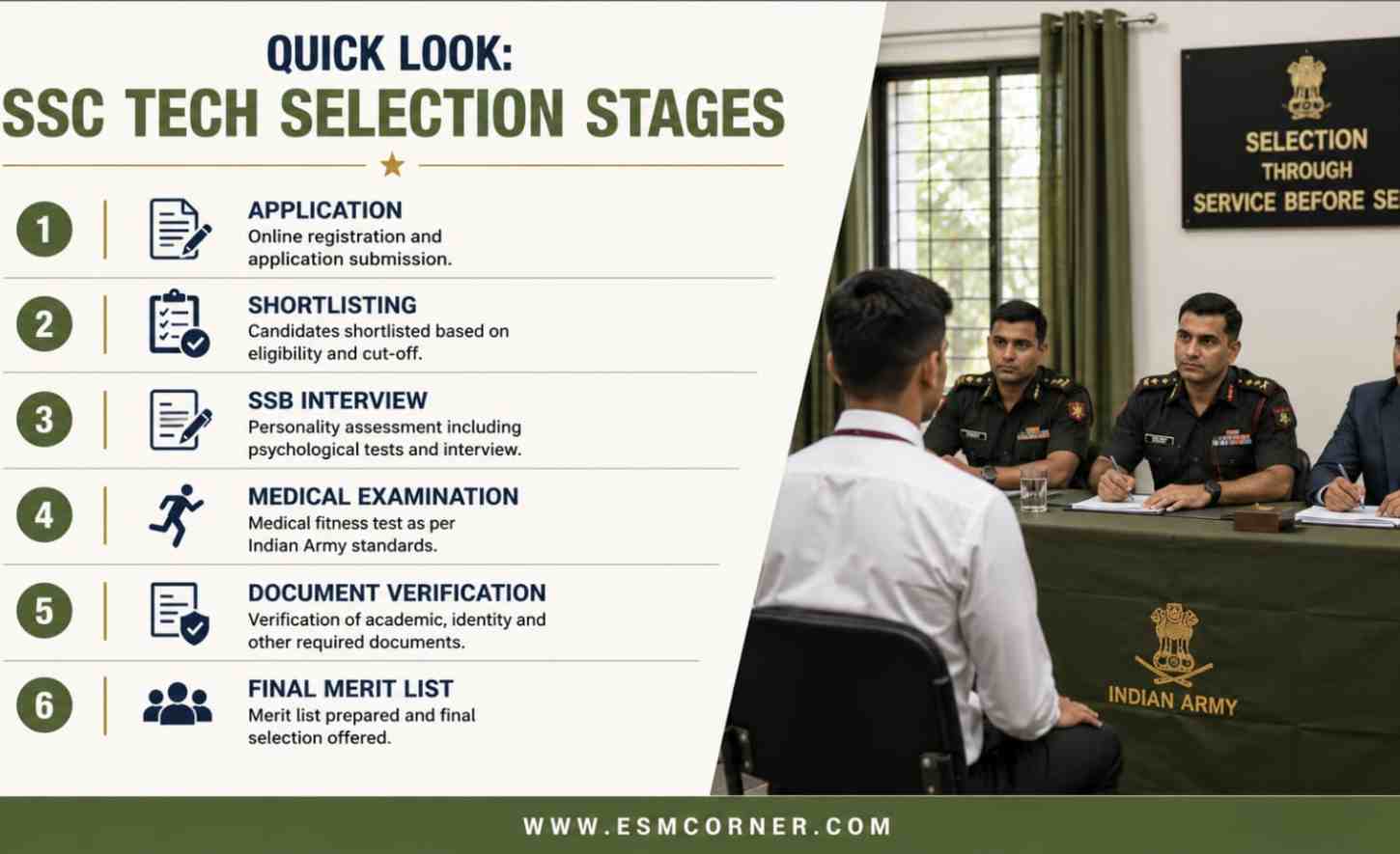
The whole process is merit-based and pretty transparent, moving through clear stages:
- Online Application – You submit your academic records online.
- Shortlisting – The Army shortlists candidates based on their engineering percentage. This cut-off changes depending on your stream and available vacancies.
- SSB Interview Call – Shortlisted candidates get called for the five-day SSB interview process.
- Stage I – Screening – Includes an Officer Intelligence Rating (OIR) test and a Picture Perception and Description Test (PPDT). This is the toughest filter — only those who clear it move ahead for the remaining four days.
- Stage II – Testing – Covers psychological tests, Group Testing Officer (GTO) tasks, and a personal interview. These assess your initiative, teamwork, confidence, and leadership potential.
- Medical Examination – Recommended candidates go through a detailed medical check at a designated military hospital.
- Final Merit List – Prepared based on your SSB scores and medical fitness, subject to available vacancies.
Quick Comparison: Army Officer Entry Options
| Entry Type | Qualification | Age Limit | Commission Type |
|---|---|---|---|
| SSC Tech | Engineering Degree | 20-27 Years | Short Service |
| TGC | Engineering Degree | 20-27 Years | Permanent |
| CDS | Graduation | 19-25 Years | Permanent/Short |
| TES | 10+2 (PCM) | 16.5-19.5 Years | Permanent |
The SSB Interview: It’s Not About Textbook Knowledge
Here’s something worth understanding clearly — the SSB Interview isn’t testing your academic knowledge. It’s evaluating your personality and what the Army calls Officer-Like Qualities (OLQs) — things like sound judgement, sense of responsibility, initiative, and the ability to actually lead a group.
During the psychological tests (like TAT, WAT, and SRT), you’re being assessed on how stable, proactive, and positive your natural reactions are. The GTO tasks — group discussions, planning exercises, outdoor tasks — check how well you cooperate and lead within a team.
And communication skills here don’t just mean fluent English — it’s about expressing your thoughts clearly and logically. The best kind of preparation isn’t memorising answers. It’s genuinely working on your self-awareness, staying updated on current affairs, keeping fit, and getting comfortable thinking on your feet under pressure.
Quick Look: SSC Tech Selection Stages
| Stage | Purpose | What’s Evaluated | What to Focus On |
|---|---|---|---|
| Application | Initial Filtering | Academic Percentage | Accurate details, genuine documents |
| Shortlisting | Eligibility Check | Cut-off Marks | Strong academic grades |
| SSB Interview | Personality Audit | OLQs and Leadership | Self-improvement, mock drills |
| Medical | Physical Suitability | Health and Fitness Standards | Diet, exercise, hygiene |
Life at OTA Chennai: Where You Actually Become an Officer
The Officers Training Academy (OTA) in Chennai is where the real transformation happens — from civilian to officer. This 49-week programme is intense, covering everything from physical training and drills to tactical military education and weapon handling. Your day often starts well before sunrise and stretches late into the night — all designed to build serious mental and physical toughness.
But it’s not just about physical training — cadets also study military law, ethics, and leadership. And here’s the thing that really defines OTA — the camaraderie. You’re not just training for yourself; you’re training as part of a team. Watching yourself go from a graduate student to a Lieutenant is genuinely a defining shift, built around the idea of “Serve with Honour.”
What About Salary and Career Growth?
SSC Technical Officers get a genuinely competitive package — basic pay at the Lieutenant level, plus Military Service Pay (MSP), Dearness Allowance (DA), and location-specific allowances. Add in free medical care for you and your family, CSD canteen access, and insurance coverage, and it becomes a genuinely solid career choice financially too.
Growth here is structured and based purely on merit. You get opportunities for higher education, foreign training, and exposure to advanced military technology. And once your service is done, this experience is genuinely valued by companies globally — it often opens doors into managerial and leadership roles in the private sector too.
Conclusion
The SSC Technical Entry is more than just a job; it is a life-defining commitment to national service. For engineering graduates who crave leadership, adventure, and the discipline of the military, this entry offers an unparalleled start to a professional life. While the path is challenging—demanding academic consistency and a strong, positive personality for the SSB interview—the rewards of wearing the uniform are immeasurable. Whether you serve for 10 years or convert to a Permanent Commission, the skills you acquire will serve you for a lifetime.
If you are an engineer who values honor over comfort and responsibility over routine, this entry is your gateway. It provides the chance to manage advanced military systems while leading the finest soldiers in the world. As you prepare, remember that the selection process is designed to find those who can remain calm under pressure and lead with integrity. If you are ready to undergo the rigors of OTA Chennai and embrace a life less ordinary, the Indian Army awaits your contribution. Evaluate your aspirations, prepare with dedication, and take the first step toward a journey of honor, pride, and service.
READ ALSO: COMPLETE GUIDE TO BECOMING AN INDIAN AIR FORCE OFFICER
Frequently Asked Questions (FAQs)
Q1: Can I apply for SSC Tech if I have backlogs in my engineering?
Usually, candidates must have passed all subjects to be eligible. The notification requires you to produce mark sheets for all semesters at the time of the SSB interview. Any active backlogs at the time of training commencement would disqualify you, as you must be a graduate to be commissioned.
Q2: Is there any written exam for SSC Tech entry?
No, there is no written examination for the SSC Technical Entry. Shortlisting is based purely on your cumulative percentage of marks in your engineering degree. If your percentage meets the cut-off set by the Army Headquarters, you are directly called for the SSB interview.
Q3: Can I get a Permanent Commission (PC) after joining via SSC Tech?
Yes, SSC officers are eligible to opt for a Permanent Commission after completing 10 years of service. This conversion is not automatic and is subject to your service record, merit, and the availability of vacancies in the Indian Army’s permanent cadre at that time.
Q4: What is the primary difference between SSC Tech Men and SSC Tech Women entries?
The eligibility, selection process, and training are largely similar. The primary difference is that these are conducted as separate entries with distinct vacancy lists and notifications. Both entries ultimately lead to commissioning at OTA Chennai as a Lieutenant in the technical corps of the Indian Army.
Q5: Is physical fitness training mandatory before joining OTA?
While you don’t need to be a professional athlete, a high level of physical fitness is expected. The training at OTA is physically demanding, involving long runs and obstacle courses. Candidates are strongly advised to start a regular fitness routine, including running, push-ups, and swimming, well before joining.
Q6: What happens if I am not recommended at the SSB interview?
If you are not recommended, you are free to apply again for subsequent batches if you still meet the age and educational criteria. Each SSB attempt is independent, and a failure in one does not bar you from future opportunities, provided you continue to meet all eligibility requirements.
Q7: Can final-year engineering students apply for the SSC Tech entry?
Yes, students in their final year of B.E./B.Tech can apply. However, they must be able to produce their proof of passing the degree and all semester mark sheets by the date specified in the official notification to be eligible for commissioning.
Q8: Do SSC Tech officers get a pension after retirement?
No, Short Service Commission officers do not receive a lifelong pension upon completing their 10 or 14-year tenure, as pension is a benefit reserved for those with a Permanent Commission. However, you will receive terminal benefits, gratuity, and the invaluable experience of having served the nation.
For daily defence updates, government notifications, recruitment alerts, welfare schemes, career opportunities, education news, and other important announcements, join our WhatsApp Community. Click here to join our WhatsApp Group.