
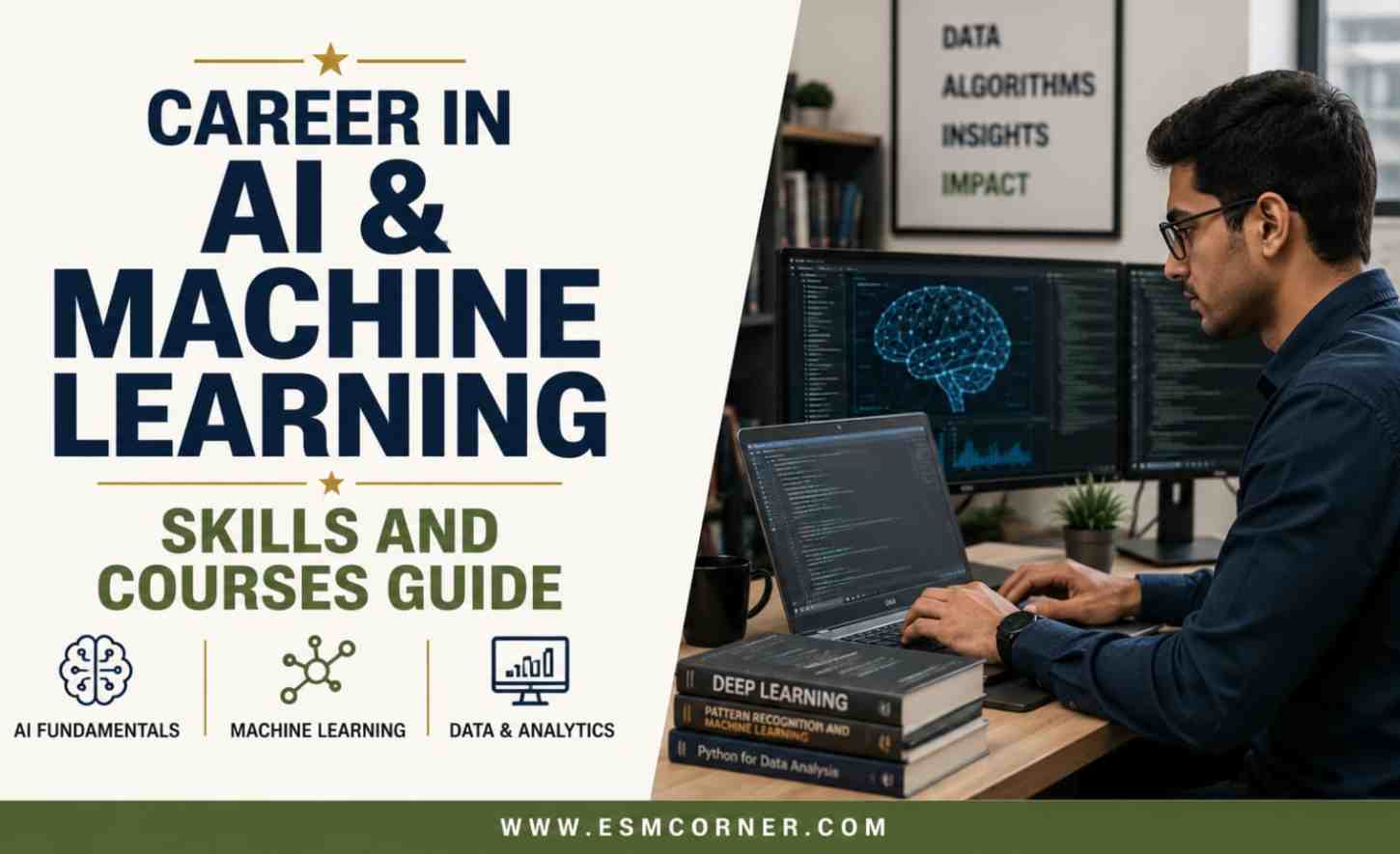
Artificial Intelligence (AI) and Machine Learning (ML) are no longer futuristic ideas—they have already become a part of everyday life and are transforming industries across the world. As a result, many students and professionals are eager to explore this field, though it often comes with plenty of questions and misconceptions.
Some of the most common questions are: “Is AI only for programmers?”, “Can students from non-technical backgrounds enter this field?”, and “Will AI replace software developers?” The reality is that AI is much broader than coding alone. Its applications span healthcare, finance, cybersecurity, robotics, education, analytics, and research. While programming is essential for many technical roles, the industry also values creative problem-solvers, domain specialists, and professionals who can address ethical and real-world challenges. Let’s explore the field in a clear and practical way.
First, Let’s Clear Up AI vs. Machine Learning
People throw around “AI” and “ML” like they mean the same thing, but they don’t.
- AI is the big umbrella term — machines that can think, learn, reason, and make decisions somewhat like humans do.
- Machine Learning is a part of AI where systems learn from data instead of following rigid, pre-written rules.
- Deep Learning is a further subset of ML that uses neural networks to handle complex stuff like images, speech, and text.
Together, these technologies quietly power everything from your Instagram recommendations to hospital diagnostics — which is exactly why this field has become one of the fastest-growing career spaces in the world.
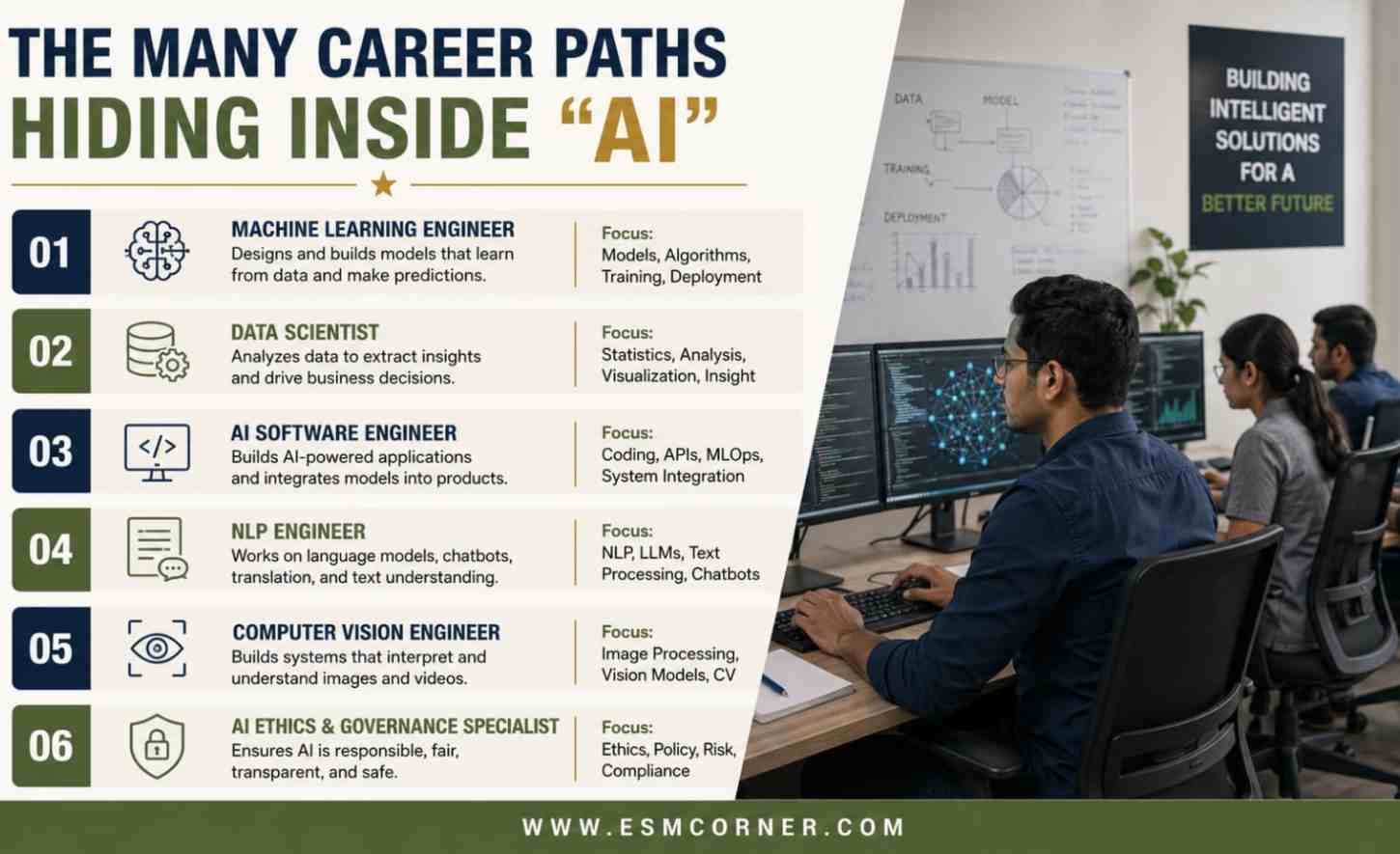
The Many Career Paths Hiding Inside “Artificial Intelligence “
Here’s the thing most people don’t realise — “AI career” isn’t one single job. It’s an entire universe of roles, and they don’t all require you to be a hardcore coder.
If You Love Building Things
- AI Engineer – Takes AI models and actually integrates them into real, working software and business systems.
- Machine Learning Engineer – The bridge between data science and software development, focused on training and scaling predictive models efficiently.
- Data Scientist – Digs through massive datasets to pull out insights that actually help businesses make decisions.
- NLP Engineer – Builds chatbots, translators, and sentiment analysis tools that understand human language.
- Computer Vision Engineer – Trains algorithms to “see” — think facial recognition, medical scans, or self-driving car systems.
If You’re Drawn to the Cutting Edge
- AI Researcher – Works in labs pushing the boundaries of what AI models can actually do.
- Robotics Engineer – Combines mechanical, electrical, and AI skills to build machines that physically interact with the world.
- Prompt Engineer – A newer, rapidly growing role focused on crafting inputs for large language models to get safe, accurate outputs.
- AI Ethics / Responsible AI Specialist – Ensures AI systems are fair, transparent, and compliant with ethical standards and data privacy regulations.
If You’d Rather Skip the Coding Altogether
- AI Product Manager – Manages an AI product’s entire journey, connecting engineers, marketers, and executives.
- AI Consultant – Helps companies figure out how to actually adopt AI without breaking their existing systems.
- Freelancer / Entrepreneur – Thanks to cloud computing, building custom AI automations or launching a niche AI-based startup has never been more accessible.
What Skills Do You Actually Need?
Let’s be real — you can’t just wake up one day and call yourself an “AI Engineer.” Here’s what genuinely matters:
- Python – The go-to language for AI, thanks to its simplicity and libraries like NumPy, Pandas, Scikit-Learn, PyTorch, and TensorFlow.
- Basic Maths and Statistics – You don’t need a PhD, but understanding linear algebra, calculus basics, and probability helps you understand how models actually learn.
- Machine Learning and Deep Learning Basics – Concepts like supervised/unsupervised learning and regression before you dive into neural networks and transformers.
- Data Analysis and SQL – Since data is basically the fuel for AI, you need to be comfortable querying, cleaning, and visualising it.
- Cloud Computing and APIs – Knowing platforms like AWS, Google Cloud, or Azure, since most AI models run on the cloud today.
- Git and GitHub – Essential for tracking code changes and working on collaborative or open-source projects.
But technical skills alone won’t cut it. You also need solid problem-solving ability, strong communication skills (since you’ll often explain complex results to non-technical people), and a genuine portfolio of real projects — that matters far more than a resume full of certificates.
Quick Career Comparison
| Career Role | Key Skills | Suitable For | Future Scope |
|---|---|---|---|
| AI / ML Engineer | Python, PyTorch, System Design | Coders who enjoy optimisation | Rising demand as companies scale AI globally |
| Data Scientist | Statistics, SQL, Data Modeling | Analytical minds focused on insights | High demand across data-heavy industries |
| Prompt Engineer | LLMs, Language, Logic | Creative, analytical problem solvers | Growing fast with GenAI adoption |
| AI Product Manager | Product Strategy, Communication | Leaders bridging tech and business | Essential for user-focused AI products |
| AI Research Scientist | Advanced Maths, Deep Learning Theory | Academic thinkers driven by innovation | Steady demand in top research labs |
How Do You Actually Get Started?
The good news is that there is no fixed route to enter the AI field. You can build your career through multiple pathways:
- Formal education – A Bachelor’s in Computer Science, Data Science, or a specialised AI/ML B.Tech gives you a strong base.
- Diplomas and postgrad certifications – Great for a faster pivot if you’ve already graduated in something else.
- Self-learning – Genuinely doable for free through platforms like Coursera, edX, Udacity, plus cloud certifications from AWS or Google, and community resources like Kaggle Learn or fast.ai.
Here’s a practical, step-by-step roadmap if you’re starting from scratch:
- Months 1-3: Build the basics. Get comfortable with Python, Pandas, and the core maths — linear algebra, calculus, probability.
- Next phase: Practice with real datasets. Build classic models like regressions and random forests using Kaggle datasets. Learn to handle messy, real-world data.
- Then: Build actual projects. Don’t stop at tutorials — build something real, like a text summariser or a computer vision tool, and deploy it as a live web app.
- Finally: Get real-world exposure. Apply for internships or contribute to open-source AI projects to experience actual production code and team workflows.
Let’s Bust a Few Big Myths
“Only Computer Science students can get into AI.” Completely false. If you’re from Commerce, your understanding of finance and business makes you a strong fit for fraud detection models or AI consulting roles. If you’re from Arts or Humanities, your grasp of language and human psychology makes you genuinely well-suited for prompt engineering, NLP design, or responsible AI governance. This field genuinely rewards diverse backgrounds.
“You can build an AI career without any coding.” Not really sustainable long-term. No-code tools exist for quick prototypes, but scaling and customising real systems still needs a basic grasp of coding and data logic.
“AI will replace software engineers.” No — it changes what they do. AI tools act like co-pilots, handling repetitive coding tasks, but human engineers are still essential for architecture, security, and complex decision-making.
“You need advanced-level maths for AI jobs.” Only if you’re aiming for core research roles. For most applied engineering jobs, frameworks handle the heavy maths — you just need a working understanding of the concepts.
“Is AI actually a good career in India?” Yes, genuinely. India’s tech hubs are shifting fast from traditional IT services to real AI innovation centres, creating strong local demand along with solid remote opportunities for global companies.
A Few Honest Warnings
This field comes with real responsibility too — issues like algorithmic bias, deepfakes, and transparency in AI decisions are genuine challenges you’ll need to think about as a professional.
And a quick heads-up on common beginner mistakes: don’t fall into “tutorial hell” (endlessly watching courses without actually coding anything), don’t chase every trending framework instead of mastering the basics, and don’t ignore communication skills — they matter more than people expect.
If your parents are worried about job stability in tech, here’s a simple way to explain it: AI isn’t some passing trend — it’s a fundamental shift in how computing works, similar to the arrival of the internet or smartphones, with genuine long-term growth ahead.
Conclusion
Building a successful, long-term career in Artificial Intelligence and Machine Learning is a rewarding journey that depends heavily on your inner drive, intellectual curiosity, and practical problem-solving capabilities. A common pitfall for many aspiring beginners is viewing this field through a passive educational lens—assuming that collecting certificates or passing exams equates to industry readiness. In the modern tech world, companies care very little about what you can recall from a textbook; they want to see what you can build, optimize, and deploy under real-world constraints.
READ ALSO: AFMC MBBS ADMISSION 2026
Q1. What are the basic eligibility criteria to start a career in AI?
There are no rigid restrictions. Anyone with a foundational understanding of logical reasoning and data can enter the field. While a background in computer science, mathematics, or engineering offers a smooth transition, individuals from commerce and arts backgrounds can successfully transition by mastering practical programming and data analytics.
Q2. Can I get a high-paying AI job without a formal computer science degree?
Yes. The modern tech market increasingly prioritizes practical capability over formal credentials. By building a high-quality portfolio of open-source projects, executing real-world data solutions on GitHub, and securing practical internships, you can readily secure high-salary roles based entirely on demonstrated engineering competence.
Q3. Which programming language should I learn first for Machine Learning?
Python is the undisputed starting point. Its clean syntax makes it highly accessible for beginners, and it boasts a massive ecosystem of libraries like PyTorch, TensorFlow, and Scikit-Learn. While languages like C++ and Java are utilized for optimization, Python remains the industry standard.
Q4. How long does it typically take for a complete beginner to learn AI?
With a disciplined, structured approach, it generally takes around six to nine months of consistent daily study to build a strong professional baseline. The first three months focus on programming, SQL, and math foundations, followed by three months of applied machine learning, capped with real-world project deployments.
Q5. Are certifications more valuable than a university degree in this field?
Certifications from top cloud providers demonstrate specialized skills, but they do not fully replace the structured system engineering foundations of a comprehensive degree. Treat degrees as your conceptual base, and use targeted practical certifications to prove your up-to-date knowledge of modern cloud deployment tools.
Q6. What kind of projects should I include in my portfolio to stand out?
Avoid generic tutorial projects like the Iris dataset or Titanic survival prediction. Instead, design end-to-end applications that solve distinct, real problems: build a multi-source financial forecasting tool, an automated image diagnostic assistant, or a deployed conversational interface tailored to a specific niche domain.
Q7. Is the future demand for AI professionals sustainable for the next decade?
Yes. The industry is moving from initial experimental phases to deep, scalable deployment across all enterprise sectors. As fields like automation, healthcare, FinTech, and cloud infrastructure continue to integrate intelligent models, the global demand for skilled data and systems engineers will accelerate over the next decade.
Q8. What is the average entry-level salary expectation for AI roles in India?
While compensation depends on an individual’s practical skill set and portfolio quality, entry-level AI engineering roles in India generally start between ₹6 Lakhs to ₹12 Lakhs Per Annum (LPA). Top-tier talent with robust project portfolios and internships frequently command higher initial compensation packages.
For daily defence updates, government notifications, recruitment alerts, welfare schemes, career opportunities, education news, and other important announcements, join our WhatsApp Community. Click here to join our WhatsApp Group.