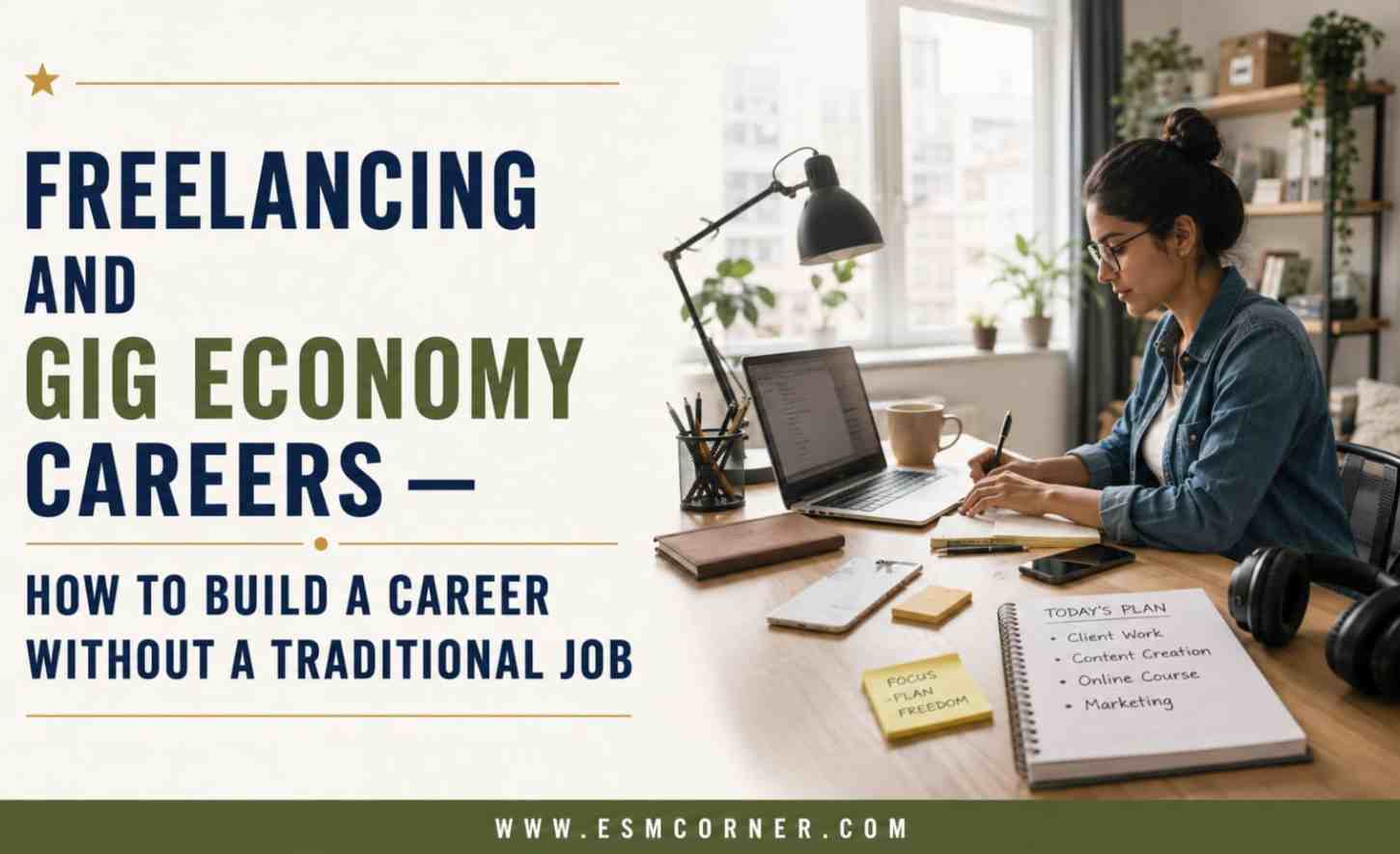
Many young people today no longer want to depend completely on a traditional 9-to-5 job. They see freelancers working comfortably from home, content creators earning income online, graphic designers taking international projects, and skilled professionals offering services directly to clients.
This shift makes many students wonder if they can skip the traditional corporate route entirely. But this modern work culture creates a major practical question: Can freelancing really become a proper, long-term career, or is it only a temporary side income? The truth is that freelancing and gig economy careers can offer genuine opportunities, but they are definitely not an easy shortcut to quick money.
A freelancer acts as a complete one-person business who must actively find clients, learn valuable skills, manage strict deadlines, communicate professionally, collect payments, and handle quiet periods when new work is slow. This comprehensive guide explains freelancing, gig economy careers, essential skills, popular options, client hunting, portfolio building, and how to create a sustainable career without relying solely on a traditional salaried job.
Understanding the Basics: What Are Freelancing and the Gig Economy?
What does it actually mean when someone says they work in the gig economy? In simple terms, freelancing means offering your specific skills or services to individual clients or companies without signing a long-term, single-employer contract. You work on specific projects, complete the assigned tasks, get paid for that work, and then move on to the next client or assignment. The gig economy is the larger market made up of these short-term, independent jobs, often called gigs. Instead of receiving a fixed monthly salary from one company, a gig worker earns money from multiple short-term projects. This model gives you complete ownership over your daily schedule, but it also places the entire responsibility of finding continuous work directly on your shoulders.
Many people wonder how freelancing differs from a traditional salaried office job. In a traditional job, you have fixed working hours, a guaranteed monthly paycheck, and specific workplace benefits like paid leave or medical insurance. In freelancing, you enjoy complete freedom to choose your projects, set your own working hours, and work from any location with an internet connection. However, you also give up employee benefits, fixed income stability, and corporate safety nets. Freelancing is becoming extremely popular across India because young individuals want geographic freedom, better control over their daily time, and the ability to increase their earnings by working with international clients.
Who Should Consider Freelancing and What Are the Real Risks?
Is freelancing suitable for every student or young professional entering the workforce? Freelancing is ideal for individuals who are self-disciplined, eager to learn continuously, and capable of managing their time without a boss supervising them. It works well for creative workers, technical experts, and service providers who prefer independence over workplace routine. However, it requires a strong mindset because you must handle sales, client communication, and administrative tasks alongside your core skill work. If you prefer fixed routine, predictable monthly income, and clear corporate instructions, a traditional job might offer a much better fit for your personal career goals.
- Key Advantages: You set your own daily work schedule, choose your clients, work from home, and scale your income by learning higher-value skills.
- Key Challenges: Income can be highly unpredictable, finding clients requires consistent effort, there are no paid leaves, and managing client feedback can sometimes feel overwhelming.
Popular Freelancing Career Options
The modern digital market offers numerous career opportunities across various fields:
- Writing and Editing: Content writing, copywriting for ads, technical writing, and proofreading articles or books.
- Visual Arts: Graphic design, logo creation, thumbnail design, and professional video editing for digital creators.
- Technical Services: Web development, mobile app development, software testing, and UI/UX interface design.
- Digital Marketing: Managing social media channels, search engine optimization (SEO), and running online advertising campaigns.
- Education and Services: Online tutoring, corporate consulting, professional photography, and administrative virtual support.
Freelance Career Options at a Glance
| Career Option | Main Work | Best For | Key Skill |
| Content Writing | Writing articles, blogs, and marketing copy | Creative writers and researchers | Clear written communication |
| Graphic Design | Creating visual assets, logos, and layouts | Visual thinkers and creative minds | Design software knowledge |
| Video Editing | Polishing raw footage into video clips | Visual storytellers and editors | Video editing software |
| Web Development | Building and maintaining websites | Problem solvers and coders | Coding languages |
| Digital Marketing | Growing online visibility for businesses | Analytical and strategic thinkers | Marketing and analytics |
Practical Learning Roadmap: How to Start Freelancing as a Beginner
Starting a freelancing journey requires a clear, step-by-step approach rather than random efforts:
- Choose one useful skill: Pick a specific area like writing, graphic design, or basic coding.
- Learn the basics properly: Use free tutorials, online documentation, and structured learning resources.
- Practice regularly: Create mock projects to build your practical confidence.
- Create 3–5 sample projects: Build high-quality example projects that showcase your core abilities.
- Build a simple portfolio: Organize your sample work on a clean, professional link or simple website.
- Create a professional profile: Set up neat profiles on professional networking sites and freelancing platforms.
- Start looking for small projects: Apply for beginner-friendly gigs to earn your first client reviews.
- Communicate clearly with clients: Respond fast, listen carefully, and confirm project details in writing.
- Deliver work on time: Always submit your completed tasks on or before the agreed deadline.
- Improve skills and gradually increase quality: Keep refining your craft and raise your pricing as your reputation grows.
How to Find Clients, Price Work, and Build a Portfolio
How do you get client projects if you have no formal work experience? The secret lies in creating self-initiated sample projects that solve real-world problems. For example, a beginner graphic designer can redesign existing brand logos, or a novice writer can draft sample blog posts for fictional companies. Assemble these examples into an easily accessible online portfolio. When starting out, you can find initial opportunities on platforms like Upwork, Fiverr, or LinkedIn, or by directly reaching out to local small business owners who need immediate digital support.
Pricing your work correctly requires a careful balance when you are starting out. Avoid charging unrealistically high rates as an absolute beginner, but do not work for free repeatedly either. Start with fair, competitive rates that reflect your beginner status, and gradually raise your prices as your portfolio and client reviews improve. Excellent client relationships depend heavily on clear communication, setting realistic expectations early, meeting all deadlines consistently, and handling revisions calmly and professionally. To avoid online scams, always communicate through official platform channels, get clear project agreements in writing, and request advance deposits or milestone payments for larger projects.
Financial Planning and Developing a Professional Mindset
Managing irregular monthly income is one of the most important aspects of long-term freelancing success. During high-income months, set aside a significant portion of your earnings into a dedicated emergency savings fund to cover quiet periods when work slows down. Maintain clean, detailed records of all completed projects, pending invoices, received payments, and business-related expenses. Treat your freelancing career like a proper business rather than a casual hobby by maintaining fixed working hours, setting clear professional boundaries, and continually upgrading your market skills.
Important Reality Check: Freelancing Is Not “Easy Money”
It is crucial to understand that freelancing is not a shortcut to effortless online wealth. Getting your very first paying client often takes considerable time, patience, and persistent outreach efforts. Some months will be busy with multiple client projects, while other months might feel quiet and uncertain. Freelancing provides wonderful geographic flexibility and professional independence, but it removes the safety net of a guaranteed monthly paycheck. Success requires a practical formula: Useful Skill + Quality Portfolio + Clear Communication + Client Outreach + Discipline + Consistency.
Conclusion
Freelancing and the gig economy offer genuine, rewarding career paths for individuals who possess practical digital skills and are willing to take full responsibility for managing their own professional work. However, freelancing is not inherently superior to a traditional job for everyone. Many individuals naturally thrive under the stability, structure, and guaranteed salary of corporate employment, while others flourish in the flexible, self-managed world of freelance projects.
The smartest approach for young students and professionals is to learn one high-value skill thoroughly, start small with personal projects, build a solid portfolio, gain real client experience, and then make an informed decision on whether freelancing should serve as a helpful side income or grow into a rewarding, full-time career.
READ ALSO: HOW TO BECOME AN OFFICER AFTER 12TH IN ARMY, NAVY & AIR FORCE
Frequently Asked Questions
Q1.Can I start freelancing while studying in school or college?
Yes, you can easily start freelancing as a student by dedicating a few hours every week to learning a practical skill, building sample projects, and taking on small freelance tasks during your free time.
Q2.Which freelancing skills are best for absolute beginners?
Beginner-friendly skills include content writing, basic graphic design, social media management, video editing, data entry, and online tutoring, as these options allow you to learn core fundamentals quickly through practice.
Q3.How can I get my very first freelancing client?
You can secure your first client by creating high-quality sample work, building a clean portfolio, networking actively on LinkedIn, reaching out to local businesses, and applying to beginner projects on established freelancing platforms.
Q4.Is it possible to start freelancing without previous job experience?
Yes, freelancers are hired based on proof of ability rather than traditional corporate experience. You can prove your skill level by sharing well-crafted sample projects, personal assignments, and self-initiated redesigns in your portfolio.
Q5.What are the best online platforms for finding freelance work?
Popular freelance marketplaces include Upwork, Fiverr, Freelancer, and LinkedIn, along with niche job boards, specialized community forums, and direct outreach to potential clients via email or professional social networks.
Q6.Should I choose freelancing over a traditional full-time job?
Choose freelancing if you prefer independence, flexible schedules, and self-directed work. However, if you value predictable monthly paychecks, fixed working hours, and employer-provided benefits, a traditional job remains a safer option.
Q7.How do freelancers manage highly irregular monthly income?
Freelancers manage unpredictable income by saving money during high-earning months, maintaining an emergency savings fund, budgeting carefully, tracking all business expenses, and building long-term retainer client relationships for steady monthly work.
Q8.How can I build a successful, long-term freelancing career?
You can build a sustainable freelancing career by continuously updating your skills, providing excellent service quality, maintaining long-term client relationships, asking for client reviews, and operating with a disciplined, business-like mindset.
For daily defence updates, government notifications, recruitment alerts, welfare schemes, career opportunities, education news, and other important announcements, join our WhatsApp Community. Click here to join our WhatsApp Group.