Graduation marks the beginning of an exciting new phase, but it also brings one of the biggest career decisions of your life. Whether you have completed a BA, BSc, BCom, BBA, BCA, or any other bachelor’s degree, choosing the right career option after graduation can feel overwhelming. Questions like “Should I get a job?”, “Should I prepare for competitive exams?”, or “Should I pursue higher studies?” are common among graduates.
If you’re feeling uncertain, you’re not alone. Every year, thousands of graduates face the same dilemma while balancing family expectations, financial responsibilities, and long-term career goals. The key is to remember that there is no single “best” career option after graduation. The right choice depends on your interests, skills, qualifications, financial situation, and the type of career you want to build.
There are numerous career options after graduation, including private sector jobs, government services, higher education, professional certifications, entrepreneurship, freelancing, defence officer entries, and competitive examinations. Each path offers different opportunities, challenges, and long-term career prospects.
This guide explores the best career options after graduation, helping you understand the available opportunities, required qualifications, career growth, and future prospects so you can make an informed decision with confidence.
The Three Big Roads Ahead
Once you cut through all the confusion, your options basically boil down to three things: jumping straight into a job, going for higher studies, or preparing for government exams.
- If your family needs financial support soon, getting a job or starting freelance work is the practical move.
- If you have some financial cushion and genuinely love deep learning or research, higher studies can seriously boost your long-term value.
- If stability and security matter most to you, government exams are worth the wait — but be ready for months, sometimes years, of serious preparation.
There’s no universally “better” option here — just the one that fits your current situation.
Option 1: Getting a Job Right After Graduation
Ever scrolled through a job portal and felt like your degree just doesn’t match the fancy corporate jargon in the requirements? Here’s some good news — that feeling is mostly a myth. Companies today care far more about your actual skills, communication, and problem-solving ability than the specific name written on your degree certificate.
Here’s where you can realistically start:
- Banking & Finance – A great fit for BCom and BSc grads. Learn basic financial modelling or accounting software, and you can step into corporate banking or investment analysis roles.
- Sales & Business Development – Doesn’t matter if you studied history or physics — if you’re good with people and negotiation, sales offers some of the fastest promotions and best incentives around.
- HR & Customer Success – Perfect if you’re genuinely good with people. These roles focus on talent management, onboarding, and building strong client relationships.
- Operations & Logistics – Ideal for organised problem-solvers who enjoy managing processes, supply chains, and improving business efficiency.
And if the traditional corporate ladder isn’t your thing, the digital economy has opened up plenty of alternatives:
- Digital Marketing & SEO – Since every business needs an online presence today, learning SEO and performance marketing can help BA or BSc graduates build careers as digital marketing professionals.
- Content Writing & Copywriting – If you have strong writing skills and can communicate ideas effectively, brands need writers for blogs, campaigns, articles, and professional content.
- Data Analytics – A BSc or BCom background with some SQL, Python, and Tableau skills can easily open doors into the tech world.
- Startups, Freelancing, and Remote Work – Startups throw you into everything at once (chaotic, but you learn fast). Freelancing lets you build a global career — design, writing, consulting — right from your room.
Option 2: Higher Studies — But Only If It’s a Real Plan, Not an Escape Route
Here’s an honest warning: don’t join a master’s programme just because you don’t know what else to do. This trap wastes years and a lot of money for thousands of students every year. Higher studies should be a deliberate move toward something specific, not a hiding spot from the job market.
- MBA – The most popular choice for boosting your income fast. Cleared through exams like CAT or XAT, a good MBA teaches leadership and strategy, and can genuinely change your career direction, no matter what you studied earlier.
- MA, MSc, MCom – Ideal if you genuinely love your subject and want to move toward research, a PhD, or university teaching.
- LLB – A three-year law degree post-graduation can lead you into corporate law, compliance, cyber law, or traditional court practice.
- PG Diplomas & Certifications – Shorter, cheaper, and faster than a full master’s — great options in fields like Data Science, Digital Journalism, or Supply Chain Management.
- Studying Abroad or Online Degrees – Clear GRE/GMAT and IELTS for international opportunities, or go for an accredited online degree while still working full-time.
Option 3: Government Exams — For Those Who Value Stability Above All
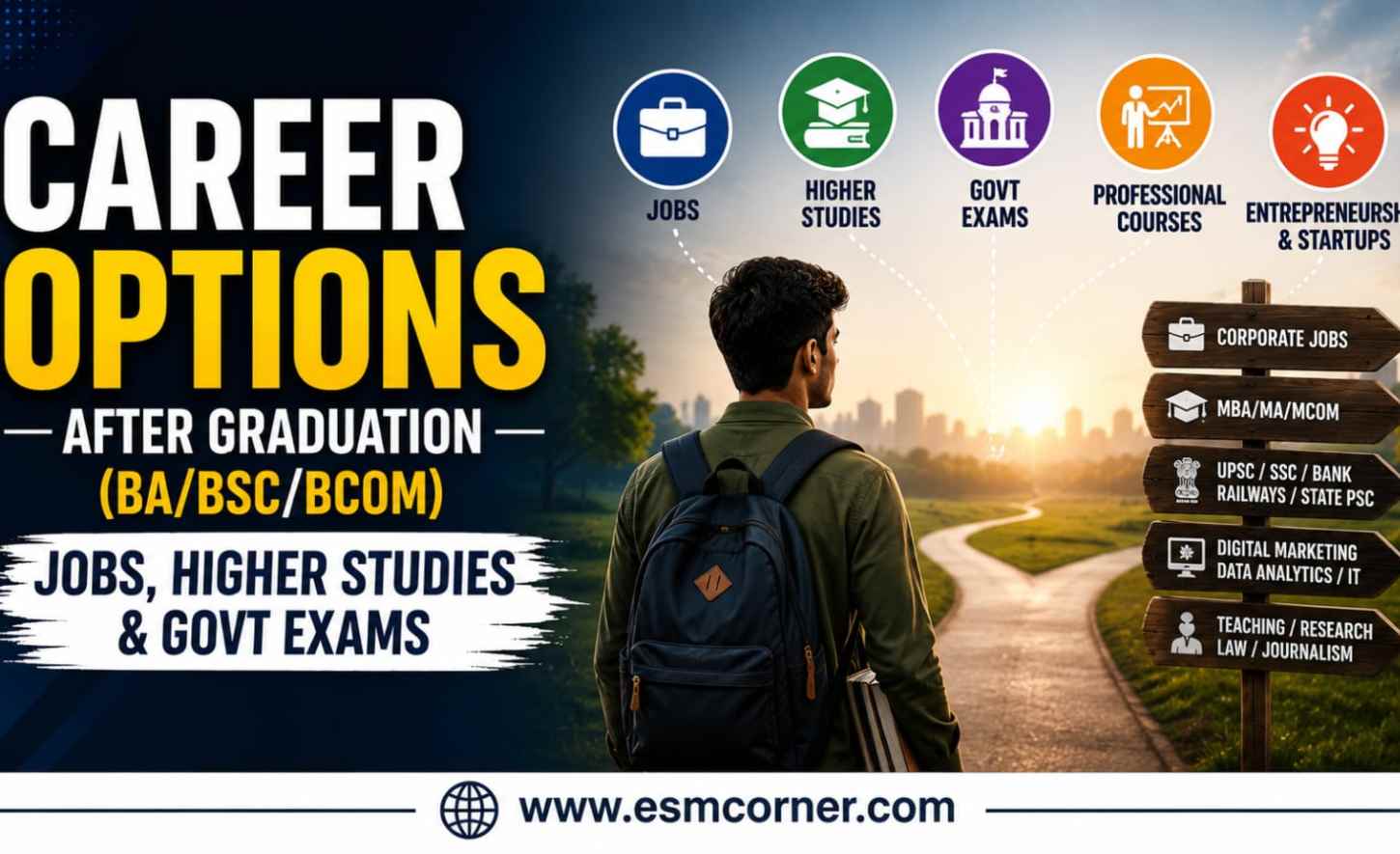
In many Indian homes, a government job is basically the gold standard of success — and honestly, the reasons make sense: job security, social respect, fixed working hours, and the ability to make a real impact. But this path is genuinely competitive and demands serious, sustained preparation.
- UPSC Civil Services & State PSCs – The toughest exams out there, but they lead straight into administrative, police, or foreign service roles with real decision-making power.
- SSC CGL – A solid option for BA, BSc, and BCom grads to enter central government ministries as inspectors, auditors, or assistants, with a good work-life balance.
- Banking Exams (SBI, IBPS, RBI) – Structured, predictable, and held every year. Strong quant and reasoning skills can get you a solid banking job within 6-8 months of focused prep.
- Railways, Defence, and Teaching – RRB exams, defence entries like CDSE or AFCAT, and state B.Ed./TET exams for stable, respected teaching careers.
Quick Comparison Table
| Career Path | Best For | Investment (Time/Money) | Future Scope |
|---|---|---|---|
| Corporate Jobs | Action-oriented, adaptive minds | Low money, immediate time | Strong corporate growth |
| Digital & Freelance | Creative self-starters | Low money, high self-learning | Global remote opportunities |
| MBA | Leadership and business aspirants | High money, ~2 years | Top executive corporate roles |
| Academic Master’s | Research and teaching minds | Medium money, 2-5 years | Specialised academic careers |
| Government Exams | Stability and status seekers | Low money, high time risk | Secure, respected bureaucratic career |
How Do You Actually Choose?
Don’t jump into a competitive path like government exams without a clear timeline — that’s how career gaps and uncertainty creep in. Set a realistic goal, and always keep a backup plan through skill-building or work experience alongside it.
A good way to figure out your direction is to actually look back at your own interests — your favourite projects, internships, or activities. They usually point toward whether you’re more suited for management, analytics, finance, or something else entirely. Short internships and certifications also genuinely help — they build real-world exposure and make your resume stand out.
Let’s Bust a Couple of Myths While We’re Here
A lot of students believe their degree decides their entire future. It really doesn’t — your degree gets your foot in the door, but your actual skills are what keep you moving forward. Don’t join an expensive master’s programme just to delay making a decision.
When picking a job, look beyond just the salary — think about learning opportunities, work culture, and mentorship. A tough role with real growth potential often beats a comfortable one that leads nowhere. And when it comes to choosing between an MBA and a government job, it really comes down to what you personally want — growth and corporate exposure, or long-term stability and security.
One last thing — talk to your parents openly. Share what you’ve actually researched, and help them understand how today’s job market genuinely values skills, adaptability, and specialisation over just a degree title.
Conclusion
As we finish this deep-dive consultation, remember that your graduation degree is the foundation of your journey, not its final destination. Your long-term success in this fast-evolving landscape depends on your continuous learning, psychological agility, and practical execution, rather than the name of your college. The modern job market, increasingly shaped by artificial intelligence and shifting automation trends, values adaptable problem-solvers who can learn, unlearn, and relearn on the fly. Do not let societal expectations or peer pressure push you into a career path that does not fit your personality or financial reality. Whether you decide to climb the corporate ladder.
READ ALSO: KSB MBBS BDS ADMISSION 2026–27: COMPLETE GUIDE
FAQ : Career Options after Graduation
1. Which career path offers the highest salary immediately after graduation?
Corporate roles in management consulting, business development, data analytics, and specialized digital marketing offer the highest entry-level packages. These fields reward direct performance, technical skills, and communication eloquence, allowing rapid financial growth far outstripping traditional entry-level administrative desks.
2. Can a BA or BCom graduate switch careers into the IT and tech sector?
Yes, absolutely. By earning verified certifications in data analytics, UI/UX design, python programming, or cloud computing, non-tech graduates can easily enter tech firms. Modern tech companies prioritize functional project portfolios and practical skill demonstrations over your college degree.
3. Is it worth dedicating 3–4 years entirely to government exam preparation?
Dedicating more than two years to full-time preparation without a backup plan is highly risky in today’s market. It creates stressful resume gaps. It is far wiser to transition to a part-time preparation model alongside a job or freelance work after your initial attempts.
4. Should I choose an ordinary local MBA or enter the job market directly?
Choose the job market directly. A low-tier, unaccredited MBA holds very little value in the corporate hiring ecosystem and yields poor returns on investment. Gaining two years of real-world work experience will teach you far more and position you for a much better executive program later.
5. How can I find remote jobs or freelancing opportunities as a fresh graduate?
Start by building a polished, professional LinkedIn profile and registering on credible global platforms like Upwork or Fiverr. Create an original portfolio showcasing your content writing, graphic design, web development, or translation skills, and pitch directly to small business owners and startups.
6. Are online degrees and certifications recognized by top corporate employers?
Yes, top corporate employers highly recognize online credentials provided they are from accredited universities or globally reputed platforms like Google, Coursera, or Microsoft. Employers view independent online certifications as a strong sign of your self-motivation, curiosity, and commitment to upskilling.
7. What are the best career options for students who want a great work-life balance?
Corporate roles in human resources, instructional design, content strategy, and public sector positions through SSC CGL or banking clerk entries offer highly predictable hours. These paths allow you to maintain distinct boundaries between your professional commitments and your personal life.
8. I am completely confused between two paths; how do I make a final decision?
Use the elimination method through low-risk experimentation. Spend two weeks reading deeply about both fields, talking to professionals on LinkedIn, or doing short micro-internships. The path that feels naturally engaging and aligns best with your immediate financial realities is your ideal starting point.
For daily defence updates, government notifications, recruitment alerts, welfare schemes, career opportunities, education news, and other important announcements, join our WhatsApp Community. Click here to join our WhatsApp Group.