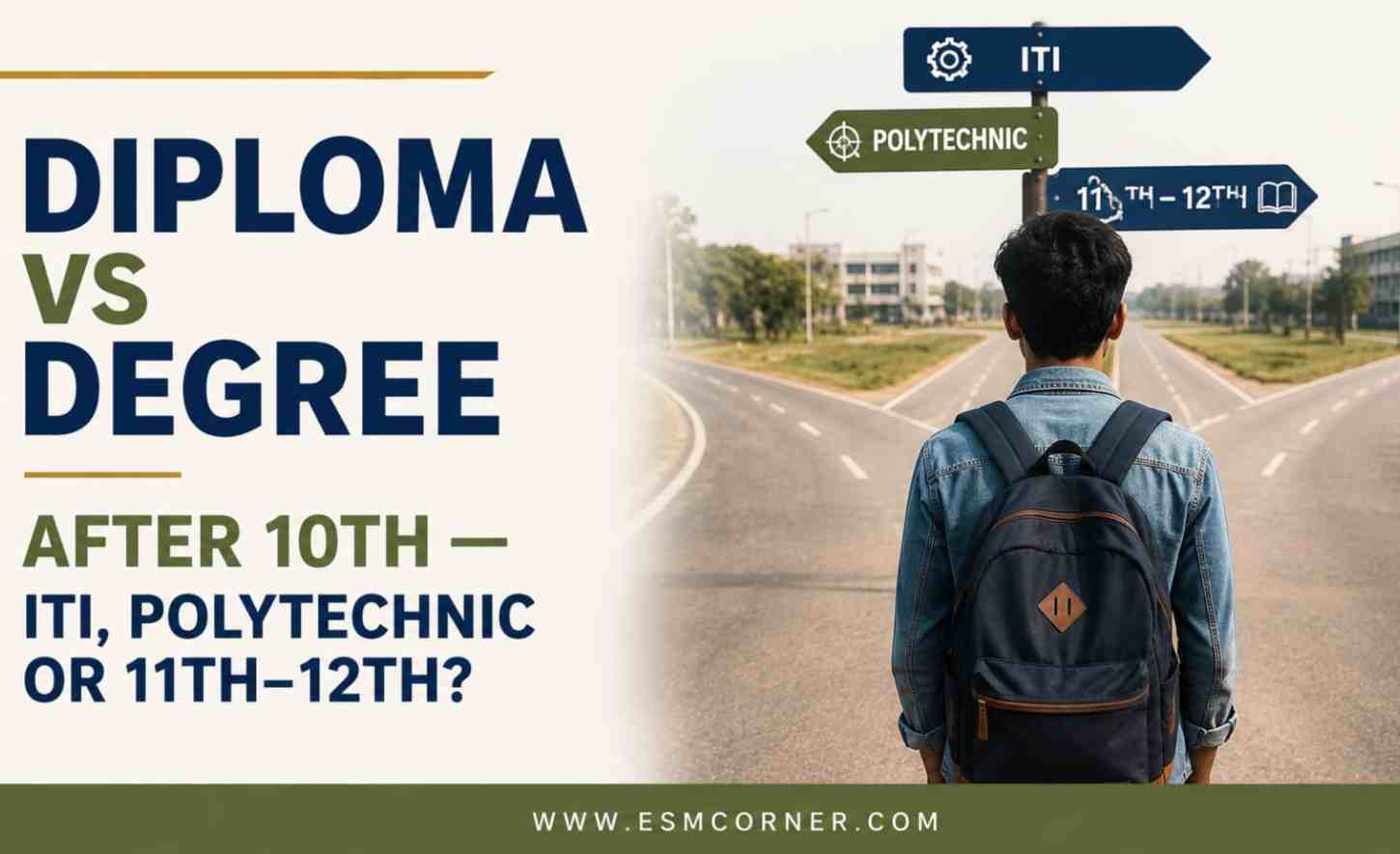


The moment Class 12 starts, it feels like everyone around you only knows two words: JEE and NEET. As if engineering and medical are the only two doors in the entire universe of opportunities. Spoiler alert — they’re not even close to being the only options.
Here’s a mistake a lot of students make: applying for every single exam they’ve heard of, just to “keep options open.” That usually backfires. Instead of preparing well for one or two exams that actually suit you, you end up half-preparing for five, and mastering none. The smarter move is picking exams based on your genuine interests and strengths — not panic, not peer pressure.
This guide walks you through the major national entrance exams, what they actually test, and which one might genuinely fit you.
What Makes Entrance Exams Different From Board Exams?
Board exams mainly evaluate how well you understand and recall what you’ve studied. Entrance exams, however, focus on conceptual understanding, logical thinking, problem-solving, and the ability to perform under time pressure.
Rather than choosing an exam because it’s popular, think about your own strengths. Whether you’re better at logical reasoning, science, creativity, or numerical aptitude, selecting an exam that matches your abilities will give you a much better chance of success.
JEE Main & JEE Advanced: The Engineering Battlefield
This is the big one for anyone aiming at engineering. JEE Main is the first screening round, opening doors to NITs, IIITs, and other centrally funded tech institutes. Only the top 2.5 lakh rank holders move on to JEE Advanced — the exam that decides who gets into the IITs.
- JEE Main tests Physics, Chemistry, and Maths at a moderate-to-high difficulty, demanding speed and clear fundamentals.
- JEE Advanced is a whole different level — multi-correct answers, matrix-match questions, and deep analytical problems that go way beyond formula memorisation.
- Cracking this leads to B.Tech degrees and careers in software engineering, data science, aerospace, core engineering, and tech entrepreneurship.
Bottom line: if you genuinely enjoy tricky numerical problems and don’t mind grinding through months of practice, this path rewards consistency more than raw genius.
NEET UG: The Medical Route
NEET UG is the national entrance examination for admission to MBBS, BDS, BAMS, BHMS, and several other medical programs, including those offered by AIIMS and JIPMER. The exam is based on the NCERT curriculum in Physics, Chemistry, and Biology.
Success in NEET requires a solid understanding of concepts, the ability to solve questions accurately under time constraints, and regular revision. Qualifying the exam can open doors to careers in medicine, surgery, healthcare, and medical research.
CUET UG: The Flexible Option for Central Universities
CUET UG serves as the common entrance exam for admission to leading central universities such as DU, BHU, and JNU. Based on the Class 12 syllabus, it allows students to choose from a variety of subject combinations according to their academic interests.
The exam is generally moderate in difficulty and favors candidates with strong fundamentals and consistent preparation over exceptional talent alone. A good CUET score can lead to admission in BA, B.Sc, B.Com, and several integrated degree programs, offering a wide range of future career opportunities.
CLAT: For Future Lawyers
CLAT is your entry point into India’s top National Law Universities. It tests English, Current Affairs, Legal Reasoning, Logical Reasoning, and Quantitative Techniques.
It’s a reading-heavy exam, which makes it genuinely tough for students who aren’t naturally into extensive reading. But if you enjoy staying updated on current affairs and love a good logical argument, this exam plays right into your strengths — and leads into integrated law programs and solid legal careers.
NDA: For Students Who Want to Serve the Nation
Conducted by UPSC, the NDA exam is for those who dream of becoming officers in the Army, Navy, or Air Force. It includes a written test on Maths and General Ability, followed by the intense SSB interview process.
This one isn’t just about academics — physical fitness and leadership qualities matter just as much. Crack it, and you’re looking at one of the most prestigious careers in national defence.
NIFT & NID: For the Creatively Inclined
Not everyone wants to spend their life solving equations or memorising case laws — and that’s exactly where NIFT and NID come in.
- NIFT focuses on fashion, apparel, and luxury management.
- NID covers product design, graphic design, animation, and textile design.
Both involve aptitude tests, creative ability rounds, and practical exercises. Success here depends less on textbook knowledge and more on your sketching skills, spatial visualisation, and a strong creative portfolio.
The Lesser-Known Exams Worth Knowing About
Most students never even hear about these until it’s too late — so here’s your heads-up:
- IPMAT – Run by IIMs like Indore and Rohtak, this targets Commerce and Humanities students wanting a direct route into a five-year integrated BBA-MBA, completely skipping the traditional CAT route.
- BITSAT – A solid alternative to JEE for BITS Pilani campuses, rewarding speed and accuracy with bonus points. State-level exams like MHT-CET, WBJEE, and KCET also offer strong regional options.
- IISER Aptitude Test (IAT) – Perfect for students drawn to pure research rather than corporate engineering, leading to five-year BS-MS dual degrees at IISERs and IISc.
- ICAR Entrance – For those interested in sustainable technology and environmental science through advanced agricultural programs.
- NCHM JEE – The standard entry exam for hospitality enthusiasts, opening doors to top government hotel management institutes and careers in luxury hospitality, culinary arts, and tourism.
Quick Comparison Table
| Entrance Exam | Best For | Courses Offered | Difficulty Level |
|---|---|---|---|
| JEE (Main & Advanced) | Engineering & Technology | B.Tech, B.Arch, Integrated M.Tech | Very High |
| NEET UG | Medical AND Dental Sciences | MBBS, BDS, BAMS, BHMS | Highly Competitive |
| CUET UG | Liberal Arts, Sciences, Commerce | BA, B.Sc, B.Com, Integrated Degrees | Moderate |
| CLAT | Corporate & Litigation Law | Integrated BA LLB, BBA LLB | High (reading intensive) |
| NDA | Defence Services Officers | B.Sc, BA, B.Tech (Armed Forces) | Moderate (written) + Tough (SSB) |
Can You Prepare for Multiple Exams at Once?

This depends entirely on syllabus overlap. If two exams share similar subjects, preparing for both together makes sense. But trying to juggle completely unrelated exams — like NEET and CLAT — usually just splits your focus and hurts your preparation for both.
And about coaching — it definitely adds structure, but let’s be honest, your actual success comes down to self-study, consistency, regular revision, and staying actively engaged with what you’re learning, not just attending classes.
Smart Study Habits That Actually Work
- Stick to 6-8 hours of focused study with proper breaks, instead of exhausting yourself with non-stop marathon sessions.
- Take regular mock tests under timed conditions — this builds speed, accuracy, and genuine exam-day confidence.
- Always review your mistakes carefully. That’s where the real improvement happens.
Let’s Bust a Few Myths While We’re At It
Myth 1: Only toppers crack these exams. Not true at all. These tests measure consistency and how well you apply concepts — not your old school report card. A disciplined average student can easily outperform a talented but inconsistent one.
Myth 2: You need to memorise everything. Also false. Modern entrance exams have shifted heavily toward application-based questions. Blind memorisation without real understanding won’t get you very far in the advanced sections.
If Things Don’t Go As Planned
Failing an entrance exam doesn’t define your intelligence or your future — full stop. If results don’t go your way, there are excellent alternative paths waiting, including digital marketing, UI/UX design, environmental sciences, and data analytics — fields that don’t hinge on one single exam score.
And a quick word for families reading this too — during this stressful period, parents play a huge role simply by staying calm, supportive, and avoiding comparisons with other students. That kind of steady support does more for a student’s confidence than any extra coaching class ever could.
Conclusion
Navigating the landscape of entrance examinations after Class 12 can feel overwhelming, but it is best approached as a journey of personal discovery rather than a race for survival. True success does not come from attempting every exam out of anxiety, but from choosing the path that matches your unique strengths, interests, and professional goals. Whether you choose the analytical world of engineering, the dedicated path of medicine, the dynamic field of law, or the expansive opportunities of central universities, your focus should remain on consistent, disciplined preparation.
Avoid the pressure of short-term trends and the urge to blindly follow what your peers are doing. This transition phase is your opportunity to take ownership of your future. View these entrance exams not as arbitrary barriers designed to eliminate candidates, but as platforms to showcase your problem-solving skills and intellectual curiosity. Stay resilient, maintain a balanced study routine, and remember that an informed, well-aligned decision made today will lay the foundation for a deeply fulfilling and successful professional life tomorrow.
READ ALSO: HOW PCM STUDENTS CAN BECOME ARMY OFFICERS WITHOUT A WRITTEN EXAM
FAQ : Entrance Exams After 12th
Q1: Can I appear for CUET UG if I studied science in Class 12 but want to pursue a BA in Economics?
A: Yes, absolutely. CUET allows you to transition across academic streams. You generally select the domain subjects you studied in Class 12, and individual universities map those scores to determine your eligibility for arts or commerce degrees.
Q2: Is negative marking applicable to all sections of the JEE Main exam?
A: Yes, negative marking applies across the board in JEE Main. For both Multiple Choice Questions and mandatory Numerical Value Questions, a correct answer awards four marks, while an incorrect response results in a deduction of one mark.
Q3: How reading-intensive is the CLAT exam compared to other humanities entrance tests?
A: CLAT is exceptionally reading-intensive. The entire paper consists of passage-based questions, meaning you must read, process, and analyze close to 10,000 words within a strict two-hour limit, testing your reading speed and comprehension under pressure.
Q4: Can an arts stream student apply for the National Defence Academy (NDA) entrance exam?
A: Arts students can comfortably apply for the Army wing of the NDA. However, the Air Force and Navy wings strictly require Physics and Mathematics at the Class 12 level, making them accessible only to science stream candidates.
Q5: What is the main difference between the NIFT and NID entrance examinations?
A: While both focus on design, NIFT leans toward the commercial fashion ecosystem, apparel production, and retail merchandising. NID focuses broadly on industrial, product, graphic, and user-interface design, emphasizing deep creative problem-solving across various industries.
Q6: Is it possible to clear the NEET UG exam without enrolling in premium coaching institutes?
A: Yes, it is entirely possible. NEET is based on the core NCERT curriculum. Consistent self-study, thorough textbook mastery, disciplined question practice, and regular mock testing can lead to a top score without commercial coaching.
Q7: What advantages does the IPMAT exam offer over standard management entry routes?
A: IPMAT offers an express route to premium business management education. By qualifying right after Class 12, you secure a five-year integrated seat at top IIMs, completely bypassing the intense pressure of the CAT exam after graduation.
Q8: Are state-level engineering exams easier than JEE Main, and should I take them?
A: Generally, state-level exams feature less complex questions than JEE Main, though they still demand high calculation speed. You should absolutely take them, as they offer excellent local options and reserve significant seat quotas for home-state candidates.
For daily defence updates, government notifications, recruitment alerts, welfare schemes, career opportunities, education news, and other important announcements, join our WhatsApp Community. Click here to join our WhatsApp Group.