
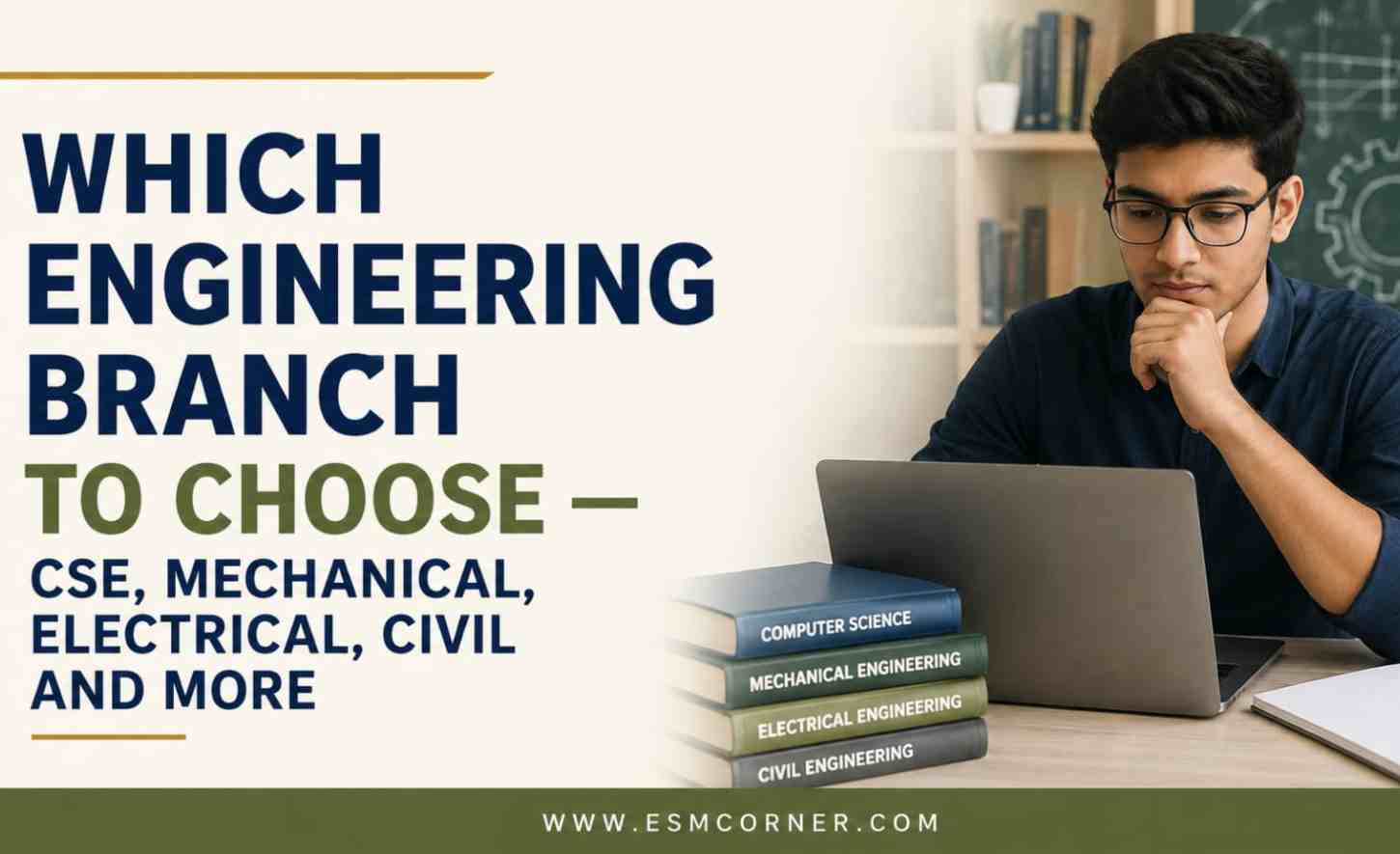
After Class 12 (PCM), many students get confused about which engineering branch to choose. Nowadays, almost everyone talks about Computer Science Engineering (CSE) because it offers good salary packages. Because of this, many students choose CSE without thinking whether they actually like coding or not.
Some students also select a branch because their friends are taking it, their parents told them to, or they saw something on social media. This is a big mistake. If you choose a branch without understanding it, you may lose interest in your studies, get poor marks, and feel confused about your career later.
The truth is that there is no single “best” engineering branch. Every branch is good for the right student. If you enjoy coding and computers, CSE can be a great choice. If you like machines, construction, electronics, or designing things, other branches may be a better fit.
Before choosing an engineering branch, first understand what each branch teaches, what skills it requires, and what career opportunities it offers. Then compare these with your own interests, strengths, and future goals. Choosing a branch based on your passion and abilities—not because everyone else is choosing it—is the smartest way to build a successful engineering career.
Why Choosing the Right Branch Matters & Common Student Mistakes
Your choice of engineering branch shapes your next four years of study and dictates your initial entry point into the professional world. Choosing a discipline aligned with your natural interests makes studying enjoyable, whereas picking an incompatible field makes academic concepts feel like a heavy burden.
Many students make major errors during Engineering After 12th PCM counseling:
- Blindly Following Trends: Selecting CSE or AI just because relatives say it offers quick placements.
- Peer Influence: Enrolling in the same department as close high school friends without checking personal interest.
- Ignoring Core Strengths: Choosing heavy mathematical branches despite struggling with basic calculus and physics.
- Focusing Only on Starting Packages: Forgetting that long-term career growth requires genuine passion and continuous skill updating.
- Lacking Long-Term Vision: Not checking whether a branch supports higher studies, foreign education, or government job aspirations.
Key Factors to Consider Before Finalizing Your Stream
Before submitting your college preference list, systematically analyze your personal suitability across these core areas:
- Personal Aptitude: Do you like writing computer code, working with electrical circuits, designing machinery, or studying building structures?
- Career Goals: Decide early whether you want private corporate jobs, government posts, research positions, or startup opportunities.
- Learning Style: Determine if you prefer sitting in front of screens or working physically on field sites and shop floors.
- Adaptability: Are you willing to constantly learn new software tools and technologies throughout your professional life?
Detailed Overview of Major Engineering Branches
Computer Science Engineering (CSE), IT & AI Streams
“Should I choose CSE even if I have never written code before?” This is the most common question today. CSE, Information Technology (IT), and Artificial Intelligence (AI) focus on software development, algorithms, data structures, and computer systems. You will excel here if you enjoy logical puzzle-solving, structured thinking, and spending long hours working on computers.
Electronics & Communication (ECE) & Electrical Engineering
“What if I like both software and hardware?” Electrical Engineering and ECE bridge physical hardware with digital intelligence. Electrical engineering focuses on power generation, motors, and energy grids, while ECE deals with microchips, telecommunications, embedded systems, and IoT devices. These fields require strong mathematical abilities and interest in physical science principles.
Mechanical, Civil & Chemical Engineering
“Are traditional core branches still relevant?” Absolutely. Mechanical Engineering covers machines, thermal systems, robotics, and manufacturing. Civil Engineering focuses on infrastructure like bridges, highways, dams, and smart cities. Chemical Engineering deals with converting raw materials into useful chemical products. These streams suit students who like real-world physical structures and tangible industrial processes.
Aerospace & Emerging Branches
“What about specialized branches like Aerospace, Biotech, or Mechatronics?” Aerospace engineering focuses on aircraft, satellites, and spacecraft design. Emerging interdisciplinary branches combine multiple fields to solve modern problems. While exciting, specialized fields require deep dedication and often demand higher studies for top-tier research positions.
Engineering Branch Comparison
| Engineering Branch | Best For | Career Scope | Key Consideration |
| Computer Science (CSE) | Logic solvers & coding lovers | Software development, AI, Cloud Computing | Requires continuous self-learning |
| Electronics & Comm. (ECE) | Chip & gadget enthusiasts | Embedded systems, Telecom, Core VLSI | Heavy math and physics concepts |
| Electrical Engineering | Power & energy management fans | Power grids, EV sector, Automation | Complex circuit theory subjects |
| Mechanical Engineering | Machine & physics lovers | Automotive, Robotics, Manufacturing | Demands physical & design aptitude |
| Civil Engineering | Building & infrastructure creators | Construction, Urban planning, Public works | Involves extensive field site work |
Core Branches vs Emerging Branches: Career Scope
When evaluating a Career in Engineering, understanding industry pathways helps clarify long-term goals.
Private vs Government Sector Opportunities
- Private Sector: Software, ECE, and Mechanical fields dominate private hires through tech companies, automotive firms, and global consultancies.
- Government Jobs: Civil, Electrical, and Mechanical engineers enjoy substantial opportunities in public sector undertakings (PSUs), railways, and defense services.
Higher Studies & Future Trends
- Higher Studies: Core branches provide strong foundations for M.Tech or MS degrees in specialized global domains.
- Skill Development: Regardless of branch, learning data analysis, project management, and basic programming boosts employability.
- Entrepreneurship: Engineering equips you to build tech startups, manufacturing units, or structural consultancy firms.
Practical Action Plan for Students and Parents
How to Discover Your Strengths
Take online aptitude tests, build small DIY science projects, or try introductory coding classes. Observe which activities excite you and which make you tired.
Essential Skill Checks
- Coding vs Non-Coding: You do not need prior programming experience, but you must be open to developing logical problem-solving skills.
- Communication Skills: Technical knowledge requires clear communication to present ideas, write reports, and clear job interviews.
- Internships & Projects: College learning becomes valuable when applied through practical internships, industry projects, and certifications.
How Parents Should Guide Students
Parents should act as supportive facilitators rather than decision-makers. Guide your child by discussing facts, supporting their natural interests, and avoiding comparisons with relatives’ children.
Crucial Questions to Ask Before Finalizing Your Choice
Ask yourself these four questions before locking your preferences:
- Am I choosing this branch out of genuine interest or external pressure?
- Do I enjoy the foundational subjects (Math, Physics, Chemistry, or Computer Science) of this discipline?
- Am I comfortable with the typical workplace environment of this field?
- Will I stay motivated to learn new tools in this sector five years from now?
Conclusion
Choosing the right engineering branch is one of the most important decisions of your academic life, but it does not have to be overwhelming. Always remember that there is no universally best engineering branch—only the branch that matches your personal interests, strengths, aptitude, and long-term career goals. Avoid choosing a discipline based purely on temporary package trends, social media hype, or peer pressure.
Analyze each field objectively, evaluate your personal comfort with its core subjects, and make a confident, well-informed choice. When you select a stream aligned with your passion and dedicate yourself to continuous skill development, success and professional fulfillment will naturally follow throughout your engineering journey.
READ ALSO: CAN HINDI MEDIUM OR RURAL BACKGROUND STUDENTS CRACK NDA AND BECOME OFFICERS?
Frequently Asked Questions
1. Can I get a software job if I choose Mechanical or Civil Engineering?
Yes, many IT companies recruit students from core branches during campus placements. However, you must independently learn programming languages, data structures, and software engineering concepts alongside your regular college curriculum to clear tech interviews successfully.
2. Is CSE strictly better than traditional core branches?
No single branch is strictly better. CSE offers rapid job opportunities in the tech sector, but core branches like Mechanical, Electrical, and Civil provide essential real-world infrastructure solutions, steady long-term growth, and extensive government job openings.
3. Do I need prior coding knowledge before joining a CSE program?
Not at all. Engineering colleges teach programming fundamentals right from the first semester. What matters most is your logical thinking, interest in problem-solving, and willingness to practice writing code consistently throughout your degree course.
4. Which engineering branch has the highest number of government job options?
Civil Engineering, Electrical Engineering, and Mechanical Engineering offer maximum government job opportunities. Public sector units, state electricity boards, municipal corporations, defense research organizations, and Indian Railways regularly recruit core engineering graduates through competitive examinations.
5. What is the main difference between CSE and IT branches?
CSE focuses deeply on computing theory, hardware architecture, operating system design, and underlying algorithm principles. IT focuses primarily on the practical application of software systems, networking, database administration, and business technology tools to solve operational problems.
6. What should I do if I am confused between two different branches?
Compare the third-year syllabus of both branches to see which subjects look more interesting. Speak with working professionals or senior college students, assess your natural academic strengths, and choose the option matching your long-term career goals.
7. Are emerging branches like AI and Data Science safe choices for undergraduates?
Specialized branches offer focused knowledge in modern technologies. However, standard CSE provides a broader base that covers basic computing foundations completely, keeping your options wider for future career shifts or higher educational pursuits.
8. How important are college campus placements when selecting a branch?
Campus placements provide your first career opportunity, but long-term success depends on individual skill development, personal adaptability, and continuous learning. Pick a branch you enjoy so that building strong professional skills comes naturally throughout your career.
For daily defence updates, government notifications, recruitment alerts, welfare schemes, career opportunities, education news, and other important announcements, join our WhatsApp Community. Click here to join our WhatsApp Group.