
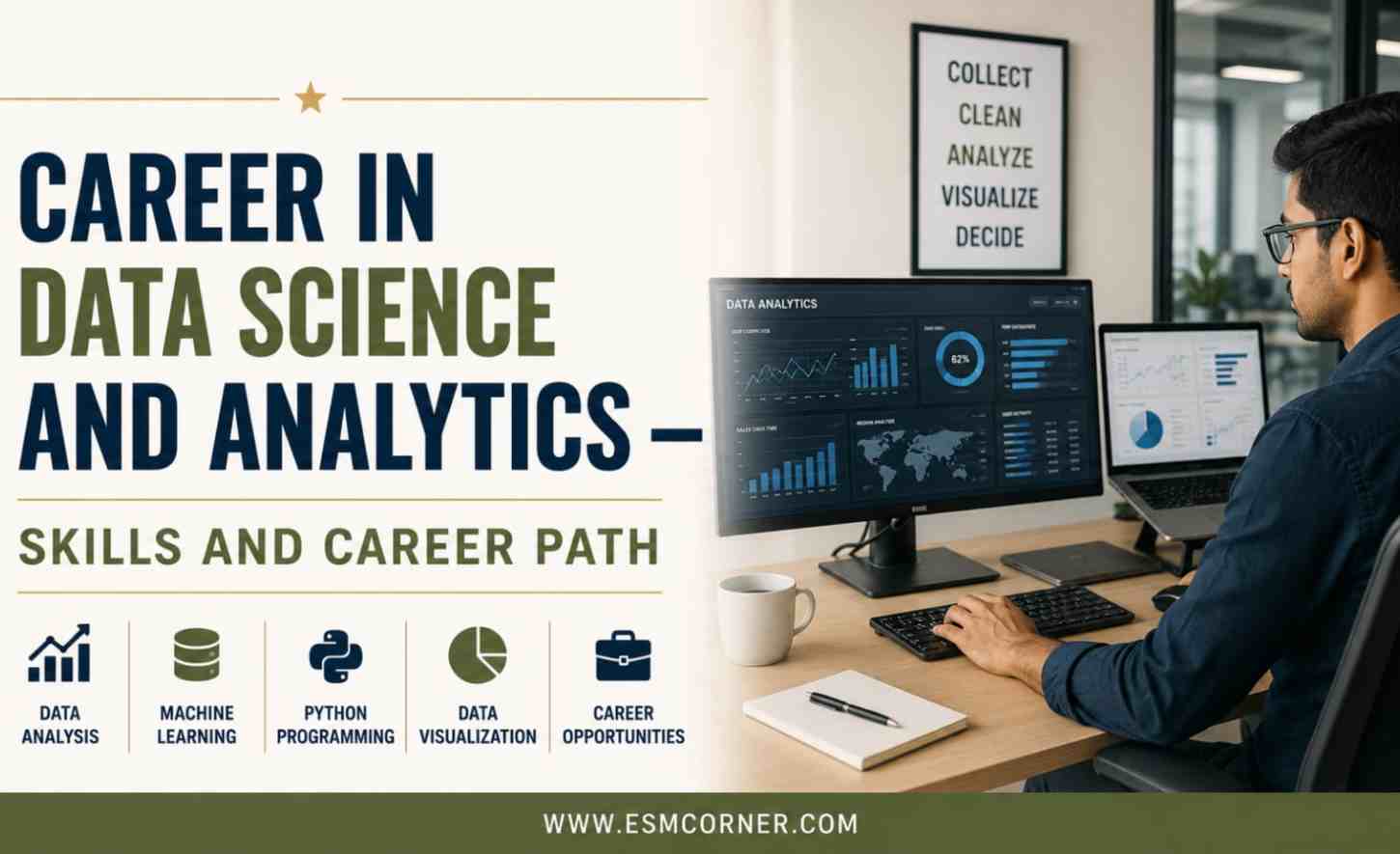
Every single day, companies collect massive amounts of data from websites, smartphone apps, online shopping orders, digital payments, and social media activities. However, raw data by itself is just like unrefined oil; it is not very useful until someone organizes it, analyzes it, and converts it into meaningful information.
This is precisely where Data Science and Analytics professionals play a crucial role in modern industry. Many students and parents frequently hear popular terms like Data Scientist, Data Analyst, Business Analyst, Machine Learning, and Big Data, but they often feel confused about what these jobs actually mean, what skills are required, which courses to choose, and whether a average student can successfully build a career in this field.
It is essential to understand that a Career in Data Science is not exclusively about heavy computer coding. It also heavily relies on everyday logical thinking, practical problem-solving, basic mathematics, business understanding, and curiosity to find hidden patterns within information. Whether you are a high school student planning your higher education or a recent college graduate exploring job options, this comprehensive guide will clearly explain every aspect of an Analytics Career Guide in very simple Indian English. We will explore key job roles, essential Data Science Skills, learning roadmaps, and future opportunities without using overly complex jargon.
What are Data Science and Data Analytics?
To understand this field, let us start with a simple everyday example. Imagine you are shopping on an online app like Amazon or Flipkart. When you search for a cricket bat, the app immediately starts showing you cricket balls, sports shoes, and gloves. How does the app know what you might want to buy next? It happens because software systems analyze the shopping choices made by millions of previous customers.
- Data Analytics: Focuses on looking at past data to answer specific questions. For example, a Data Analyst looks at last year’s sales to figure out which festival brought the highest revenue.
- Data Science: Takes this a step further by using advanced mathematical techniques to predict future trends. A Data Scientist builds automated smart models that can predict what customers will buy next month.
In simple words, Analytics tells us what happened in the past, while Data Science predicts what is likely to happen in the future.
Key Career Roles in the Data World
Many beginners wrongly assume that every person working with data does the exact same job. In reality, the industry offers several specialized roles depending on your personal interests and technical strengths.
- Data Analyst: Examines numbers, creates clear charts, and prepares visual reports to help companies understand their daily performance.
- Data Scientist: Uses mathematics, programming, and advanced algorithms to build smart predictive systems that solve complex business problems.
- Business Analyst: Acts as a helpful bridge between business management and technical software teams, focusing heavily on business decisions rather than intense coding.
- Data Engineer: Focuses on building the backend pipelines and secure digital storage systems that collect and deliver clean data to analysts and scientists.
Summary Comparison of Data Roles
| Career Role | Main Work | Best For | Key Skill |
| Data Analyst | Finds patterns in past data | Students who like numbers | SQL and Excel |
| Data Scientist | Builds smart predictive models | Students who like math and coding | Python and Statistics |
| Business Analyst | Improves business decisions | Students with good communication | Business Understanding |
| Data Engineer | Builds clean data pipelines | Students who love software building | Database Design |
| Machine Learning Engineer | Creates automated learning systems | Coding enthusiasts | Advanced Algorithms |
Key Skills You Need to Build
Building a successful Data Analyst Career or Data Scientist Career Path requires a balanced combination of technical tools, mathematical concepts, and soft skills. You do not need to be a mathematical genius to start, but having a comfortable relationship with numbers is helpful.
Core Technical and Non-Technical Skills:
- Basic Mathematics and Statistics: Concepts learned in school—such as averages, percentages, probability, and graphs—form the main foundation of data analysis.
- Database Management (SQL): Structured Query Language (SQL) is a simple language used to request, extract, and organize data stored inside large databases.
- Spreadsheets (Microsoft Excel): Excel remains the most widely used tool in the corporate world for quick calculations, sorting information, and creating simple tables.
- Programming Languages (Python): Python is extremely popular because it reads like simple English, making it very easy for beginners to write basic computer programs.
- Data Visualization Tools: Tools like Power BI and Tableau help you turn boring tables of numbers into colorful, interactive charts and dashboard visual reports.
- Business Understanding and Curiosity: You must understand how a business operates so that your findings can actually help the company save money or grow.
- Clear Communication: The ability to explain complex technical findings in simple words to managers and business owners who do not know coding.
Educational Paths and Courses
You can enter this field through multiple academic routes after completing school or university.
- Data Science After Class 12: Students from science, commerce, or arts backgrounds can pursue undergraduate degrees like B.Sc. in Data Science, B.Sc. in Statistics, BCA, or B.Tech in Computer Science.
- Data Science After Graduation: Graduates from almost any discipline can transition into data roles by pursuing an M.Sc. in Data Analytics, an MCA, an MBA in Business Analytics, or specialized post-graduate diplomas.
- Online Certifications: Platforms offer flexible skill-based courses. However, remember that an online certificate alone will never guarantee a job; hands-on skill practice is what truly matters to recruiters.
Practical Roadmap: How a Beginner Can Start Data Science
If you are wondering how to begin your learning journey from scratch, follow this practical step-by-step roadmap:
- Master Computer Basics: Get comfortable using computers, organized folder structures, and basic software tools.
- Learn Excel Thoroughly: Practice basic formulas, filtering data, summary tables, and creating simple charts.
- Understand Basic Statistics: Review school-level concepts like mean, median, mode, variance, standard deviation, and basic probability.
- Learn SQL for Data Extraction: Spend a few weeks practicing basic database queries to pull specific information from tables.
- Start Learning Python Programming: Focus on fundamental Python programming concepts, basic data types, and writing simple logic functions.
- Practice Data Visualization: Learn how to present data cleanly using free visualization tools like Power BI Desktop.
- Explore Basic Machine Learning: Understand how simple predictive algorithms work conceptually before writing complex code.
- Build Real-World Projects: Use free public datasets from platforms like Kaggle to analyze real sales, weather, or sports statistics.
- Create a Simple Portfolio: Upload your completed analysis projects to GitHub or summarize your findings in clear LinkedIn posts.
- Apply for Internships: Look for entry-level internship opportunities to gain real industry exposure and working experience.
Common Myths and Mistakes to Avoid
Many beginners fall into common traps due to misleading advertisements and incomplete information found online.
Major Myths Busted:
- Myth 1: “You need an advanced engineering degree.” False. Students from commerce, economics, and basic science backgrounds successfully work in analytics every day.
- Myth 2: “Heavy coding is strictly required for all data jobs.” False. Roles like Business Analyst focus far more on logic and communication than deep programming.
- Myth 3: “A 30-day course guarantees a high-paying job.” False. Real skill development takes consistent effort, practice, and continuous learning over several months.
Mistakes Beginners Should Avoid:
- Collecting dozens of course certificates without actually building practical projects.
- Memorizing programming syntax instead of developing logical problem-solving abilities.
- Ignoring soft skills and failing to present findings clearly to others.
Future Scope of Data Careers
The future of data-driven careers remains exceptionally bright across multiple global industries. Every modern sector—including retail banking, healthcare, e-commerce platforms, logistics companies, entertainment streaming apps, and agriculture—relies heavily on data to make smarter daily decisions. As artificial intelligence continues to expand globally, the demand for trained humans who can interpret data correctly will keep growing steadily.
Conclusion
A Data Analytics Career offers an exciting, practical, and highly rewarding professional path for students who enjoy problem-solving, numbers, modern technology, and uncovering practical insights from information. However, long-term success in this dynamic field is not achieved by simply chasing trends or collecting course certificates.
True professional growth comes from mastering fundamental concepts, practicing regularly on real datasets, building practical projects, and developing a keen understanding of real-world business challenges. Choose a career in data science because you genuinely enjoy logical thinking and continuous learning—not just because it is a trending topic. With consistent practice and the right approach, anyone can successfully navigate this field.
READ ALSO: CAREER OPTIONS AFTER 12TH ART/HUMANITIES
Frequently Asked Questions
1. Can a non-technical or commerce student learn Data Science?
Yes, non-technical students can definitely build a career in data science. Starting with simple tools like Excel, SQL, and basic statistics allows non-technical background students to comfortably step into data analytics without needing prior engineering knowledge.
2. Is heavy coding compulsory to work in Data Analytics?
No, heavy coding is not compulsory for all data roles. Positions such as Data Analyst or Business Analyst rely heavily on SQL, spreadsheet tools, visual dashboards, and business logic rather than complex software development.
3. How much time does it take to learn Data Science from scratch?
For a complete beginner practicing consistently for one to two hours daily, acquiring core job-ready skills typically takes around six to nine months of dedicated study, hands-on practice, and project building.
4. Are online certificates enough to get a entry-level job?
No, certificates alone are not enough to secure a job. Employers prioritize practical problem-solving skills, real project portfolios, logical thinking ability, and clear communication over simple course completion certificates.
5. What is the main difference between a Data Analyst and a Data Scientist?
A Data Analyst examines historical data to answer past business performance questions. A Data Scientist uses advanced statistics, programming, and predictive models to forecast future trends and automate complex decision-making processes.
6. Do I need to be a mathematics expert to join this field?
No, you do not need advanced mathematical expertise. A strong understanding of basic high-school concepts like averages, percentages, ratios, basic algebra, and fundamental statistics is completely sufficient for most entry-level data roles.
7. Which programming language should beginners learn first?
Python is the best programming language for beginners. Its simple, English-like syntax makes it very easy to read and write, while offering powerful built-in tools specifically designed for analyzing data effortlessly.
8. What kind of projects should a beginner build for their portfolio?
Beginners should work on practical projects using real-world public data. Examples include analyzing local store sales trends, visualizing sports player statistics, or studying customer review patterns on popular e-commerce websites.
For daily defence updates, government notifications, recruitment alerts, welfare schemes, career opportunities, education news, and other important announcements, join our WhatsApp Community. Click here to join our WhatsApp Group.