
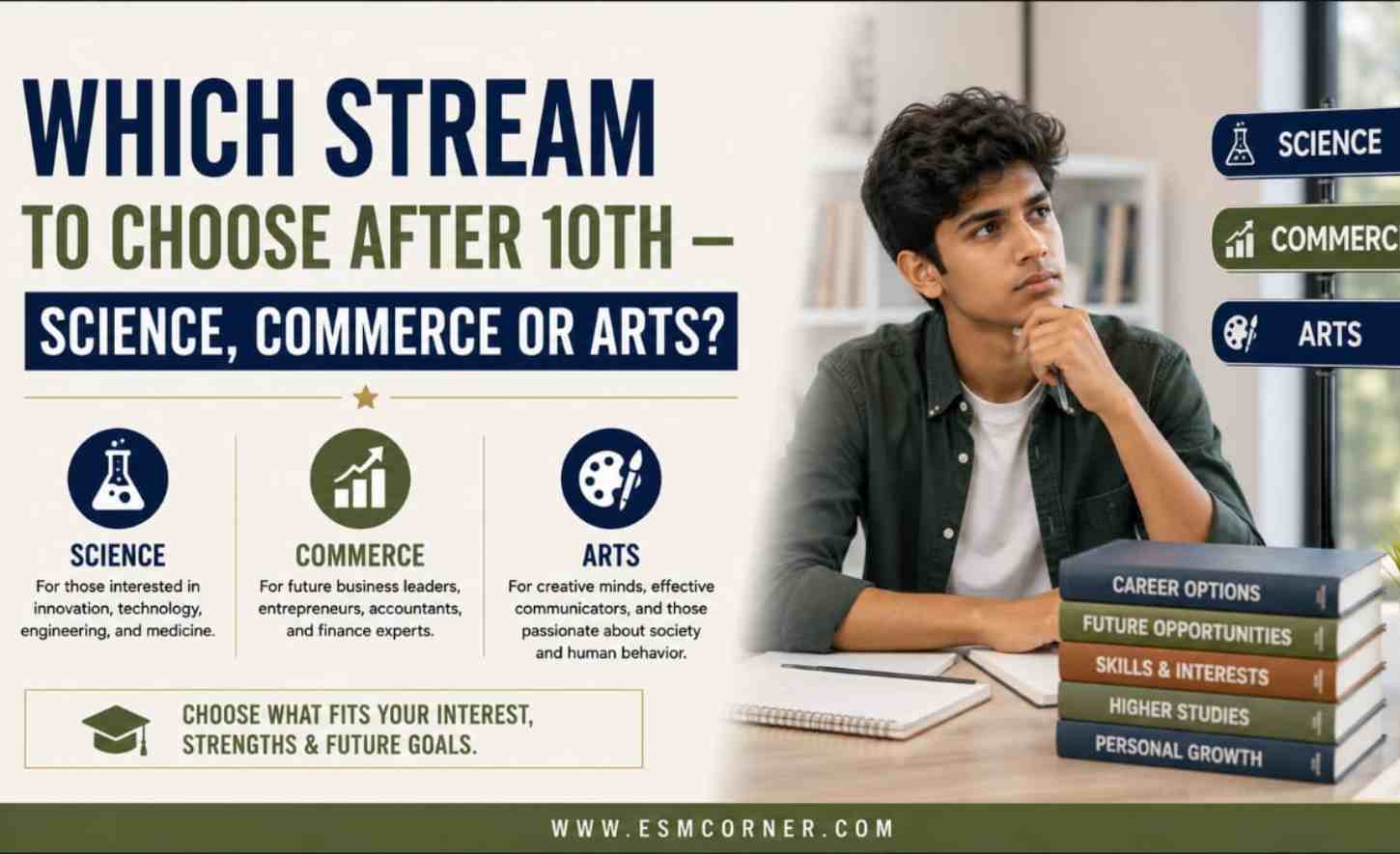
So Class 10 boards are done, the results are out, and now comes the real headache — choosing your stream. Suddenly everyone’s an expert. Your relatives are pushing Science because “beta, engineer ya doctor banna hai.” Your friends are picking Commerce because “paisa yahin hai.” And Arts? Half your family probably thinks it’s for “those who couldn’t handle Science.”
Here’s the truth: none of that matters as much as what YOU are actually good at and enjoy doing. Stream selection isn’t a one-shot decision that seals your fate forever. It’s simply the next step that should match your interests, strengths, and the kind of work you can imagine yourself doing without dreading Monday mornings.
Let’s break down all three streams properly — no sugar-coating, no scare tactics — so you can make a decision that actually makes sense for you.
Why This Decision Actually Matters (But Isn’t Life-Or-Death)
Your stream decides which subjects you’ll study, which skills you’ll build, and which entrance exams you’ll be eligible for. So yes, it matters.
But here’s the relief: choosing the “wrong” stream doesn’t end your career. Education today is flexible — people switch directions all the time. That said, picking a stream that fits you right from the start saves you a ton of stress and helps you build real skills faster instead of constantly feeling like a misfit in your own classroom.
Science Stream: For the Curious, Logical, “How Does This Work” Minds
Science isn’t one single package — it splits into different combos, and picking the wrong one for your personality can genuinely burn you out.
- PCM (Physics, Chemistry, Maths) – Perfect if you love numbers, formulas, and structured logical problem-solving. Zero biology memorisation, all calculation and mechanics.
- PCB (Physics, Chemistry, Biology) – For people who enjoy understanding how living things work. Heavy on memorising terms and processes, but no complex maths.
- PCMB (All four) – The “I want every door open” combo. Sounds great, but be warned — it’s intense and leaves very little breathing room.
You’ll enjoy Science if: you’re naturally curious, like solving problems, enjoy experiments, and don’t mind consistent self-study.
Where it can take you (and what it pays):
- Engineering & Tech – Starting salaries roughly ₹6–18 lakh per annum, and it only grows from there.
- Medicine – Prestigious and stable, but expect 7-10 years of serious training before the big money starts.
- Data Science & AI/ML – One of the world’s fastest-growing career fields, offering some of the highest-paying job opportunities.
Skip Science if: you’re only doing it because your parents want bragging rights, or because you genuinely dislike maths and analytical thinking. Forcing yourself through this stream without real interest is a fast track to burnout.
Commerce Stream: For Those Curious About How Money, Business, and the Economy Work
Ever wondered how big brands make crores, why the stock market panics over political news, or how a small startup becomes a billion-dollar company? That’s Commerce — the engine room of the business world.
- Accountancy – The language of business. You learn to read a company’s financial health like a book.
- Economics – Understanding money, markets, inflation, and how countries make financial decisions.
- Business Studies – The “how organisations actually run” subject — management, marketing, HR, the whole operational picture.
And here’s a myth to bust immediately: you don’t need Maths to succeed in Commerce. Commerce with Maths opens doors to finance and data-heavy careers, while Commerce without Maths leads beautifully into management, marketing, law, and entrepreneurship.
You’ll enjoy Commerce if: you like logical thinking, working with numbers or data, and understanding how real businesses function.
Where it can take you (and what it pays):
- CA / CS / CMA – Fresh Chartered Accountants often start around ₹7–15 lakh per annum. Serious respect and stability attached.
- Investment Banking & Corporate Finance – High base pay plus bonuses, for those who love high-pressure, high-stakes work.
- Management Consulting (after an MBA) – Advising top companies on strategy, often at premium pay.
Skip Commerce if: tax rules, financial statements, and business compliance sound painfully boring to you, or if you want purely creative, unstructured work with zero data or rules attached.
Arts & Humanities: For Those Curious About People, Society, and Human Behavior
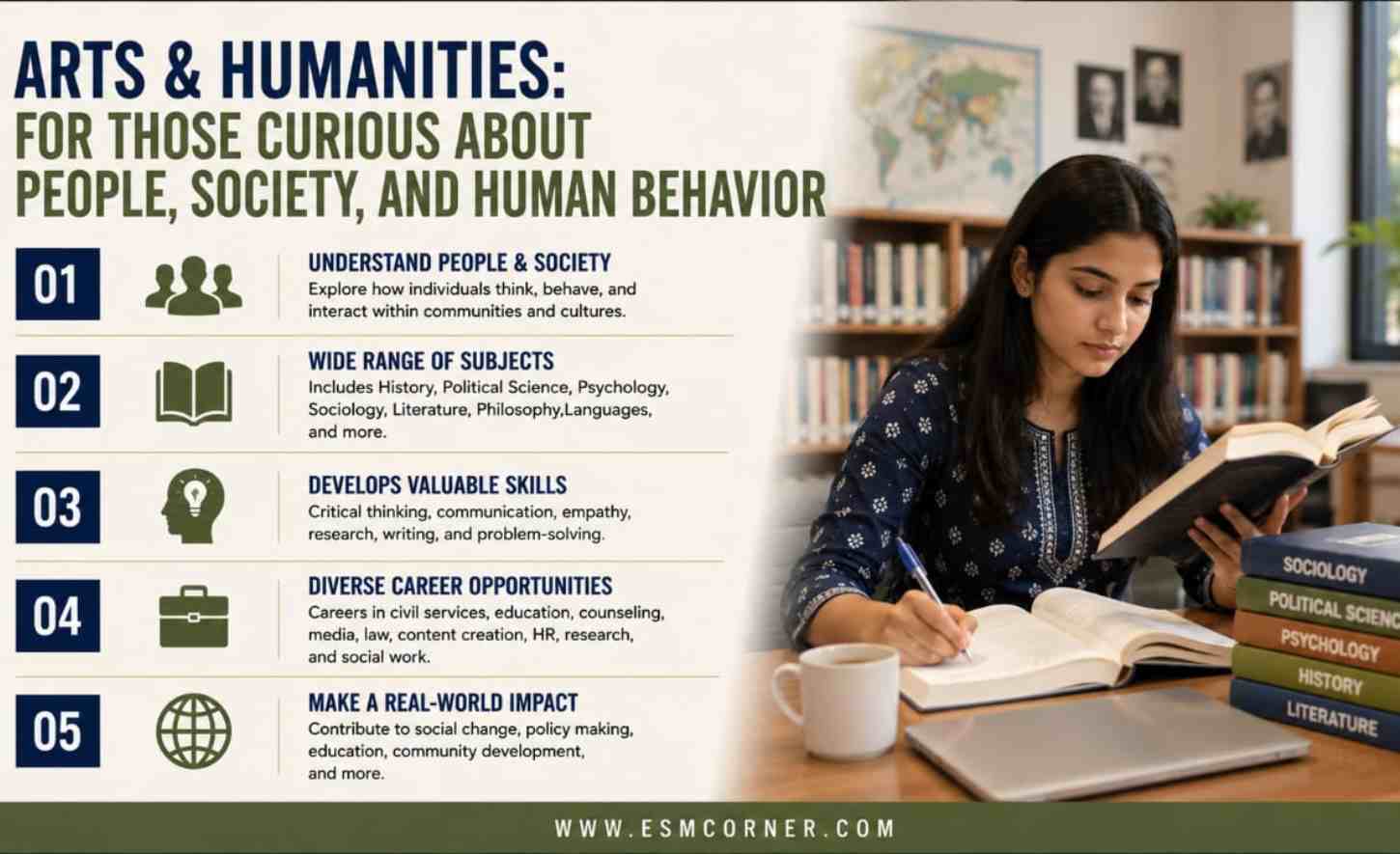
Let’s kill an old, unfair myth right now: Arts is NOT the “leftover” stream for people with lower marks. That thinking is outdated and honestly a bit insulting to how demanding this stream actually is. It’s about understanding society, human behaviour, politics, and culture — and doing it well requires serious critical thinking.
- Psychology & Sociology – Understand human behavior, decision-making, and social interactions.
- Political Science & History – Study governance, international relations, and how historical events continue to shape the present.
- Economics & Geography – Learn how economies, resources, and regions shape development and policy.
- Literature & Fine Arts – Develop creativity, communication, and a deeper appreciation of language and culture.
You’ll enjoy Arts if: you love reading, enjoy debating, ask a lot of “but why” questions, write well, and genuinely care about people and society.
Where It Can Lead You (and What You Can Earn) (most natural)
- Law (via BA-LLB) – Corporate law and litigation can offer packages that easily rival top engineering jobs.
- Civil Services (UPSC) – IAS, IPS, IFS — massive social impact and respected government careers.
- UX Design & Media – Fast-growing, well-paid fields shaping how people experience products and content daily.
Skip Arts if: you hate reading and long essays, need every question to have one clear “correct” answer, or strongly prefer pure calculation over open-ended discussion.
Quick Comparison Table
| Stream | Best Suited For | Popular Careers | Future Outlook |
|---|---|---|---|
| Science | Curious, analytical, tech-loving minds | Engineer, Doctor, Data Scientist, AI Specialist | Booming in AI, biotech, green energy |
| Commerce | Practical, numbers-and-strategy minded people | CA, Investment Banker, Corporate Lawyer, FinTech Lead | Strong growth in finance, startups, digital markets |
| Arts / Humanities | Creative thinkers, communicators, social minds | Lawyer, IAS Officer, UX Designer, Psychologist | Rising demand in policy, design, and human-centric careers |
Important: Don’t choose a stream based only on an attractive job title. Careers like Investment Banker or AI Specialist may sound exciting, but reaching them requires years of consistent effort and learning. Focus on your interests and strengths—the career is the result of the journey, not a shortcut.
So, How Do You Actually Decide?
Forget your Class 10 marks for a second — those exams just tested memory under pressure, not your future potential. Instead, ask yourself:
- What kind of problems do I enjoy solving — numerical, business-related, or people-related?
- Do I prefer clear right-and-wrong answers, or open-ended discussions and debates?
- Can I honestly picture myself doing the daily work of this stream — not just the final job title — for years?
Your honest answers here matter far more than anyone else’s opinion.
Conclusion
There’s no “best” stream. There’s just the stream that’s best for you. A genuinely passionate Arts student who works hard will build a far more successful and satisfying career than someone who takes up Science purely to please their family and loses motivation halfway through.
Choose based on what excites you, not what impresses people at family gatherings. That’s the real secret to getting this decision right.
READ ALSO: VETERANS FEEL LOST AFTER RETIREMENT — FINDING PURPOSE & NEW IDENTITY
Q1.an I change my academic stream later in college if I realize I made a mistake?
Yes, you absolutely can change paths later, though the transition is much easier for some streams than others. A Science student can comfortably switch into Commerce or Arts degrees for college, but an Arts or Commerce student cannot enter engineering or medical courses. Additionally, modern educational frameworks like the NEP are introducing much greater flexibility, allowing students to mix and match subjects across streams more freely than ever before.
Q2.My parents are completely set on Science, but I want to pursue Commerce. How do I handle this?
Avoid escalating the situation into an emotional argument. Instead, schedule a quiet time to present a well-researched career roadmap showing the specific professional courses, entrance exams, and clear earning potential available in Commerce. You can also take a professional psychometric aptitude test; having an independent career expert explain your data-driven strengths to your parents is often the most effective way to win their support.
Q3.Is it possible to pursue corporate law if I choose the Science stream in high school?
Yes, absolutely. India’s premier National Law Universities (NLUs) admit students based entirely on the CLAT entrance exam, which tests logical reasoning, reading comprehension, and general awareness rather than high school stream subjects. Students from Science, Commerce, and Arts are all fully eligible to take the CLAT exam and build highly successful careers in international corporate law or intellectual property litigation.
Q4.What are the main differences between choosing Commerce with Mathematics versus Commerce without Mathematics?
Choosing Commerce with Math opens up highly analytical, data-driven career paths like Investment Banking, Actuarial Science, Quantitative Economics, and FinTech management. Opting for Commerce without Math replaces calculus with practical electives like Entrepreneurship or Informatics Practices, shifting your focus toward essential corporate roles in Human Resources, Marketing, Corporate Law, International Trade, and Business Management.
Q5.I scored less than 70% in my Class 10 board exams. Does this mean I cannot succeed in Science?
Not necessarily, because Class 10 marks are often just a measure of short-term memorization rather than your true long-term analytical capacity. However, you must evaluate your work ethic honestly. The Science stream requires intense daily discipline, complex math problem-solving, and deep conceptual understanding. If your lower marks were caused by a genuine struggle with basic math concepts, you will likely find the heavy workload of high school Science very challenging.
Q6.What exactly is Actuarial Science, and which stream prepares me best for it?
Actuarial Science is a highly lucrative field focused on using advanced mathematics, probability models, and statistics to predict and manage financial risks for insurance companies and global banks. The absolute best path for this career is choosing the Commerce stream paired with core Mathematics, followed by passing the professional certification exams held by the Institute of Actuaries of India (IAI).
Q7.Do creative career fields like Animation, Graphic Design, and UI/UX design require an Arts stream background?
No, these creative fields welcome talented students from all three streams. While the Humanities stream provides an excellent foundation in visual history, literature, and human psychology, admission to premier design schools like NID or IIT-IDC depends entirely on your performance in creative entrance exams like UCEED or DAT. These exams test your natural spatial observation, drawing skills, and original problem-solving ability.
Q8.If my long-term goal is to clear the UPSC Civil Services exam, which stream should I choose?
While engineering and medical graduates clear the UPSC exam every year, choosing the Humanities stream gives you a major head start. Core subjects like Political Science, Indian History, Sociology, and Economics make up a huge portion of the UPSC General Studies syllabus. Studying these subjects early helps you build the deep analytical reading habits and strong essay-writing skills required to succeed in the exam
For daily defence updates, government notifications, recruitment alerts, welfare schemes, career opportunities, education news, and other important announcements, join our WhatsApp Community. Click here to join our WhatsApp Group.