
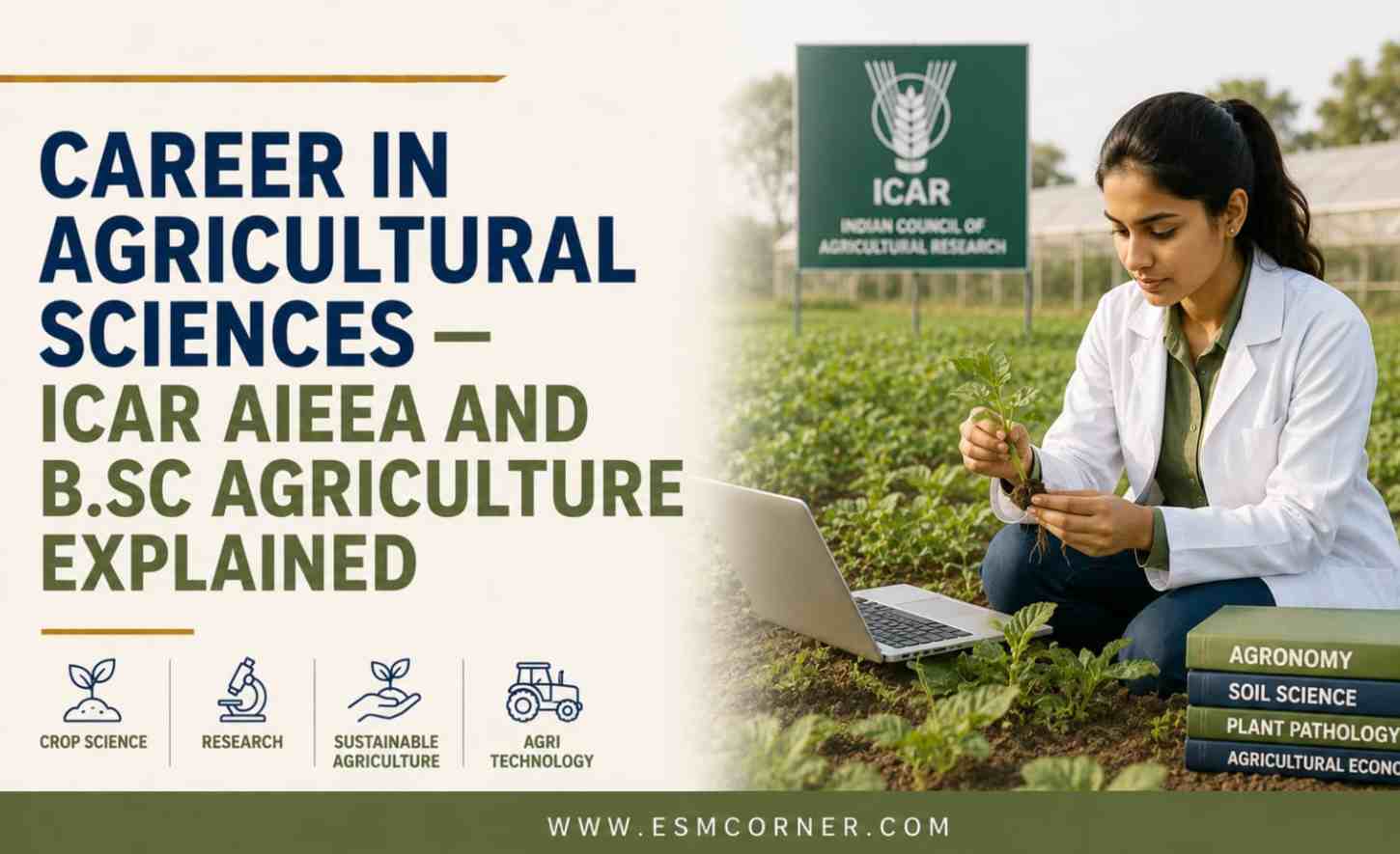
When most students hear the word “agriculture,” they immediately picture a farmer working in a muddy field under the harsh sun. Because of this deep-rooted misunderstanding, millions of bright young minds completely ignore one of the most dynamic, fast-growing, and essential sectors in the modern world.
Agriculture today is not just about traditional farming; it is a high-tech intersection of biological science, artificial intelligence, drone technology, food security, and global business. After completing Class 12 with a science background, students frequently find themselves standing at a confusing crossroad.
They hear terms like B.Sc Agriculture, ICAR AIEEA, bank officer exams, and seed research, but they lack a clear roadmap to connect these pieces together.
The reality is that as the global population grows, the demand for safe food, sustainable farming practices, and advanced agricultural technology is reaching an all-time high. This makes agricultural science a powerful, recession-proof career choice for the modern generation.
Whether you want to work in a high-tech laboratory, advise farmers on crop protection, manage global supply chains, or launch your own agritech startup, this field offers endless opportunities. This comprehensive Agriculture Career Guide breaks down the ICAR AIEEA Exam, degree structures, job prospects, and essential skills in very simple language so you and your parents can confidently decide if an Agricultural Science Career is your true calling.
What is Agricultural Science and B.Sc Agriculture?
Have you ever wondered how scientists create crops that can survive harsh droughts or how fresh fruits reach supermarket shelves without spoiling? Agricultural Science is the multidisciplinary field of biology, chemistry, economics, and technology used to understand, manage, and improve food production.
It takes the fundamental principles of science and applies them directly to real-world biological challenges. Rather than performing manual field labor, agricultural scientists use knowledge to solve complex problems related to food security, soil health, plant genetics, and crop protection.
A B.Sc Agriculture degree is a four-year professional undergraduate program designed to turn curious science students into qualified agricultural experts. Unlike general basic science degrees, this course balances classroom lectures with hands-on outdoor field learning. Students learn how plants grow, how soil absorbs nutrients, how pests attack crops, and how agricultural products are marketed globally. It provides a solid foundation in both scientific theory and practical field management, preparing graduates for diverse professional roles across public and private sectors.
What is ICAR AIEEA and Who Conducts It?
When students start searching for an Agriculture Entrance Exam, they almost always run into the term ICAR. The Indian Council of Agricultural Research (ICAR) is the apex national body responsible for coordinating, guiding, and managing agricultural education and research across the nation. To streamline admissions into prestigious agricultural universities, national-level entrance examinations are conducted annually through the All India Entrance Examination for Admission (AIEEA) framework managed by testing agencies.
These entrance exams allow eligible students from across different states to secure seats in top-tier State Agricultural Universities, Central Universities, and National Research Institutes. Appearing for these national entrance tests opens doors to quality education, modern laboratories, highly experienced faculty, and strong institutional credibility. Securing admission through a recognized entrance exam ensures that your degree is fully recognized by government departments, research organizations, and international universities for higher studies.
Who Should Choose Agriculture and What is the Eligibility?
Are you someone who naturally loves nature, enjoys practical biology, and prefers solving real-world problems over sitting at a desk all day? Choosing a Career in Agriculture Sciences requires a healthy balance of scientific curiosity and practical enthusiasm. You do not need a farming background to succeed in this field; you simply need a willingness to observe natural systems and apply scientific methods to improve them.
- Academic Stream: You must complete Class 12 in the Science stream with subjects like Physics, Chemistry, and either Biology or Mathematics.
- Minimum Marks: Most recognized universities require a minimum aggregate of 50% marks in Class 12 science subjects.
- Key Traits: A strong interest in living organisms, environmental conservation, technology integration, and outdoor practical work.
- Problem-Solving Mindset: A desire to address real challenges such as climate change, food shortages, and resource depletion.
Key Subjects Studied in B.Sc Agriculture
Many students worry that B.Sc Agriculture will be full of complex, dry theory. On the contrary, the curriculum is incredibly diverse, practical, and fascinating because it covers almost every aspect of life sciences and rural economics.
- Agronomy & Crop Production: Learning how to cultivate field crops efficiently using smart irrigation and farming techniques.
- Genetics & Plant Breeding: Understanding plant DNA to breed high-yielding, disease-resistant crop varieties.
- Soil Science & Chemistry: Analyzing soil health, nutrient levels, fertilizers, and sustainable land management.
- Entomology & Plant Pathology: Identifying beneficial and harmful insects, plant diseases, and eco-friendly crop protection methods.
- Agricultural Economics & Extension: Studying market trends, rural finance, supply chains, and teaching modern technology to farming communities.
Skills Required, Practical Training, and Fieldwork
Unlike theoretical degrees where learning is restricted to textbooks, an Agriculture Courses program emphasizes hands-on experience. During your degree, you will participate in the Rural Agricultural Work Experience (RAWE) program, spending months living in farming communities, observing real agricultural challenges, and helping design practical solutions.
To build a successful long-term career, students must focus on cultivating specific core competencies:
- Scientific Observation: The ability to spot plant diseases, soil deficiencies, or pest attacks early in the field.
- Data Analysis: Interpreting field data, weather forecasts, and soil test reports using digital tools.
- Communication Skills: Explaining complex scientific concepts in simple local language to farmers and business partners.
- Adaptability: Comfortably moving between modern high-tech research labs and outdoor field conditions.
Career Opportunities: Government, Private, and Research
One of the biggest advantages of earning a B.Sc Agriculture degree is the wide variety of career pathways open to graduates. You are never restricted to just one industry.
Government Sector Opportunities
- Agricultural Field Officer (AFO): Specialist officers in public sector banks managing rural credit, loans, and agricultural investments.
- State Agriculture Officers: Working in state departments to implement government welfare schemes, seed testing, and quality control.
- Food Safety Officers: Inspecting food processing plants and distribution centers to maintain national health standards.
Private Sector Opportunities
- Agrochemical & Seed Companies: Working in product development, quality testing, and field marketing for leading multinational firms.
- Agritech Startups: Utilizing modern satellite mapping, IoT devices, and artificial intelligence to offer precision farming services.
- Food Processing & Logistics: Managing post-harvest supply chains, cold storage facilities, and food packaging companies.
Research and Higher Studies
- Master’s & Doctorate Studies: Pursuing M.Sc and Ph.D. specializations in biotechnology, seed technology, or agronomy to become a university professor or research scientist.
- Global Opportunities: Higher research programs abroad focusing on climate-resilient farming, crop genetics, and international food security.
Agribusiness, Entrepreneurship, and Allied Careers
For students who dream of running their own business rather than working for someone else, Agriculture offers fantastic business opportunities. Agribusiness and Entrepreneurship are booming as modern consumers demand organic food, high-quality seeds, and advanced farming tools. Graduates can start commercial nurseries, tissue culture labs, organic fertilizer production plants, or smart greenhouse farms.
Furthermore, Allied Agriculture Careers in horticulture, forestry, dairy science, poultry management, and fisheries offer specialized career paths for students passionate about specific sub-sectors of nature and animal science.
Quick Career Area Comparison
| Career Area | Best For | Future Scope | Key Point |
| Agricultural Research | Curious minds who love labs and experiments | Very High | Focuses on inventing climate-resilient seeds and technologies |
| Agribusiness Management | Leaders who enjoy business, sales, and strategy | High | Connects farm products directly to commercial markets |
| Government Services | Students seeking job stability and public service | Stable | Involves managing agricultural policies and rural bank loans |
| Agritech & Precision Farming | Tech enthusiasts who love software, drones, and AI | Extremely High | Uses modern technology to make farming smarter and automated |
| Agricultural Extension | Great communicators who enjoy working with people | High | Bridges the gap between research labs and rural communities |
Developing Scientific Thinking and Smart Guidance
Succeeding in agricultural science requires developing a keen scientific mindset early in your academic journey. Start noticing the natural world around you, asking questions about plant growth, soil types, and food processing. Focus heavily on practical learning, attend every lab session, interact enthusiastically with farmers during fieldwork, and stay updated on how technology is changing global food production.
Common Myths Students Believe
- Myth 1: “Agriculture is only for farmers.” Reality: It is an advanced biological and technological science practiced by researchers, corporate managers, and technicians.
- Myth 2: “There are no well-paying jobs in Agriculture.” Reality: Agribusiness MNCs, banks, and agritech companies offer highly competitive career packages.
- Myth 3: “It is an outdated field.” Reality: Modern agriculture uses drones, DNA sequencing, satellite imaging, and hydroponics.
Questions to Ask Before Choosing This Career
- Do I genuinely enjoy biological science, nature, and practical field learning?
- Am I excited about using science and technology to solve global food challenges?
- Am I comfortable balancing indoor laboratory analysis with outdoor fieldwork?
Conclusion
A career in Agricultural Sciences is far more than an academic choice; it is a powerful opportunity to be part of the solution to global food security, climate change, and economic development. By combining natural biology with modern technology, this field ensures that you build a future-proof, rewarding career that directly benefits society. Do not let old misconceptions hold you back from exploring this thriving sector.
If you possess a genuine passion for science, an appreciation for nature, and a desire to solve real-world problems, taking the B.Sc Agriculture path through recognized national entrance exams like ICAR AIEEA can be the best decision of your student life. Evaluate your personal strengths, ask the right questions, and step confidently into a bright and sustainable future.
READ ALSO: SECOND CAREER: OVERCOMING SELF-DOUBT & BUILDING CONFIDENCE
Frequently Asked Questions
1. What is the scope after B.Sc Agriculture?
B.Sc Agriculture graduates have exceptional career scope across government departments, public banks, seed MNCs, food processing industries, agritech startups, and research institutions. You can choose stable government jobs, fast-paced corporate careers, or higher research programs based on your personal interest.
2. Is ICAR AIEEA mandatory for B.Sc Agriculture admission?
Appearing for national or state-level entrance exams like ICAR AIEEA is highly recommended. It allows you to secure admission in accredited, high-quality central and state agricultural universities, ensuring that your professional degree is fully recognized for government jobs and higher studies.
3. Can PCB and PCM students both join B.Sc Agriculture?
Yes, students with either Physics, Chemistry, Biology (PCB) or Physics, Chemistry, Mathematics (PCM) in Class 12 are eligible to apply for B.Sc Agriculture entrance examinations, provided they meet the minimum percentage requirement set by universities.
4. Is B.Sc Agriculture harder than general B.Sc degrees?
B.Sc Agriculture is a comprehensive 4-year professional degree covering diverse subjects like agronomy, genetics, soil chemistry, and economics. While it requires dedication and field practicals, simple scientific understanding and regular study make it very manageable and engaging.
5. What are the best government job options after B.Sc Agriculture?
Key government job options include Agricultural Field Officer (AFO) in nationalized banks, State Agriculture Officer, Food Safety Officer, and technical posts in organizations like the Food Corporation of India (FCI) and agricultural research labs.
6. What is the role of technology in modern Agriculture?
Technology plays a massive role in modern agriculture through satellite crop monitoring, drone spraying, automated irrigation, AI-driven soil analysis, hydroponics, and genetic crop modification, making farming far more efficient, precise, and sustainable than ever before.
7. Is B.Sc Agriculture a good choice for girls?
Absolutely. B.Sc Agriculture offers equal, flourishing career opportunities for everyone. Many female graduates excel as research scientists, university professors, agribusiness managers, laboratory technicians, seed quality analysts, and bank specialist officers across the nation.
8. Can I start my own business after completing B.Sc Agriculture?
Yes, B.Sc Agriculture equips you with practical technical knowledge and market understanding, allowing you to launch successful ventures in commercial nursery management, organic farming, seed production, tissue culture, agricultural consulting, or agritech solutions.
For daily defence updates, government notifications, recruitment alerts, welfare schemes, career opportunities, education news, and other important announcements, join our WhatsApp Community. Click here to join our WhatsApp Group.