
If You have studied Physics, Chemistry, and Maths in Class 12 and want to serve in the Indian Army as an officer. But you do not want to sit for a big written exam like NDA or CDS. Good news. There is a specific entry for you.
It is called the Technical Entry Scheme — TES.
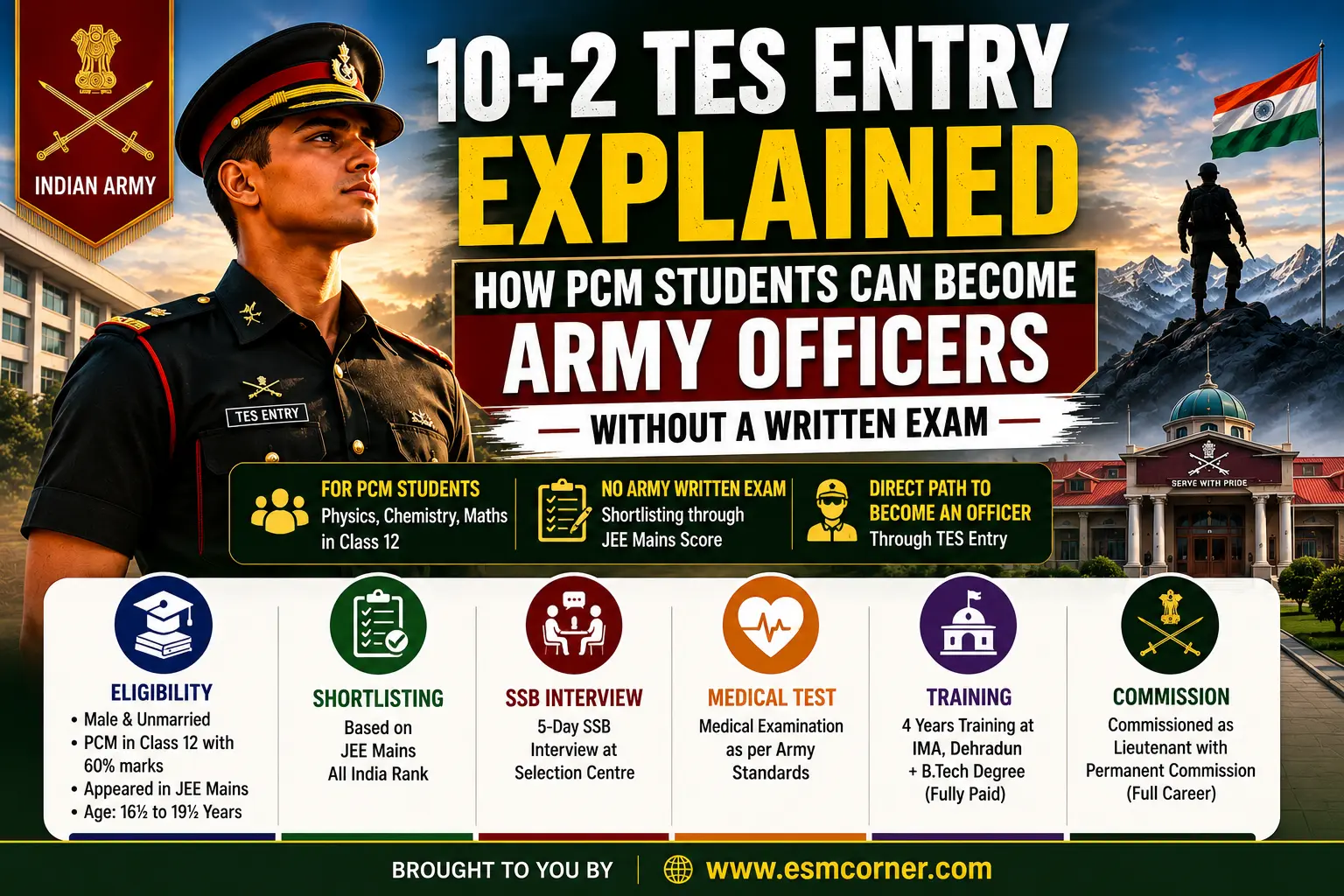
Through TES, the Indian Army selects PCM students directly. You do not give any Army written exam. Instead, your JEE Mains score is used to shortlist you. After that, you attend a 5-day SSB interview. If you clear that and the medical test, you join the Army for a 4-year training programme. You get a B.Tech engineering degree during training — The Government covers the entire cost of your engineering degree. When training ends, you are commissioned as a Lieutenant in the Indian Army with a Permanent Commission.
This means it is not a 2-year or 5-year job. It is a full career in the Indian Army.
This article is based on the official TES notification published at joinindianarmy.nic.in. Every fact here comes directly from that document. Nothing has been added from outside.
1. What Exactly Is 10+2 TES ENTRY ?
TES stands for Technical Entry Scheme.
It is a programme run by the Indian Army. Through this programme, male students who have studied PCM in Class 12 and appeared in JEE Mains can join the Army as officers.
Let us understand this simply:
- No written examination for this entry
- Your JEE Mains score decides if you get an SSB call
- After SSB and medical, you join a 4-year training programme
- During training, you study engineering and do military training together
- At the end, you get a B.Tech degree and become a Lieutenant in the Indian Army
- The Government pays for your entire training — food, books, accommodation, everything
- This is a Permanent Commission — meaning it is a full career, not a short contract
2. Who Can Apply for TES?
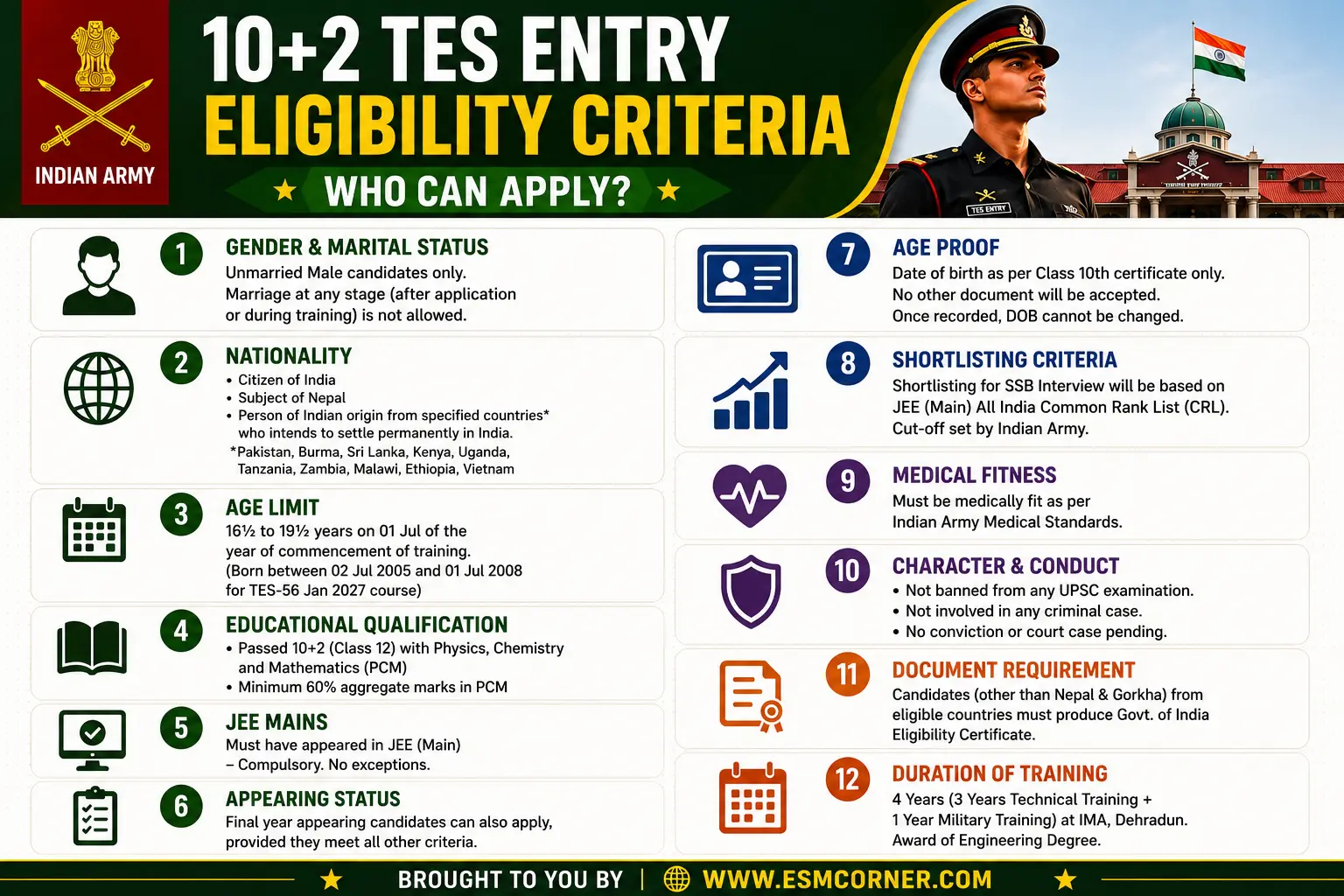
You Must Be Male and Unmarried
TES is currently open to unmarried male candidates only. Female candidates are not qualified for this entry.
You must stay unmarried throughout your training. If you get married after applying — even if you have cleared SSB — you will not be allowed to join. If you get married during training, you will be removed. You will also have to pay back all the money the Government spent on your training.
Nationality
You must be one of the following:
- A citizen of India
- A subject of Nepal
- A person of Indian origin who migrated from certain countries like Pakistan, Burma, Sri Lanka, Kenya, Uganda, Tanzania, Zambia, Malawi, Ethiopia, or Vietnam — and who wants to settle permanently in India
Nepali Gorkha candidates do not need any extra certificate. Others from the above list need a Government of India eligibility certificate.
Age
Your age must be between 16½ years and 19½ years on the first day of the month in which the course begins.
Your age is counted only from your Class 10 school certificate. No other document is accepted. Once your date of birth is recorded, it cannot be changed.
Class 12 Marks
- You must have passed Class 12 with Physics, Chemistry, & Mathematics
- You need a minimum of 60% aggregate marks in PCM
- The percentage is calculated based only on Class 12 marks — not Class 11
JEE Mains
- You must have attended in JEE Mains exam
- This is compulsory. There are no exceptions.
- If you have not appeared in JEE Mains, you cannot apply — even if your PCM percentage is very high
Other Conditions
- You must not have been banned from any UPSC examination
- You must not have been arrested, convicted, or involved in any court case
3. The Role of JEE Mains in TES — Parents and Students Must Read This
Many families think TES has no written exam at all. That is not fully correct. Let us explain clearly.
The Indian Army does not conduct its own written exam for TES. But JEE Mains is obligatory.
Here is how it works:
The Army uses your JEE Mains All India Common Rank List (CRL) to shortlist candidates for the SSB interview. The Army sets its own cut-off from this list. Only students above that cut-off get an SSB call.
So if you have a good JEE Mains rank, your chances of getting an SSB call are much better.
This means two things for students:
First — appear in JEE Mains seriously. A good rank opens the door to TES SSB.
Second — even if your JEE Mains rank is average, do not give up. The Army’s cut-off is separate from JEE counselling cut-offs. Many students with moderate ranks have received TES SSB calls.
After shortlisting, the Army informs you about your SSB centre and date by email. The SSB centre assigned to you is final and cannot be changed.
4. Selection Process — How It Works Step by Step
The selection has five clear stages:
Stage 1 — Apply Online
Go to joinindianarmy.nic.in and fill the online application form. Submit only one application. Multiple applications cancel your candidature. You can correct mistakes before the closing date. After closing, no changes are allowed.
Documents you need at SSB:
- Class 10 certificate showing date of birth
- Class 12 certificate and marksheet
- JEE Mains scorecard showing CRL
- Original ID proof
- 20 self-attested passport size photographs
Note: DigiLocker certificates are not accepted. Carry original documents.
Stage 2 — Shortlisting Based on JEE Mains CRL
The Army shortlists candidates from the JEE Mains CRL. The cut-off is set by the Army without giving any reason. Shortlisted candidates are informed by email and SMS on registered email address and mobile.
Stage 3 — SSB Interview (5 Days)
This is the most important stage. It is a 5-day residential interview at one of four centres: Prayagraj (Uttar Pradesh), Bhopal (Madhya Pradesh), Bengaluru (Karnataka), or Jalandhar (Punjab)
The SSB tests your personality, leadership, and thinking ability. It does not test your Class 12 or JEE knowledge.
Stage 4 — Medical Examination
Candidates recommended by SSB go for a medical examination at the nearest Military Hospital. Medical board proceedings are confidential. Visit joinindianarmy.nic.in for detailed medical standards.
Stage 5 — Merit List and Joining Letter
The final merit list is prepared based only on SSB marks. Nothing else counts — not your JEE rank, not your PCM percentage, not your NCC background. Only SSB marks decide your final position in the merit list. Joining letters are issued based on this merit list and available vacancies.
If you do not report within 7 days of the joining date, your candidature is cancelled.
5. What Happens During Training — The 4-Year Programme
After joining, you train for 4 years at Army training institutions. The training has two phases:
Phase 1 — 3 Years at a Cadet Training Wing (CTW)
You will be posted to one of these three centres:
| Training Centre | Location | Engineering Stream | Corps |
| CTW, CME | Pune | Civil & Mechanical Engineering | Corps of Engineers |
| CTW, MCTE | Mhow | Telecom & IT Engineering (Dual Degree) | Corps of Signals |
| CTW, MCEME | Secunderabad | Electronics & Mechanical Engineering | Corps of EME |
During these 3 years, you do both military training and engineering studies together. You do not receive a monthly stipend during this phase.
Phase 2 — 1 Year at Indian Military Academy Dehradun
In the final year, you train at the Indian Military Academy (IMA), Dehradun. During this year, you receive a monthly stipend of ₹56,100.
After completing the full 4 years, you are awarded an Engineering degree and commissioned as Lieutenant in the Indian Army.
The Government pays for everything — your training costs, food, accommodation, and books. However, if you leave on your own for personal reasons, you must repay the training cost. As per the notification, the cost of training is approximately ₹13,940 per week (rate as of 2021, updated from time to time).
Digilocker Note: Maximum two academic backlogs are allowed during the 4-year training as per JNU ordinance. Any further failure leads to removal from training.
6. Which Corps Will You Join?
Your corps depends on which CTW you train at:
- CME Pune → Corps of Engineers
- MCTE Mhow → Corps of Signals
- MCEME Secunderabad → Corps of Electronics and Mechanical Engineers (EME)
After SSB recommendation, you fill three CTW preferences. But the final allotment is decided by the Indian Army. You cannot object to the allotment. It is done in the interest of the organisation.
7. Salary and Benefits After Commissioning
On commissioning as Lieutenant, you receive:
| Component | Amount |
| Basic Pay | ₹56,100 – ₹1,77,500 per month (Level 10) |
| Military Service Pay (MSP) | ₹15,500 per month (Fixed) |
| CTC on Commissioning | Approximately ₹17–18 lakh per year |
The CTC figure of ₹17–18 lakh excludes free medical cover and one annual home town travel — as stated in the official notification.
Other benefits include:
- Free ration in peace and field postings
- Transport Allowance (₹7,200 + DA in major cities; ₹3,600 + DA in other places at Level 9 and above)
- Dress Allowance: ₹20,000 per year
- Children Education Allowance: ₹2,250 per month per child (first two children, Class 1 to 12)
- Officers with children studying in hostels receive a subsidy of ₹6,750 every month per child (for first two children)
- Field area allowances depending on posting (ranging from ₹3,400 to ₹25,000 per month based on risk and hardship matrix)
- Free medical care for self and family under ECHS after service
Army Group Insurance:
- In the first three years — when cadets do not yet receive a monthly stipend — the Army Group Insurance Fund provides a life cover of ₹30 lakh. To activate this, the cadet pays a one-time premium of ₹14,000 which is not refunded under any circumstance.
- After stipend begins (4th year onwards): Insurance cover of ₹1.25 crore — subscription of ₹12,500 per month
8. Career Growth — Promotion After TES Commission
TES gives you a Permanent Commission. Your promotion path is:
| Rank | How You Get There |
| Lieutenant | On commissioning after 4-year training |
| Captain | After 2 years of reckonable commission service |
| Major | After 6 years of reckonable commission service |
| Lieutenant Colonel | After 13 years of reckonable commission service |
| Colonel (Time Scale) | After 26 years of reckonable commission service |
| Colonel | By selection |
| Brigadier | By selection |
| Major General and above | By selection |
Your pay also increases at each rank. For example, a Major earns at Level 11 (₹69,400–₹2,07,200 per month) and a Lieutenant Colonel earns at Level 12A (₹1,21,200–₹2,12,400 per month).
TES officers also get opportunities for staff courses at the Defence Services Staff College (DSSC) Wellington, foreign postings, and UN peacekeeping missions during their career.
9. TES vs Other Entries — Simple Comparison
| Feature | TES | NDA | CDS |
| Entry After | Class 12 PCM | Class 12 | Graduation |
| Army Written Exam | No | Yes (UPSC) | Yes (UPSC) |
| JEE Mains Needed | Yes | No | No |
| Training Duration | 4 Years | 3 + 1 Years | 1.5 Years |
| B.Tech Degree | Yes | Yes (NDA) | No |
| Commission | Permanent | Permanent | Permanent/SSC |
| Open to Women | No | Limited | Yes |
10. Physical Standards You Must Meet Before Joining
When you receive a joining letter, you must be ready with these minimum physical standards on arrival:
| Activity | Minimum Standard |
| 2.4 km Run | 10 minutes 30 seconds |
| Push Ups | 40 |
| Pull Ups | 6 |
| Sit Ups | 30 |
| Squats | 2 sets of 30 repetitions |
| Lunges | 2 sets of 10 repetitions |
| Swimming | Must know basic swimming fundamentals |
Start building physical fitness from today. Do not wait for the joining letter.
Conclusion
TES is one of the best opportunities for PCM students in India who want to become Army officers. You get a Permanent Commission, a B.Tech degree, a full career, and all training paid by the Government.
The path is clear. Score well in Class 12 PCM. Appear seriously in JEE Mains. Prepare for SSB from today. Stay physically fit. And apply during the official notification window at joinindianarmy.nic.in.
The Indian Army is looking for its next generation of technical officers. If you have studied PCM and carry the desire to serve the nation — TES could be your door.
📌 Current Notification Details — TES-56
Always verify from official website before applying — details change every cycle
| Detail | Information |
| Course | TES-56 — January 2027 |
| Vacancies | 90 (provisional — subject to change) |
| Application Open | 13 May 2026 at 12:00 hrs |
| Application Close | 12 June 2026 at 12:00 hrs |
| JEE Mains Required | JEE Mains 2026 — compulsory |
| PCM Minimum | 60% aggregate in Class 12 |
| Age (as on 01 Jan 2027) | Born between 01 Jul 2007 and 01 Jul 2010 (both dates inclusive) |
| SSB Likely Period | August to September 2026 |
| Shortlisting Cut-off Date | Tentatively first week of July 2026 |
| Apply At | www.joinindianarmy.nic.in |
| Application Fee | Nil |
📋 Official Source
All data in this article is sourced from the official Indian Army TES-56 Notification published at www.joinindianarmy.nic.in
The notification is the only official document for this course. Always read the full notification before applying. Data changes every cycle.
👉 Explore more guides, preparation strategies, eligibility details, and officer entry pathways in our Defence Career Guidance section.
Q1. What is TES and how is it different from NDA?
A1. TES is the Technical Entry Scheme for PCM students who want to join the Indian Army as officers. In NDA, you give a UPSC written exam. In TES, there is no Army written exam — instead your JEE Mains rank is used to shortlist you for SSB. Both give Permanent Commission, but TES is only for the Army while NDA gives access to Army, Navy, and Air Force.
Q2. Is JEE Mains compulsory for TES? What if I did not appear?
A2. Yes. JEE Mains is completely compulsory for TES. . If you have not appeared in JEE Mains, you cannot apply — even if your PCM percentage is very high. The Army shortlists candidates for SSB based on the JEE Mains All India Common Rank List. There is no way around this condition.
Q3. What is the minimum PCM percentage required for TES?
A3. You need a minimum of 60% aggregate marks in Physics, Chemistry, and Mathematics in Class 12. Your PCM percentage is entered up to two decimal places in the application. Any false entry is rejected outright at any stage of selection.
Q4. How many years is TES training and where does it happen?
A4. TES training is 4 years total — 3 years at one of the Cadet Training Wings (CTW at CME Pune, MCTE Mhow, or MCEME Secunderabad) and 1 year at the Indian Military Academy (IMA), Dehradun. Both military training and engineering studies happen together. You get an Engineering degree after successfully completing all 4 years.
Q5. What engineering degree do TES officers get?
A5.Your engineering specialisation is linked to the Cadet Training Wing you train at. CTW CME Pune gives Civil and Mechanical Engineering under Corps of Engineers. CTW MCTE Mhow gives Telecom and IT Engineering as a dual degree under Corps of Signals. CTW MCEME Secunderabad gives Electronics and Mechanical Engineering under Corps of EME. The Army decides the final CTW allotment — you only fill preferences.
Q6. What is the stipend during TES training?
A6.You do not receive a stipend during the first 3 years of training at the CTW. The monthly stipend of ₹56,100 starts only in the 4th year when you train at IMA Dehradun. After commissioning as Lieutenant, you receive full pay at Level 10 of the pay matrix along with MSP of ₹15,500 per month. The total CTC at commissioning is approximately ₹17–18 lakh per annum as stated in the official notification.
Q7. How is the final merit list made for TES?
A7.The final merit list is based only on the marks you score in the SSB interview. Nothing else is counted — not your JEE rank, not your PCM percentage, not your NCC certificate, not your school results. The official notification specifically states that higher educational qualifications, previous performances, and NCC background have no role in finalising the merit list.
Q8. Where are TES SSB interviews held?
A8. SSB interviews for TES are held at four centres — Prayagraj in Uttar Pradesh, Bhopal in Madhya Pradesh, Bengaluru in Karnataka, and Jalandhar in Punjab. The Army decides which centre you go to. Whichever SSB centre the Army assigns to you — that is where you go. No request for a change is entertained or even replied to, as per the official notification.
Q9. Is TES open for girl students or female candidates?
A9. No. As per the official TES notification, TES is currently open to unmarried male candidates only. Female candidates who want to join the Indian Army after Class 12 can look at other entries such as the Military Nursing Service (MNS). After graduation, women can apply for SSC Non-Tech Women Entry, JAG Entry, or CDS OTA entry.
Q10. What happens if I get a TES joining letter but also get an NDA SSB call?
A 10. The official notification covers this situation clearly. If you are recommended in TES SSB before your NDA SSB, you must appear for TES medical first. If declared fit in TES, then NDA medical for Air Force and Navy begins separately. For NDA Army, you do not need to repeat the medical. If you are declared unfit in NDA medical, you are considered unfit for TES as well. Both entries are linked for medical purposes.
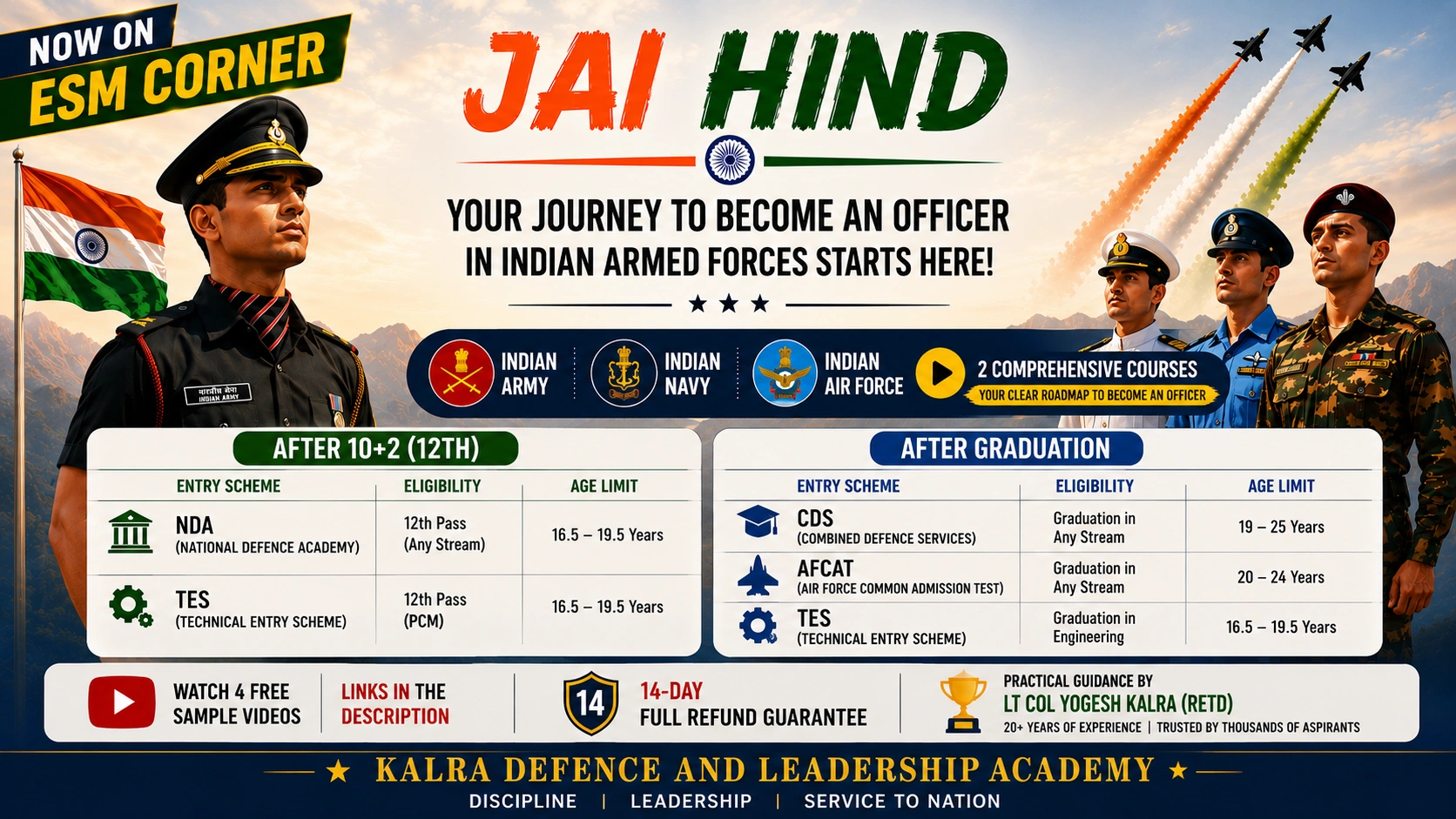
Whether you are preparing for NDA, CDS, AFCAT, TES, SSB Interview, or other officer entries after 12th and graduation, proper guidance can save years of confusion and wrong preparation.
Lt Col Yogesh Kalra has designed practical online guidance courses covering:
• Officer entry pathways
• SSB Interview understanding
• Preparation strategy
• Common mistakes made by aspirants
• Realistic guidance for defence careers
You can first watch 4 FREE sample videos from the links below. If the course does not meet your expectations, a 14-day full refund policy is also available.
👉 Course for Defence Aspirants: https://tinyurl.com/43m67sda
👉 Course for Serving Personnel & Internal Entries: https://tinyurl.com/4h4td9kf