

Military life naturally builds a deep sense of belonging, daily structure, and lifelong camaraderie that few civilian professions can ever replicate. FromMilitary life gives you something civilian life rarely can — a real sense of belonging, a fixed daily rhythm, and friendships built through actual shared hardship. From sweating it out together in training to trusting each other with your life during deployment, your unit becomes more than colleagues — they become family. So when you finally step out of uniform, that sudden change can hit harder than you’d expect. Many veterans find themselves surrounded by people, yet feeling completely disconnected inside.
When the noise of barrack life, physical training, and shared missions suddenly go quiet, that silence can feel deafening. And here’s something important to understand — feeling lonely after service isn’t weakness. It’s not a character flaw. It’s simply what happens when your entire social world and sense of purpose disappear overnight. It’s a completely human reaction, not a personal failure.
The good news? With a little patience and the right approach, you can absolutely rebuild a life that feels just as connected and meaningful — just in a different shape. This guide walks you through exactly how.
Understanding Isolation: Why Loneliness Happens After Defence Service
Ever wonder why civilian life can feel so oddly distant, even with family and old friends around you? The answer is simple — military life and civilian life run on completely different systems. In service, your identity, your circle, and your purpose were all clearly defined by rank, structure, and mission. Civilian life, on the other hand, is far more individual and unstructured — nobody’s handing you a daily plan anymore.
Understanding the real difference between being alone and feeling lonely is the first step toward settling into this new chapter.
Separating Alone Time from Emotional Loneliness
Here’s something worth remembering — being alone and feeling lonely are not the same thing at all.
- Being alone is just physical solitude. It can actually feel peaceful, even necessary sometimes, for reflection or rest.
- Feeling lonely is an emotional state — feeling disconnected, unheard, or misunderstood by the people around you.
You could be sitting in a room full of colleagues and still feel completely isolated, simply because they haven’t lived what you’ve lived. Realising this stops you from blaming yourself unnecessarily, and instead helps you focus on building a few genuine connections rather than just filling your day with small talk.
The Impact of Losing Routine and Military Identity
For years, someone else planned your entire day — your training, your duties, your schedule. The moment that structure disappears, it’s completely normal to feel a bit lost. Even small everyday decisions can suddenly feel oddly meaningless without that familiar framework around you.
Rebuilding a solid daily routine on your own brings that sense of predictability back. It reduces mental fatigue and — almost naturally — opens up chances to meet people and get involved in your local community again.
Reconnecting with Purpose and Your Community
When loneliness creeps in, the natural instinct is to wait quietly for someone else to reach out first. But you already have the exact skill needed to break that pattern — initiative. The same initiative that got missions done in service can absolutely be applied to rebuilding your social life too.
And don’t worry — reconnecting with people doesn’t mean leaving your military roots behind. It simply means widening your circle to include new perspectives and shared civilian interests too.
A few practical ways to start:
- Join veteran support groups — talking to people who’ve walked a similar path means you don’t have to explain everything from scratch; they just get it
- Volunteer in your community — your leadership and problem-solving skills are incredibly valuable outside service too, whether it’s disaster response, mentoring youth, or local community work
- Pick up a new hobby — woodworking, cycling, gardening, or joining a local sports club naturally puts you around people with shared interests, and friendships grow from there
- Keep learning something new — a short course or skill workshop keeps your mind active and puts you in touch with new, growth-focused people
Practical Action Matrix for Veteran Well-Being
Use this simple table to turn common struggles into small, doable daily habits:
| Situation | Practical Action | Daily Habit | Benefit |
|---|---|---|---|
| Feeling disconnected from civilians | Join a local sports or hobby club | One non-military group activity weekly | Builds genuine new friendships |
| Missing your old routine and discipline | Write out a structured daily plan | List your top 3 priorities each morning | Brings back purpose and momentum |
| Tension in family relationships | Practice listening without judging | 30 minutes of undivided family time | Rebuilds trust and closeness |
| Low motivation to stay fit | Set a clear fitness goal | 30 minutes of exercise daily | Lifts mood and mental strength |
| Feeling like life lacks purpose | Mentor or volunteer locally | 2 hours of community service weekly | Turns leadership into real impact |
Small, consistent habits like these add up over time — slowly shifting your civilian life from something you’re just “getting through” to something you’re actively building with purpose.
Cultivating Emotional Resilience and Daily Structure
Staying mentally strong after service takes a bit of intentional effort — structured routines, honest communication, and a framework that supports both your body and mind, since the forced discipline of service life is no longer doing that for you.
Maintaining Discipline without Military Structure
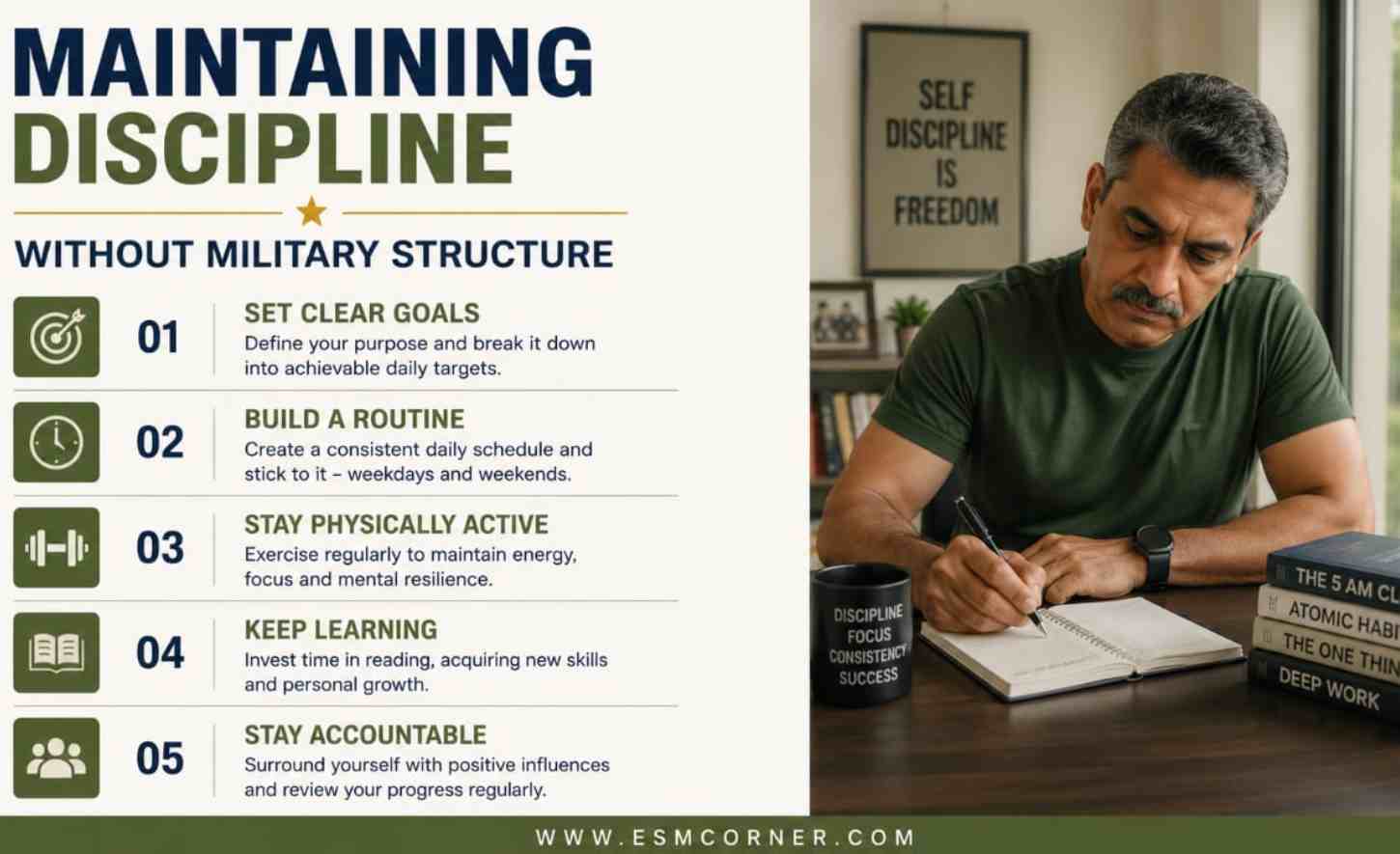
Just because you’ve taken off the uniform doesn’t mean discipline has to go with it — it just needs a new direction. A steady sleep schedule, regular exercise, and balanced meals build a strong physical foundation for handling stress well. Staying physically active genuinely lowers stress hormones and keeps your thinking clear. On top of that, keep your mind active too — reading, learning new tech, or simply having good conversations keeps your confidence sharp as you navigate this new civilian world.
Nurturing Family Relationships and Open Communication
Coming home full-time is a big adjustment — for you, and for your family too. While you were away, they built their own routines and ways of managing things. So try not to run your household like an operations unit. Instead, listen — really listen — to what they’ve been going through, and spend genuine, quality time together. These close bonds are one of the strongest defences against loneliness you’ll ever have.
When to Seek Professional Support: Feeling a bit disconnected during such a huge life change is completely normal. But if you’re experiencing constant hopelessness, heavy anxiety, or sadness that just won’t lift, please don’t ignore it. Reaching out to a mental health professional at that point isn’t a weakness — it’s a smart, proactive move to protect your long-term well-being.
Conclusion
Stepping out of uniform closes one proud chapter of your life, but it opens up an entirely new one, still unwritten. The exact camaraderie and structure of service life might not come back in the same form — but the values that built you — discipline, resilience, integrity, leadership — those are yours for life.
Beating loneliness simply means pointing those same strengths toward your civilian life now — getting involved in your community, building new friendships, and genuinely taking care of your physical and emotional health. And remember, reaching out for connection or support isn’t a weakness — it’s tactical strength, plain and simple. Stay connected, stay active, keep nurturing your relationships. Your time in service may be over, but your ability to lead a purposeful, fulfilling life is only just getting started.
Also Read: 10 Simple Habits for ESM to Stay Fit & Happy
FAQ 1: Why do I feel so lonely even when surrounded by family?
Feeling lonely around family often happens because civilians lack your unique military context. Shared living spaces do not automatically guarantee emotional connection; building depth requires open, non-military communication regarding your feelings, daily experiences, and transition challenges.
FAQ 2: How can I explain my military experiences to civilian friends?
Focus on shared human emotions rather than operational details. Explain feelings of teamwork, stress, relief, and camaraderie in simple terms, allowing civilians to relate to your core human experiences without feeling alienated by specialized military jargon.
FAQ 3: What is the fastest way to regain purpose after military retirement?
Regaining purpose after defence service requires redirecting your skills toward community involvement, volunteering, mentoring, or pursuing a second career. Setting clear, achievable goals creates immediate momentum and rebuilds a rewarding sense of personal accomplishment.
FAQ 4: How do I handle the loss of my military daily routine?
Design your own daily schedule every evening. Include structured times for physical fitness, personal hobbies, family interaction, and skill development. Self-imposed discipline prevents aimlessness and restores order, predictability, and control to your civilian life.
FAQ 5: Are veteran support groups really helpful for loneliness?
Yes, veteran support groups offer a safe environment with peers who understand your background. These groups reduce the burden of self-explanation, provide practical transition advice, and foster authentic friendships grounded in mutual respect and shared military heritage.
FAQ 6: How can I build confidence in civilian social settings?
Build confidence by focusing on active listening and genuine curiosity about others. Recognize that your military leadership, adaptability, and problem-solving skills are valuable assets, and approach civilian interactions as opportunities for continuous personal growth.
FAQ 7: How does physical fitness impact veteran well-being after service?
Regular physical activity releases endorphins, lowers stress levels, and maintains mental sharpness. Group fitness classes or sports clubs also serve a dual purpose by providing healthy social interactions alongside physical conditioning and discipline.
FAQ 8: When should a veteran consult a mental health professional?
You should seek a qualified mental health professional if loneliness persists for months, causes severe emotional distress, disrupts sleep, or prevents daily functioning. Professional support offers practical, confidential tools to process transition stress effectively.
For daily defence updates, government notifications, recruitment alerts, welfare schemes, career opportunities, education news, and other important announcements, join our WhatsApp Community. Click here to join our WhatsApp Group.