
The Services Selection Board (SSB) interview is one of the most comprehensive selection processes for SSB Day 1 Screening: The Real Story Nobody Tells You
the excitement after receiving your SSB call letter usually lasts only a couple of days. Soon after, anxiety starts to take over. The thought that comes to almost every candidate is, “What if I get screened out on the very first day?” In fact, many aspirants have this exact worry at 2 AM before their interview.
The good part is that Day 1 screening is not a complicated mystery or a process created only to eliminate candidates. It is a structured and logical evaluation system. Once you understand how the screening process works, much of the fear begins to fade. So, let’s go through it step by step in simple words — without unnecessary jargon or lectures, just a clear explanation of what actually happens and how you can deal with it.
Why Does Screening Even Exist?
Look at the situation from the Army’s perspective for a moment. When 500–600 candidates report on the same day, it is not practical to put every individual through the complete 5-day selection process — including psychological tests, GTO tasks, personal interviews, and other assessments. Doing so would require an enormous amount of time and resources.
Therefore, they need a fast and effective method to identify candidates who show basic reasoning skills and the potential to become officers, while filtering out those who may not meet the initial requirements — all within a few hours. That is the purpose of Day 1 screening. It is not a personal judgment against anyone; it is simply a structured process based on numbers, efficiency, and practical requirements.
What Actually Happens on Day 1 — Step by Step
- Reporting & Document Verification — You arrive at the Selection Centre, where your call letter, identity proof, certificates, and required forms are checked and verified. It may seem like a routine step, but it is important. Keep all your documents organized in a single folder so you don’t waste time looking for papers like your Aadhaar card while others are waiting.
- Chest Number & Briefing — You get a chest number (this becomes your identity for the next 5 days, forget your name for a while) and a briefing about the day’s schedule.
- OIR Test — This is basically a reasoning test. Verbal and non-verbal questions, strict time limit. Think of it like an aptitude test you’d give for any exam, just faster paced.
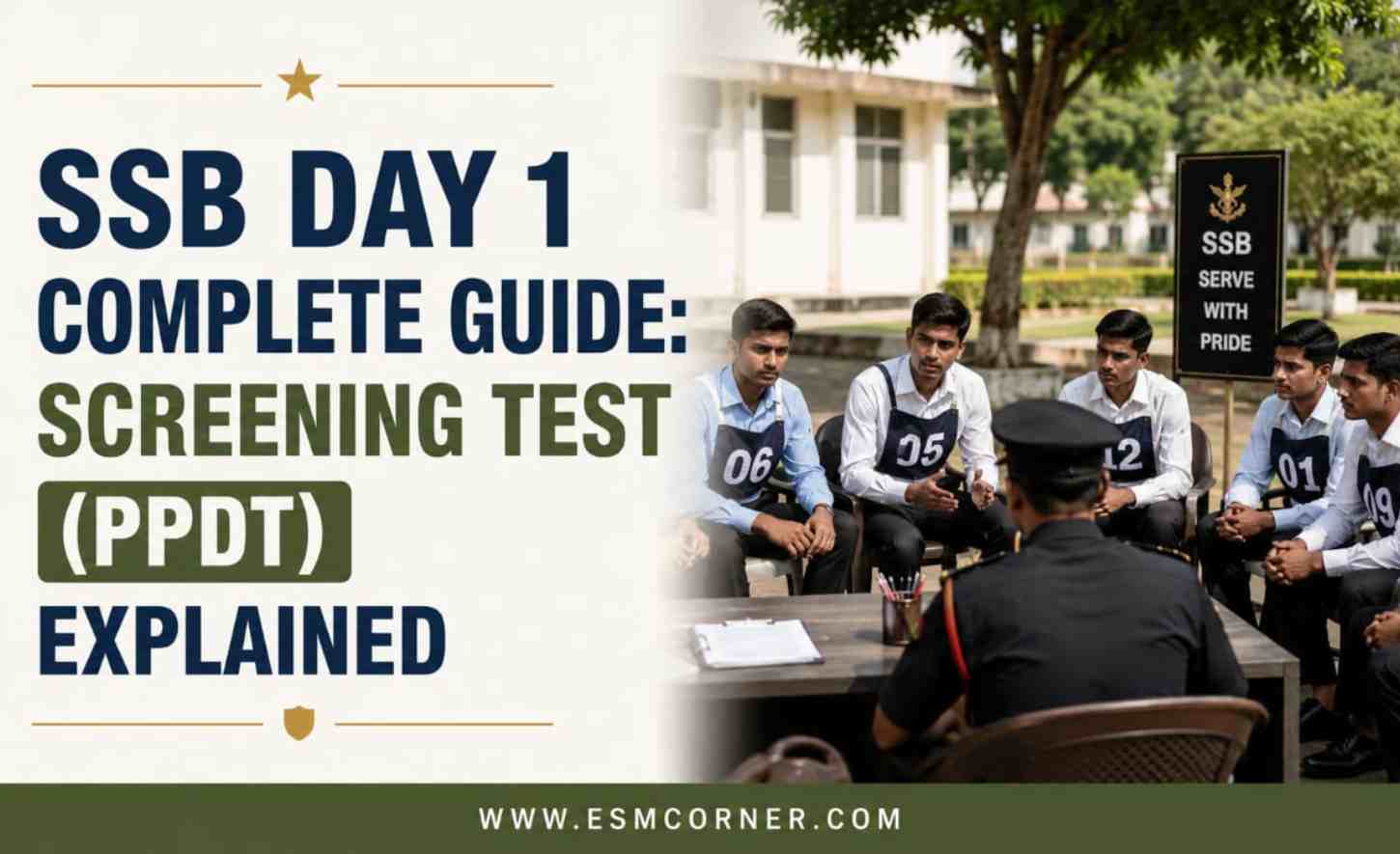
- PPDT — A picture flashes on screen for 30 seconds. You get 1 minute to jot down what you saw, and 4 minutes to write a story around it. Sounds short because it is short. This is where most people freeze.
- Narration + Group Discussion — You narrate your story in front of the group, and then everyone discusses to build one common story together.
- Results — Assessors combine your OIR and PPDT performance and decide who’s “screened in.” Those who aren’t, head home — and honestly, many come back stronger the next attempt.
OIR, PPDT, and GD — Quick Comparison
Here’s a simple way to understand what each stage is actually testing, and where people usually slip up:
- OIR Test — Tests your raw thinking speed and logic. Common mistake: getting stuck on one tough question and wasting time, or leaving answers blank even though there’s no negative marking. Silly mistake, easily avoidable.
- PPDT Story — Tests how practical and grounded your thinking is. Common mistake: writing filmy, over-dramatic stories that sound fake. Assessors have read thousands of stories — they can smell a copy-pasted “hero saves the day” plot from a mile away.
- Group Discussion — Tests how you behave in a team under pressure. Common mistake: either turning the discussion into a fish market with everyone shouting, or going completely silent and letting others dominate.
“But My English Is Not That Good…” — Relax
This is probably the biggest myth that stops good candidates from even trying. Let’s clear it once and for all: the SSB is not an English exam.
Yes, English is preferred because it’s the official language of instruction. But if you’re struggling for a word mid-sentence, you can switch to Hindi for a second and come back to English. Nobody’s marking you down for a slightly rusty accent or a grammar slip. What they actually care about is whether your thinking is clear. A candidate who says a simple, logical sentence in broken English will always beat someone who says a fancy, meaningless sentence in perfect English.
So if you’re a Hindi-medium student worrying about this — stop worrying, and start focusing on clarity of thought instead of showing off vocabulary.
“I’m an Introvert, Will I Even Survive the GD?” — Yes, Absolutely
Second biggest myth: that only loud, aggressive, “alpha” types clear SSB. Completely false.
The board isn’t looking for the loudest voice in the room — they’re looking for the most useful one. An introvert who speaks only 3-4 times in the whole discussion, but each time adds something logical that actually moves the conversation forward, will score far better than someone who talks non-stop without saying anything meaningful.
So if you’re naturally quiet, don’t force yourself to become someone you’re not. Just make sure that whenever you do speak, it counts.
When Things Go Wrong: Real Situations, Real Fixes
No guide is complete without talking about the moments that actually scare candidates the most — the “what if” situations.
What if you forget your story mid-narration? Stay calm, avoid overreacting, and don’t let fear leave you completely stuck.Take one calm breath, glance down for a split second to gather your thoughts, and pick up from wherever you remember — even if it’s the ending. Assessors are far less bothered about a forgotten line and far more impressed by how calmly you recover from it. A composed comeback says more about your officer potential than a perfectly memorized story ever could.
What if the group discussion turns into complete chaos? Everyone’s shouting, nobody’s listening, and it feels like a vegetable market. Don’t add to the noise. Step back mentally, keep your expression calm, and wait for that one tiny pause when people take a breath. Then jump in with a calm, steady voice: something like, “Let’s slow down and hear Chest Number 10 out first, we’re wasting time.” That one line, said at the right moment, shows more leadership than ten minutes of shouting ever could.
Does Your Background or School Matter?
Short answer — no. This is another rumour that refuses to die. Some candidates genuinely believe SSB favours convent-educated, “well-spoken” types from big cities. It doesn’t. The system is built to judge merit and potential, not your school tie or your English accent. Village background, small-town college, government school — none of it matters once you’re standing in front of the assessors. What matters is how you think and how you handle pressure.
Daily Practice Routine (30-45 Days Before Your SSB)
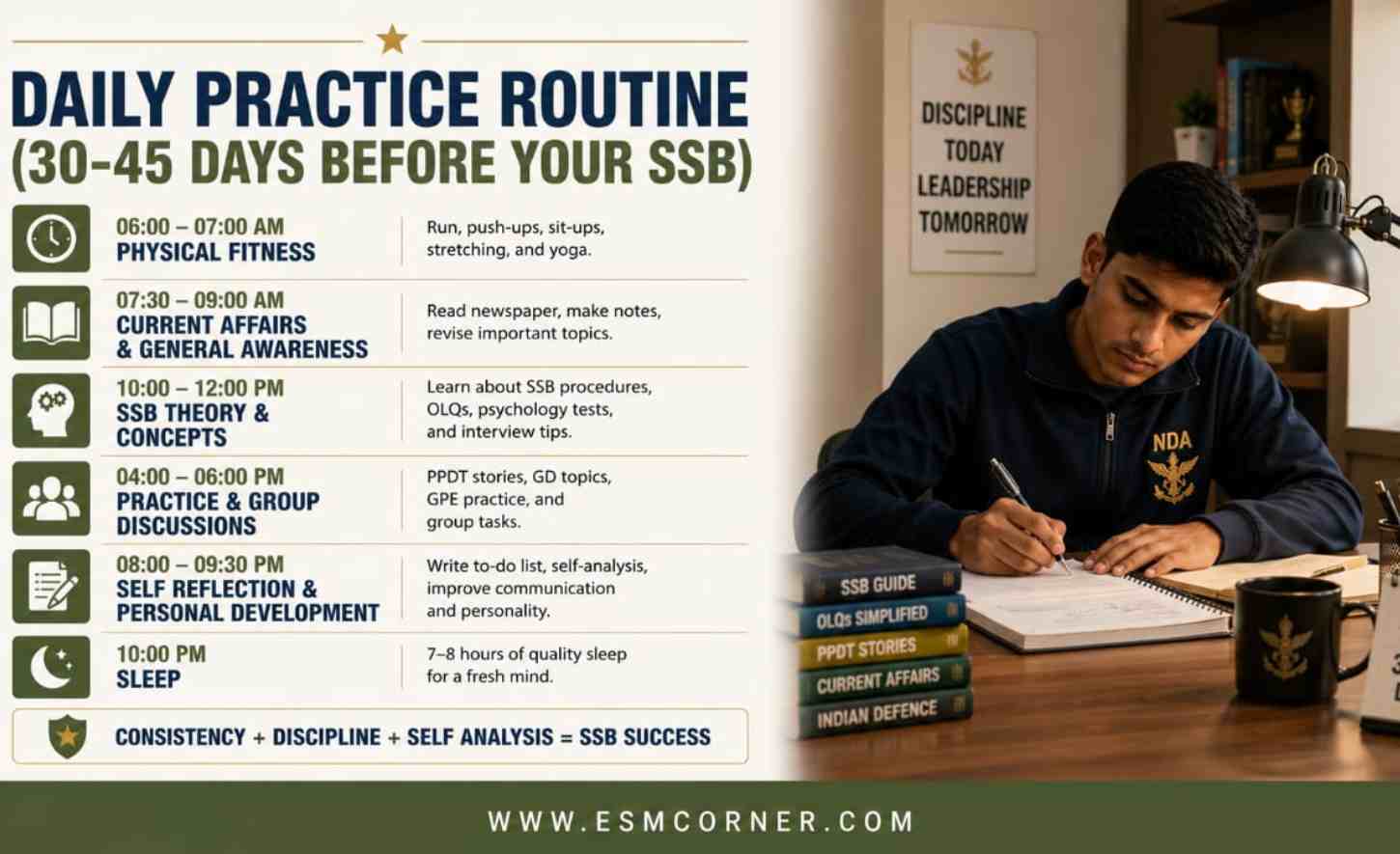
If you want real, lasting improvement — not last-minute cramming — build this into your daily routine:
- 5-minute observation drill: Look at a busy photo daily — a market scene, a crowd, anything complex. Close your eyes and try to recall the number of people, their expressions, and the background details. This trains your brain for that quick 30-second PPDT glance.
- Timed story writing: Pick any random picture online once a day. Give yourself exactly 30 seconds to observe, 1 minute to note details, and 4 minutes to write the story. No extra time, no cheating — this builds real exam discipline.
- Mirror narration practice: Stand in front of a mirror and narrate your story in under 60 seconds. Watch your posture, cut out the “umm” and “basically,” and record yourself on your phone once a week to track improvement.
Conclusion
Day 1 screening isn’t designed to trip you up — it’s designed to find candidates with genuine reasoning ability, honest thinking, and calm composure under pressure. Most people who get screened out aren’t lacking talent; they’re usually let down by nervousness, over-rehearsed stories, or trying too hard to “perform” instead of being themselves.
So walk in prepared, but walk in as yourself. Practice daily, stay calm when things don’t go as planned, and remember — the board isn’t hunting for perfection. They’re looking for a genuine, level-headed young person who can lead others one day. That could easily be you.
READ ALSO: OFFICER LIKE QUALITIES (OLQ) – 15 KEY QUALITIES FOR DEFENCE ASPIRANTS
Q1: Is the OIR test score considered when creating the final merit list after the 5-day SSB?
Ans: The OIR test score is primarily utilized as an initial filtering mechanism during the Day 1 screening process. However, your OIR rating remains documented in your dossier throughout the selection cycle. In instances where a candidate sits right on the borderline during the final Day 5 conference, a top-tier OIR 1 or OIR 2 rating serves as a strong indicator of cognitive capability, tipping the scale in their favor.
Q2: Can I change the character’s gender from what is visible in the PPDT image if it suits my story?
Ans: You should always try to align your story with what is actually shown in the picture. If the image is highly blurred or ambiguous, you have the creative freedom to interpret the gender based on your perception. However, deliberately changing a clearly visible male character into a female character simply to match a pre-memorized script shows poor observational discipline and lack of authenticity.
Q3: What should I do if two candidates start fighting or arguing aggressively during the group discussion?
Ans: Do not join the argument or take sides in a personal dispute. Maintain your composure, wait for a minor lull in the argument, and speak up firmly to redirect the focus toward the team’s objective. Suggest returning to the common points of the story, which demonstrates mature leadership and helps de-escalate the tension naturally.
Q4: Does a candidate with good English fluency have a better chance of clearing the screening test?
Ans: Clear communication is essential, but English fluency alone does not guarantee selection. The assessors evaluate the underlying logic, confidence, and teamwork behind your words. A candidate who speaks simple, grammatically clear English with substance will score much higher than someone who speaks fluent, fast English but exhibits an arrogant attitude or lacks practical reasoning skills.
Q5: Is it mandatory for the group to reach a unified consensus on a single story during the discussion?
Ans: The assessors instruct the group to try and reach a common consensus story. However, if the discussion remains divided due to conflicting ideas, the board looks at how constructively you tried to bridge those differences. The effort you put into keeping the group unified is far more important than achieving a forced, artificial agreement at the last second.
Q6: How long does the final Board Conference take to decide the screening results on Day 1?
Ans: The screening conference usually takes about 1 to 2 hours after the group discussions conclude. During this time, the Psychologist, GTO, and Interviewing Officer independent evaluations are compared alongside your OIR scores. Borderline cases are discussed collectively to ensure every candidate receives a fair, comprehensive, and objective review before the results are finalized.
Q7: Can I write a story about a historical event or a famous personality if the image reminds me of it?
Ans: It is highly recommended to write an original story featuring an everyday protagonist rather than relying on famous historical figures or well-known events. Writing about historical personalities often leads to a simple recital of facts rather than an expression of your personal problem-solving style, which defeats the purpose of a projective psychological test.
Q8: What happens immediately after a candidate is declared “Screened In” on Day 1?
Ans: Candidates who are screened in are assigned a new set of chest numbers for the remainder of the testing cycle. They are moved into regular candidate living quarters within the Selection Centre and attend an administrative briefing later that evening. This briefing outlines the schedule for the upcoming Psychology tests, GTO tasks, and Personal Interviews.
For daily defence updates, government notifications, recruitment alerts, welfare schemes, career opportunities, education news, and other important announcements, join our WhatsApp Community. Click here to join our WhatsApp Group.