
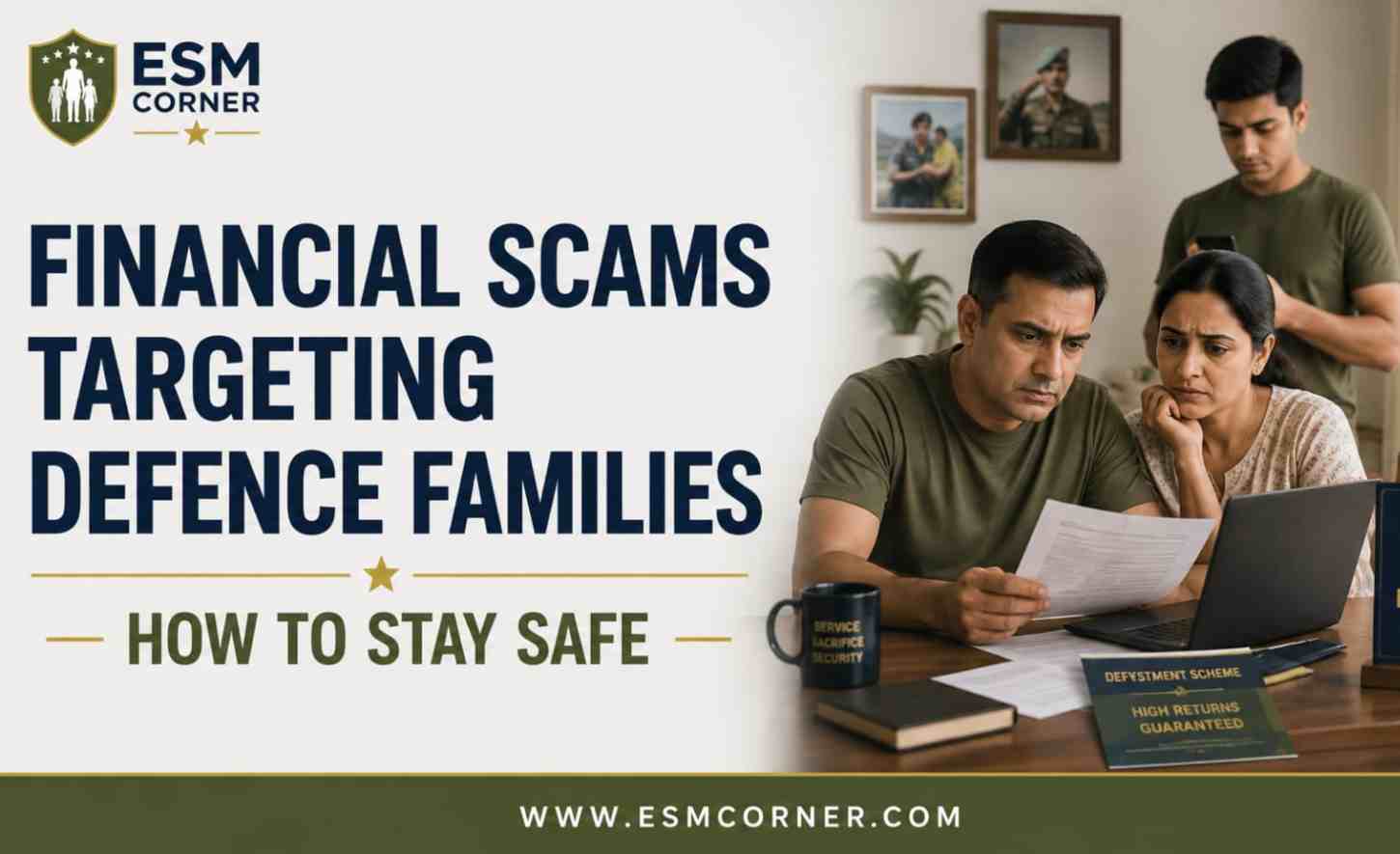
The phone rings. A calm, confident voice speaks in official Hindi or English.
“Sir, your pension account KYC has expired. If you do not update it within two hours, your account will be blocked. Please share the OTP we just sent you.”
The caller sounds professional. The urgency feels real. And for a retired veteran or elderly pensioner sitting at home — who trusts official language and uniformed authority — the pressure to comply can feel overwhelming.
This is exactly how thousands of defence families lose their hard-earned savings every year.
Financial scams in India are not new. But they are becoming smarter, more targeted, and more dangerous every year. And defence families — soldiers, veterans, pensioners, and their dependents — are among the most frequently targeted groups.
Understanding how these scams work is now as important as any financial investment decision.
Why Scammers Target Defence Families Specifically
Fraudsters are not random. They choose their targets deliberately. Defence families are attractive targets for specific reasons:
- Pension accounts receive regular monthly transactions, signalling a reliable income source
- Many retired veterans and senior pensioners are less familiar with digital fraud methods
- Trust in official language, uniform references, and government terminology is genuinely high among defence communities
- Personal information like names, ranks, and pension details can sometimes be found through public sources or data leaks
- Emotional manipulation using military respect and urgency works effectively on people who are trained to respond quickly to authority
Scammers know this. And they use it deliberately and coldly.
Most Common Scams Targeting Defence Families
Fake Bank KYC Calls
This is the most common scam. A caller claims your KYC has expired, your ATM card will be blocked, or your account needs urgent verification. They ask for your OTP, card number, or PIN.
Remember this clearly — no real bank ever asks for OTP, PIN, or password over a phone call. Ever.
Pension and SPARSH Account Frauds
Retired personnel receive calls claiming there is a problem with their PPO number, SPARSH account, life certificate, or pension verification. The call creates panic and then asks for sensitive personal or banking details to “fix” the problem.
Real pension departments and government offices never ask for bank details or OTPs through unsolicited phone calls.
Fake Investment Schemes
These target both serving personnel and veterans. Promises include guaranteed high returns, double money in six months, risk-free profit, or exclusive investment plans for defence personnel.
There is no such thing as guaranteed high returns with zero risk. Every such claim is either a scam or an extremely risky product whose true nature is being hidden from you.
Remote Access App Scams
A caller says they will help you fix a banking problem if you install a particular app. Once installed, this app gives the scammer complete control of your phone — including access to your banking apps, OTPs, and personal data. Never install any app suggested by an unknown caller.
WhatsApp and SMS Link Frauds
Fake messages arrive claiming your pension is due, your canteen card needs renewal, your income tax refund is ready, or your reward points will expire. The message contains a link. Clicking it can compromise your phone, your banking access, or your personal data completely.
How to Recognise a Scam Call — Warning Signs
Most financial scams follow the same basic pattern. Once you know the pattern, recognition becomes much easier.
Common warning signs include urgent pressure to act within minutes or hours, requests for OTP or PIN over the phone, promises of guaranteed profit or instant money, threats of account blocking or legal action, unfamiliar links sent through SMS or WhatsApp, requests to install apps to solve problems, and emotional manipulation using official-sounding language or military references.
The moment you feel pressure, urgency, or fear during a financial call — that feeling itself is a warning sign. Legitimate institutions do not create panic.
Simple Safety Habits Every Defence Family Must Follow
These habits take seconds to follow but can prevent devastating financial losses:
- Never share OTP with anyone — Not with bank callers, pension officials, insurance agents, or anyone else. OTP is yours alone.
- Never share ATM PIN or internet banking password — No legitimate institution ever needs these from you.
- Disconnect and verify — If any call feels suspicious, cut the call and contact your bank or institution through their official number independently.
- Avoid unknown links — Do not click any link in SMS or WhatsApp unless you initiated the conversation yourself.
- Never install apps on stranger’s request — No genuine banking problem requires you to install a screen-sharing or remote access application.
- Discuss with family before acting — If something feels confusing or pressured, talk to a trusted family member before doing anything.
Protecting Elderly Parents and Pensioners
This section is especially for children and family members of retired veterans and senior pensioners.
Many elderly pensioners are genuinely unfamiliar with digital fraud techniques that did not exist when they were young. They trust official language. They fear account problems. And they may not know that OTPs should never be shared with anyone.
Take time to explain these things clearly and patiently to elderly parents:
- Fake call examples and how they sound
- Why OTP should never be shared with anyone including family
- How to disconnect suspicious calls without feeling rude
- Which official numbers to use for genuinely verifying pension or banking issues
This five-minute conversation can prevent the loss of an entire lifetime of savings.
What to Do Immediately if Fraud Happens
Speed matters enormously when fraud occurs. Every minute of delay gives fraudsters more time to move stolen money.
If you suspect fraud has occurred — contact your bank immediately using the official helpline number, not the number that called you. Request blocking of your debit card, credit card, and internet banking access. Change all passwords and PINs immediately. Report the fraud to the National Cyber Crime helpline by calling 1930 or visiting cybercrime.gov.in. Save all call recordings, screenshots, and transaction details for the investigation. Inform a trusted family member immediately.
Fast action has helped many victims recover some or all of their money. Delay helps only the fraudster.
Conclusion
Financial discipline means more than just investing wisely and saving regularly. It also means staying alert, thinking carefully before acting, and refusing to be rushed into financial decisions by strangers on the phone.
A soldier is trained to verify orders, question suspicious situations, and never act blindly under unknown authority. The same trained instinct must be applied to financial phone calls and messages.
No genuine bank will block your account in two hours. No real pension department needs your OTP. No actual government scheme promises guaranteed double returns.
Verify first. Act later. And never let urgency replace careful thinking.
READ MORE: BEST CREDIT CARD FOR ARMED FORCES PERSONNEL IN 2026
Frequently Asked Questions
Q1. Why are defence families and pensioners targeted by scammers?
Pension accounts show regular income, senior citizens may be less familiar with digital fraud, and defence communities naturally trust official-sounding language. Scammers use military terms and government language to sound credible and create pressure — making defence families and retirees frequent and easy targets.
Q2. What are the most common scams targeting defence pensioners?
Fake KYC calls threatening account blocking, pension verification frauds mentioning SPARSH or PPO, fake high-return investment schemes, remote access app scams disguised as banking help, and fraudulent WhatsApp or SMS links pretending to be from pension offices or army canteen services. All use urgency and fear to extract sensitive information quickly.
Q3. Do real banks or pension departments ever ask for OTP on phone?
Never. No genuine bank, pension office, or government department ever asks for OTP, ATM PIN, or internet banking password over phone, SMS, or WhatsApp. Anyone asking for these details — however official they sound — is a fraudster. Disconnect immediately and verify through official channels yourself.
Q4. What should you do immediately after a suspicious call?
Disconnect without sharing anything. Don’t feel obligated to stay polite if they pressure you. Then find the official customer care number from the bank’s website or the back of your debit card and call that number yourself. Never call back the number that contacted you — it likely connects to the same scammer.
Q5. How do fake investment schemes target defence families?
Through phone calls, WhatsApp groups, or local agents promising guaranteed high returns, exclusive defence plans, or risk-free doubling of money. These target hardworking people with retirement savings. No legitimate investment ever guarantees returns or risk-free profit — such promises are always a fraud warning sign.
Q6. What is a remote access app scam and why is it dangerous?
A scammer posing as bank support asks you to install an app to “fix” your account. Once installed, they can see your entire phone — banking apps, OTPs, photos, documents — and operate it remotely. Never install any app suggested by an unknown caller, no matter what problem they describe.
Q7. How can family members protect elderly pensioners from fraud?
Explain clearly that no bank ever asks for OTP on phone. Show them examples of scam calls. Save the official bank helpline in their phone. Encourage them to disconnect without guilt if pressured. Check in regularly about unusual calls. Family awareness is one of the strongest protections available.
Q8. What should a fraud victim do immediately?
Call your bank’s official helpline immediately. Block all cards and internet banking. Change all passwords from a secure device. Report to the National Cyber Crime helpline — call 1930 or visit cybercrime.gov.in. Save all evidence — call recordings, screenshots, transaction records. Act within minutes because fraudsters move money very fast.
Q9. Are WhatsApp or SMS links from official-looking sources safe?
No. Professionally designed fake messages now look exactly like genuine communications from banks, pension departments, or government offices. Clicking such links can install malware, steal login details, or redirect you to fake banking websites. Simple rule — if you didn’t request a link, don’t click it.
Q10. What is the single most important financial safety habit?
Verify before you act. Never let urgency replace calm thinking. The moment a caller pressures you, threatens account blocking, or asks for OTP — disconnect, breathe, and verify independently. No genuine bank or government will punish you for taking time to verify. Protecting your information always comes first.
For daily defence updates, government notifications, recruitment alerts, welfare schemes, career opportunities, education news, and other important announcements, join our WhatsApp Community. Click here to join our WhatsApp Group.