
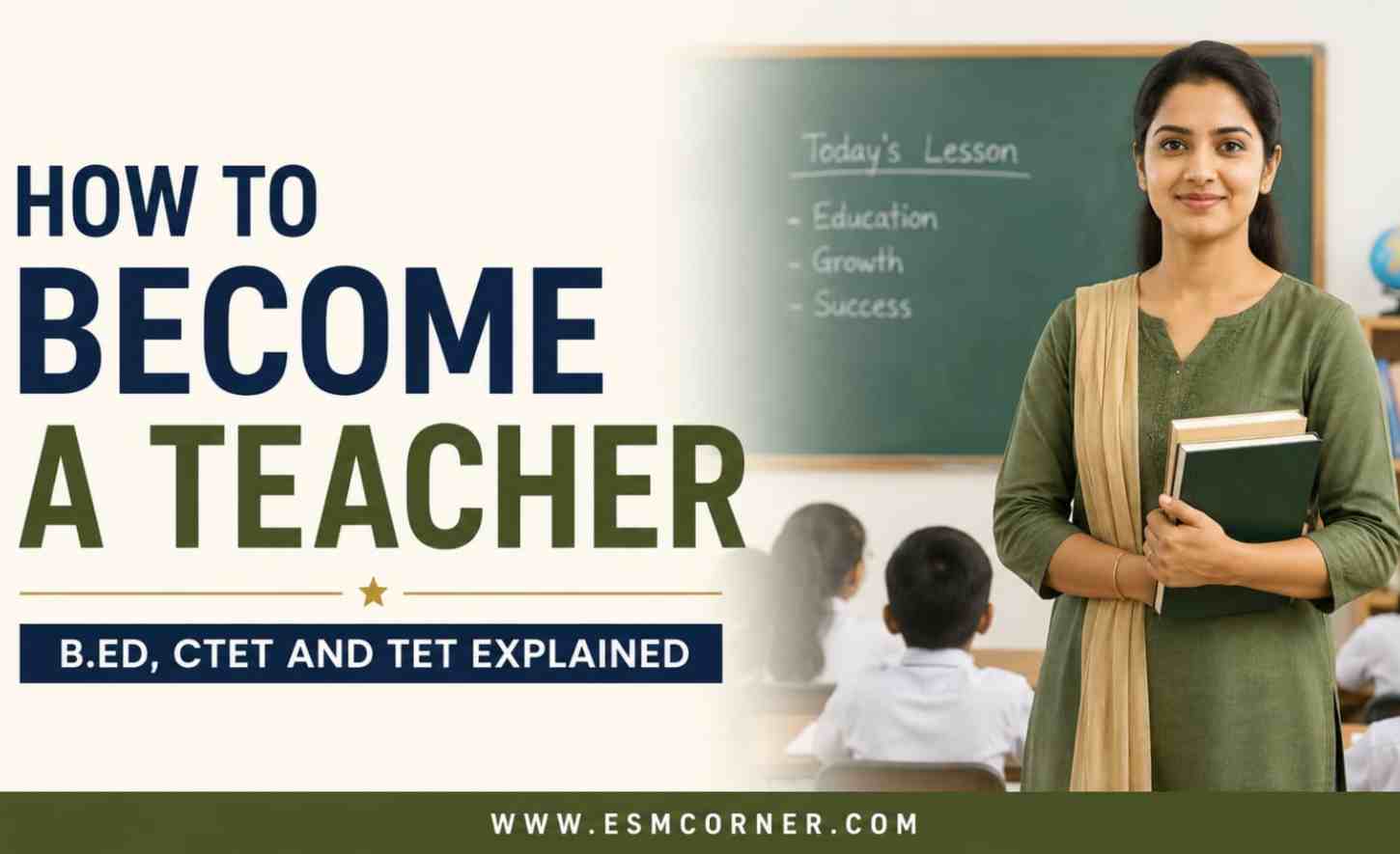
Many students naturally gravitate toward teaching because they love explaining tricky concepts, guiding younger siblings, or making a real difference in young lives. However, after completing Class 12 or graduation, confusion often strikes when trying to navigate terms like D.El.Ed, B.Ed, CTET, State TETs, government recruitment exams, and private school hiring criteria.
A common misconception is assuming that any degree allows you to teach anywhere, but the reality is that your exact pathway depends on the school level, subject specialization, and state regulations you target.
Understanding this career path starts with recognizing that teacher training degrees and eligibility tests perform completely different functions in your journey. While a training course teaches you how to manage classrooms and design lesson plans, an eligibility test officially verifies that you possess the necessary knowledge to enter a classroom.
Neither of these alone guarantees an immediate job offer, but together they form the compulsory foundation required for modern teaching careers across India. By understanding how these qualifications connect, you can make smart decisions immediately after school or college without wasting precious time. This complete Teaching Career Guide breaks down every step in simple terms so you can confidently plan your path toward becoming a successful educator.
Why Choose Teaching as a Career?
Teaching is one of the most respected professions in India, offering long-term professional stability, personal satisfaction, and a unique opportunity to shape the future generation. When you teach, every single day presents fresh opportunities to inspire young minds, share subject knowledge, and help students overcome personal learning hurdles. It is a career that keeps you continuously connected with learning, creativity, and community service while building a solid professional identity.
You should strongly consider entering the teaching field if you possess these key traits:
- Natural Patience: You enjoy explaining things repeatedly until a student fully grasps the core idea.
- Strong Subject Curiosity: You love reading, updating your knowledge, and sharing interesting facts about your chosen subject.
- Empathy and Observation: You easily notice when a young student feels confused, anxious, or left behind in a group.
- Active Communication: You like speaking, presenting ideas, and breaking complex topics into small, easily digestible parts.
Decoding School Levels and Entry Paths
Before picking a course, you must decide which age group of students you actually want to teach. Indian schools divide teaching positions into distinct levels, and each level demands a specific educational qualification:
- Primary Teachers (PRT): They teach Classes 1 to 5 and focus on foundational literacy, basic arithmetic, and overall personality development.
- Trained Graduate Teachers (TGT): They teach Classes 6 to 10 and focus on specific subjects like Mathematics, Science, Social Studies, or Languages.
- Post Graduate Teachers (PGT): They teach Classes 11 and 12 and handle advanced academic disciplines requiring deep subject mastery.
Starting Your Journey After Class 12th
If you realize your passion for teaching early, you can start your preparation immediately after completing high school. You can opt for a Diploma in Elementary Education (D.El.Ed), which specifically prepares candidates to teach primary school children. Alternatively, integrated teacher training programs allow you to combine a traditional bachelor’s degree with professional teacher training, saving you academic time while building strong foundational skills early.
Pursuing a Teaching Career After Graduation
If you decide to enter education after finishing a general bachelor’s degree such as a BA, B.Sc, or B.Com, your main pathway involves enrolling in a professional teaching degree. Completing a B.Ed After Graduation opens doors to becoming a subject teacher for middle and secondary school classes. Postgraduates can also pursue B.Ed to qualify for higher secondary teaching positions in both government and private educational institutions.
What is B.Ed? (Bachelor of Education)
The Bachelor of Education (B.Ed) is a mandatory professional degree program that transforms subject graduates into trained classroom educators. Unlike regular academic degrees that focus only on theoretical textbook knowledge, this course teaches child psychology, modern teaching methods, educational technology, and practical classroom management.
Who should pursue a B.Ed Course Guide pathway?
- Candidates aiming to become Subject Teachers for middle, secondary, and higher secondary classes.
- Graduates who want to master practical lesson planning, educational evaluation, and student assessment techniques.
- Anyone seeking long-term growth, administrative roles, or senior academic posts in recognized schools.
Understanding CTET and State TET Exams
Completing your teacher training diploma or B.Ed degree makes you eligible to apply, but it does not automatically allow you to start working as a teacher in most recognized schools. You must clear a Teacher Eligibility Test to prove your readiness for actual classroom teaching.
Central Teacher Eligibility Test (CTET)
Organized at the national level, CTET Explained simply means a standardized test that evaluates whether a candidate possesses basic teaching aptitude for primary and upper-primary levels. Qualifying CTET makes you eligible to apply for teaching vacancies in Central Government schools like Kendriya Vidyalayas (KVS), Jawahar Navodaya Vidyalayas (JNV), and Central Tibetan Schools, as well as many top-tier private institutions across India.
State Teacher Eligibility Test (TET)
Individual state governments conduct their own TET Explained exams to recruit teachers for state-run public schools and state-board aided institutions. While CTET is widely accepted across central institutions and several states, appearing for your specific State TET is vital if you wish to secure a teaching job within your home state’s public school system.
B.Ed vs CTET/TET Framework
| Qualification/Exam | Main Purpose | Best For | Key Point |
| D.El.Ed | Elementary teacher training diploma | Primary school teaching (Classes 1–5) | Completed after Class 12 or graduation |
| B.Ed | Professional teaching degree | Subject teaching (Classes 6–12) | Required for secondary school teaching |
| CTET | National eligibility test | Central government and private schools | Valid across India for eligibility |
| State TET | State-level eligibility test | State government public schools | Specific to state school recruitment |
| Recruitment Exam | Final job selection exam | Securing permanent government teaching posts | Conducted by specific recruitment boards |
Core Skills for Modern Educators
Becoming an effective teacher requires building real practical abilities that go far beyond memorizing textbook lessons.
- Clear Communication: You must explain complicated ideas using simple words, clear tone, and engaging stories that match your students’ age level.
- Classroom Management: Maintaining discipline requires creating a supportive, calm environment where students feel safe, valued, and encouraged to ask questions.
- Child Psychology: Understanding how young minds grow helps you tailor your teaching style for slow learners, quick absorbers, and quiet students alike.
- Digital Teaching Skills: Modern classrooms rely heavily on smartboards, educational apps, slide presentations, and online learning platforms to make lessons interactive.
Building Your Career in Government and Private Schools
Securing a Government Teacher Job usually involves a multi-step process. First, you earn your academic degree and teacher training qualification (D.El.Ed or B.Ed). Next, you pass the relevant CTET or State TET exam to meet eligibility requirements. Finally, you must clear competitive recruitment examinations conducted by central or state selection boards, followed by document verification.
On the other hand, Private School Teaching offers immediate entry opportunities for passionate candidates. Most reputable private schools prefer candidates with strong English communication skills, B.Ed degrees, and CTET qualification. Private institutions often conduct written tests, subject demonstrations, and personal interviews to evaluate a candidate’s real classroom presence and passion for teaching.
Conclusion
Choosing a career in education is a meaningful path that combines personal stability with profound societal impact. Becoming a successful teacher is not just about clearing exams or getting a degree; it requires building real patience, subject mastery, communication skills, and a genuine love for helping students grow.
As educational standards evolve across India, well-trained educators who embrace modern teaching tools and empathetic classroom management will always remain in high demand. If you enjoy mentoring young minds, start planning your pathway early, build your communication confidence, and consistently verify official government notifications to take your first step toward a rewarding teaching career.
READ ALSO: CAN HINDI MEDIUM OR RURAL BACKGROUND STUDENTS CRACK NDA AND BECOME OFFICERS?
Frequently Asked Questions
Q1.Can I clear CTET without doing B.Ed or D.El.Ed?
No, CTET requires candidates to either possess or currently pursue a recognized professional teacher training qualification like D.El.Ed or B.Ed. Academic degrees alone do not qualify you to appear for the test.
Q2.Does passing CTET guarantee a government school job?
No, qualifying CTET only grants you basic eligibility to apply for teaching vacancies. You must still clear separate competitive recruitment exams and interviews conducted by specific central or state recruitment boards.
Q3.What is the primary difference between CTET and State TET?
CTET is conducted at the national level for central government schools and union territories. State TETs are organized by individual states specifically for recruitment in state board public schools.
Q4.Can I become a high school teacher right after Class 12th?
No, teaching high school classes requires deep subject knowledge. You must complete your graduation in a specific subject along with a professional B.Ed degree to teach secondary or higher secondary students.
Q5.Is B.Ed compulsory for teaching in private schools?
Most recognized private schools strictly prefer or mandate a B.Ed degree for subject teachers. It ensures that candidates understand pedagogy, lesson planning, and child psychology before entering the classroom.
Q6.Can I pursue B.Ed after completing a B.Com or B.Tech degree?
Yes, graduates from commerce, engineering, or science backgrounds can pursue B.Ed, provided they meet the minimum percentage criteria set by universities and select suitable teaching subjects based on their graduation coursework.
Q7.What is the age limit for appearing in CTET exams?
There is generally no upper age limit for appearing in the CTET examination. Candidates can take the test as long as they meet the required professional teacher training eligibility criteria.
Q8.How can I choose between teaching primary or secondary classes?
Base your decision on your personal interests. Choose primary teaching if you enjoy working with young children and foundational learning, or secondary teaching if you love deep subject specialization.
For daily defence updates, government notifications, recruitment alerts, welfare schemes, career opportunities, education news, and other important announcements, join our WhatsApp Community. Click here to join our WhatsApp Group.