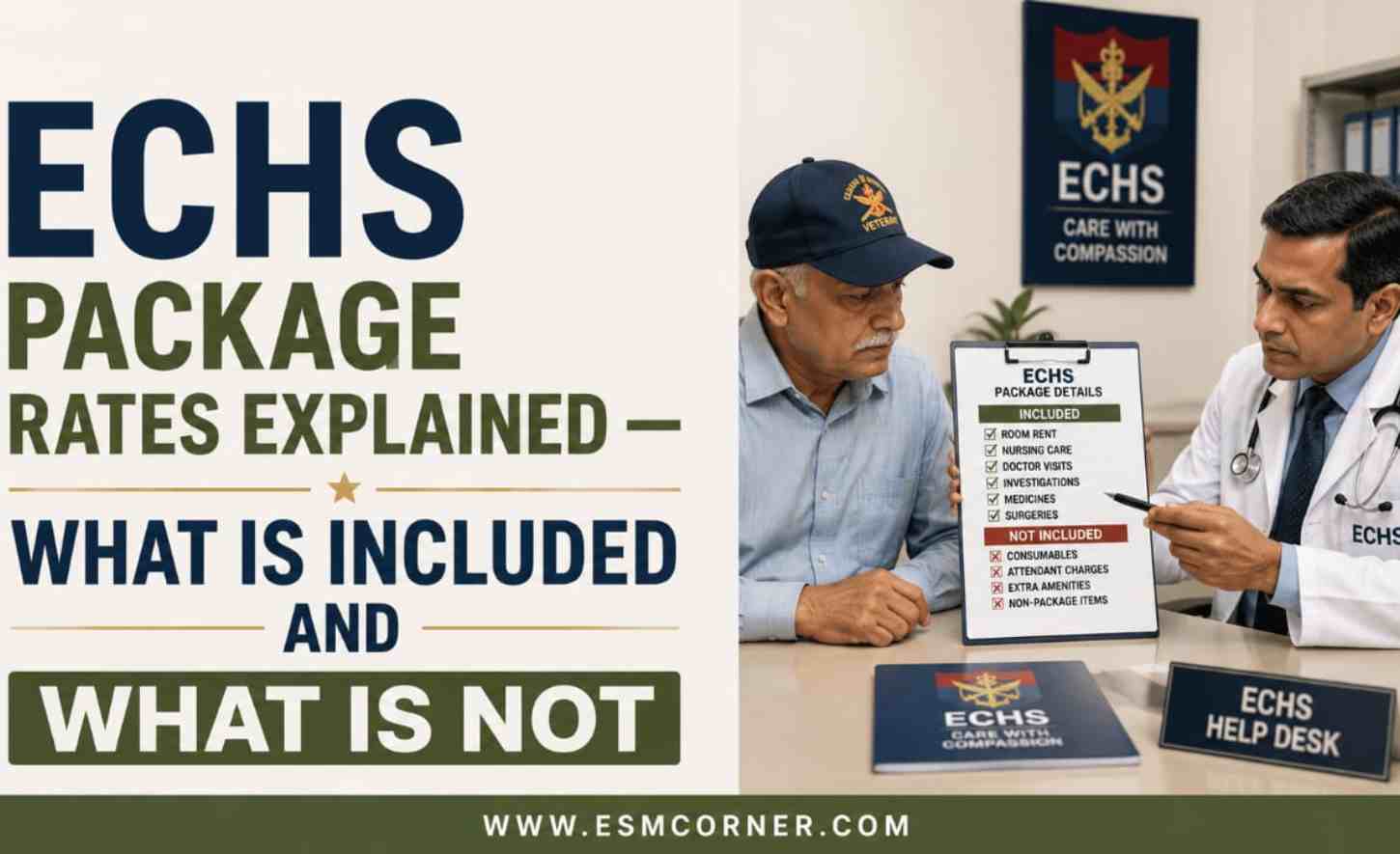

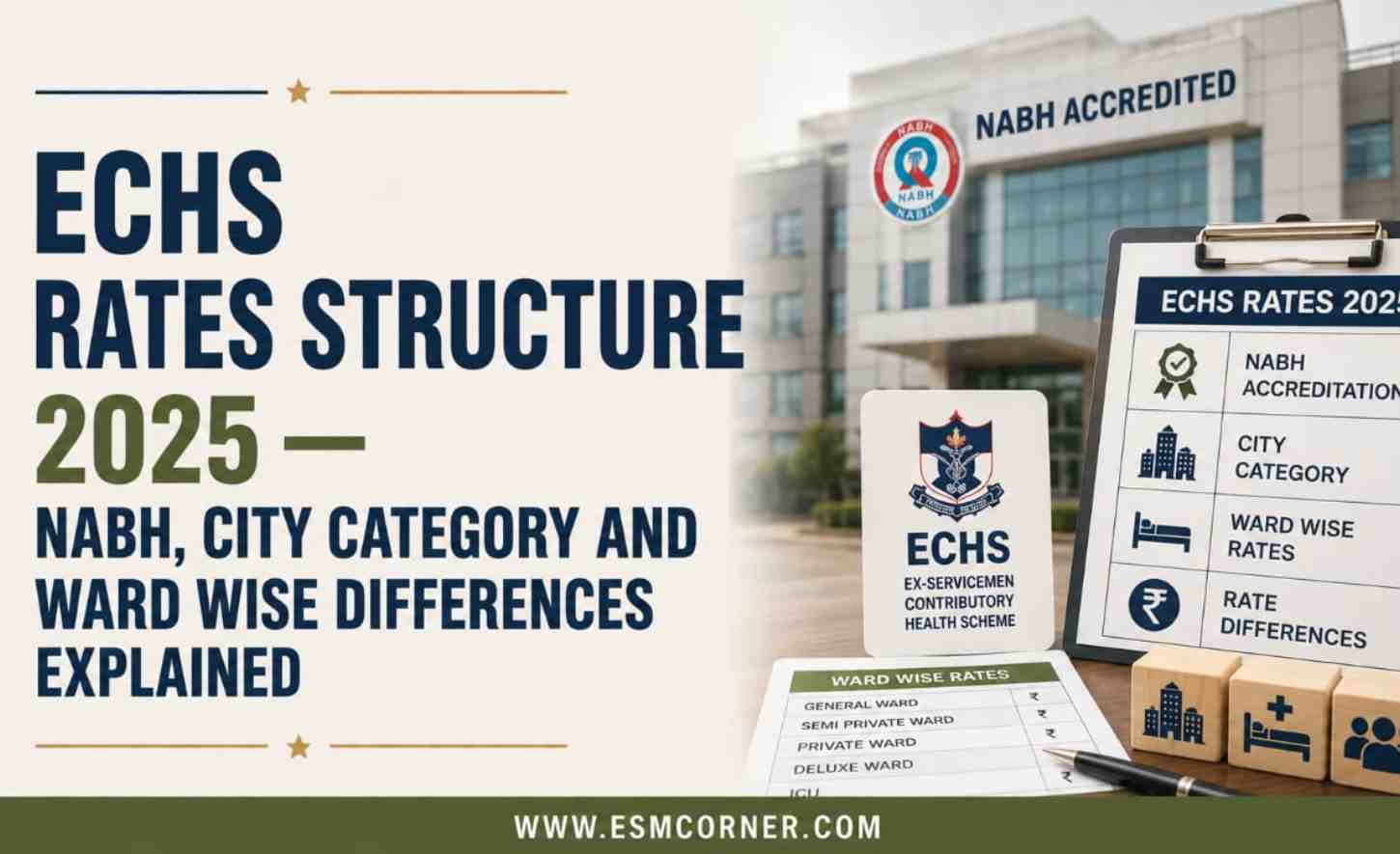
When an ECHS beneficiary gets treated at an empanelled hospital, the amount ECHS pays to the hospital is not a single fixed rate for everyone. The rate varies depending on several factors — whether the hospital is accredited, which city it is in, what type of hospital it is, and what ward the patient is entitled to.
Many veterans and their families wonder why the same surgery might be billed differently at different hospitals. The answer lies in the ECHS revised rates structure of 2025 which introduced a rationalised system based on specific criteria.
Understanding this rate structure helps beneficiaries know what to expect, prevents billing confusion, and ensures the hospital is not over or under claiming on their behalf. All facts are strictly from ECHS SOP April 2026.
The Four Factors That Determine ECHS Rates
The revised ECHS rates structure is based on four key factors —
Accreditation status of the hospital — whether it is NABH and NABL accredited or not.
Type of hospital — whether it is a regular empanelled hospital or a super specialty hospital.
City classification — whether the hospital is in a Tier 1, Tier 2, or Tier 3 city.
Ward entitlement of the patient — General, Semi-Private, or Private Ward.
Each of these factors adjusts the base rate upward or downward. Together they determine the final rate applicable to a specific patient at a specific hospital.
Factor 1 — NABH and NABL Accreditation
NABH stands for National Accreditation Board for Hospitals and Healthcare Providers. NABL stands for National Accreditation Board for Testing and Calibration of Laboratories. These are quality accreditation bodies that certify hospitals and labs meeting defined standards of care.
Under the revised ECHS rates —
Non-NABH and non-NABL accredited hospitals are paid at rates that are 15 percent lower than NABH and NABL accredited hospitals.
This means if you are treated at a NABH accredited empanelled hospital the rates are higher. If the hospital is not accredited the rates are 15 percent lower. This encourages hospitals to maintain quality standards.
Factor 2 — Super Specialty Hospitals
For super specialty hospitals the rates are 15 percent higher than those applicable to NABH accredited hospitals for the corresponding super specialists within the same city category.
So a super specialty hospital gets a premium over even an accredited regular hospital. This reflects the higher cost and complexity of super specialty care.
Factor 3 — City Classification
The city where the hospital is located significantly affects the rates. The classification is as follows —
Hospitals in X category cities — Tier 1 cities — get the standard base rates.
Hospitals in Y category cities — Tier 2 cities — get rates that are 10 percent lower than Tier 1 city rates.
Hospitals in Z category cities — Tier 3 cities — get rates that are 20 percent lower than Tier 1 city rates.
An important additional rule — Y category rates also apply to hospitals located in the North-East region and in the Union Territories of Jammu and Kashmir and Ladakh.
This city-based adjustment recognises that operating costs differ across different parts of India.
Factor 4 — Ward Entitlement
The base package rates in the revised ECHS structure are set for Semi-Private Ward patients. Adjustments are made for other ward categories as follows —
For General Ward patients — a decrease of 5 percent is applied to the applicable rate.
For Private Ward patients — an increase of 5 percent is applied to the applicable rate.
This means Officers entitled to Private Ward get 5 percent more than the base Semi-Private rate. NCOs entitled to General Ward get 5 percent less.
What Rates Remain the Same Regardless of Ward
Not all charges vary with ward entitlement. The following rates remain uniform regardless of ward category —
Consultation fees, radiotherapy charges, investigation charges, day care procedure charges, and minor procedure charges that do not require admission are all charged at the same rate regardless of whether the patient is in a General, Semi-Private, or Private Ward.
Cancer Surgery — Special Rule
For cancer surgeries specifically, existing CGHS rules and rates continue to apply under ECHS. However the revised rates do apply to chemotherapy, investigations, and radiotherapy for cancer patients.
Rates for Consultations
Each consultation fee is inclusive of the cost of examination consumables such as paper gloves, unsterile gloves, or examination gloves used during the examination. Each consultation is considered valid for a period of seven days provided it pertains to the same specialty. This means if you see the same specialist within seven days for the same condition it is considered the same consultation.
Common Mistakes to Avoid
Not knowing that the hospital’s accreditation status affects the rate ECHS pays — always check if your empanelled hospital is NABH accredited.
Assuming all hospitals in all cities charge the same rates under ECHS — city category significantly affects the rate.
Not knowing that base rates are for Semi-Private Ward — General Ward gets 5 percent less and Private Ward gets 5 percent more.
Assuming consultation charges vary by ward — they do not. Consultation rates are uniform regardless of ward entitlement.
Not knowing that cancer surgery follows CGHS rules while chemotherapy and radiotherapy follow revised rates.
Conclusion
The ECHS revised rates structure of 2025 is a well-thought-out system that balances hospital quality, geographic cost differences, and patient entitlement. NABH accreditation, city category, hospital type, and ward entitlement — all four factors work together to determine the final rate applicable to your treatment.
As a beneficiary you do not need to calculate these rates yourself. But knowing the structure helps you understand your hospital bill, verify that the correct rates are being applied, and ensure your empanelled hospital is billing ECHS accurately on your behalf.
READ ALSO: WHAT IS ECHS AND WHO CAN USE IT?
Frequently Asked Questions
Q1. What are the four factors that determine ECHS rates under the revised 2025 structure?
The four factors that determine ECHS rates are the accreditation status of the hospital whether NABH and NABL accredited or not, the type of hospital whether regular or super specialty, the city classification whether Tier 1 Tier 2 or Tier 3, and the ward entitlement of the patient whether General Semi-Private or Private Ward. All four factors together determine the final applicable rate.
Q2. What is the difference in rates between NABH accredited and non-accredited hospitals under ECHS?
Non-NABH and non-NABL accredited hospitals are paid at rates that are 15 percent lower than NABH and NABL accredited hospitals under the revised ECHS rates structure. This difference encourages empanelled hospitals to obtain and maintain quality accreditation to provide better standards of care to ECHS beneficiaries.
Q3. Do super specialty hospitals get higher rates under ECHS?
Yes. Rates for super specialty hospitals are 15 percent higher than those applicable to NABH accredited hospitals for the corresponding super specialists within the same city category. This premium reflects the higher complexity and cost of super specialty medical care provided at these facilities.
Q4. How does city classification affect ECHS rates?
Hospitals in Tier 1 X category cities get the standard base rates. Hospitals in Tier 2 Y category cities get rates 10 percent lower than Tier 1 rates. Hospitals in Tier 3 Z category cities get rates 20 percent lower than Tier 1 rates. Y category rates also apply to hospitals in the North-East region and in the Union Territories of Jammu and Kashmir and Ladakh.
Q5. What is the base ward for ECHS package rates and how are other wards adjusted?
The base package rates in the revised ECHS structure are set for Semi-Private Ward patients. For General Ward patients a decrease of 5 percent is applied to the applicable rate. For Private Ward patients an increase of 5 percent is applied. Officers in Private Ward get 5 percent more than the base rate and NCOs in General Ward get 5 percent less.
Q6. Do consultation charges vary based on ward entitlement under ECHS?
No. Consultation fees remain uniform regardless of ward entitlement under the revised ECHS rates structure. The same rate applies whether the patient is entitled to General Ward Semi-Private Ward or Private Ward. Radiotherapy charges investigation charges day care procedure charges and minor procedure charges also remain uniform regardless of ward category.
Q7. What is the special rule for cancer surgery rates under the revised ECHS structure?
For cancer surgeries specifically existing CGHS rules and rates continue to apply under ECHS. However the revised ECHS rates do apply to chemotherapy investigations and radiotherapy for cancer patients. This means the surgical component of cancer treatment follows CGHS rates while the chemotherapy and radiotherapy components follow the revised ECHS rates.
Q8. How long is a consultation valid under the revised ECHS rates structure?
Each consultation is considered valid for a period of seven days provided it pertains to the same specialty. This means if a patient visits the same specialist within seven days for the same medical condition it is treated as the same consultation. The consultation fee also includes the cost of examination consumables such as gloves used during the examination.
Q9. Do the revised rates apply to hospitals in Jammu and Kashmir and Ladakh?
Yes. The ECHS SOP April 2026 specifically states that Y category Tier 2 city rates apply to hospitals located in the North-East region and in the Union Territories of Jammu and Kashmir and Ladakh. This means these hospitals are reimbursed at rates 10 percent lower than Tier 1 city rates under the revised ECHS structure.
Q10. How can an ECHS beneficiary use knowledge of the rates structure to protect themselves?
Knowing the rates structure helps beneficiaries verify that their empanelled hospital is billing ECHS accurately. Check whether your hospital is NABH accredited as this affects the rate. Confirm your city category. Ensure your ward entitlement adjustment of plus or minus 5 percent is correctly applied. If you suspect incorrect billing report it to your ECHS Polyclinic or Regional Centre immediately.
For daily defence updates, government notifications, recruitment alerts, welfare schemes, career opportunities, education news, and other important announcements, join our WhatsApp Community. Click here to join our WhatsApp Group.