
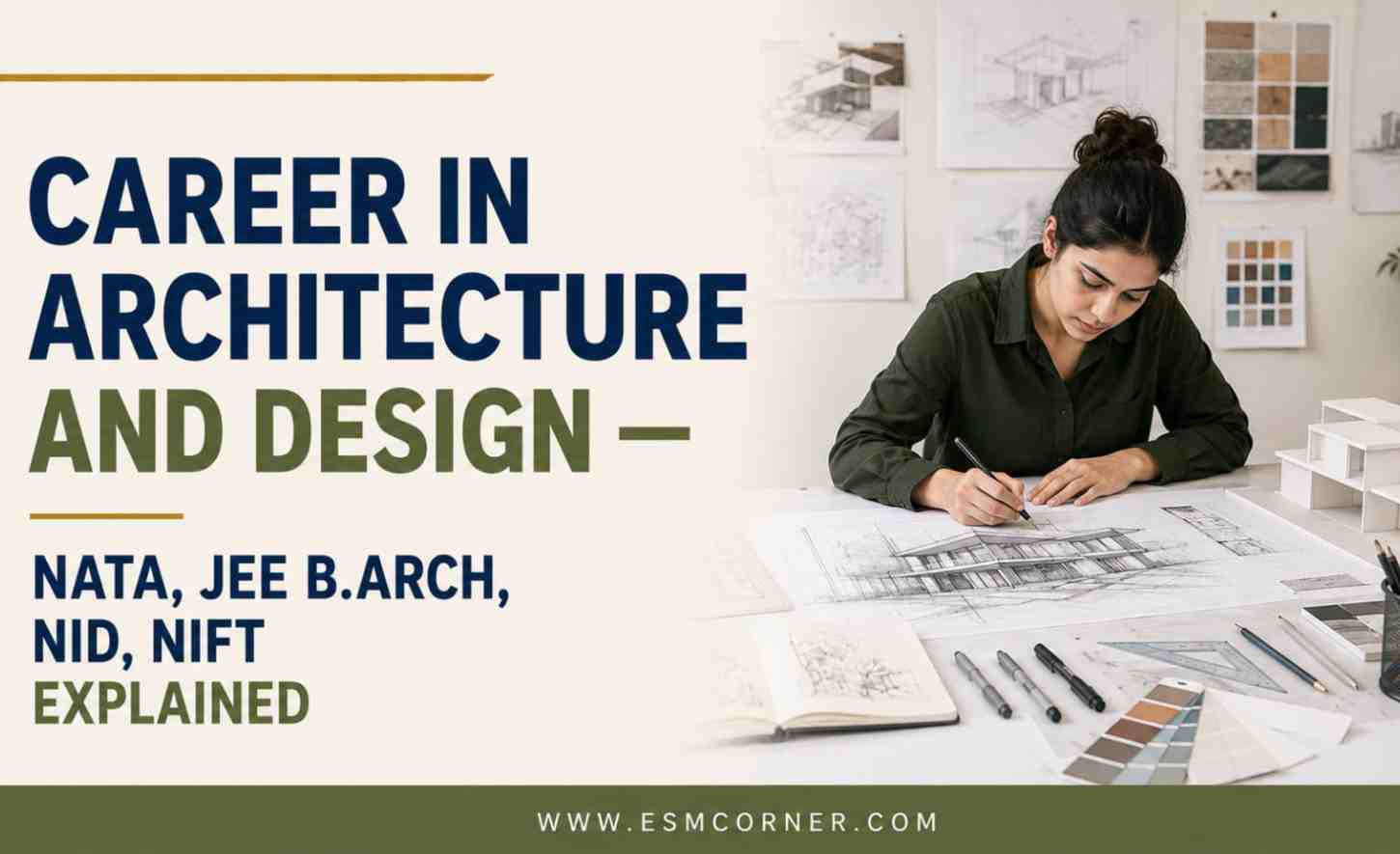
Do you love doodling in your notebooks during class? Maybe you find yourself re-arranging your bedroom furniture to see how the room looks, or you notice the beautiful patterns on clothes and poster designs on the street. Many creative students after Class 10 or 12 feel a strong urge to pursue something visual and hands-on. However, when it comes to picking a college path, confusion quickly sets in. You hear terms like Architecture, Interior Design, Fashion Design, Product Design, and Graphic Design, alongside complex entrance exam names like NATA, JEE B.Arch, NID, and NIFT.
It is completely normal to feel overwhelmed by all these choices. Many people mistakenly think that entering these fields requires being a world-class painter. In reality, these professions are not just about making pretty pictures on paper. They are about observation, smart problem-solving, understanding how humans live, and communicating your ideas clearly. Whether you want to build eco-friendly homes, design comfortable sneakers, or create user-friendly mobile apps, your creative drive has real value. This comprehensive guide will break down every major Architecture and Design Career Option in simple language, clearing your doubts so you can confidently choose the path that best suits your personality.
Why Architecture and Design are Becoming Popular Careers
Have you ever wondered why every new coffee shop looks so stylish, or why mobile applications feel so easy to swipe through? That is the magic of professional designers and architects at work. In today’s fast-changing world, businesses realize that good design is no longer a luxury; it is an absolute necessity for success.
Modern buyers care deeply about how a product looks, feels, and functions. As a result, companies in India and around the globe are actively hiring skilled creative minds. This rapid growth has transformed creative fields from unconventional choices into highly respected, stable professional paths.
- High Demand for Smart Spaces: Cities are growing rapidly, creating a huge need for planners who can design functional homes, offices, and public parks.
- Digital Explosion: Every brand needs websites, mobile apps, digital graphics, and engaging advertisements to reach customers online.
- Focus on Sustainability: Creative professionals are leading the charge to build green buildings and eco-friendly products using recycled materials.
- Better Career Respect: Families now recognize that creative professions offer great financial rewards and executive growth alongside traditional fields like engineering or medicine.
Difference Between Architecture and Design
A common question students ask is: “If both fields are creative, how do I know the actual difference between them?” The simplest way to understand this distinction is to look at scale, structural rules, and daily focus.
Architecture focuses primarily on designing physical, built environments where human beings live, work, and play. Architects must balance visual artistic vision with strict mathematical, structural, and safety rules. They worry about load-bearing walls, weather conditions, local building laws, and long-term durability.
On the other hand, Design is a broad umbrella term that focuses on solving human problems across products, clothing, graphics, and digital systems. While architects work mainly with physical structures, designers focus heavily on user comfort, aesthetics, branding, and daily utility.
- Architecture: Focuses on buildings, urban planning, safety regulations, engineering principles, and long-term structures.
- Design: Focuses on user experience, product function, visual communication, fashion, and digital solutions.
- Education Path: Architecture usually requires a 5-year B.Arch degree, whereas Design degrees like B.Des generally take 4 years.
- Core Math Requirement: Architecture mandates studying Physics, Chemistry, and Mathematics in Class 12, while many Design streams welcome students from Arts, Commerce, and Science backgrounds alike.
Understanding the Major Entrance Exams
Navigating entrance examinations can feel confusing when every test seems to evaluate different creative abilities. Let us break down the four biggest entrance exams in India clearly.
What is NATA?
NATA (National Aptitude Test in Architecture) is the primary national-level test conducted for admission into 5-year B.Arch degree programs across India. It evaluates your visual observation, drawing proportion, spatial intelligence, aesthetic sensitivity, and logical thinking abilities rather than memorized textbook facts.
What is JEE B.Arch?
JEE Main Paper 2 (B.Arch) is a national exam specifically for entering architecture programs at prestigious government institutions like NITs, IIITs, and SPAs. It tests three distinct areas: Mathematics, Aptitude, and practical Drawing skills. Science stream students with Mathematics usually target both NATA and JEE B.Arch simultaneously.
What is NID?
The National Institute of Design (NID) conducts the Design Aptitude Test (DAT) to select students for its Bachelor of Design (B.Des) programs. The exam is divided into two stages: Prelims (written visual paper) and Mains (studio test and personal interview). NID focuses heavily on original thinking, problem-solving, and hand skills.
What is NIFT?
The National Institute of Fashion Technology (NIFT) conducts its entrance exam for students aiming for careers in fashion, apparel, textile, and accessory design. The exam tests creative ability, general knowledge, communication, and basic quantitative skills, followed by a hands-on situation test.
Quick Comparison of Key Exams and Careers
| Exam/Career | Best For | Leads To | Key Point |
| NATA | Architecture Aspirants | 5-Year B.Arch Degrees | Tests spatial reasoning and drawing skills |
| JEE B.Arch | Engineering-Minded Students | NITs, IIITs, SPAs B.Arch | Requires strong Class 12 Mathematics |
| NID DAT | Creative Problem Solvers | B.Des in Product, Graphic, UI/UX | Focuses heavily on innovative thinking |
| NIFT Entrance | Fashion & Style Enthusiasts | B.Des in Fashion, Textiles, Apparel | Balances business sense with artistic style |
| Interior Design | Spatial Layout Enthusiasts | Residential & Commercial Design | Focuses on indoor comfort and aesthetics |
Who Should Choose Which Path?
Are you still asking yourself, “Which field actually matches my personality?” Let us break down the key traits that suit each pathway best so you can self-evaluate accurately.
Choose Architecture If You:
- Enjoy thinking about large physical structures, houses, and urban spaces.
- Are comfortable with geometry, physics, and precise technical calculations.
- Like seeing long-term physical projects come to life over several years.
- Are prepared to commit to a rigorous 5-year degree program.
Choose Design If You:
- Love improving everyday objects like apps, furniture, shoes, or advertisements.
- Enjoy understanding human psychology and how people use objects daily.
- Prefer working across diverse industries like technology, media, entertainment, or retail.
- Want a flexible 4-year degree with varied specialization options.
Popular Design Specializations
If you lean toward a Design Career After 12th, you will find a wide range of specialized fields to explore. Here are the most prominent options:
- Graphic & Communication Design: Creating brand identities, visual logos, book layouts, and marketing campaigns.
- User Experience (UX) & User Interface (UI) Design: Designing easy-to-use digital screens for websites and smartphone applications.
- Industrial & Product Design: Creating physical consumer goods, from kitchen appliances to medical devices and gadgets.
- Fashion & Textile Design: Crafting clothing collections, patterns, fabrics, and wearable accessories.
- Interior & Furniture Design: Planning comfortable, functional indoor layouts for homes, corporate offices, and retail stores.
Essential Skills for Creative Success
Entering a Creative Career Option requires cultivating a balanced mix of artistic, technical, and soft skills. Success in these fields depends on more than just raw drawing talent.
1. Curiosity & Observation Skills
Top designers notice small details that others overlook. Pay attention to how people sit on public benches, how doors open, or how colors make people feel.
2. Basic Drawing & Sketching
You do not need to draw like a fine artist, but you must be able to sketch your ideas on paper clearly so clients and team members understand your thoughts.
3. Digital Tool Mastery
As you progress, you will learn software tools like AutoCAD, Photoshop, Illustrator, Figma, or Rhino to bring your rough paper concepts to life digitally.
4. Communication & Presentation
A design is only as good as your ability to explain it. You must confidently present your choices to clients, builders, and project managers.
Portfolio Importance and Preparation
When applying to top private colleges or landing your first job, your mark sheet takes a back seat to your professional portfolio. A portfolio is a curated collection of your best creative work that showcases your thought process.
- Show Your Process: Include rough sketches, brain dumps, and failed attempts—not just finished, polished artwork.
- Include Diversity: Show a variety of work such as nature sketches, 3D paper models, photography, or personal craft projects.
- Solve Real Problems: Include at least one small project where you redesigned a flawed everyday object to make it more useful.
- Keep It Clean: Organize your work neatly with short, simple captions explaining what you built and why.
Career Opportunities: Government, Private, Freelancing & Entrepreneurship
Graduating with an architecture or design degree opens doors across multiple employment sectors, giving you flexibility throughout your career.
- Government Sector: Architects and urban planners are hired by municipal corporations, railways, housing boards, and smart city development departments.
- Private Industry: Top real estate developers, tech firms, advertising agencies, automobile brands, and fashion houses recruit designers continuously.
- Freelancing Freedom: Many designers work independently, taking project-based assignments from global clients while working flexibly from home.
- Entrepreneurship: Starting your own design agency, architecture firm, fashion label, or decor startup is a common path for experienced professionals.
Common Mistakes Students Make
To ensure a smooth transition into higher education, avoid these common traps that many aspirants fall into:
- Confusing Fine Arts with Design: Assuming that being good at painting automatically means you will love structural architecture or UI/UX design.
- Ignoring Mathematics: Forgetting that architecture entrance exams like JEE B.Arch require a solid foundation in Class 12 mathematics.
- Relying Only on Coaching: Depending entirely on exam coaching classes while neglecting personal observation skills and real-world curiosity.
- Copying Other Portfolios: Filling your portfolio with copied internet art instead of showing your original, authentic creative thoughts.
Conclusion
Choosing a Career in Architecture or pursuing a Design Career After 12th is an exciting choice for anyone who wants to combine creative passion with practical problem-solving. Whether you aim for top government institutes like NID, NIFT, and NITs through exams like NATA, JEE B.Arch, or private universities, remember that these fields value original thinking, curiosity, and continuous learning above all else.
Take time to evaluate your natural strengths, talk with working professionals, and practice observing the world around you with fresh eyes. Do not select a career path based merely on temporary trends or peer pressure. Choose the path that lights up your imagination every day—because when you love what you build and design, a fulfilling and successful career naturally follows.
REAS ALSO: SSC (NON-TECH) WOMEN ENTRY – COMPLETE GUIDE FOR INDIAN ARMY OFFICER ENTRY
Frequently Asked Questions
1. Is drawing talent mandatory for clearing NATA and NID?
Drawing is important, but exams look for proportion, perspective, observation, and idea generation rather than painterly perfection. Basic sketch clarity can easily be improved with regular daily practice before the exam.
2. Can Commerce or Arts students apply for NATA and JEE B.Arch?
JEE B.Arch strictly requires Physics, Chemistry, and Mathematics in Class 12. NATA eligibility rules updated periodically generally require Physics, Chemistry, and Math background, whereas general Design courses (NID/NIFT) welcome students from any academic stream.
3. What is the main difference between NID and NIFT degrees?
NID focuses broadly on industrial products, graphic design, animation, and digital user interfaces. NIFT specializes specifically in fashion design, apparel production, textile materials, fashion management, and lifestyle accessories.
4. How long does it take to complete Architecture and Design degrees in India?
A Bachelor of Architecture (B.Arch) degree takes 5 years of full-time study. In contrast, a Bachelor of Design (B.Des) degree in India is completed over 4 academic years.
5. Do I need an expensive laptop right from my first year?
During your initial foundation year, most institutes focus on manual drawing, hand modeling, and basic concepts. You can purchase a high-end graphic laptop in your second year as software demands increase.
6. Is Interior Design covered under Architecture degrees?
Architects study indoor spatial planning and structural changes during their degree. However, specialized Interior Design degrees focus exclusively on interior aesthetics, lighting, furniture, materials, and soft furnishings without heavy structural engineering elements.
7. What higher education options exist after completing B.Des or B.Arch?
You can pursue M.Arch or M.Des degrees in specialized fields such as Urban Planning, Transportation Design, Interaction Design, Sustainable Architecture, or an MBA in Design Management.
8. Are private design colleges worth considering alongside government institutes?
Yes, many reputed private design universities offer world-class infrastructure, updated industry-aligned curricula, foreign exchange programs, and excellent campus placement networks comparable to government institutes.
For daily defence updates, government notifications, recruitment alerts, welfare schemes, career opportunities, education news, and other important announcements, join our WhatsApp Community. Click here to join our WhatsApp Group.