

Source: SC
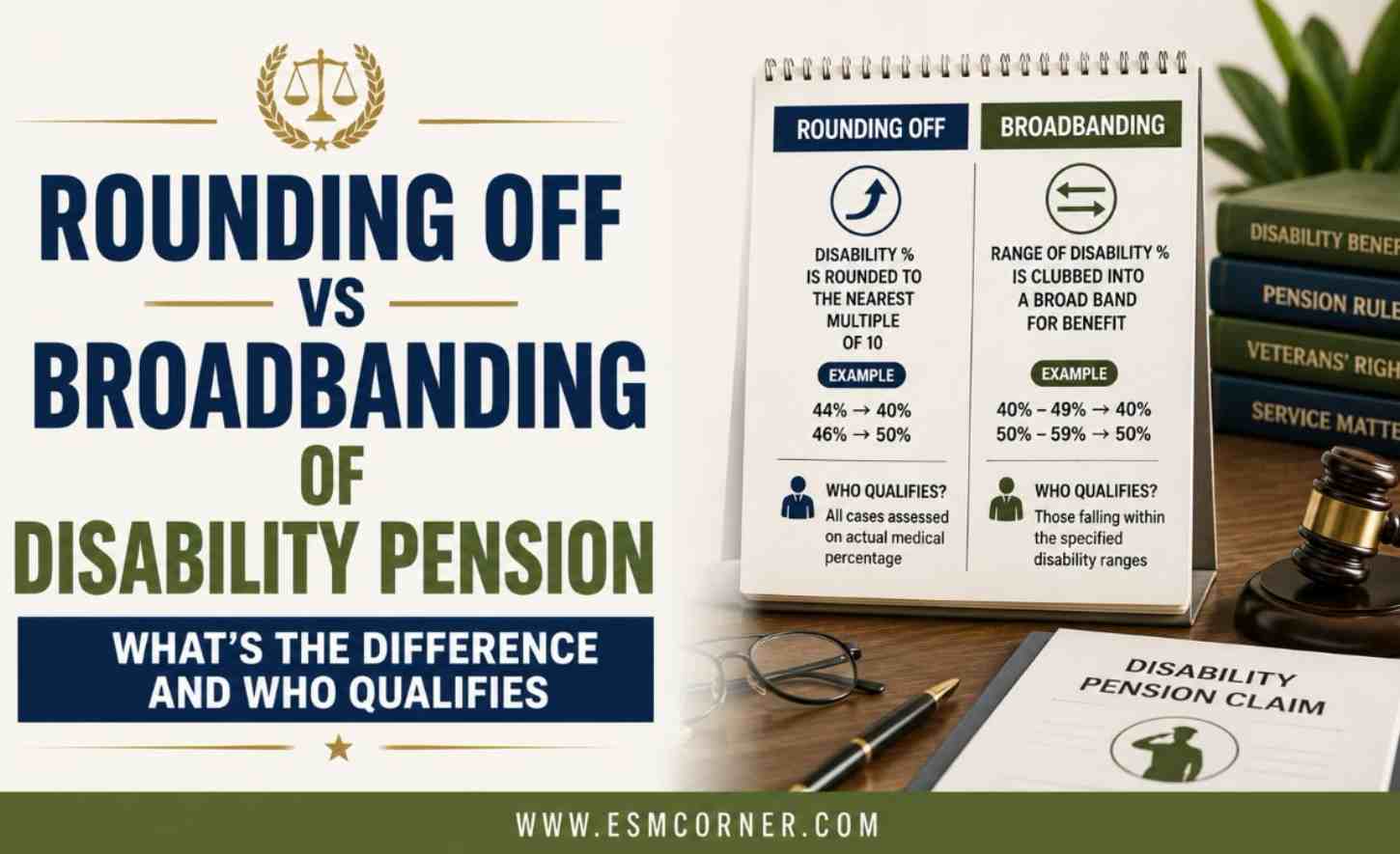
These two terms get used almost interchangeably by veterans, but understanding the real difference in the rounding off vs broadbanding disability pension conversation can directly affect how much pension you’re entitled to. This guide breaks down what each term actually means and who qualifies.
What Is Broadbanding, in Simple Terms?
Broadbanding is a policy that rounds up an assessed disability percentage to the nearest standard slab, rather than paying strictly proportional to the exact percentage assessed. Under this system, a disability of up to 49% is rounded up to 50%, a disability between 50% and 75% is rounded up to 75%, and a disability of 76% and above is rounded up to 100%.
Why This Matters Financially
This is a significant benefit. Instead of receiving a pension calculated on your exact, sometimes lower, assessed disability percentage, broadbanding ensures you receive the more generous “slab” rate, which can substantially increase your monthly disability element.
The Big Legal Dispute: Who Actually Qualifies?
For years, this benefit was applied narrowly — a 2001 government policy letter granted broadbanding only to personnel who were “invalided out” of service on medical grounds. This excluded personnel who retired or were discharged through other modes, even if their disability was equally genuine and equally connected to service.
The Ram Avtar Judgment That Changed Everything
This restrictive approach was successfully challenged before the Supreme Court in Ram Avtar v. Union of India. The Court held clearly that the benefit of rounding off disability pension cannot be restricted only to those invalided out of service, and must be extended to all Armed Forces personnel entitled to disability pension, regardless of their specific mode of discharge.
What About Arrears? A Recent Supreme Court Clarification
A more recent Supreme Court ruling addressed another important angle: once a veteran’s entitlement to broadbanding is judicially settled, arrears cannot be arbitrarily restricted to just three years before the claim. The Court upheld payment of arrears going back to 1 January 1996, or the date of retirement,
whichever is later, rejecting any blanket three-year cap once entitlement is legally established.
What Is “Rounding Off” Then, Exactly?
In practice, “rounding off” and “broadbanding” refer to the same core mechanism
— rounding an assessed disability percentage up to the nearest standard slab (50%, 75%, or 100%). The terms are often used interchangeably in judgments and policy letters, which is part of why the distinction can feel confusing.
Important Exception: The 20% Threshold
One important limit worth knowing: the Supreme Court has also clarified that no disability element is payable where the assessed disability is less than 20% in the first place — rounding off and broadbanding only come into play once this basic threshold is crossed.
Step 1: Check Your Assessed Disability Percentage
Confirm your Medical Board’s exact assessed percentage, and check whether it falls within a rounding slab that hasn’t been properly applied in your pension calculation.
Step 2: Check How You Were Discharged
If your broadbanding was denied specifically because you were not “invalided out,” this is now a settled, winnable point following Ram Avtar, regardless of your discharge category.
Step 3: Raise a Claim for Correction and Arrears
If broadbanding wasn’t properly applied, or arrears were wrongly restricted to three years, this can be raised through a representation and, if needed, before the AFT, citing both the Ram Avtar and the more recent arrears rulings.
Final Thoughts
Understanding disability pension broadbanding rules and your rounding off eligibility can meaningfully change your monthly pension amount and any arrears owed to you. The law has moved decisively in favour of extending this benefit broadly, regardless of discharge category.
tailored to your case.
If you want help with your specific situation, get in touch with ESM Corner’s Legal Help team for guidance tailored to your case.
Frequently Asked Questions
Q1: What is the difference between rounding off and broadbanding?
A1: In practice, they refer to the same mechanism — rounding an assessed disability percentage up to the nearest standard slab of 50%, 75%, or 100%. The terms are often used interchangeably.
Q2: Does broadbanding only apply to personnel who were invalided out?
A2: No, not anymore. The Supreme Court in Ram Avtar v. Union of India held that this benefit must be extended to all Armed Forces personnel entitled to disability pension, regardless of their mode of discharge.
Q3: What are the standard broadbanding slabs?
A3: A disability of up to 49% is rounded to 50%, between 50% and 75% is rounded to 75%, and 76% and above is rounded to 100%.
Q4: Can I claim more than three years of arrears for broadbanding?
A4: Yes, according to a recent Supreme Court ruling, once broadbanding entitlement is judicially settled, arrears cannot be restricted to just three years and can go back further, subject to the specific facts of the case.
Q5: Is there a minimum disability percentage needed to get any benefit at all?
A5: Yes. The Supreme Court has clarified that no disability element is payable where the assessed disability is below 20%.
Q6: What should I do if I was denied broadbanding because I wasn’t invalided out?
A6: This is now a settled legal point in your favour following Ram Avtar v. Union of India, and is worth raising through a representation or an AFT case. Meta Title Kit
Want regular updates on pension, legal, and welfare matters for veterans? Join the ESM Corner WhatsApp group.






























Do you mean as under:-
Disability Rounding up
20 or+20-49%. 50%
50 or+50-74%. 75%
75 or+75-99%. 100%