
The retirement certificate is signed. The farewell parade is done. The family is together after years of postings and separations. And then the money arrives.
Gratuity. Commutation. Leave encashment. Provident fund. It looks like a large amount sitting in the bank account — perhaps more money than the family has ever seen together in one place.
This moment feels like the beginning of financial comfort. For many defence families, it sadly becomes the beginning of financial problems.
The first five years after retirement are arguably the most important financial years of a veteran’s life. The decisions made during this period — how money is spent, saved, invested, or given away — directly shape the next 30 to 40 years of retirement life.
And unfortunately, these five years are also when the most damaging financial mistakes are made.
Mistake 1 — Believing Pension Alone is Enough
This is the most common and most expensive mistake of all.
Pension is reliable and genuinely valuable. But it is a fixed or slowly growing income in a world where expenses never stop rising.
Consider what increases every year after retirement — medical costs, household expenses, children’s education or marriage support, home maintenance, and emergency requirements. Inflation quietly adds to each of these year after year.
A pension that feels comfortable at 50 may feel genuinely tight at 65. Many retirees realise this too late — when savings are already reduced and earning opportunities are limited.
Pension should be treated as the foundation of retirement income, not the complete structure. Additional financial support must be built during service years or in the early years of retirement.
Mistake 2 — Spending Retirement Benefits Too Quickly
The lump sum received at retirement feels like financial freedom. And for many families, a spending wave begins almost immediately.
House construction or major renovation. A new expensive vehicle. Repaying relative’s loans. Lavish celebrations. A business idea that was not properly researched. Family pressure to fund various needs immediately.
None of these are necessarily wrong individually. The problem is doing all of them together in the first one to two years without a proper plan — leaving the retirement corpus significantly depleted before any serious financial planning begins.
A practical rule that many financial advisors suggest is to avoid any major irreversible financial decision in the first three to six months after retirement. Let the emotional relief of retirement settle. Then plan carefully with a clear head.
Mistake 3 — Investing Blindly Chasing Higher Returns
After retirement, some people swing to the opposite extreme. Instead of spending everything, they want to “make their money work harder” — and start investing in anything that promises high returns.
An unknown mutual fund scheme recommended by an agent. A relative’s business that “cannot fail.” A real estate deal that needs immediate decision. A stock tip shared in a WhatsApp group.
Retirement money is irreplaceable. There is no salary to recover losses. This is exactly why retirement savings require more caution, not less.
Higher returns always come with higher risk. Anyone promising guaranteed high returns on retirement money without clearly explaining the downside is not acting in your interest.
Mistake 4 — Underestimating Medical Expenses
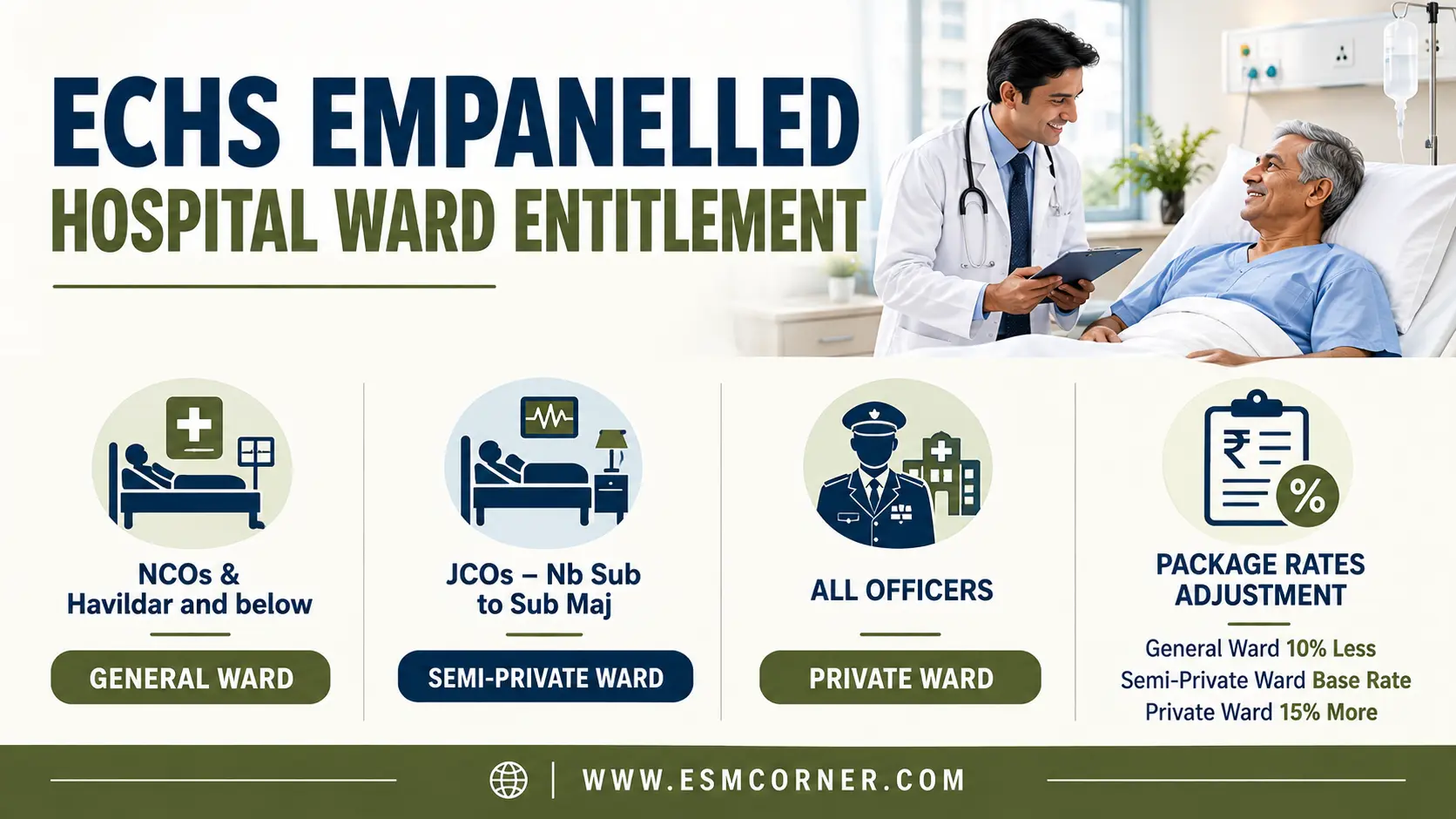
This is the mistake that catches most families completely off guard. During service years, ECHS and service medical facilities provide significant support. After full retirement, while some facilities continue, the overall financial burden of healthcare increases meaningfully with age.
Regular medicines for chronic conditions like blood pressure, diabetes, or heart issues can cost several thousand rupees monthly. A single hospitalisation can cost ₹50,000 to several lakhs depending on the condition and hospital. Diagnostic tests, specialist consultations, and emergency procedures add further.
Healthcare inflation in India rises faster than general inflation. Without a dedicated medical emergency fund of at least ₹3 to ₹5 lakh kept separately in accessible savings, one medical emergency can severely disrupt the entire retirement financial plan.
Mistake 5 — Lending Retirement Money to Relatives and Friends
Retirement brings a new kind of social pressure that many veterans are not prepared for. Relatives who knew you received a large retirement payout begin approaching with requests. A cousin needs money to start a business. A friend needs a loan to handle a family situation. A brother-in-law has a “sure profit” investment opportunity.
The pressure often comes wrapped in emotion — family loyalty, friendship, helpfulness. And many retirees give generously, sometimes without any written agreement.
In a majority of such cases, the money does not return. The relationship often suffers too. And the retiree is left with permanently reduced savings and a painful lesson.
Setting clear and honest boundaries about retirement money is not selfishness. It is responsible protection of your family’s long-term security.
Mistake 6 — Keeping Everything Idle in Savings Accounts
Some retirees go entirely the other direction from risky investing. Frightened by stories of fraud and market losses, they keep everything in savings accounts or low-interest fixed deposits and refuse to invest anywhere.
Safety is important. But savings account interest of 3 to 4 percent cannot keep pace with inflation running at 6 to 7 percent. Over 20 years of retirement, this gap significantly reduces the real value and purchasing power of savings.
A balanced approach — combining safe stable options for short-term needs and emergency reserves with some growth-oriented investments for long-term stability — is more practical than choosing one extreme over the other.
Mistake 7 — Ignoring Financial Documentation and Nominations
Many retirees receive pension, organise basic expenses, and then completely ignore the state of their financial documents.
Old nominations list deceased relatives. Insurance policy locations are unknown to the spouse. Mutual fund investments exist on a platform only the veteran knows. Property papers are scattered across three different files in different rooms.
This is not just an inconvenience. This is a serious risk to the family’s ability to access financial benefits when genuinely needed — whether during a medical emergency or after death.
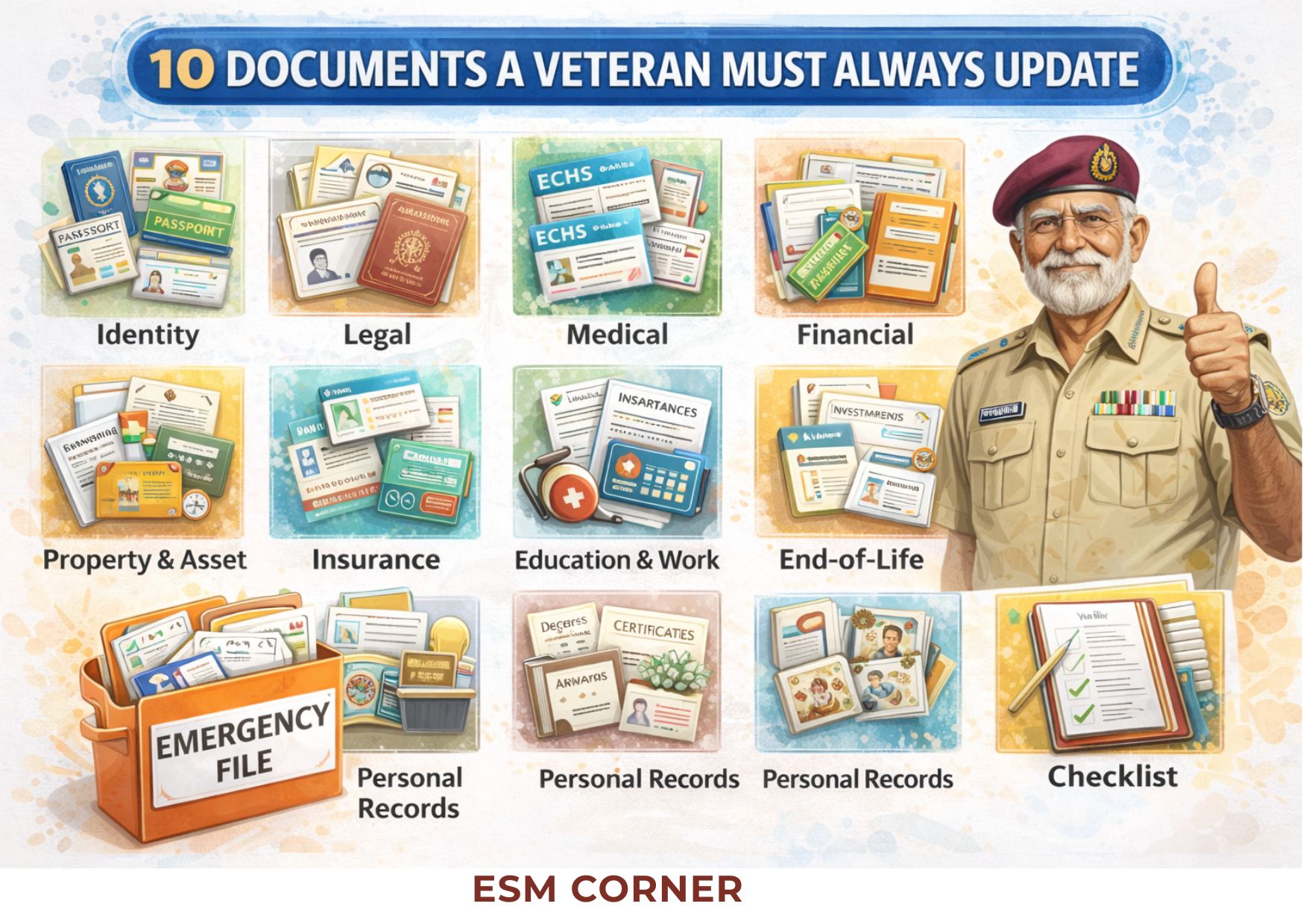
Organising documents, updating nominations, and ensuring the spouse knows the basic financial picture is as important as any investment decision.
Mistake 8 — Stopping All Financial Planning After Pension Begins
Many retirees treat the arrival of pension as the end of financial planning. Pension is here. Job is done. This mindset becomes costly over time. Retirement can last 35 to 40 years. During that entire period, inflation continues, expenses evolve, family needs change, and medical requirements grow.
Continuing some form of financial planning — even modest — throughout retirement is what maintains long-term comfort and dignity. This might mean a small SIP continued into retirement, a systematic withdrawal plan set up from accumulated savings, rental income from a property, or simply a regular annual review of financial situation and documents.
Conclusion
Retirement from the armed forces is earned through decades of sacrifice, discipline, and service. That sacrifice deserves to be protected through equally disciplined financial decisions after retirement.
Most retirement financial problems do not happen because pension is insufficient. They happen because the first five years are spent without a clear plan — money flows out faster than expected and the financial foundation weakens before it is properly built.
Spend carefully in the first year. Protect the retirement corpus from impulsive decisions. Build emergency medical savings. Maintain and update financial documents. Continue some form of long-term financial planning.
The soldier who secures his position after the battle is won understands that the work is never truly finished. Financial security after retirement requires the same sustained discipline.
READ ALSO: CIBIL SCORE FOR DEFENCE PERSONNEL
Frequently Asked Questions
Q1. Why are the first five years after retirement the most financially important?
This is when retirees receive their largest lump sums — gratuity, commutation, leave encashment, and provident fund. How you use this money directly shapes the next 30 years. Good decisions create lasting comfort. Poor decisions — overspending, bad investments, or lending to relatives — are very hard to recover from once earning capacity is gone.
Q2. What is the most common retirement planning mistake defence families make?
Depending entirely on pension without building any additional income. Pension is reliable but inflation, rising medical costs, and family responsibilities stretch it thin over 30–40 years. Many families realise this only when savings are already gone. Even modest additional income through SIP, SWP, or safe savings schemes makes a significant long-term difference.
Q3. Why do retirees lose money in risky investments?
After receiving a large retirement lump sum, many want to grow it quickly. Unverified agents, social media tips, and high-return schemes trap people who don’t understand the risks. Retirement money is irreplaceable — there is no salary to recover losses. Any investment promising unusually high guaranteed returns deserves extreme caution and independent verification before committing a single rupee.
Q4. Why must medical emergency savings be a priority after retirement?
Medical expenses rise sharply with age. Healthcare inflation in India grows faster than general inflation every year. Without a dedicated emergency fund of at least ₹3 to ₹5 lakh in accessible savings, one unexpected hospitalisation can derail your entire retirement financial plan. Medical planning is not optional — it is the most urgent priority for every newly retired defence family.
Q5. Is keeping all retirement money in a savings account safe?
No. Savings accounts give 3–4% interest while inflation runs at 6–7% annually. Over 20 years your balance appears to grow but real purchasing power quietly shrinks. Combine accessible savings for emergencies with some balanced growth investments that can maintain your purchasing power throughout the long retirement period.
Q6. Should retirees lend money to relatives or friends?
Large informal loans during retirement carry serious risk. In many cases the money doesn’t return, and the loss is permanent because earning capacity is limited. If you genuinely want to help, only give what you can afford to lose completely without affecting your own security. Any larger arrangement must involve written documentation and honest assessment of repayment ability.
Q7. What happens when financial documents are not properly organised?
Delayed pension claims, blocked bank access, insurance rejections, property disputes, and permanently unclaimed investments. Families often don’t know which accounts or policies even exist. Organise all documents, update nominations, and ensure your spouse knows the basic financial picture — this is as important as any investment decision you make.
Q8. Why is passive income planning important even after retirement begins?
Retirement can last 35–40 years. Pension alone, with inflation eating into it every year, creates growing financial pressure over time. Even small additional monthly income — from SWP, rental income, savings scheme interest, or small skill-based work — significantly improves long-term comfort and dignity without requiring complex strategies or large capital.
Q9. How should emotional financial decisions be managed during retirement?
Emotional decisions driven by fear, family pressure, or excitement cause most retirement financial mistakes. Simple solution — never commit retirement money within 24 to 48 hours of being asked. Always discuss major decisions with a trusted family member first. Treat retirement money with the same discipline as military planning — no decisions under pressure, always verify, always think consequences through carefully.
Q10. What is the most practical overall approach to retirement financial planning?
Spend carefully in the first year. Build a ₹3–5 lakh emergency medical fund immediately. Keep retirement corpus in a balanced mix of safe savings and modest growth investments. Set clear boundaries around lending to relatives. Update all documents and nominations right away. Review finances every year. Treat pension as the foundation — not the entire structure — and build at least one or two modest additional income sources for genuine long-term stability.
For daily defence updates, government notifications, recruitment alerts, welfare schemes, career opportunities, education news, and other important announcements, join our WhatsApp Community. Click here to join our WhatsApp Group.