
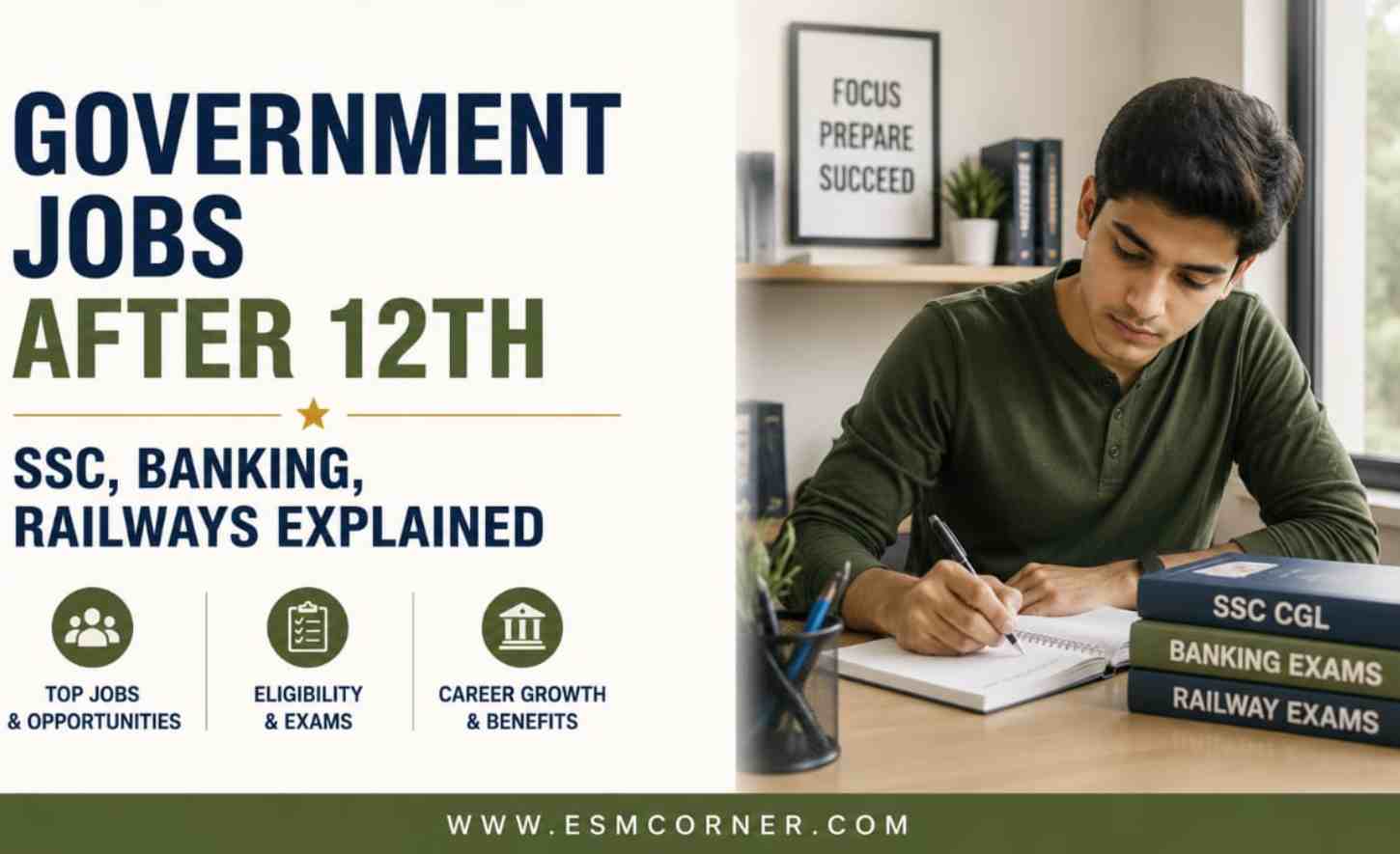
For many Indian families, a government job remains one of the most trusted career choices. The combination of job security, a stable income, social respect, and long-term benefits like a pension makes it highly attractive. However, many students wrongly believe that these careers are meant only for toppers or that clearing the exams requires extraordinary talent.
In reality, every year thousands of 12th-pass candidates from Science, Commerce, and Arts backgrounds are selected for roles in SSC, Banking, Railways, Defence, and Postal Services. Success depends far more on understanding the exam pattern, meeting the eligibility requirements, and preparing with consistency than on being exceptionally brilliant in school. Let’s explore the available opportunities one by one.
Where Do These Government Jobs Actually Exist?
Before jumping into specific exams, it helps to understand the four broad categories these opportunities fall under:
- Central Government Jobs – Positions in federal ministries and departments across the country. These come with uniform pay, great allowances, and the option to get transferred nationwide.
- State Government Jobs – Recruited through your state’s own public service boards. You stay rooted in your home state, working on local administration and regional matters.
- Public Sector Undertakings (PSUs) – Government-owned companies that operate like corporates but come with public-sector stability, decent bonuses, and modern work setups.
- Uniformed Services – Armed forces, police, and security units, ideal for those who want a disciplined, active career serving the nation.
Now let’s look at the specific exams within these categories that you can actually target right after 12th.
SSC CHSL: The Clerical Gateway to Central Ministries
This is one of the most respected entry points into federal desk jobs — recruiting for roles like Lower Division Clerk, Junior Secretariat Assistant, and Data Entry Operator. Perfect if you’re organised and enjoy structured, office-style work in ministries like External Affairs or Income Tax.
- Eligibility: 18-27 years, must have passed Class 12.
- Selection: Two stages — Tier 1 is a multiple-choice test (English, Maths, Reasoning, GK), Tier 2 adds an objective test plus a mandatory typing test.
- Growth: Clerk → Upper Division Clerk → Assistant Section Officer → Section Officer.
- Salary: Roughly ₹30,000-₹45,000 per month depending on your city. The catch? Cut-offs can be quite competitive.
SSC MTS: The Easiest Entry Into Government Service
If you want a simpler, more direct way into the system, SSC MTS (Multi-Tasking Staff) is your best bet. It keeps government offices running smoothly on a day-to-day basis.
- Eligibility: Technically just Class 10, but tons of Class 12 students apply too, thanks to the wide 18-27 age window.
- Selection: A single computer-based exam in two sessions — one qualifying (Maths & Reasoning), one that decides your final merit (GK & English).
- Growth: Can move up into the Lower Division Clerk cadre through internal promotions.
- Salary: Around ₹24,000-₹28,000 to start. Easier exam, but the work itself is fairly hands-on and physical.
SSC Selection Posts: The Hidden Gem Most Students Ignore
This one flies under the radar, but it’s worth knowing about. Instead of one big cadre, it fills very specific roles across departments — lab assistants, junior draftsmen, data verifiers, and more. Great if you did a vocational course or a specific subject combination in Class 12.
- Eligibility: 10+2 with subject-specific requirements depending on the post.
- Selection: A single written computer-based test, plus practical or skill tests for technical roles.
- Salary: ₹28,000-₹46,000, and here’s the best part — way less competition per seat compared to bigger exams.
Banking Jobs: For the Numbers-Minded Crowd
Yes, most core bank clerk jobs need a graduation degree, but plenty of regional and cooperative banks directly recruit 12th-pass candidates too.
- Eligibility: 18-25 years with 10+2 and a clean academic record.
- Selection: Online tests covering Numerical Ability, Reasoning, English, and basic Computer skills, plus a mandatory local language test.
- Growth: Clerk to Scale-I Officer within a few years through internal exams.
- Salary: Around ₹26,000-₹32,000 to start, with one of the fastest promotion tracks around — though you will be handling busy public counters daily.
Railway Jobs: A Career as Big as the Network Itself
Indian Railways is one of the largest employers on the planet, and RRB NTPC (Undergraduate) opens up roles like Commercial cum Ticket Clerk, Accounts Clerk, and Junior Clerk.
- Eligibility: 18-30 years, Class 12 passed with at least 50% (general category).
- Selection: Two-stage computer-based test covering Maths, General Intelligence, and GK, with a typing test for some roles.
- Growth: Can rise to Assistant Station Master, Commercial Inspector, or Section Supervisor.
- Salary: ₹30,000-₹38,000 plus excellent travel passes and medical benefits — though shift work can get irregular.
India Post: The Fastest Way Into Government Service
Want to skip long exam battles entirely? India Post recruits massive numbers of Gramin Dak Sevaks (GDS), Branch Postmasters, and Assistant Branch Postmasters.
- Eligibility: 18-40 years. Selection is largely based on your Class 10 marks, though 12th-pass students get preference for higher posts.
- Selection: No written exam at entry level — it’s purely merit-based on your academic percentage.
- Salary: ₹12,000-₹15,000 to start — lower pay, but zero entrance exam stress, and a clear path to becoming a permanent Postal Assistant later.
Defence and Uniformed Services: For the Ones Who Want to Serve
If discipline, patriotism, and active fieldwork excite you, this is where you belong. The NDA remains the gold standard for becoming a commissioned officer in the Army, Navy, or Air Force.
- Eligibility: NDA needs unmarried candidates aged 16.5-19.5, with Navy/Air Force strictly requiring Physics and Maths. Police and CAPF constable roles are open to general 12th-pass candidates aged 18-25.
- Selection: NDA involves a tough UPSC written exam followed by a 5-day SSB interview. Police/CAPF roles focus on a written test plus physical fitness tests.
- Salary: NDA officer cadets start at around ₹56,100 basic pay; police constables start around ₹21,700 basic. Huge honour and top-tier fitness standards come attached, along with real operational risk.
State Government and Forest Department Jobs
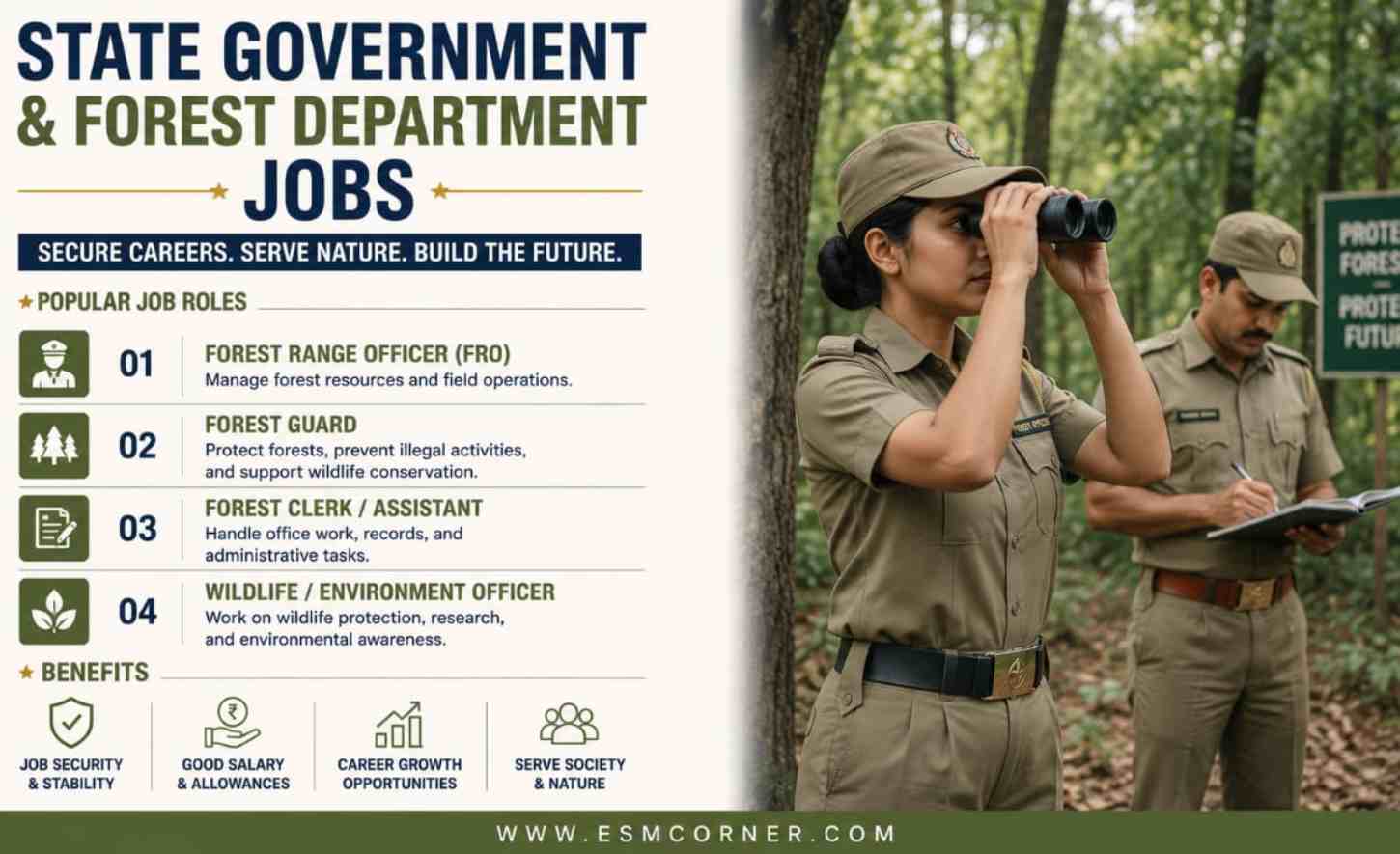
Every state runs its own recruitment for roles like Junior Assistant, Panchayat Secretary, Lekhpal, and Forest Guard — great if you want to work close to home.
- Eligibility: 18-40 years with 10+2 from a recognised board.
- Selection: Written tests focused on regional history, local language, and general studies. Forest guard roles add a physical endurance test.
- Salary: ₹25,000-₹35,000 roughly, with growth into Senior Assistant, Revenue Inspector, or Deputy Forester roles.
Quick Comparison Table
| Exam / Job | Basic Eligibility | Selection Process | Career Growth |
|---|---|---|---|
| SSC CHSL | 10+2, Age 18-27 | Tier-1 + Tier-2 (Objective + Typing) | Upper Division Clerk → Section Officer |
| RRB NTPC (UG) | 10+2 (50%), Age 18-30 | CBT Stage-1 + Stage-2 + Typing | Assistant Station Master → Chief Supervisor |
| NDA Entry | 10+2 (PCM for Navy/Air Force), Age 16.5-19.5 | UPSC Written Exam + 5-Day SSB | Commissioned Officer → General ranks |
| State Police Constable | 10+2, Age 18-25 | Written Test + Physical/Medical Tests | Head Constable → ASI → Sub-Inspector |
| SSC MTS | 10th/12th Pass, Age 18-27 | Single-Stage CBE | Internal promotion to LDC |
Does Your Stream Actually Matter?
Short answer: not really. Science students often have an edge in technical exams like NDA or Air Force thanks to their Maths background, while Arts and Commerce students tend to do well in General Awareness and Economics-heavy sections. But honestly, consistent preparation beats your stream every single time.
Here’s a simple way to decide where to focus:
- Good with Maths and speed-based questions? Go for SSC and Banking exams.
- Strong at General Knowledge and memorisation? Railways and State Government exams suit you better.
Should You Drop Studies to Focus on Exam Prep?
This is where a lot of students panic — job now, or degree first? Here’s the honest answer: don’t completely give up your higher education. You can absolutely pursue a regular or distance-mode degree alongside structured exam preparation.
A government job right after 12th gives you early financial independence, but having a degree later unlocks bigger opportunities — Group B and Group A gazetted officer exams like SSC CGL or even civil services. Treat your first government job as a stepping stone, not necessarily your final destination.
How to Actually Prepare (Without Losing Your Mind)
Random, chaotic studying doesn’t work for these exams. Here’s a proven three-phase approach:
- Months 1-3 — Build the Foundation: Focus purely on core concepts — quantitative aptitude, English grammar, and reasoning basics. Don’t rush into mock tests yet.
- Months 4-6 — Build Speed: Start daily topic-wise quizzes, practice mental maths, and build a habit of reading current affairs regularly.
- Months 7-9 — Full Mock Tests: Take timed, full-length mocks under realistic conditions. Analyse every mistake. Also dedicate daily time to typing practice or physical fitness, depending on your target exam.
Common Mistakes to Avoid
- Preparing for too many exams at once. Instead, group exams with overlapping syllabi — like SSC CHSL, SSC MTS, and RRB NTPC together.
- Collecting endless PDFs and study guides without finishing any of them. Keep your material minimal and revise previous years’ papers at least three times.
- Believing average school marks will hold you back. Recruitment boards only care about your performance on exam day, not your Class 10 or 12 percentage.
- Assuming coaching is compulsory. It’s not. Millions crack these exams using free online resources and disciplined self-study.
- Thinking these roles aren’t suitable for women. That’s outdated — today’s public sector offers dedicated quotas, relaxed physical standards, safe environments, and equal pay.
A Quick Word on Family and Patience
The financial sector and SSC generally offer the fastest promotional tracks through internal departmental exams, letting a dedicated candidate jump pay grades faster than usual.
One last thing — talk openly with your parents about this journey. Help them understand that serious exam prep takes patience and realistically 12 to 18 months of focused effort. Their biggest contribution isn’t pressure — it’s giving you a calm, supportive environment to work in.
Conclusion
Government jobs after Class 12 offer financial security, career stability, and excellent growth opportunities. Success depends on consistent preparation, smart exam selection, and disciplined study rather than academic brilliance. Choose exams that align with your strengths and career goals, follow a structured preparation plan, practice regularly with mock tests, and stay patient. With dedication, achieving your dream government job is entirely possible.
READ ALSO: 10+2 TES ENTRY EXPLAINED : HOW PCM STUDENTS CAN BECOME ARMY OFFICERS WITHOUT A WRITTEN EXAM
Q1: Can I apply for SSC CHSL or Railway exams immediately after my Class 12 board results are announced?
A: Yes, you can apply the moment your official final marksheet is generated, provided you meet the specific age criteria (usually 18 years minimum) by the date specified in the official notification. Temporary or expected results do not qualify.
Q2: Is there a minimum percentage requirement in Class 12 to sit for the SSC CHSL exam?
A: No, the SSC CHSL exam requires a simple passing certificate in your 10+2 schooling. Your specific past school percentages or grades have no impact on your eligibility or final merit ranking.
Q3: Can an Arts stream student apply for undergraduate Railway NTPC positions?
A: Absolutely. All non-technical undergraduate positions within the Railways, such as Ticket Clerks or Junior Typists, are fully open to students from Arts, Commerce, or Science streams alike.
Q4: How long does the entire selection process take from the notification to the final appointment?
A: A typical central recruitment lifecycle across tiers, skill tests, document verification, and medical checks takes roughly 8 to 12 months to complete.
Q5: Can I prepare for these competitive exams effectively while pursuing a regular B.A. or B.Com degree?
A: Yes, many students successfully balance both. Dedicating 4 to 5 hours of disciplined study daily to your exam preparation is more than enough to cover the syllabus within a year.
Q6: What is the exact difference between central government jobs and state government jobs?
A: Central jobs feature uniform pay scales under the 7th Pay Commission and offer posts across India. State jobs operate under regional regulations, focus on local administration, and keep you posted within your home state.
Q7: Do I need to be exceptionally good at complex mathematics to crack the SSC MTS exam?
A: No, the mathematical component in the SSC MTS exam is basic, matriculation-level arithmetic. Focus on mastering foundational arithmetic concepts and practice regularly to build speed and accuracy.
Q8: What happens if I clear the written exam but fail the subsequent typing skill test?
A: For positions that explicitly require typing, failing the skill test disqualifies you from final selection. It is crucial to practice typing concurrently with your written preparation.
For daily defence updates, government notifications, recruitment alerts, welfare schemes, career opportunities, education news, and other important announcements, join our WhatsApp Community. Click here to join our WhatsApp Group.