
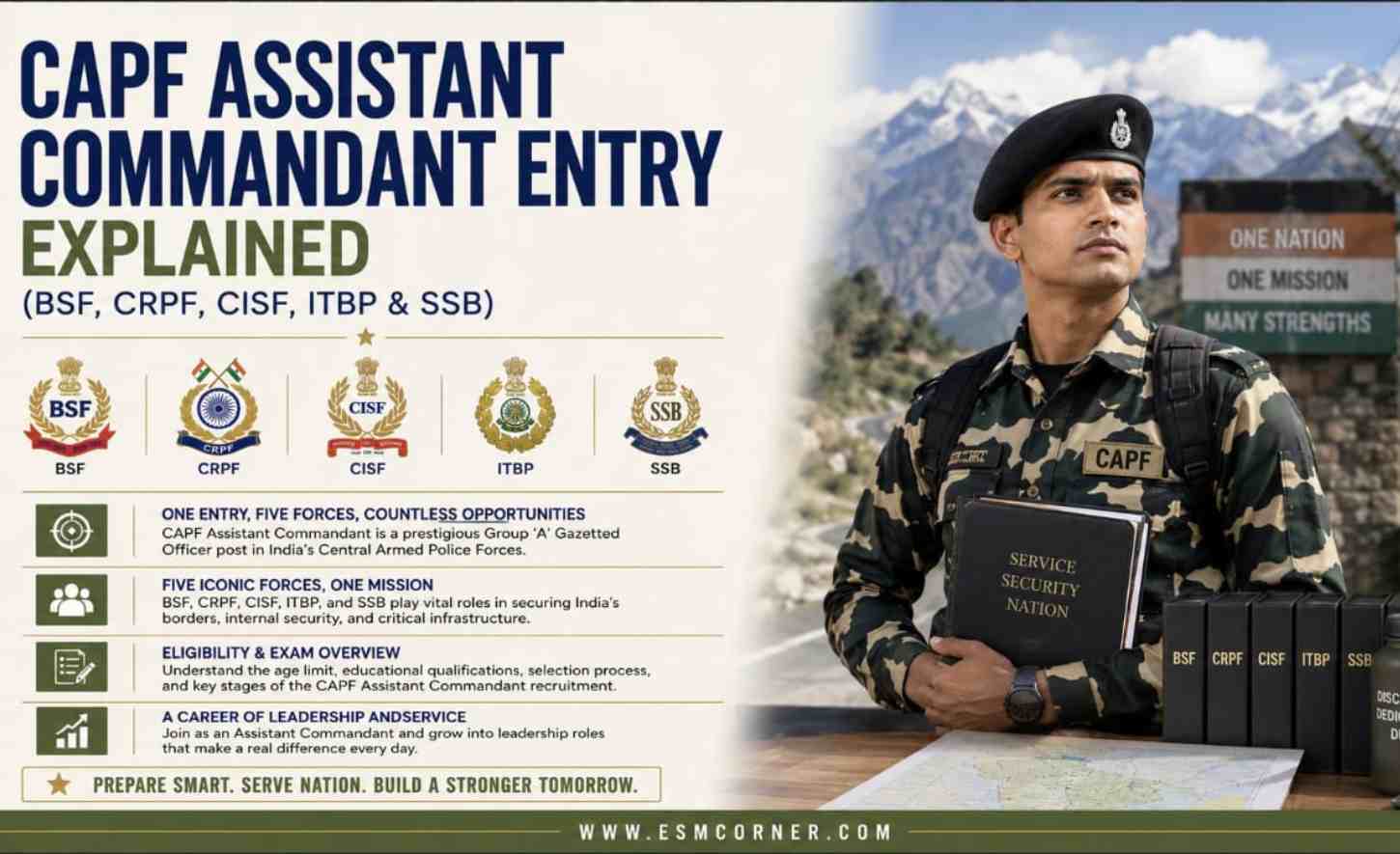
Talk to ten UPSC hopefuls about the CAPF AC post, and you’ll mostly get vague, half-formed answers — “Kuch police-military type ka officer job hai na, BSF CRPF wagera.” That’s usually where the knowledge ends. Which is a bit unfortunate, because this happens to be one of the most rewarding, action-packed, and genuinely respected Group A careers open to any regular graduate in India.
Let’s break it down properly, in plain language, without the dry government-brochure tone.
Lakhs of graduates dream about this uniform every year, and thousands actually sit for this UPSC exam. Why the pull? Simple — you get officer-level respect, the excitement of leading troops in live operational settings, and a pay package plus job security that most private-sector roles simply cannot beat. But don’t assume that it will be an easy journey. This exam demands sharp thinking for the written stage, physical toughness for the fitness rounds, and real maturity for the interview. It’s a complete personality test, not just a memory contest.
So what does an Assistant Commandant actually do on the job? Put simply, they act as the connecting link between force headquarters sitting far away in Delhi and the actual troops standing at the border or handling a tense ground situation. Quick decisions, full accountability, on-the-spot leadership — that’s the daily reality. It’s a big ask for someone barely into their twenties, but that’s precisely the kind of maturity this selection process is built to test for.
Five Different Forces, Five Very Different Lives
Here’s a detail many guides skip past too quickly — CAPF is not a single, uniform force. It’s actually an umbrella covering five separate forces, each offering a completely different work environment, challenge level, and lifestyle. Getting familiar with these differences early on genuinely helps when you’re later asked to rank your force preferences.
- BSF (Border Security Force) — Stationed along the Indo-Pakistan and Indo-Bangladesh borders. Expect deserts, riverbeds, harsh weather swings, and round-the-clock vigilance against infiltration attempts.
- CRPF (Central Reserve Police Force) — The country’s largest paramilitary force, deployed for internal security, anti-insurgency operations, and law-and-order duties in some of the most volatile regions of India.
- CISF (Central Industrial Security Force) — Responsible for securing airports, metro systems, nuclear installations, and other critical infrastructure. More urban-based, more tech-oriented, far less about ground combat.
- ITBP (Indo-Tibetan Border Police) — Deployed along the high-altitude Indo-China frontier. Sub-zero temperatures, thin air, long isolated postings — this force demands serious physical endurance.
- SSB (Sashastra Seema Bal) — Secures the Indo-Nepal and Indo-Bhutan borders, with a primary focus on intelligence gathering, border management, community engagement, and curbing cross-border smuggling instead of direct combat.
A quick comparison to keep things clear:
| Force | Deployment Zone | Typical Daily Responsibility |
|---|---|---|
| BSF | Indo-Pak & Indo-Bangladesh frontier | Border patrols, ambush duty, checkpoint monitoring |
| CRPF | Naxal belts, Jammu & Kashmir, North-East | Anti-terror operations, crowd/riot control |
| CISF | Airports, nuclear and space facilities | Surveillance systems, VIP protection, access control |
| ITBP | Himalayan Indo-China border | High-altitude patrols, mountain survival operations |
| SSB | Indo-Nepal & Indo-Bhutan frontier | Intelligence gathering, anti-smuggling, community liaison |
Basic Eligibility — Who’s Even Allowed to Try?
Nothing overly complicated here:
- A recognized Bachelor’s degree is mandatory (final-year students can still apply provisionally, so don’t sit around waiting for your result)
- Indian citizens qualify directly; applicants from Nepal or Bhutan need certain special clearances
- Prescribed age limits, physical standards, and medical fitness benchmarks apply, with the usual relaxations for reserved categories
The Selection Marathon — Three Major Rounds
This isn’t a single make-or-break exam day. It’s a long-drawn, multi-month process broken into three distinct stages — which, honestly, works in favour of well-rounded candidates instead of only rewarding bookish toppers.
- Round One — The Written Test: Split into two papers. The first checks your general awareness and reasoning through objective-type questions. The second is a descriptive paper involving essay writing and comprehension. Clearing both is your ticket to the next round.
- Round Two — Physical & Medical Screening: This is where your fitness routine (or the absence of one) becomes obvious. Running events, physical benchmarks, and a thorough medical examination to confirm you’re field-ready.
- Round Three — Interview & Personality Assessment: The final and arguably toughest filter. It’s less about facts you’ve memorized, and more about how you think under pressure and whether real leadership instincts show up naturally.
Cracking the Written Papers — What’s Actually Being Measured
Paper I (General Ability & Intelligence) carries 250 marks across 125 objective questions, spanning science, current affairs, polity, economics, history, geography, and logical reasoning. Since negative marking applies, random guessing can genuinely cost you marks rather than help.
Paper II (General Studies, Essay & Comprehension) is worth 200 marks and runs for three hours. It covers essay composition, argument framing, précis writing, comprehension passages, and grammar — essentially testing whether your thoughts translate clearly onto paper.
The Interview Round carries 150 marks, and this is exactly where many candidates trip up by underestimating it. It isn’t a general knowledge round — it evaluates your communication style, decision-making instincts, ethical grounding, and overall self-assurance. Genuine NCC exposure or well-thought-out personal opinions tend to work far better here than rehearsed, textbook-style responses.
Mistakes That Quietly Sink Good Candidates
A few recurring errors worth flagging early:
- Treating Paper II as a formality — Countless aspirants pour all their prep energy into the objective paper and barely touch essay practice. That’s a costly oversight. Set aside a couple of hours daily purely for descriptive writing — it’s a skill built through steady practice, not last-week cramming.
- Rushing through questions in Paper I — Under exam-hall pressure, candidates misread questions and rack up avoidable negative marks. The fix? Attempt previous years’ papers under strict timed conditions until skipping uncertain questions becomes second nature.
- Starting fitness prep too late — Events like the 800-metre run and long jump need months of steady conditioning, not a last-minute sprint before the physical test.
Setting the Record Straight on Common Myths
Time to knock down a couple of misconceptions that discourage genuinely capable candidates:
Myth: “Only candidates with an Army background or NCC training can top this exam.”This is a common misconception. UPSC evaluates your analytical thinking, leadership qualities, and overall fitness standards—not your family’s military background or whether you were part of NCC during school.
Myth: “CAPF officers are treated as lesser compared to State Police or the Army.” Also inaccurate. CAPF Commandants exercise full, independent command over large strategic zones, functioning directly under central government authority, with clearly defined legal standing and administrative powers.
CAPF Officer vs a State Police DSP — The Real Difference
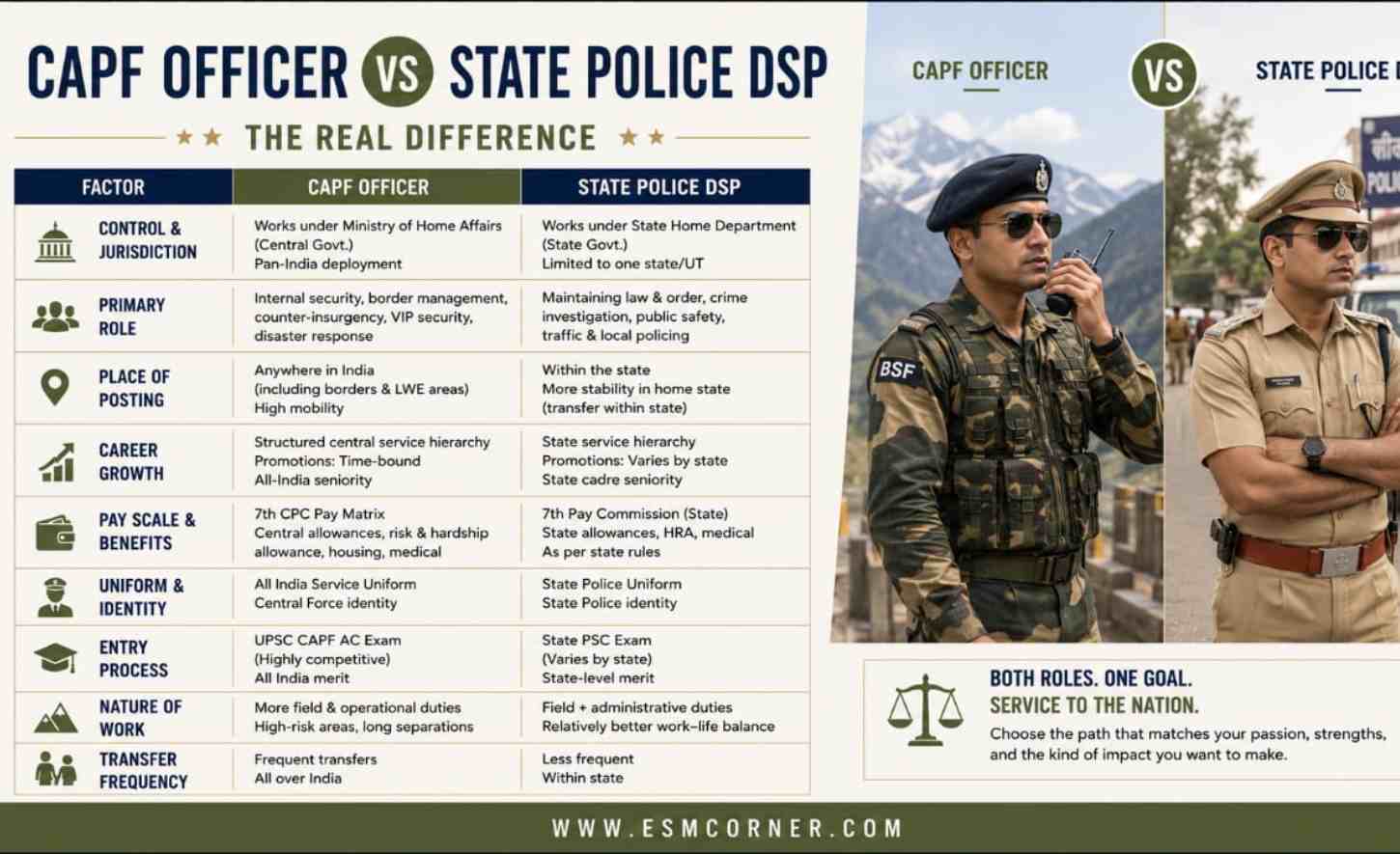
A State Police DSP typically handles local law-and-order matters, investigates district-level crimes, and works closely — often under the influence of — local political and administrative structures. A CAPF Assistant Commandant, in contrast, functions under central legislation and can be posted anywhere across the country to tackle large-scale security challenges — border disputes, insurgency, VIP security, disaster relief, and more.
The added advantage? A far more structured career progression, genuine opportunities for UN peacekeeping missions and deputations to specialized agencies like NSG, IB, RAW, and NIA — plus, notably, near-complete insulation from local political pressures while carrying out your duties.
From Civilian to Commissioned Officer
Clearing all three selection rounds doesn’t mean you’re handed a uniform the next day. There’s a rigorous, roughly year-long training period ahead — covering physical conditioning, weapons training, tactical operations, legal knowledge, and field exercises. Only after completing this training and taking the formal oath do you actually step into the role of a commissioned officer.
The pay isn’t disappointing either — Assistant Commandants start at Level 10 pay with a basic salary of ₹56,100, along with additional allowances, healthcare coverage, accommodation, canteen benefits, and hardship allowances for tougher postings.
A Balanced Look — The Good and the Tough
Why this career genuinely appeals to many:
- Real authority and prestige that comes with a Group A Gazetted post
- Direct involvement in national security — border protection, internal stability, disaster response
- A clear, structured path toward senior ranks over time
- Rare access to international missions and elite agency deputations
What you should be mentally ready for:
- Postings in remote, physically demanding terrains — deserts, high altitudes, insurgency-hit belts
- Non-stop alertness and physical demands that don’t fade as years pass
- Regular transfers that can put real strain on family life
- A profession that asks for far more resilience than a standard office job ever would
Wrapping It Up
Opting for the CAPF Assistant Commandant route isn’t simply about landing a job — it’s about committing to an entirely different rhythm of life. It calls for sharp preparation to clear a genuinely demanding UPSC selection, paired with real physical grit to hold your ground and lead effectively in tough field conditions.
If a predictable desk job leaves you feeling restless, and you’d rather take on real responsibility, hands-on field command, and the satisfaction of serving the country directly — this remains one of the most respected and fulfilling career paths a graduate in India can pursue today. It asks a lot from you, no doubt, but it gives back just as much in purpose, security, and pride.
READ ALSO: AFMC MBBS ADMISSION 2026: ELIGIBILITY SELECTION PROCESS & CAREER REALITY
Q1. Can final-year graduation students apply for the UPSC CAPF AC exam?
Yes, final-year undergraduate students are fully eligible to apply provisionally for the examination. However, they must complete their graduation requirements and produce definitive proof of passing their degree examination along with their Detailed Application Form (DAF) during the physical and medical verification phase.
Q2. Is there a fixed limit on the number of attempts for the CAPF exam?
Unlike the Civil Services Examination, the Union Public Service Commission does not enforce a restriction on the total number of attempts for the CAPF AC entry. Candidates can attempt the exam as many times as they wish, provided they remain within the official age limit.
Q3. Are female candidates eligible for all forces under the CAPF entry?
Yes, female candidates are fully eligible to apply for all five forces: BSF, CRPF, CISF, ITBP, and SSB. They are recruited directly into combat leadership roles as Assistant Commandants, following the exact same operational pay matrix and promotion avenues as male officers.
Q4. What are the key rules regarding tattoos during the medical test?
Tattoos are permitted only if they depict religious symbols or figures, consistent with the traditions of the Indian Army. Such tattoos must be located strictly on the inner aspect of the left forearm or the dorsum of the hands, and their total size must not exceed $1/4\text{th}$ of the particular limb area.
Q5. Do NCC ‘C’ certificate holders receive any direct weightage or relaxation?
NCC ‘B’ or ‘C’ certificate holders do not receive extra marks or exemptions during the written examination phase. However, their qualifications are explicitly reviewed during the Interview/Personality Test stage, where the panel gives due weightage to their structured training during final grading.
Q6. Can a candidate with a minor case of Knock Knees clear the physical stage?
No, structural issues like knock knees, flat feet, or varicose veins result in immediate disqualification during the rigorous medical standards review. The force demands complete structural integrity to ensure that officers can march across rough, high-altitude mountain borders or deep jungle terrains without facing sudden physical breakdowns.
Q7. What does the initial in-hand salary look like for a newly joined officer?
A newly commissioned Assistant Commandant receives a starting gross monthly salary ranging between ₹85,000 and ₹95,000 in peace areas. If posted to highly active counter-insurgency zones or freezing border outposts, the final in-hand figure easily crosses ₹1,15,000 due to specialized allowances.
Q8. Is the CAPF entry eligible for standard pension benefits after retirement?
Officers recruited through the UPSC CAPF entry are covered under the comprehensive structure of the National Pension System (NPS) implemented by the Central Government. They receive strong retirement benefits, gratuity payouts, medical coverage under the Ayushman framework, and access to resettlement avenues.
For daily defence updates, government notifications, recruitment alerts, welfare schemes, career opportunities, education news, and other important announcements, join our WhatsApp Community. Click here to join our WhatsApp Group.