
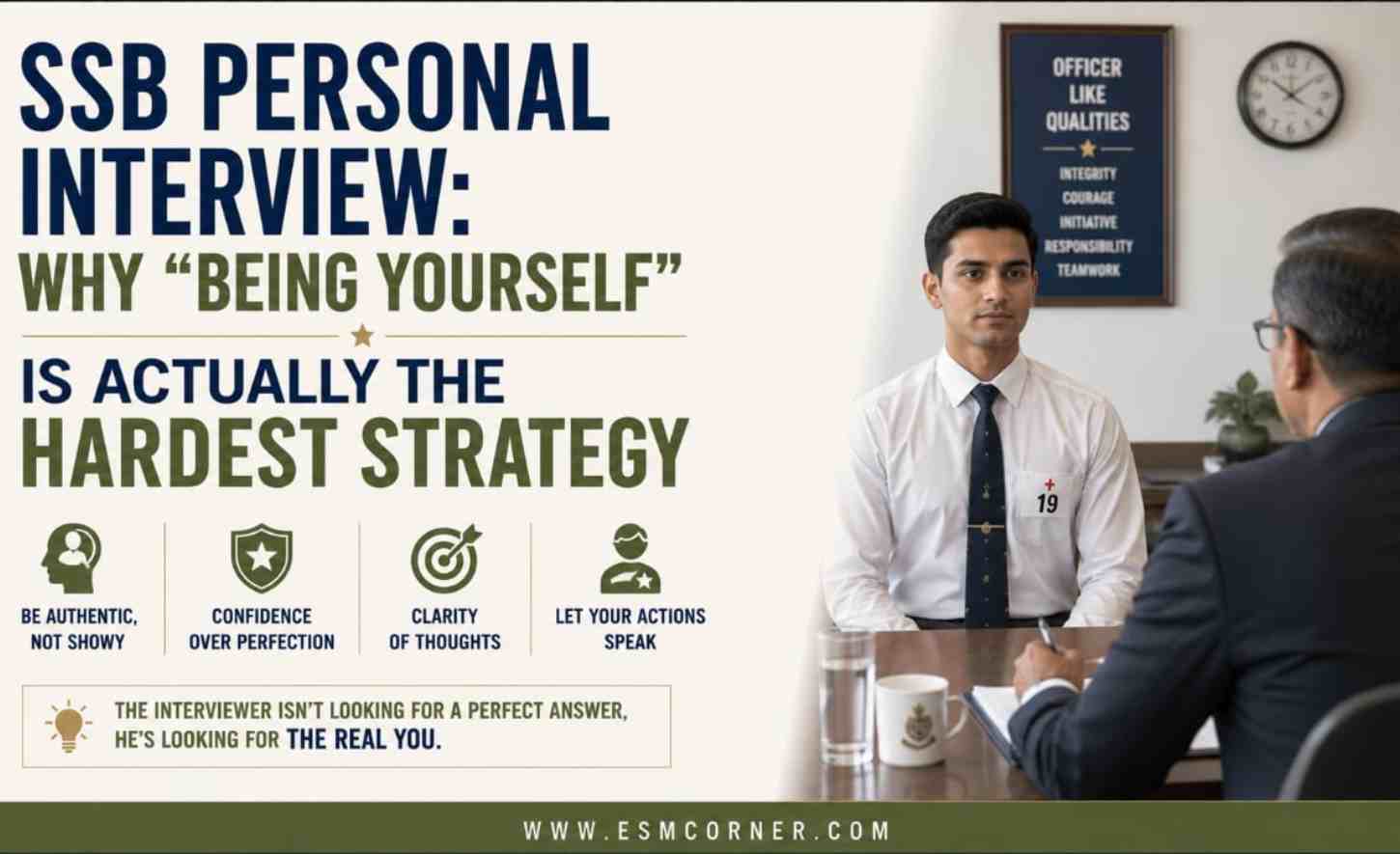
Here’s an interesting pattern that shows up year after year — a lot of genuinely smart, capable candidates walk out of their SSB Personal Interview feeling defeated, not because they didn’t have good answers, but because they treated it like a job interview or a viva. They prepared “impressive” answers, rehearsed a polished version of themselves, and walked in trying to perform. And that’s exactly where it goes wrong.
The Interviewing Officer (IO) isn’t hunting for a flawless candidate with picture-perfect answers. He’s trying to meet the real you — your honesty, your maturity, and whether your thinking is consistent. Sounds simple, but it’s actually one of the hardest things to do naturally, especially when you’re nervous. So, let’s understand what actually takes place in that room and the reason behind each step.
What Is This Interview Actually Checking?
Remember, the SSB doesn’t rely on the interview alone — it’s one leg of a three-legged stool, along with the psychology tests and the GTO tasks. So the IO isn’t trying to test your subject knowledge or your English fluency. He’s checking something much deeper: do your thoughts, your words, and your actions actually line up with each other? That consistency is basically the entire game here.
What Actually Happens in the Room
Here’s something people don’t realize — your interview doesn’t start the moment you sit on that chair. It starts the moment you’re called and start walking towards the room. How calmly you wait, how confidently you knock and enter, how naturally you greet the officer — all of this is already being observed before a single question is asked.
Once you’re in, it usually starts with light, casual conversation to ease you in, before moving into deeper questions based on your PIQ form (that background form you filled earlier) and your personal experiences. The whole thing generally runs 45 to 60 minutes, and honestly, the questions matter less than how naturally and consistently you answer them.
The Question Categories — And What They’re Really Digging For
This is the part most guides gloss over, but it’s genuinely useful to know. Every question category the IO asks has a specific, quiet purpose behind it:
- Family Background — He’s not judging your financial status here. He’s checking your maturity and sense of responsibility. Be straightforward about your parents’ work, your family’s situation, your siblings. Exaggerating wealth or hiding struggles almost always backfires, because it comes across as insecurity, not confidence.
- Academics — This isn’t about your marks. It’s about your learning attitude and how you handle setbacks. If you had a bad semester, own it and explain what you did differently afterward. Blaming teachers or “tough syllabus” comes across as someone who doesn’t take responsibility.
- Friends & Social Life — He wants to know if you can actually build relationships and work with people. Talk about your friends honestly, what you do together, even what they’d say about you. Claiming you’re a total loner who doesn’t need anyone is a bigger red flag than you’d think — teamwork is literally the job description of an officer.
- Hobbies & Sports — Only mention things you genuinely do. This is possibly the easiest trap to fall into — writing “chess” or “trekking” because it sounds impressive, and then fumbling when asked a basic follow-up question about it. The IO can tell within seconds if you actually know what you’re talking about.
- Achievements & Failures — Nobody expects a spotless track record. What they’re checking is resilience — did you bounce back, did you learn something? Also mention genuine responsibilities you handle at home, because that quietly shows dependability.
- Leadership & NCC/Extracurriculars — If you have held any role — class monitor, team captain, NCC cadet, or similar — be prepared to explain your actual responsibilities, not just the position name. True leaders highlight the team’s contribution, not only their personal achievements.
- Current Affairs — Here, balanced and logical opinions win over dramatic or one-sided ones. Avoid getting emotionally charged about politics or religion. The IO isn’t checking if you agree with him — he’s checking if you can think clearly and stay objective.
- Motivation to Join the Forces — This is where memorized, dramatic lines like “I want to serve the motherland” without any personal backing actually hurt you. Talk about genuine reasons — maybe it’s the discipline, the adventure, the responsibility — but connect it to something real from your own life, not a movie dialogue.
- Strengths, Weaknesses & Moral Questions — Honestly admitting a real weakness, along with what you’re doing about it, will always land better than claiming you have none. Perfection isn’t believable, and everyone in that room knows it.
Rapid Fire Round — The Real Skill Being Tested
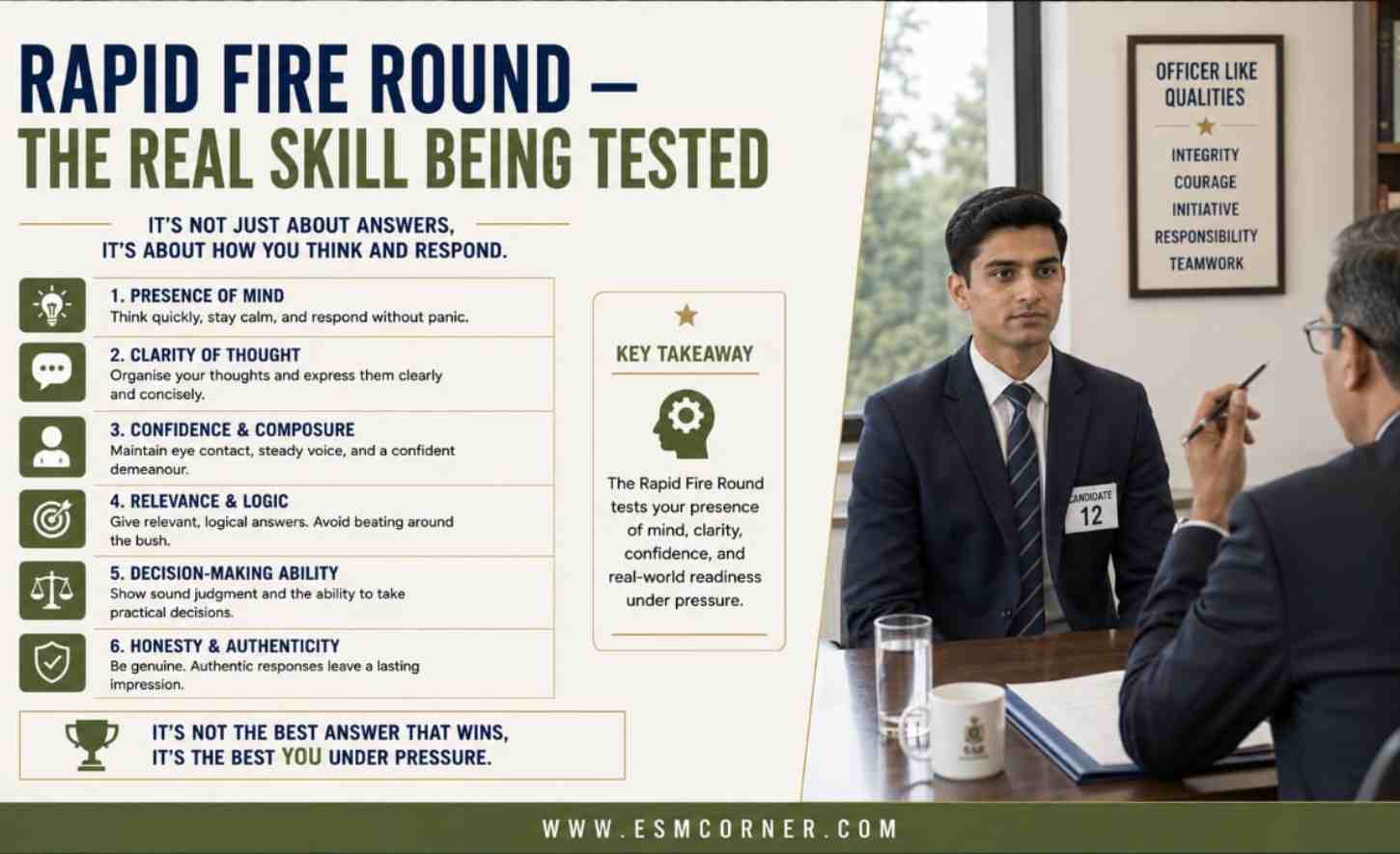
This is the part where many candidates struggle, mainly because of the speed at which questions are asked. The IO may throw multiple questions at once — covering topics like your family, hobbies, and achievements — and expects you to respond in the same sequence. It may sound intimidating, but it’s actually simpler than it seems.
The key is to stay calm and avoid rushing. Listen carefully, keep track of the order as much as possible, and answer each question one at a time with confidence. If you genuinely forget any question, there is no harm in politely requesting the IO to repeat it. What is being evaluated here is not your memory skills, but your ability to remain calm, structured, and composed when faced with pressure and a fast pace.
Quick Reality Check — Common Mistakes By Category
- Family questions: Exaggerating financial status or hiding real struggles.
- Academic questions: Making excuses instead of owning up to a weak performance.
- Sports/hobbies: Listing “impressive” activities you don’t actually know much about.
- Current affairs: Giving emotional, one-sided opinions instead of balanced reasoning.
- Failure-related questions: Claiming you’ve “never really failed” — which almost never sounds believable.
Notice the pattern here? Nearly every single mistake comes from trying to look better than you actually are. That’s the one thread running through all of it.
Your Body Is Talking Even When You’re Not
Here’s something worth remembering — your PIQ form is basically the map the IO uses to cross-question you, so everything you say needs to genuinely match what you wrote earlier. Inconsistencies get noticed fast.
Beyond words, your body language matters more than people realize. Sit upright, keep natural eye contact, and speak clearly without mumbling. If you genuinely don’t know an answer, it’s completely okay to say so politely instead of making something up on the spot — that guessing game is far more obvious to a trained officer than you’d expect.
“But I’m Not Fluent in English / I’m Shy” — Stop Worrying About This
This is genuinely one of the most damaging myths floating around. A lot of candidates believe only smooth-talking extroverts with polished English clear this stage. Completely false. What the Armed Forces actually value is honesty, logical thinking, and emotional stability — not accent or personality type.
If you’re from a Hindi-medium background or a smaller town, you have just as much of a fair shot as anyone else. If you lose a word mid-sentence, switch to Hindi briefly and carry on confidently — nobody’s marking you down for that. Build your comfort gradually: read the newspaper daily, practice speaking in front of a mirror or camera, and most importantly, spend time genuinely understanding your own strengths and weaknesses instead of memorizing someone else’s answers.
Conclusion
The SSB Personal Interview isn’t a trap designed to catch you saying the “wrong” thing — it’s a scientific, fairly designed conversation meant to understand who you genuinely are. The IO isn’t looking for a rehearsed performance or a flawless human being. He’s looking for someone honest, self-aware, and consistent — someone whose words actually match their actions.
So walk in and just be that person. Answer with clarity, admit what you don’t know, own your failures instead of hiding them, and let your natural personality do the talking. Ironically, that’s usually the hardest strategy to pull off — and exactly why it works.
read also: 15 KEY QUALITIES FOR DEFENCE ASPIRANTS
Q1: What should I do if the Interviewing Officer continuously cross-questions or disagrees with my opinion on a topic?
A: Maintain absolute emotional stability and composure. The IO is testing your psychological resilience and checking for any signs of arrogance or conversational rigidity. Listen to his perspective politely, state your own well-reasoned facts calmly, and never enter into an emotional, defensive argument. If he provides a valid counter-fact, show the maturity to accept it gracefully.
Q2: Is it mandatory to answer every single sub-question in a Rapid Fire Question cluster?
A: While it is ideal to answer all questions in the exact sequence asked, missing one or two items due to information overload is completely normal. The key is to remain perfectly calm. Answer what you remember clearly, avoid stuttering or panicking, and politely ask the IO for clarification on the specific points you missed once you finish speaking.
Q3: How heavily do my past academic scores dictate my final selection in the interview?
A: Your academic record is used as a reliable indicator of your historical focus, effective intelligence, and work ethic. However, a drop in your percentages is not a ground for rejection. The IO wants to understand the genuine reasons behind any drop and assess whether you took personal responsibility to correct your trajectory later in life.
Q4: Can I change or update any information in my PIQ form after submitting it to the board?
A: No, the PIQ form cannot be altered once it is formally submitted. If you made an honest clerical error, it is best to bring it to the Interviewing Officer’s attention yourself at the very beginning of the interview. This demonstrates proactive honesty, preventing any contradictions from looking like an attempt to deceive the board.
Q5: What is the ideal dress code and grooming standard for the SSB Personal Interview?
A: Your grooming must be clean, neat, and strictly professional. Gentlemen should wear a crisp, light-colored long-sleeved shirt, well-fitted dark trousers, a conservative tie, and polished leather shoes, along with a fresh haircut and clean-shaven face. Ladies should opt for a formal trousers-and-shirt combination or a neat, professional light salwar-suit with tied hair.
Q6: How do I handle questions about a sensitive personal topic, like a long relationship breakup or a family dispute?
A: Approach these questions with complete emotional maturity, keeping your response objective and concise. Avoid playing the victim or speaking ill of others involved. Focus your explanation entirely on what the experience taught you about human relationships, how it helped you grow emotionally, and how you managed to maintain your focus on your career goals.
Q7: Will choosing a non-traditional or unconventional hobby on my PIQ form hurt my selection chances?
A: Not at all. We welcome diverse, unique, and genuine hobbies because they demonstrate an interesting, well-rounded personality. The only requirement is that your engagement with the hobby must be authentic. You must possess deep, firsthand knowledge of its practical aspects, history, and tools, rather than just using it as a decorative line on paper.
Q8: How can I effectively overcome a natural habit of using filler words during my interview responses?
A: Practice pausing deliberately for two to three seconds before you begin speaking to organize your thoughts. Speak at a measured, steady pace rather than rushing through your answers. Regular practice—such as recording your responses or delivering short speeches in front of a mirror—will help you become conscious of filler words and systematically eliminate them from your speech.
For daily defence updates, government notifications, recruitment alerts, welfare schemes, career opportunities, education news, and other important announcements, join our WhatsApp Community. Click here to join our WhatsApp Group.