

Picture this: you’ve got two offers in hand. One is a big, famous college — but for a course you’re not really excited about. The other is a lesser-known college — but offering exactly the course you’ve always wanted. Which one do you pick?
This is genuinely one of the toughest calls students (and honestly, their parents too) have to make. And here’s the uncomfortable truth: there’s no one-size-fits-all answer. What works brilliantly for a future software engineer might completely fail for someone aiming to become a researcher or a consultant. So instead of chasing a universal formula, let’s build a framework that actually helps you decide based on your own goals.
Why This Decision Deserves More Than Five Minutes of Thought
Choosing a college or course is about much more than earning a degree. The next few years will influence the skills you develop, the confidence you build, the people you connect with, and your overall personal and professional growth. Many students focus only on placement statistics and overlook the other valuable opportunities a college can provide.
A simple way to understand this is: your course shapes what you learn and the skills you gain, while your college influences your exposure, credibility, and future opportunities. Selecting the wrong course, even at a top college, or choosing the wrong college for the right course can limit your long-term potential.
So, Course or College — Which One Actually Matters More?
Honestly, it depends entirely on the field you’re heading into.
Go with the course if you’re entering technical, skill-heavy fields like computer science, data analytics, nursing, design, or architecture. In these fields, recruiters care way more about what you can actually build, code, or design than which college logo is on your ID card. A killer portfolio or strong technical skills will get you hired, brand name or not. Picking a random course just to get into a famous college often backfires badly — you end up struggling in technical interviews later.
Go with the college if you’re aiming for fields like management consulting, investment banking, public policy, corporate law, or luxury brand marketing. These industries genuinely recruit heavily from top-tier institutions, and a big-name college acts almost like a shortcut — it silently vouches for your abilities before you even walk into the interview room. It’s also a smart pick if you’re genuinely unsure what you want to do yet, since a reputed university gives you room to explore, meet sharp peers, and figure things out along the way.
Government College or Private College — What’s The Real Difference?
- Government colleges usually mean lower fees, solid academic rigor, and a diverse mix of students. The downside? Curriculum updates and infrastructure improvements can move painfully slowly.
- Private colleges generally have higher tuition fees, but they often offer modern infrastructure, stronger industry connections, and a more flexible learning environment in return.
But here’s what actually matters more than “government vs private” — whether the college is autonomous or affiliated.
- An autonomous college can design its own syllabus, run its own exams, and quickly introduce trending topics like AI or sustainability into its curriculum.
- An affiliated college has to follow a centralised university syllabus, which can take years to update.
Also, don’t skip checking the NAAC Accreditation — colleges rated A+ or higher genuinely reflect strong teaching quality, research output, and governance. It’s a solid credibility check.
Should You Trust NIRF Rankings Blindly?
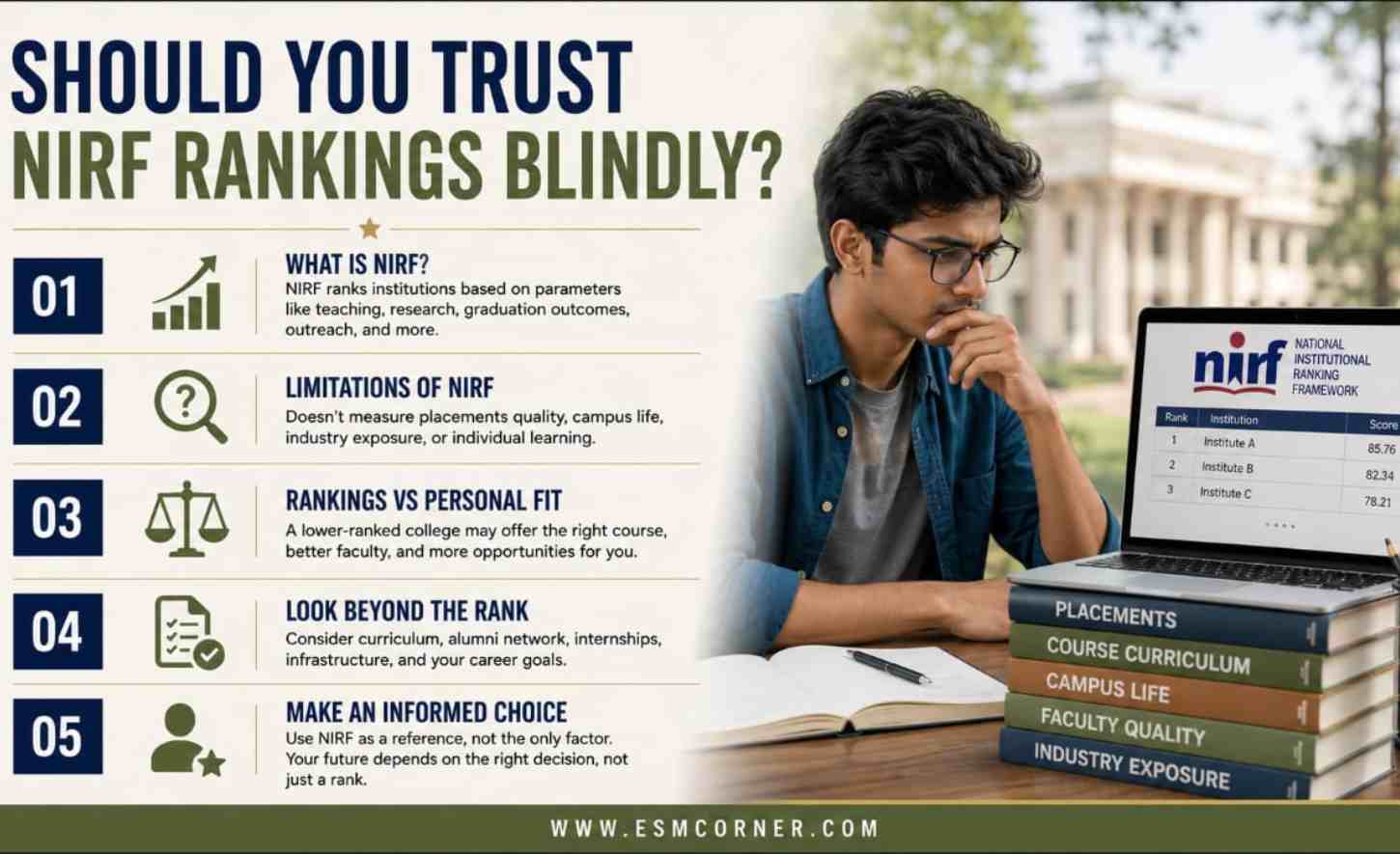
Rankings are useful, but not gospel. A college’s overall NIRF ranking can sometimes get boosted purely by research output from its postgraduate departments — which has nothing to do with the actual undergraduate experience you’ll have. Use rankings as a starting filter, not the final word.
What Actually Makes a Good Campus? Look Beyond The Brochure
Before you get swept away by glossy prospectuses, dig into these:
- Faculty quality – Are professors just reading off slides, or do they mentor students, involve them in research, and connect them with industry contacts? Check if they hold doctoral degrees, have active research, or real corporate experience.
- Labs and practical infrastructure – Will you actually get hands-on time with tools and software that are used in real industry setups today?
- Return on Investment (ROI) – Add up the total cost — tuition, hostel, books, daily expenses — and compare it honestly against the median salary of graduates, not the flashy “highest package” numbers in ads. A hugely expensive private college funded by a massive loan might not be worth it compared to a solid, affordable government or autonomous college.
- Scholarships and financial aid – Actively look these up. They can seriously reduce your financial stress.
- Location – A college in a major city gives you easier access to networking, internships, and corporate exposure. A peaceful, isolated campus might feel calmer, but it can limit those spontaneous real-world connections.
- Hostel, safety, and medical facilities – Don’t skip this. Your living conditions directly affect your mental well-being and how well you actually perform academically.
Quick Decision Matrix
| Decision Factor | Why It Matters | When To Prioritize It | Impact On Career |
|---|---|---|---|
| Curriculum Agility | Keeps you learning current tools, not outdated theory | Fast-evolving tech and creative fields | Affects your productivity from day one at work |
| Alumni Network | Opens doors through referrals and mentorship | Corporate roles, finance, entrepreneurship | Speeds up mid-career growth and leadership opportunities |
| Industry Exposure | Bridges the gap between textbooks and real work | If you want a job right after graduation | Often leads to pre-placement offers |
| Campus Culture | Builds soft skills and confidence | For overall personal growth | Shapes how well you work in diverse teams later |
| International Ties | Opens up exchange programs and dual degrees | If you’re planning to study abroad later | Boosts global employability |
Let’s Bust The Biggest Myth Right Now
A lot of students genuinely believe that getting into a famous college guarantees lifetime success. It doesn’t. A big brand name can absolutely help you land your first interview — but it won’t help you keep the job or get promoted if you don’t have real skills.
Here’s the flip side that rarely gets talked about: a self-motivated student at an average, mid-tier college can easily outperform an unmotivated student at an elite university — simply by using free online courses, professional certifications, and open-source communities to build a genuinely strong portfolio. Your college can open a door, but it can’t walk through it for you.
Conclusion
Making the final decision on where to enroll should never feel like an uncalculated gamble or a blind surrender to societal pressure. As we have explored throughout this comprehensive decision-making roadmap, long-term professional fulfillment and career resilience are never built upon a single factor. True success emerges from cultivating a highly strategic combination of an updated course curriculum, active skill development, hands-on internships, robust professional networking, and an enduring passion for continuous personal growth. A prestigious institutional brand can undeniably provide you with a brilliant head start, but your ultimate career trajectory will always be powered by your personal drive, work ethic, and ability to solve real-world problems.
READ ALSO: AFMC MBBS ADMISSION 2026: ELIGIBILITY SELECTION PROCESS & CAREER REALITY
Q1. If I have to choose between a top college with a bad course and an average college with a great course, what should I pick?
For highly technical and skill-driven fields, you should strongly prioritize the preferred course at an average college because functional competence beats institutional branding. However, if you seek a broader corporate career like consulting, choosing the top college brand for its powerful network and prestige can be highly advantageous.
2. How can I verify if a college’s placement claims are authentic or highly exaggerated?
Look past the highlighted highest international salary packages in brochures and actively seek out the median salary figures in the mandatory institutional NIRF data reports. Additionally, reach out directly to current final-year students and recent alumni via professional networks to gather real, unedited feedback regarding actual campus recruitment drives.
3. Does graduating from an autonomous college offer distinct benefits over an affiliated one?
Yes, autonomous institutions possess the operational freedom to rapidly upgrade their syllabus to match modern industry trends, introduce flexible elective choices, and conduct highly streamlined examination cycles. This agility prevents you from spending years studying obsolete technologies that have already been phased out by modern global employers.
4. How much emphasis should I place on NAAC accreditation scores during my research?
NAAC accreditation scores serve as a vital, peer-reviewed indicator of an institution’s comprehensive educational quality, faculty standards, and infrastructural health. You should always aim for institutions holding an A or higher rating, as this ensures your degree is well-recognized by global universities and top corporate employers.
5. Can a student from a tier-three college successfully compete with tier-one graduates?
Absolutely, because the modern workplace prioritizes provable skills, practical portfolios, and problem-solving abilities over mere institutional labels. By mastering specialized online certifications, contributing to open-source projects, and securing competitive external internships, an ambitious student can easily outpace a complacent graduate from a premier, highly ranked university.
6. What role does an institutional alumni network play in my long-term career?
A robust, highly active alumni network functions as a powerful gateway to the hidden global job market by providing institutional mentorship and corporate referrals. Alumni are far more likely to respond to your professional inquiries, offer career guidance, and unlock specialized employment opportunities that are never advertised publicly.
7. Is it wise to take out a substantial student loan for an expensive private college?
Taking a major financial loan is only justifiable if the institution’s verified median placement salary justifies the financial risk and enables smooth repayment. If the projected loan EMIs will severely cripple your financial freedom for a decade post-graduation, opting for a highly reputable, affordable public college is a smarter choice.
8. How do I convince my parents if we disagree completely on a college choice?
Avoid emotional arguments and instead present them with an objective, data-backed comparison document detailing verified placement metrics, total expenditure analysis, and future career trajectories. Involving a neutral, professional career counselor can also bridge communication gaps and help your family arrive at a harmonious, logical, and future-proof decision.
For daily defence updates, government notifications, recruitment alerts, welfare schemes, career opportunities, education news, and other important announcements, join our WhatsApp Community. Click here to join our WhatsApp Group.