
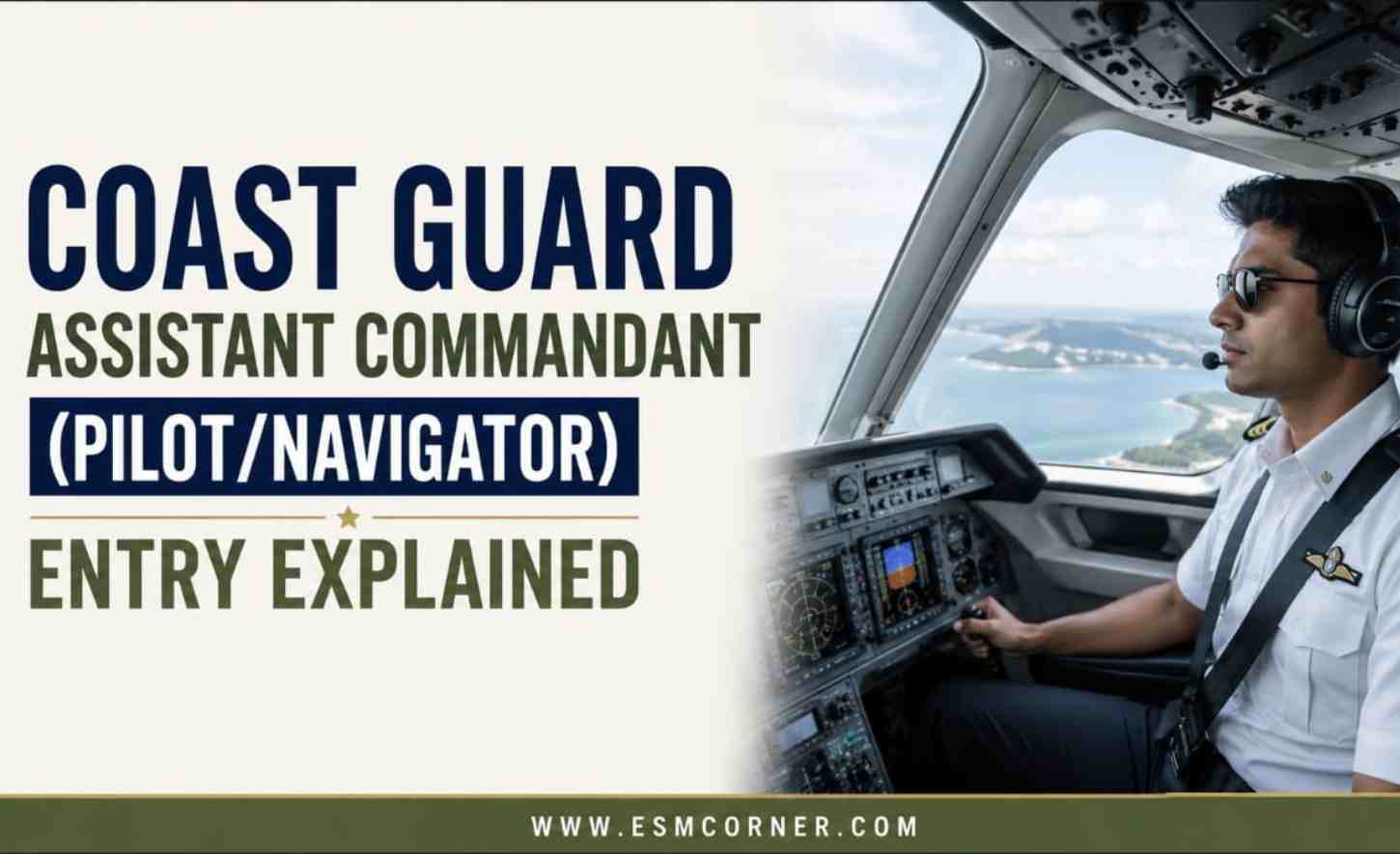
When people hear the term military aviation, they usually think of Air Force fighter jets or Army attack helicopters. However, many people are unaware that the Indian Coast Guard also has its own aviation wing, offering an equally prestigious and exciting career opportunity.
Through the Coast Guard Assistant Commandant Pilot Entry or Navigator Entry, candidates get the chance to operate advanced maritime aircraft and take part in important national defence missions. This role combines flying expertise, tactical navigation, maritime surveillance, search and rescue operations, and military leadership into one challenging career.
If you dream of combining your passion for flying with a career in national defence, this could be the perfect path to explore. Let’s understand what it takes to pursue this opportunity.
What Does This Role Actually Involve?
A common question — “Is this just flying, or am I trained as a proper military officer too?” Here’s the answer: this is a Group ‘A’ Gazetted Officer entry in the General Duty branch of the Coast Guard. You’re trained as a military aviator or tactical navigator, flying both fixed-wing aircraft and helicopters, while holding full executive leadership authority. You’re not just flying point A to point B — you’re commanding airborne maritime operations.
Pilots control the aircraft through tough weather, low-altitude ocean sweeps, and tricky landings on moving ships at sea. Navigators operate radar, sensors, and navigation systems to track vessels, plan interception routes, and run search patterns. Together, this crew enforces maritime law, stops smuggling, protects marine ecosystems, and watches over India’s coastal waters.
Why Is This Different From Regular Fighter Jet Flying?
Unlike high-altitude combat flying, maritime aviation happens mostly over vast, open oceans, often at very low altitudes and in genuinely rough weather. A lot of these missions are literally about saving lives during storms — which means precision hovering and sharp navigation aren’t optional, they’re everything. It demands split-second decisions, strong spatial awareness, and staying calm when things get genuinely intense.
Is This Career Right For You?
This path suits you if you’ve got strong maths and science skills, good spatial awareness, a genuine love for flying, and a pull toward service over a typical desk job. If you thrive in dynamic, high-energy environments and take pride in protecting the coastline, this is a genuinely solid fit.
Do You Need an Engineering Degree or a Pilot’s License?
Short answer — no, not necessarily. A regular graduate degree works fine, as long as you meet the specific subject requirements. Here’s how it breaks down:
- General Duty (Pilot/Navigator) – A recognised Bachelor’s degree with at least 60% aggregate, plus Physics and Maths as compulsory subjects in Class 12, meeting the minimum percentage specified in official notifications.
- CPL Entry (Commercial Pilot License route) – Class 12 with Physics and Maths (minimum 55%), plus a valid Commercial Pilot License issued or validated by the DGCA.
Basic Eligibility Points to Know
- Age – Generally 19 to 25 years for General Duty Pilot/Navigator entries, with relaxations for reserved categories as per government rules.
- Gender – Both men and women can apply, depending on the specific branch and notification.
- Vision Standards – You’ll need uncorrected vision of 6/6 in one eye and 6/9 in the other (correctable to 6/6), with zero tolerance for colour blindness or night blindness.
- Height – Minimum 162.5 cm, with regional relaxations where applicable, along with specific leg length and sitting height requirements for safe cockpit fit.
- Physical Fitness – A healthy BMI, good core strength, cardio stamina, and basic swimming ability will genuinely help you transition smoothly into training without injury.
The Selection Process: From Written Test to Final Merit List
Here’s how the whole journey unfolds, stage by stage:
- CGCAT (Computer-Based Exam) – The first screening round, testing English, Reasoning, Numerical Ability, General Science, and General Knowledge. Speed and accuracy genuinely matter here.
- Preliminary Selection Board (PSB) – Shortlisted candidates go through the Computerised Cognitive Battery Test and Picture Perception & Discussion Test — checking your logic, perception, and group communication under time pressure. Document verification also happens here.
- Final Selection Board (FSB) – A 5-day evaluation covering:
- Psychological Tests – WAT, SRT,TAT, and Self-Description Test.
- GTO Tasks – Outdoor obstacles, group discussions, and command tasks testing teamwork and physical stamina.
- Personal Interview – A detailed conversation checking your self-awareness, general knowledge, and genuine motivation to join.
- Medical Examination – A thorough aviation-specific medical check at a specialised centre.
- Merit List – Your final placement, based on performance across all stages and available training vacancies.
Quick Overview of the Selection Stages
| Stage | Purpose | What’s Tested | Outcome |
|---|---|---|---|
| CGCAT | Academic and Aptitude Screening | Speed, accuracy, general awareness | Shortlisting for Board |
| PSB | Cognitive Ability Check | Perception, logic, communication | Qualification for Final Board |
| FSB | In-Depth Personality Assessment | Leadership, teamwork, stability | Recommendation by Board |
| Medicals | Fitness and Aviation Standards | Physical health, sight, body measurements | Medical Fitness Clearance |
| Merit List | Final Selection | Overall performance and vacancy fit | Joining Letter for Academy |
Where Does Training Actually Happen?
Once selected, you start basic officer training at the Indian Naval Academy (INA) Ezhimala — covering seamanship, military law, leadership, drill, and weapons handling. After that, flight trainees move on to Air Force or Naval flying establishments for basic and advanced flying or navigation training to earn their wings.
What Do Coast Guard Pilots Actually Fly and Do?
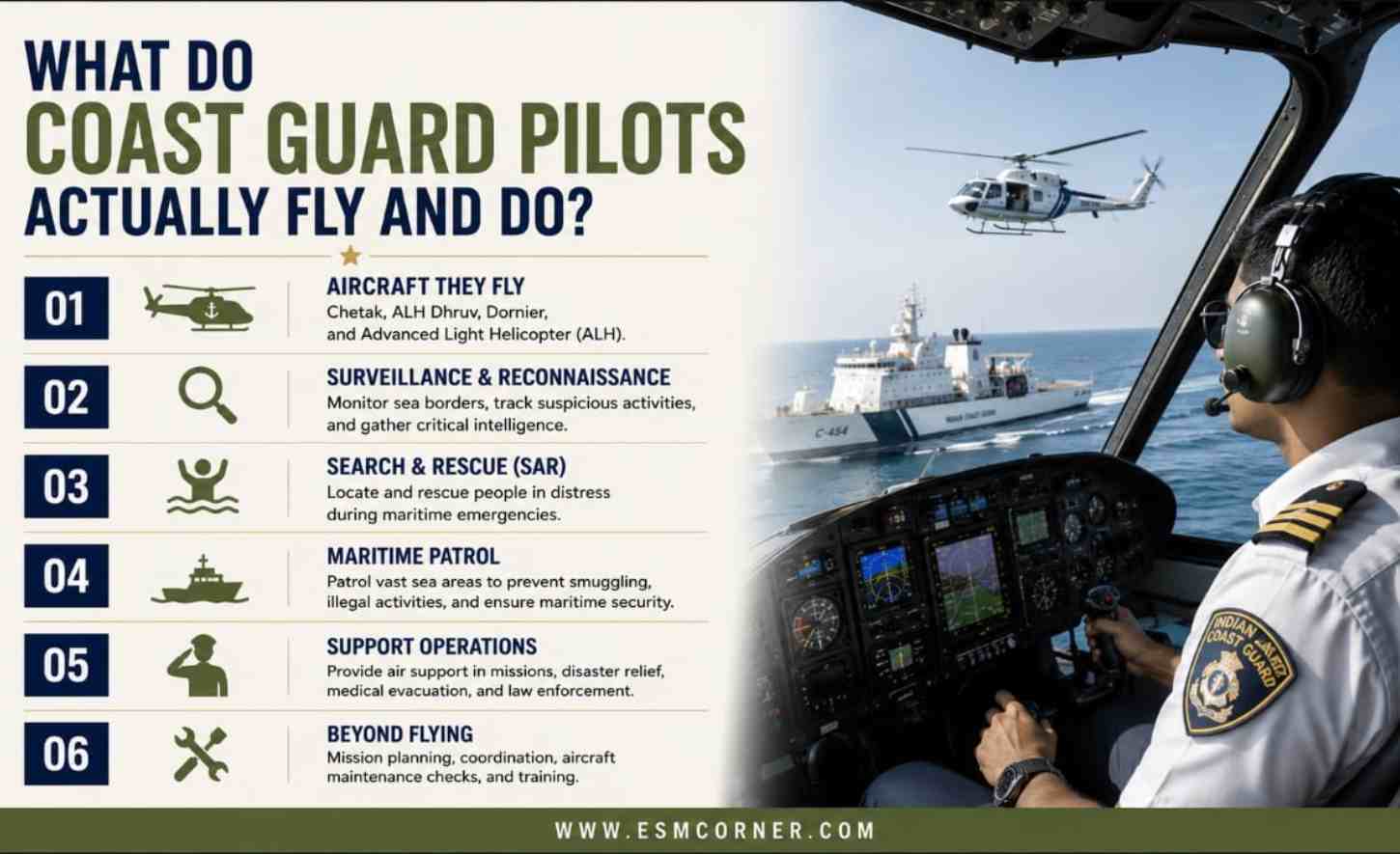
Coast Guard aircrews typically fly aircraft like the Dornier 228, along with helicopters like the Advanced Light Helicopter (ALH Dhruv) and Chetak. Their day-to-day missions include:
- Maritime Surveillance – Patrolling to track shipping, spot illegal fishing, and monitor territorial waters.
- Search and Rescue – Locating stranded fishermen or distressed vessels during storms and airlifting people to safety.
- Disaster Relief – Dropping emergency supplies during cyclones and floods.
- Coastal Security – Intercepting vessels smuggling contraband, drugs, or weapons before they reach Indian shores.
What Does Career Growth Look Like?
You start as an Assistant Commandant (Group ‘A’ Gazetted Officer), and with experience and promotion exams, you can rise to Deputy Commandant, Commandant, and eventually higher ranks like Deputy Inspector General or Inspector General. Both permanent commission and short-service paths offer real, structured growth.
The upside? A genuine sense of purpose, an active lifestyle, flight pay, and the honour of saving lives at sea. The challenges? Sudden emergency call-outs, time away from family, tough weather conditions, and strict military discipline — worth knowing upfront.
How Should You Actually Prepare?
- Master the basics – Practice maths, reasoning, and basic physics under timed conditions for CGCAT, and stay updated on national and maritime defence news.
- Build genuine Officer Like Qualities – Work on your decision-making, initiative, and social adaptability in everyday life, not just before the interview.
- Sharpen communication – Practice expressing your thoughts clearly in English, since group discussions and interviews demand real clarity.
- Stay physically fit – Daily running, basic strength training, and outdoor sports build genuine stamina and confidence.
- Avoid the biggest mistake – Don’t fake it during psychological tests or interviews. Trained assessors can spot rehearsed, textbook answers almost instantly.
Conclusion
The Coast Guard Assistant Commandant (Pilot/Navigator) Entry represents a extraordinary career avenue for motivated young men and women who aspire to blend the thrill of military aviation with meaningful national service. Flying low-level maritime reconnaissance missions over stormy ocean waters to save lives or safeguard maritime borders provides a level of professional satisfaction and purpose that few civilian careers can ever match. It demands high intellect, rapid decision-making under pressure, emotional maturity, and strong physical conditioning.
READ ALSO: HOW TO BECOME AN OFFICER IN INDIAN ARMED FORCES
Frequently Asked Questions (FAQs)
Who can apply for Pilot/Navigator Entry?
Indian citizens meeting the required age limits who possess a recognized Bachelor’s Degree with 60% aggregate marks can apply. Candidates must have studied Physics and Mathematics at the 10+2 educational level. Both fresh graduates and CPL holders have tailored entry options.
Is engineering compulsory for this entry?
No, an engineering degree is not mandatory for the General Duty Pilot/Navigator branch. Any graduate holding a recognized Bachelor’s degree in science, commerce, or arts is eligible, provided they passed Physics and Mathematics in Class 12th with required marks.
What medical standards are important for aviation?
Aviation standards require 6/6 vision in one eye and 6/9 in the other (correctable to 6/6) without color blindness. Height must be at least 162.5 cm, with specific leg length and sitting height measurements to fit cockpit dimensions safely.
Is SSB conducted for Coast Guard selection?
The Coast Guard conducts its own two-stage selection process called the Preliminary Selection Board (PSB) and Final Selection Board (FSB). The testing philosophy, psychological evaluation, GTO tasks, and personal interviews are structurally similar to standard Service Selection Board (SSB) assessments.
What does a Coast Guard Pilot do?
A Coast Guard Pilot commands fixed-wing aircraft and helicopters to perform maritime surveillance, search and rescue missions, illegal smuggling prevention, marine pollution response, and coastal security patrols. They combine active military flying with executive officer duties.
Is physical fitness important for selection?
Yes, physical fitness is vital for clearing military training and enduring demanding flight operations. Maintaining steady stamina, functional strength, normal body mass index, and basic swimming ability ensures you adapt easily to officer training demands.
How difficult is the selection process?
The selection process is rigorous and highly competitive, designed to identify genuine officer potential and flight aptitude. However, candidates with clear conceptual knowledge, good communication skills, authentic personality, and steady physical fitness can clear it comfortably.
How should beginners start preparation?
Beginners should first thoroughly verify their educational and visual eligibility. Start preparing systematically for the CGCAT written exam, read daily newspapers to build general awareness, practice public speaking, and establish a daily physical fitness routine.
For daily defence updates, government notifications, recruitment alerts, welfare schemes, career opportunities, education news, and other important announcements, join our WhatsApp Community. Click here to join our WhatsApp Group.