

Many college graduates quietly assume that their realistic window for joining the military as an officer closes the moment they complete school or turn twenty. However, the Combined Defence Services proves that graduate entry is actually one of the most robust, respected, and direct pathways toward earning a military commission.
Conducted twice a year by the Union Public Service Commission, the CDS examination serves as a premier gateway for male and female graduates who aspire to join the Indian Army Through CDS, the Indian Navy Through CDS, and the Indian Air Force Through CDS. This exam is far more than a routine written test because it assesses your underlying character, logical reasoning, and potential to lead troops under challenging conditions. By choosing this route, you step into a career where academic knowledge, physical stamina, decision-making ability, and deep discipline align to form an honorable lifestyle.
When candidates ask me how to navigate a Defence Career After Graduation, I remind them that military leadership requires both intellectual clarity and emotional stability. The CDS entry does not merely look at your academic percentages, but evaluates whether you possess the foundational personality traits needed to make critical choices under immense pressure.
Graduates from arts, science, commerce, and engineering backgrounds all compete on a level playing field, provided they possess the required mental agility and determination. Joining the armed forces through this entry gives you immediate exposure to structured training academies that refine raw graduate talent into battlefield-ready military commanders. Understanding this complete journey helps you transition from an uncertain college graduate into a focused aspirant ready to serve the nation.
In this comprehensive CDS Entry guide, we will systematically break down every critical dimension of the selection framework so you can plan your preparation effectively. We will explore basic educational eligibility, compare CDS with other popular entry routes, examine service-specific requirements, and demystify the comprehensive written examination format. Furthermore, we will walk through the renowned Services Selection Board evaluation, medical standards, academy training life, long-term officer career progression, and practical study strategies. Whether you are currently in your final year of college or evaluating your postgraduate options, this guide provides the clarity you need to succeed. Let us begin this journey by laying out the exact foundation of what makes the CDS Officer Entry so unique and rewarding.
Understanding the CDS Entry Framework and Basic Eligibility
A very common question among final-year students is whether they need stellar academic percentages or elite sports achievements to apply for the CDS entry. The reality is that the basic educational criteria are straightforward and designed to invite broad participation from diverse academic disciplines across the country. For the Indian Military Academy and Officers Training Academy, a simple recognized degree in any discipline fulfills the basic educational requirement.
Meanwhile, entry into the Indian Naval Academy requires an engineering degree, while the Air Force Academy demands a degree with physics and mathematics at the ten-plus-two level or a bachelor’s degree in engineering. Candidates must also satisfy age, gender, and marital status conditions that vary slightly depending on whether they seek a Short Service Commission or a Permanent Commission.
CDS vs NDA and AFCAT: Choosing Your Gateway
Aspirants often confuse CDS with the National Defence Academy entry or the Air Force Common Admission Test, creating unnecessary confusion regarding their career path. The primary difference between NDA and CDS lies in the entry level, as NDA targets school-leaving candidates while CDS is exclusively designed for college graduates with mature mindsets.
On the other hand, AFCAT specifically selects officers for the Indian Air Force across flying and ground duties, whereas CDS caters to all three service branches through a unified selection exam. Choosing CDS offers a distinct advantage because it allows candidates to apply for multiple service preferences simultaneously depending on their eligibility. Understanding these fundamental distinctions ensures that you direct your energy toward the exact entry mechanism that aligns with your educational qualifications and career aspirations.
Service Options, Commission Types, and Life as an Officer
When aspirants plan their preference order, they frequently ask how life and career trajectories differ between the various officer training establishments. Joining the Indian Army through the Indian Military Academy or Officers Training Academy prepares officers for ground combat, logistics, intelligence, and technical support roles across diverse terrains. The Indian Naval Academy trains young officers for high-seas operations, maritime aviation, engineering, and strategic naval defense duties across modern warships. Meanwhile, the Air Force Academy grooms officers for combat flying, transport operations, helicopter missions, and vital air defense support systems. Each branch offers an enriching environment where personal growth, global exposure, operational command, and lifelong brotherhood become integral parts of your professional identity.
Another critical decision candidates face involves choosing between a Permanent Commission and a Short Service Commission, particularly through the OTA route. A Permanent Commission allows an officer to serve until superannuation, providing a traditional long-term career path with continuous promotion prospects through the rank structure.
A Short Service Commission through the Officers Training Academy offers an initial service period of ten years, extendable up to fourteen years, providing immense flexibility for young leaders. SSC officers gain elite military training, tactical command experience, and decision-making skills that make them exceptionally valuable in corporate, managerial, and entrepreneurial roles later in life. Both commission types carry equal dignity, authority, and responsibility while wearing the uniform of a commissioned officer in the armed forces.
Selection Process Overview and Examination Structure
The CDS selection process is conducted in multiple stages to assess a candidate’s knowledge, personality, and physical fitness. It begins with the UPSC written examination, which tests English, General Knowledge, and Mathematics. Candidates who qualify are called for the Services Selection Board (SSB) interview to evaluate their leadership qualities, personality, and psychological aptitude. Those recommended by the SSB undergo medical examinations to ensure they meet the required physical standards. The final merit list is prepared by the Ministry of Defence based on the combined performance in the written examination and the SSB interview, after which candidates are allotted to their respective training academies.
| Stage | Purpose | Candidate Focus | Outcome |
| Written Exam | Screen academic capabilities | Concept mastery and accuracy | UPSC cut-off clearance |
| SSB Interview | Evaluate officer potential | Demonstrating core OLQs | Recommendation by board |
| Medical Board | Evaluate officer potential | Physical fitness and medical rules | Fitness clearance report |
| Merit List | Final candidate ranking | Combined total score | Academy call letter |
| Academy Training | Transform candidates into officers | Discipline and tactical skills | Commissioned Officer rank |
Success in the CDS pathway depends entirely on maintaining a balanced preparation approach across all selection stages. Clearing the written examination with exceptionally high marks provides a vital cushion in the final merit list, but it cannot compensate for poor performance during the SSB interview.
Conversely, demonstrating strong Officer Like Qualities at the selection board will not secure a commission if your written score remains too close to the baseline cut-off. Candidates must recognize that physical fitness, psychological maturity, current affairs awareness, and medical readiness must be developed simultaneously rather than sequentially. Approaching the CDS selection process as a holistic transformation ensures that you remain competitive from the written test all the way to the final merit list.
Comprehensive CDS Preparation Strategy and Career Progression
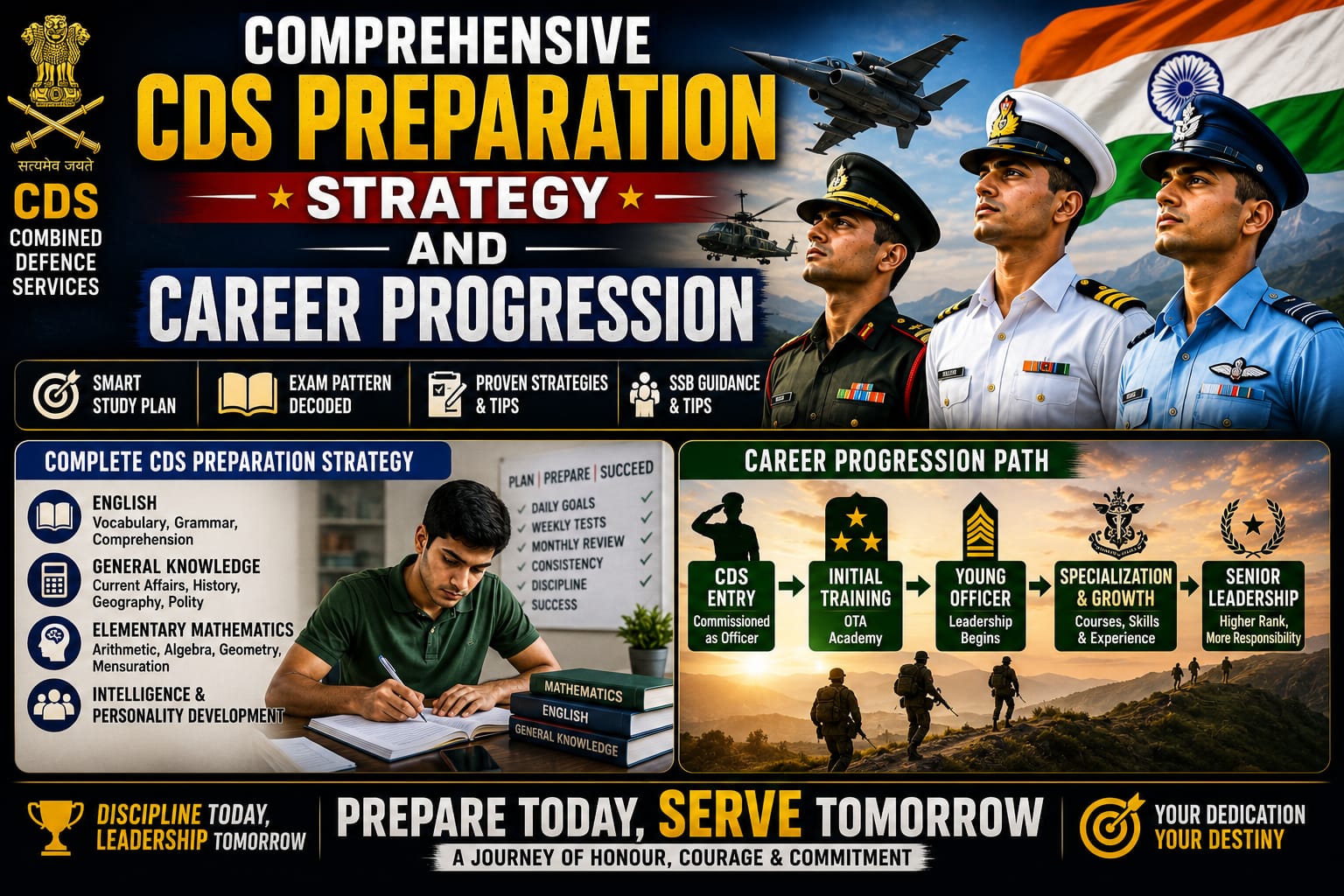
A common dilemma for beginners is deciding how to structure their daily study routine while balancing college final exams or regular jobs. Effective CDS Preparation Strategy starts with a thorough analysis of the basic syllabus, focusing on English proficiency, General Knowledge, and Elementary Mathematics. Candidates targeting the Officers Training Academy only need to write the English and General Knowledge papers, which simplifies their preparation schedule significantly. Daily reading of reputable national newspapers enhances your vocabulary, clarifies complex current affairs, and builds mature opinions required for SSB group discussions. Consistent practice with previous years’ question papers helps you identify recurring question patterns, build speed, and eliminate negative marking errors during the actual exam.
Beyond clearing written cut-offs, developing authentic SSB Preparation habits requires a long-term commitment to self-improvement and personality building. The selection board evaluates fifteen explicit Officer Like Qualities, including effective intelligence, organizing ability, social adaptability, courage, and stamina. Aspirants often make the mistake of attempting to fake these qualities during psychological tests or personal interviews, which expert selectors easily identify and reject. Instead, focus on taking initiative in daily life, improving your public speaking confidence, participating in group activities, and maintaining daily physical exercise. Developing clear communication skills, logical reasoning, and an empathetic leadership attitude naturally transforms your demeanor into that of a potential military officer.
Long-term career progression after earning your commission offers unprecedented professional growth, continuous specialized learning, and deep personal satisfaction. An officer begins their journey as a Lieutenant or equivalent rank, rapidly assuming tactical command over units, specialized equipment, or high-tech operational systems. As you progress through the ranks, your responsibilities shift from direct troop leadership toward strategic planning, administrative command, and policy formulation. Beyond prestige, the armed forces provide competitive compensation, comprehensive medical cover, official housing, and extensive postgraduate educational opportunities throughout your service life. Ultimately, the CDS entry provides not just a secure post-graduation job, but an extraordinary lifestyle defined by duty, honor, and selfless service to the nation.
Conclusion
Stepping into the military through the CDS entry is one of the most fulfilling career choices available to ambitious graduates in India today. It represents far more than an employment option; it is a conscious commitment to a lifestyle governed by honor, discipline, operational courage, and selfless national service. While the multi-stage selection process demands academic focus, psychological maturity, and physical endurance, systematic preparation makes the goal completely achievable for any dedicated student.
Do not look for shortcuts or quick hacks when aiming for a military commission, because true military leadership is built on authentic self-improvement and unyielding character. Focus daily on mastering your written subjects, staying informed on current affairs, polishing your communication skills, and cultivating genuine Officer Like Qualities.
Frequently Asked Questions (FAQs)
Q1: What is CDS Entry?
The Combined Defence Services entry is a competitive national examination conducted twice a year by the Union Public Service Commission. It enables male and female graduates to join the Indian Army, Navy, and Air Force as commissioned officers. Selected candidates undergo rigorous tactical and leadership training at prestigious military academies.
Q2: Who can apply for CDS?
Unmarried male and female graduates who meet specified age, educational, and physical criteria can apply for the CDS examination. Candidates in their final year of graduation are also eligible to sit for the test. Specific educational qualifications vary depending on whether you choose the Army, Navy, or Air Force.
Q3: Is engineering compulsory?
Engineering is not compulsory for all CDS entries, as graduates from arts, science, and commerce can easily join the Indian Army and Officers Training Academy. However, an engineering degree is mandatory for joining the Indian Naval Academy and serves as an eligible background for the Indian Air Force Academy.
Q4: Is SSB mandatory?
Yes, passing the SSB interview is entirely mandatory for every candidate who clears the CDS written examination. The multi-day evaluation assesses your officer potential through psychological tests, outdoor group tasks, and personal interviews. Candidates who fail to earn a recommendation from the board cannot proceed to the medical stage.
Q5: What is the difference between CDS and NDA?
The fundamental difference between NDA and CDS lies in the candidate’s entry-level age and educational qualification. The NDA entry is designed for high school graduates right after class twelve, whereas CDS targets college graduates. Additionally, CDS candidates undergo training at post-graduate officer training academies rather than a three-year academic degree academy.
Q6: How difficult is the CDS exam?
The CDS examination is moderately challenging, testing conceptual clarity, general awareness, and speed rather than rote memorization. Candidates with consistent study habits, basic mathematical skills, and strong English comprehension can clear the written cut-off easily. The main challenge lies in balancing written exam scores with SSB recommendation performance.
Q7: How should beginners start preparation?
Beginners should start by understanding the complete syllabus, reviewing previous question papers, and creating a realistic daily study routine. Focus on strengthening fundamental grammar, reading newspapers daily for current affairs, and practicing basic mathematics. Simultaneously, maintain physical fitness and actively work on building clear verbal communication skills for the interview.
Q8: What are the career growth opportunities?
Officers commissioned through CDS enjoy structured career progression, rising through officer ranks based on service tenure, professional performance, and promotional examinations. The career offers tactical command experience, specialized technical training, strategic policy roles, and competitive perks. Furthermore, military leadership experience opens exceptional administrative and corporate leadership avenues lifelong.
For daily defence updates, government notifications, recruitment alerts, welfare schemes, career opportunities, education news, and other important announcements, join our WhatsApp Community. Click here to join our WhatsApp Group.