

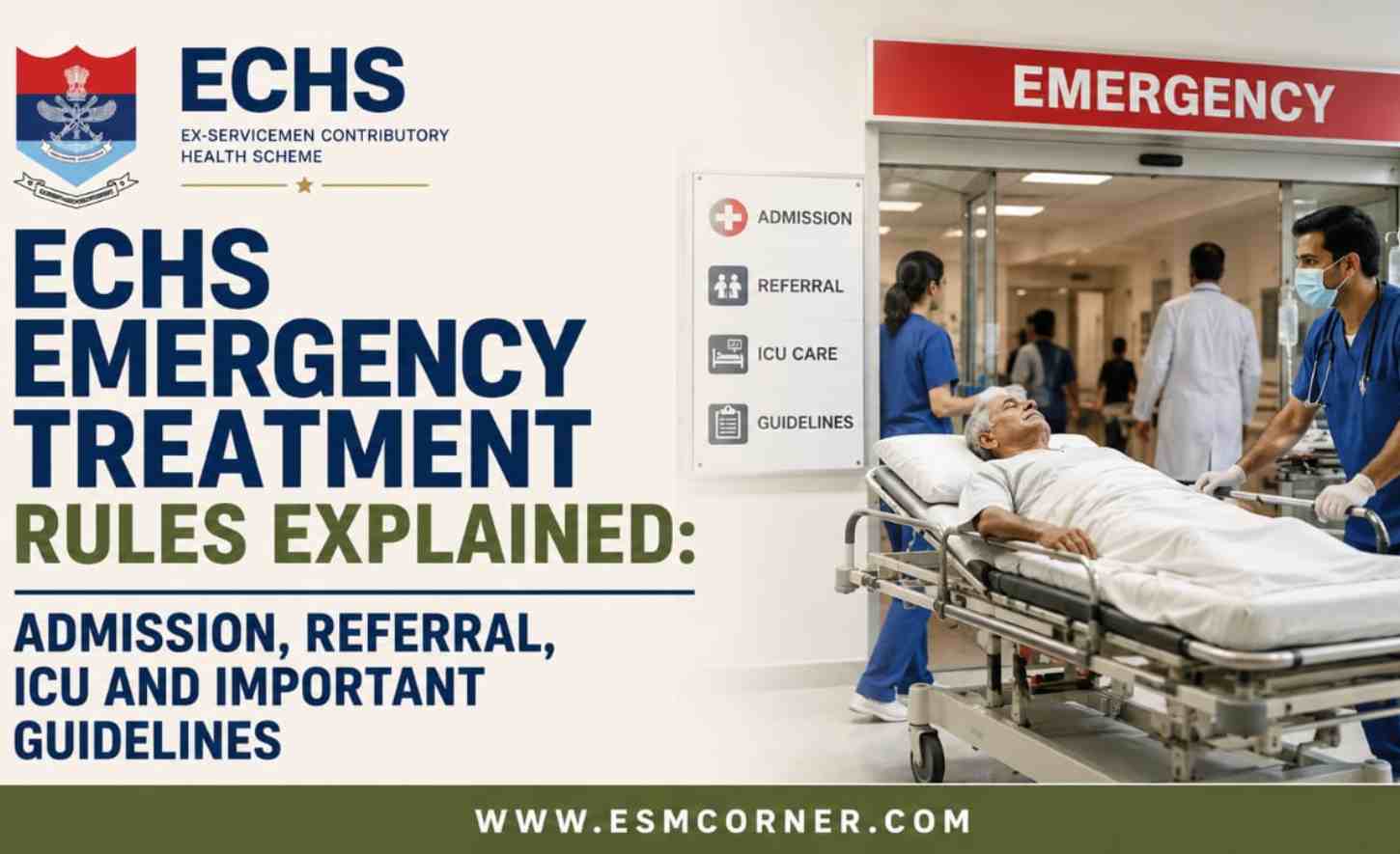
Medical emergencies do not come with a warning. A sudden heart attack, a road accident, a stroke in the middle of the night — in these moments no one has time to visit a polyclinic, wait for a Medical Officer, and collect a referral. ECHS understands this completely.
Under ECHS rules, emergency treatment has its own separate set of provisions. In a genuine emergency, you can walk into any empanelled hospital and get admitted without any referral. No paperwork beforehand. No polyclinic visit first.
This article explains every emergency treatment rule under ECHS — what conditions qualify, what the hospital must do, and what protections exist for both patients and hospitals. All facts are strictly from ECHS SOP April 2026.
The Core Emergency Rule — No Referral Needed
In a genuine medical emergency, an ECHS patient can be admitted to any empanelled hospital without any referral. This applies to all ECHS beneficiaries regardless of age or card type.
The hospital cannot refuse admission in an emergency citing absence of referral. Treatment must begin immediately.
What Conditions Qualify as an Emergency?
The ECHS SOP April 2026 lists specific conditions that qualify as emergencies. These are:
- Acute cardiac conditions including heart attack, unstable angina, ventricular arrhythmias, cardiac tamponade, acute left ventricular failure, accelerated hypertension
- Vascular emergencies including surgical and medical shock, peripheral circulatory failure, acute limb ischaemia, rupture of aneurysms
- Cerebrovascular accidents including strokes, neurological emergencies, coma, meningeal infections, convulsions, acute paralysis, acute visual loss
- Acute respiratory emergencies including respiratory failure and decompensated lung diseases
- Acute abdomen including acute obstetrical and gynaecological emergencies
- Life threatening injuries including road traffic accidents, head injuries, multiple injuries, crush injuries, and thermal injuries
- Acute poisonings and snake bite
- Heat stroke and cold injuries of life-threatening nature
- Acute endocrine emergencies like diabetic ketoacidosis
- Acute renal failure
- Severe infections leading to life-threatening consequences including septicaemia and miliary tuberculosis
- Any other condition where delay could result in loss of life or limb
The Medical Officer or specialist at the hospital is the final authority on whether a condition qualifies as an emergency.
Animal bite cases are treated as emergencies and treatment is provided on day care charge basis.
What the Hospital Must Do After Emergency Admission
Once an ECHS patient is admitted in emergency, the hospital has specific obligations:
Emergency Intimation Report — within 48 hours The hospital must raise an Emergency Intimation Report on the BPA portal within 48 hours of admission. The Officer in Charge of the polyclinic approves this report within 24 to 48 hours.
Geo-Tagged Photograph The hospital must attach a geo-tagged photograph of the admitted patient along with the Emergency Intimation Report.
Verification Call ECHS authorities will make a verification call — preferably a video call — on the patient’s registered mobile number. If the patient does not have their registered mobile with them, the hospital must arrange a video call to the Officer in Charge of the Polyclinic for verification.
Pseudo Emergency — What Happens When It Is Not a Real Emergency
Sometimes a patient arrives claiming emergency but after examination the doctor finds the condition is not serious. In such cases the patient should be stabilised and discharged at the earliest. The hospital can claim day care charges for the duration of detention — up to a maximum of eight hours.
Denial of Admission — Not Permitted
No empanelled hospital can deny admission to an ECHS patient. However if the entitled category bed is not available the hospital must either:
- Send the patient to another empanelled hospital under its own coordination, or
- Provide a bed in a higher category if the patient is willing
In emergency cases the hospital must never deny treatment. If no ICU space is available the patient must be stabilised and then sent to another empanelled hospital. It is the hospital’s responsibility to coordinate this transfer — not the patient’s family.
Whenever a hospital cannot admit due to non-availability of beds, it must inform the OIC ECHS Polyclinic or Regional Centre by phone immediately, followed by an email within 24 hours.
The Misuse Warning
The ECHS SOP April 2026 includes a clear warning — emergency provisions must not be misused either by the beneficiary or the empanelled hospital. Misuse may result in serious consequences. However the SOP also states that benefit of doubt should be given to the patient.
Common Mistakes to Avoid
- Not knowing you can go directly to any empanelled hospital in an emergency without referral
- Family members wasting time trying to get a referral during a genuine emergency
- Not knowing the hospital must coordinate bed transfers — not the family
- Not being aware of the verification call process — keep your registered mobile active and accessible
- Misusing emergency provisions for non-emergency conditions
Conclusion
In a genuine emergency, ECHS fully protects you. No referral, no prior paperwork, no polyclinic visit — just walk in and get treated. The hospital handles the Emergency Intimation Report, the geo-tagged photograph, and the verification process. Your only job in an emergency is to reach the nearest empanelled hospital as fast as possible.
Know these rules. Share them with your family. In an emergency, knowing your rights can save a life.
READ ALSO: CGHS VS ECHS: WHICH IS BETTER FOR EX-SERVICEMEN?
Frequently Asked Questions
Q1. Can an ECHS patient be admitted to a hospital in emergency without a referral?
Yes. In a genuine medical emergency an ECHS patient can be admitted to any empanelled hospital without any referral. The hospital cannot refuse admission citing absence of referral. Treatment must begin immediately and the Emergency Intimation Report is raised by the hospital within 48 hours of admission.
Q2. Who decides whether a condition qualifies as an emergency under ECHS?
The Medical Officer or specialist at the hospital attending the ECHS patient is the final authority on emergency diagnosis. The ECHS SOP April 2026 provides a detailed list of qualifying emergency conditions but also states that any condition where delay could result in loss of life or limb qualifies as an emergency.
Q3. What is an Emergency Intimation Report and who raises it?
An Emergency Intimation Report is a report raised by the empanelled hospital on the BPA portal to inform the ECHS polyclinic about an emergency admission. The hospital must raise this report within 48 hours of admission. The Officer in Charge of the polyclinic approves it within 24 to 48 hours.
Q4. What is the geo-tagged photograph requirement in emergency admissions?
The empanelled hospital must attach a geo-tagged photograph of the admitted patient along with the Emergency Intimation Report. This photograph serves as verification that the patient is physically present and admitted at the hospital at the time of the emergency.
Q5. What happens if the ECHS verification call cannot be completed on the patient’s mobile?
If the patient is not carrying their registered mobile number the hospital must arrange a video call to the Officer in Charge of the Polyclinic for the verification call. It is the hospital’s responsibility to facilitate this verification — not the patient’s family.
Q6. Can a hospital deny admission to an ECHS patient in an emergency?
No. No empanelled hospital can deny admission to an ECHS patient in an emergency. If beds are unavailable the hospital must stabilise the patient and then coordinate transfer to another empanelled hospital. The responsibility of coordinating this transfer lies with the hospital — not with the patient’s family.
Q7. What are day care charges and when do they apply in emergency cases?
If an ECHS patient arrives in emergency but after examination the doctor finds the condition is not serious, the patient is stabilised and discharged. The hospital can claim day care charges for the detention period of up to eight hours. This is called a pseudo emergency case under the ECHS SOP.
Q8. Are animal bite cases treated as emergencies under ECHS?
Yes. The ECHS SOP April 2026 specifically states that animal bite cases will be treated as emergencies and treatment will be provided on a day care charge basis.
Q9. What is the warning about misuse of emergency provisions?
The ECHS SOP April 2026 contains a specific warning that emergency provisions must not be misused either by the ECHS beneficiary or by the empanelled hospital. Misuse may result in serious consequences. However the SOP also clearly states that benefit of doubt should always be given to the patient.
Q10. If a hospital has no ICU beds available for an emergency ECHS patient what should happen?
If no ICU space is available the hospital must provide first aid, stabilise the patient, and then send them to another empanelled hospital. The hospital is responsible for coordinating this transfer. It must also immediately inform the OIC ECHS Polyclinic or Regional Centre by phone followed by an email within 24 hours.
For daily defence updates, government notifications, recruitment alerts, welfare schemes, career opportunities, education news, and other important announcements, join our WhatsApp Community. Click here to join our WhatsApp Group.



















What an ECHS person do under folowing conditions:
1. There is no empannelled hospital nearby or is far away and the emergency is acute?
2. Patient is briefly out of station (of parent polyclinic) in another city and no empannelled hospital is nearby or caretakers have no knowledge of empannelled hospital.
1. Acute emergency, no empanelled hospital nearby: Patient should immediately approach the nearest available hospital without delaying treatment. ECHS should be informed at the earliest, and all medical records/bills should be preserved for reimbursement as per rules.
2. Patient temporarily out of station: In an emergency, treatment should not be delayed for locating an ECHS empanelled hospital. Seek treatment at the nearest suitable hospital, inform ECHS/parent Polyclinic as soon as possible, and retain all documents for further action.