


Growing old comes with its own health challenges. Visiting a polyclinic, getting a referral, waiting in queues — for an elderly defence veteran aged 70 or above, this process can be physically exhausting and genuinely difficult. ECHS recognises this reality.
There are special rules under ECHS specifically for beneficiaries aged 70 years and above. These rules remove several steps from the normal treatment process and make healthcare access significantly easier for senior veterans and their elderly dependents.
This article explains every special provision available to ECHS beneficiaries aged 70 and above — based strictly on ECHS SOP April 2026.
The Big Benefit — No Referral Needed for OPD/ECHS Rules for Senior Citizens
The single most important benefit for senior ECHS beneficiaries is this —
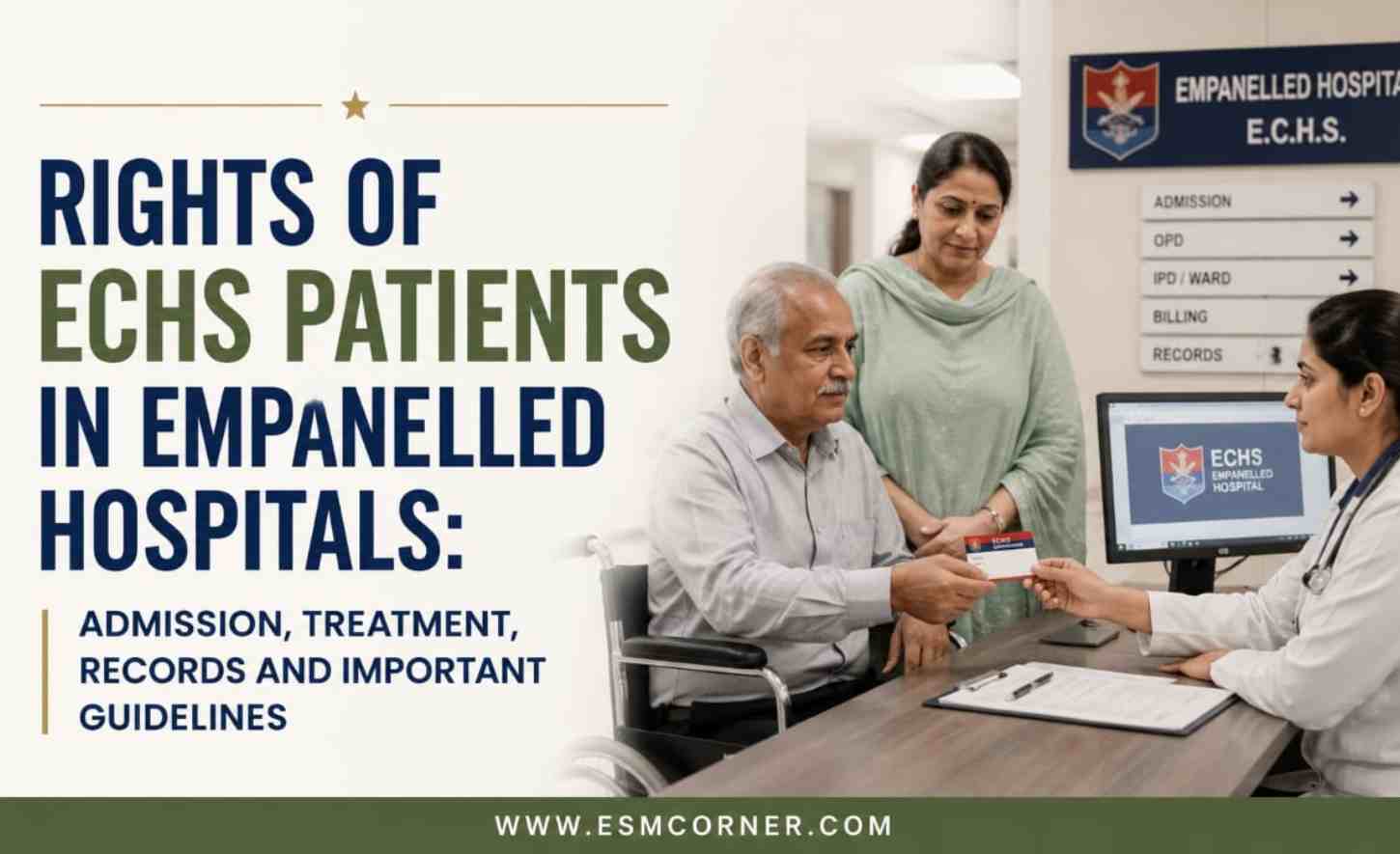
ECHS beneficiaries aged 70 years and above can visit any empanelled hospital directly for OPD consultation and investigations without any referral from the polyclinic.
This means a 72-year-old veteran or their elderly spouse does not need to first travel to the polyclinic, wait for the Medical Officer, and get a referral paper before going to the hospital. They can go directly to the empanelled hospital with their ECHS card.
This is a significant relief for senior citizens who may have mobility issues, travel difficulties, or health conditions that make every trip outside the house an effort.
No Separate Referral for Any Listed Tests
For most ECHS beneficiaries below 70 years, listed tests above Rs 3,000 require a separate ECHS referral from the polyclinic. This rule does not apply to beneficiaries aged 70 and above.
For senior beneficiaries — no separate referral is required for any listed tests or investigations — whether the cost is below or above Rs 3,000.
The specialist at the empanelled hospital can directly recommend any listed test and the hospital can carry it out without waiting for a separate referral from the polyclinic.
This saves elderly patients multiple trips and removes a major procedural hurdle.
Unlisted Tests Above Rs 5,000 — Approval Still Required
While senior beneficiaries get significant relaxation in the referral process, there is one rule that still applies to them.
For unlisted tests, investigations, or procedures costing above Rs 5,000 — online approval from ECHS authorities is still required.
However — and this is important — the beneficiary does not need to go anywhere for this approval. The empanelled hospital raises the online approval request through the ECHSF-U form on the BPA portal on behalf of the patient. The senior beneficiary simply waits at the hospital.
IPD Admission — Referral is Still Mandatory
The relaxation for senior beneficiaries applies only to OPD visits and investigations. When it comes to hospital admission, the rules are the same as for all other ECHS beneficiaries.
An IPD referral from the ECHS polyclinic is mandatory for admission — even for patients aged 70 and above. No hospital will admit a senior ECHS beneficiary without an IPD referral except in a genuine emergency.
So if a senior beneficiary visits the hospital on OPD basis and the specialist recommends admission, the family must obtain an IPD referral from the polyclinic before admission can proceed.
What About Proxy Consultation for Bed-Ridden Senior Patients?
Sometimes a senior patient is completely bed-ridden and physically cannot travel to the hospital even for a consultation. In such cases, proxy consultation may be permitted.
For this to be allowed — a written undertaking from the patient is required and the Regional Centre ECHS must be kept informed. Proxy consultation is an exception, not a standard facility.
Summary of Rules for 70-Plus Beneficiaries
- Direct OPD visit to empanelled hospital — No referral needed
- Listed tests any amount — No separate referral needed
- Unlisted tests above Rs 5,000 — Online approval needed — hospital applies, not the patient
- Hospital admission — IPD referral mandatory
- Bed-ridden patient consultation — Proxy allowed with written undertaking and Regional Centre informed
Common Mistakes to Avoid
- Senior beneficiaries not knowing they can go directly to the hospital for OPD without referral
- Family members making elderly patients travel to polyclinic unnecessarily for routine consultations
- Assuming no referral means no rules — IPD admission still needs a referral
- Not knowing that unlisted test approvals above Rs 5,000 are handled by the hospital, not the patient
- Not using the proxy consultation provision when the patient is genuinely bed-ridden
Conclusion
ECHS has made the treatment process considerably easier for its senior beneficiaries aged 70 years and above. Direct hospital access for OPD, no referral for any listed tests, and hospital-managed approvals for unlisted procedures — these provisions reduce the burden on elderly veterans and their families significantly.
The only things that remain unchanged are the IPD referral requirement for admission and the approval process for unlisted procedures above Rs 5,000 — and even for the latter, the hospital does the work, not the patient.
Every senior ECHS beneficiary and their family must be aware of these special provisions. Use them fully. Do not make an elderly veteran travel unnecessarily when the rules already protect them.
READ ALSO: ECHS HOSPITAL RULES: 4 ESSENTIAL TREATMENT RULES EVERY EX-SERVICEMAN MUST KNOW
Frequently Asked Questions
Q1. Can an ECHS beneficiary aged 70 and above visit an empanelled hospital without a referral?
Yes. ECHS beneficiaries aged 70 years and above can visit any empanelled hospital directly for OPD consultation and investigations without any referral from the polyclinic. This is a specific provision under ECHS SOP April 2026 to reduce the burden on elderly beneficiaries.
Q2. Do senior ECHS beneficiaries need a referral for tests above Rs 3,000?
No. For beneficiaries aged 70 and above no separate referral is required for any listed tests or investigations — whether below or above Rs 3,000. The specialist at the empanelled hospital can directly recommend listed tests without waiting for a polyclinic referral.
Q3. Is approval needed for unlisted tests above Rs 5,000 for senior beneficiaries?
Yes. Even for beneficiaries aged 70 and above online approval from ECHS authorities is required for unlisted tests or procedures above Rs 5,000. However the patient does not need to go anywhere — the empanelled hospital raises the approval request online through the ECHSF-U form on the BPA portal.
Q4. Can a senior ECHS beneficiary be admitted to hospital without a referral?
No. The relaxation for senior beneficiaries applies only to OPD visits and investigations. For hospital admission an IPD referral from the ECHS polyclinic is still mandatory even for patients aged 70 and above. The only exception is a genuine medical emergency.
Q5. What happens if a 70-plus patient visits on OPD and the specialist recommends admission?
If the specialist recommends admission after an OPD visit the family must obtain an IPD referral from the polyclinic before admission can proceed. The OPD visit without referral is permitted but the IPD admission still requires a proper referral from the polyclinic.
Q6. Is proxy consultation available for elderly bed-ridden ECHS patients?
Yes but only as an exception. For a genuinely bed-ridden patient who cannot travel a proxy consultation may be permitted. A written undertaking from the patient is required and the Regional Centre ECHS must be kept informed. It is not a routine facility available to all patients.
Q7. Does the spouse of a veteran also get the 70-plus benefit?
The ECHS SOP April 2026 states that ECHS beneficiaries aged 70 and above get this benefit. Dependents registered on the ECHS card who are aged 70 and above would fall under the same category as ECHS beneficiaries for this provision. Confirm the specific application with your polyclinic.
Q8. Do senior beneficiaries still need to carry their ECHS card when visiting the hospital?
Yes absolutely. Even though no referral is needed for OPD visits the ECHS card is always required. Carry your original ECHS card and a photocopy every time you visit the polyclinic or empanelled hospital regardless of your age.
Q9. Can a senior beneficiary visit any empanelled hospital or only the one they are registered with?
The ECHS SOP April 2026 states that beneficiaries aged 70 and above can visit an empanelled hospital for OPD consultation without a referral. For specific hospital restrictions or preferences contact your ECHS polyclinic or Regional Centre for guidance applicable to your area.
Q10. Where can senior ECHS beneficiaries get help if they face problems at the hospital?
Every empanelled hospital must have a designated Authorised Representative for ECHS beneficiaries whose contact details are displayed at the ECHS help desk and on the hospital website. For unresolved issues contact the Officer in Charge of your ECHS Polyclinic or the Regional Centre ECHS. The official ECHS website is www.echs.gov.in.
For daily defence updates, government notifications, recruitment alerts, welfare schemes, career opportunities, education news, and other important announcements, join our WhatsApp Community. Click here to join our WhatsApp Group.




















Good initiative
Very nice information sir,
Thanks
My claim reimbusement of pharmacy bill op ECHS PC sALEM
3 BILLS not at selled how long it will take Time pl inform me சார்.
Sir ramram my ECHS bill not at remite my account.
Sir mira echs bill pass ho ki nhi aaya
What are the listed tests and unlisted tests? I am 86years old, anything more for super senior veterans?
helpful clarifications for 70 plus veterans
Thanks for the timely updates.
Rgds,
Jay hind!