
Have you always dreamed of wearing the olive green uniform but believed that only engineering graduates can become Army officers? If that thought has been holding you back, it’s time to clear the confusion. One of the most common misconceptions among aspiring female candidates is that a technical degree is mandatory for joining the Indian Army as an officer. The reality is quite different—you can earn a commission in the Indian Army without having an engineering or technical background.
The SSC (Non-Tech) Women Entry exists precisely to bust this myth. It’s a proper, respected, no-shortcuts pathway for women from arts, commerce, science, humanities — literally any stream — to walk straight into leadership roles in the Indian Army. This entry isn’t bothered about what you studied. It cares about who you are: your mental sharpness, your character, your ability to take a decision and stand by it.
As someone who has mentored defence aspirants for over two decades, here’s the one thing I want you to remember before reading any further: your determination will take you further than your degree ever will. Now let’s break down everything — eligibility, exams, the SSB interview, training at OTA Chennai, and how to actually prepare — in plain, simple language.
So, What Exactly Is SSC (Non-Tech) Women Entry?
In simple words, this is a scheme through which the Indian Army commissions women officers for a 10-year Short Service Commission, extendable by 4 more years (so, up to 14 years total). And here’s the best part — unlike the technical entries that demand an engineering degree, this route is open to graduates from any recognized university, any subject.
The Army isn’t just looking for engineers here. It’s looking for people who can lead — in logistics, administration, intelligence, communications, and operational support. That could be you.
Why does this matter so much?
- It offers a career built on purpose, not just a paycheck.
- You get equal command, equal responsibility, and equal respect as your male counterparts — from day one.
- Instead of a 9-to-5 desk job, you’re leading real soldiers, making real decisions, in real challenging situations.
- It turns “I have a degree” into “I lead people” — a completely different level of achievement.
Is this path for you? Ask yourself honestly — are you disciplined? Do you stay calm when things go wrong? Do you enjoy working in a team rather than alone? Do you have that itch to serve something bigger than yourself? If yes, keep reading, because this entry was made with you in mind.
Eligibility: Do You Even Qualify
Let’s get the boring-but-important part out of the way first.
- Nationality: You must be an Indian citizen (or eligible as per official notification).
- Marital status: Unmarried.
- Age: Generally between 19 and 25 years at the time the course begins (always check the latest notification, as this can vary slightly).
- Education: A recognized Bachelor’s degree in any discipline, with the minimum percentage mentioned in the specific notification — whether it’s UPSC CDS or NCC Special Entry.
- Final year students: Good news — you can apply too, as long as you can prove you’ve passed before training starts.
How do they shortlist candidates?
It depends on which door you’re knocking:
- UPSC CDS route (for OTA Chennai): You clear a written exam, and your score decides if you get called for the SSB interview.
- NCC Special Entry route: No written exam here — instead, your graduation percentage and your NCC ‘C’ certificate grading matter the most.
Moral of the story? Keep your academics solid, no matter which route you’re eyeing. It genuinely opens more doors than people realise.
The Selection Process: What Actually Happens?
Here’s something people don’t tell you enough — the Indian Army’s selection process isn’t about mugging up facts. It’s designed to see the real you. Your composure, your instincts, your social skills, your physical toughness. All of it, tested over multiple stages.
Here’s how the journey typically flows:
| Stage | What It Checks | What You Should Focus On | What You Get |
|---|---|---|---|
| Written Exam / Shortlisting | Academic and basic cognitive ability | Solid exam prep or strong degree marks | Call letter for SSB |
| SSB Stage 1 (Screening) | Basic intelligence and perception | OIR test, PPDT storytelling, group discussion | Screening in for Stage 2 |
| SSB Stage 2 (Core Testing) | Psychology, GTO tasks, personal interview | Genuine confidence, teamwork, OLQs | Recommendation from the Board |
| Medical Exam | Physical and medical fitness | Overall health, vision, stamina | Fit-for-training certificate |
| All India Merit List | Final ranking | Cumulative performance | Joining instructions for OTA |
Notice something? Not one single test decides your fate. It’s your overall personality — your integrity, adaptability, courage, and stamina — that gets you through.
Let’s Talk About the Real Deal: The 5-Day SSB Interview
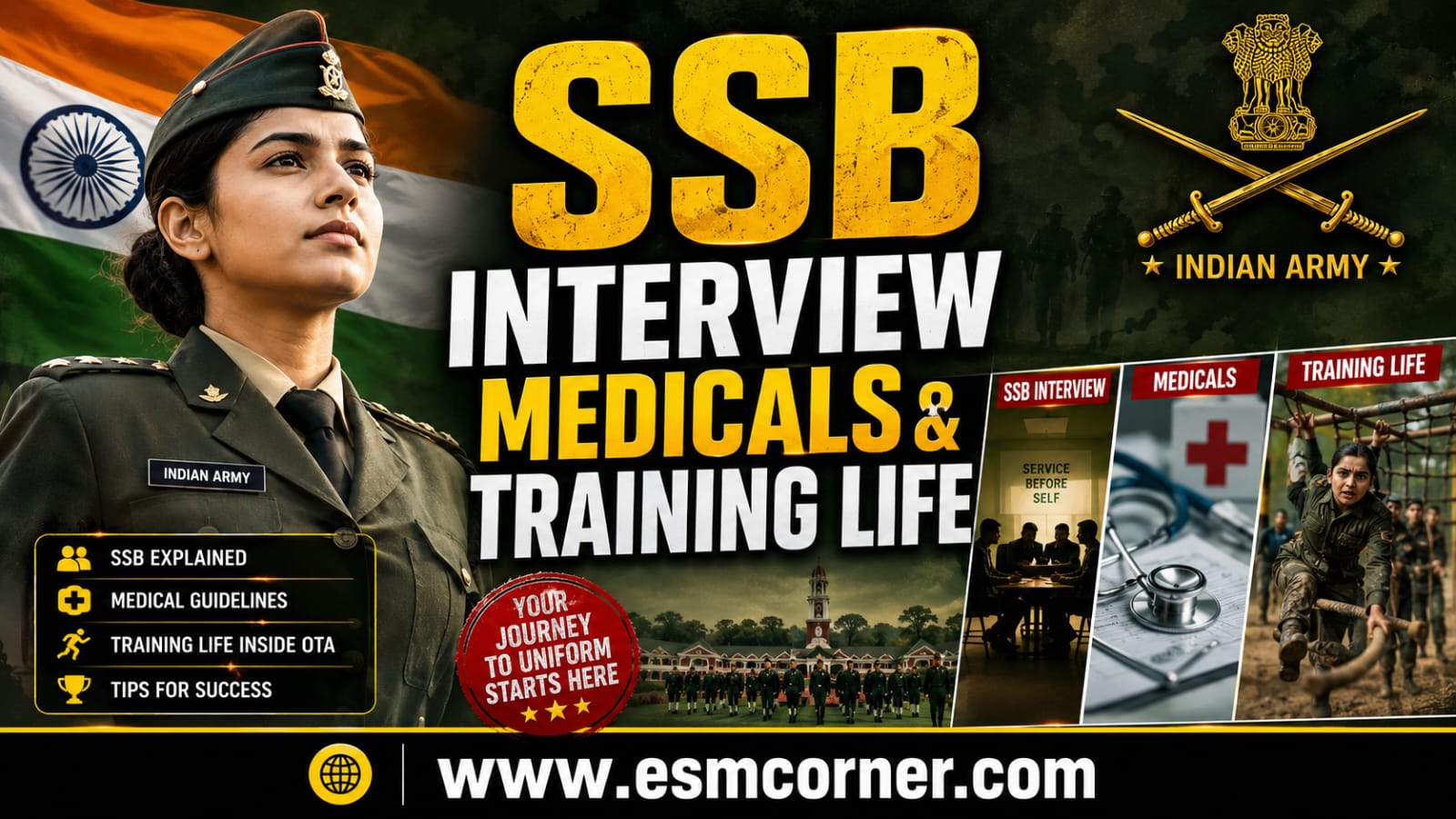
This is the part that scares most aspirants, so let’s demystify it.
The SSB interview runs across 5 days, split into two stages:
- Stage 1 — Officer Intelligence Rating (OIR) tests and the Picture Perception & Description Test (PPDT), where you build a story around a picture and discuss it in a group.
- Stage 2 — This is where it gets deeper: psychological tests (TAT, WAT, SRT, SDT), outdoor GTO tasks that test how you behave under pressure and in a team, and finally, a one-on-one interview with a senior officer.
Here’s the honest truth about SSB: the assessors have seen it all. They can spot a rehearsed, “ideal” answer from a mile away. So don’t try to be who you think they want. Be authentically, unapologetically yourself — with clear communication and genuine emotional maturity. That’s what actually works.
Got Recommended? Here’s What Happens Next
- Medical Examination — You’ll be sent to a designated military hospital for a thorough health check. This isn’t just a formality; the standards are genuinely strict.
- All India Merit List — Based on your total SSB score and available vacancies, a merit list is published.
- Joining Instructions — If you make the cut, you’re off to the Officers Training Academy (OTA), Chennai, for 49 weeks of intense military training.
Think of OTA as the place where a regular civilian graduate is reshaped — physically, mentally, tactically — into a confident, disciplined military leader. Weapons training, physical conditioning, leadership drills — it’s tough, but it’s exactly what builds that unmistakable “officer bearing.”
Life After Commissioning: What Does the Career Actually Look Like?
Once you pass out of OTA, you’re commissioned as a Lieutenant. From there, your career moves forward:
- Lieutenant → Captain → Major → Lieutenant Colonel, based on your years of service and performance.
- You could be posted to arms like the Army Ordnance Corps, Army Service Corps, Corps of Signals, Intelligence Corps, or Army Aviation Corps — handling everything from logistics to communications to intelligence, across terrains ranging from icy borders to peacetime cantonments.
- Depending on current policy, you may also get the chance to apply for a Permanent Commission (PC) — meaning your career doesn’t have to stop at 10 or 14 years; it can go all the way up.
- And even if you do decide to exit after your tenure, the leadership experience you carry opens doors into corporate, administrative, and public sector roles that most fresh graduates can only dream of.
How to Actually Prepare — A Practical Game Plan
You don’t need to wait till your final year to start. Begin today, even if you’re just in your first or second year of graduation.
Do this consistently:
- Read a newspaper daily — not to memorise headlines, but to actually form opinions on current affairs.
- Work on your spoken English through daily conversations, debates, or group discussions.
- Get physically active — running, sports, anything that builds real stamina, not just gym selfies.
- Take up leadership roles in college clubs or community work — this naturally sharpens your Officer Like Qualities (OLQs).
Avoid these mistakes at all costs:
- Faking your personality during SSB. It never works — trained assessors catch it instantly.
- Ignoring fitness until the last month. GTO outdoor tasks are physically demanding; you cannot cram stamina.
- Cramming “model answers” from coaching centres instead of developing your own genuine thought process.
- Isolating yourself socially. Officers are made through people skills, not just bookish knowledge.
The Bottom Line
The SSC Non-Tech Women Entry proves one thing beyond doubt — you don’t need to be an engineer to lead. You need character, clarity, courage, and consistency. The Army isn’t hunting for perfect candidates; it’s hunting for potential, and potential can be built, every single day, starting right now.
So work on your fitness. Sharpen your communication. Read more, observe more, lead more — even in small ways, in your own college or community. Stay honest through your preparation instead of hunting for shortcuts.
Because one day, that same discipline and grit will earn you the right to lead soldiers — and wear those officer ranks with pride.
READ ALSO: INET (GRADUATE ENTRY) – ELIGIBILITY, SELECTION & CAREER GUIDE
Frequently Asked Questions
What is SSC (Non-Tech) Women Entry?
It is a Short Service Commission entry scheme allowing non-engineering women graduates to join the Indian Army as officers. Selection is based on written exams or direct shortlisting, followed by the SSB interview and training at OTA Chennai.
Who can apply for this officer entry?
Unmarried women holding a recognized graduation degree in any discipline within the prescribed age criteria are eligible to apply. Candidates must also satisfy the medical and physical standards set by the Indian Army.
Is an engineering degree required for Non-Tech entry?
No, an engineering degree is strictly not required for non-technical entry. Graduates from arts, commerce, science, business administration, or humanities disciplines are fully eligible to apply for this entry.
Is there a written examination for SSC Non-Tech entry?
Entries through UPSC Combined Defence Services (CDS) require clearing a written exam. However, specific channels like the NCC Special Entry allow eligible candidates to bypass written exams and go directly to SSB shortlisting.
Is the SSB interview compulsory for selection?
Yes, the 5-day SSB interview is mandatory for all officer entries in the Indian Armed Forces. It evaluates psychological suitability, leadership traits, social adaptability, and decision-making capabilities.
What does Army training at OTA involve?
Training spans 49 weeks at Officers Training Academy (OTA), Chennai. It includes intense physical conditioning, weapon handling, military tactics, leadership drills, obstacle courses, and academic instruction in military science.
How should a beginner start preparing?
Beginners should focus on building daily fitness habits, improving English communication skills, and staying updated on current affairs. Consistent self-introspection, participating in group activities, and developing problem-solving skills help cultivate Officer Like Qualities.
What are the long-term career growth opportunities?
Officers earn regular promotions from Lieutenant up to Lieutenant Colonel based on length of service. They can opt for Permanent Commission based on eligibility or transition into senior corporate leadership roles after completing their commission.
For daily defence updates, government notifications, recruitment alerts, welfare schemes, career opportunities, education news, and other important announcements, join our WhatsApp Community. Click here to join our WhatsApp Group.