The National Defence Academy (NDA) serves as the first step toward a career as an officer in the Indian Armed Forces. Each year, thousands of aspiring candidates appear for the NDA written examination and the Services Selection Board (SSB) interview, aiming to secure admission to this prestigious academy.
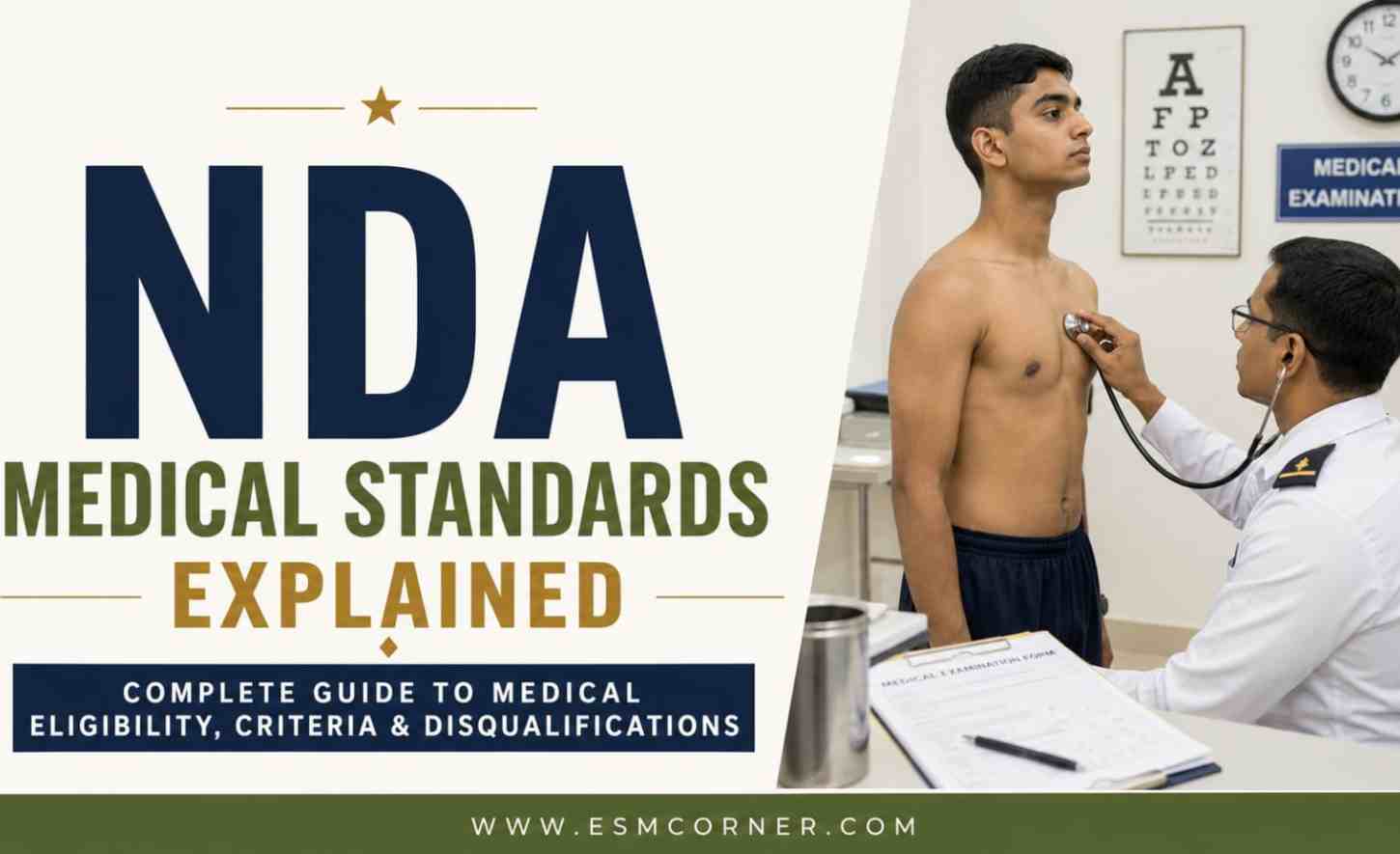
However, many candidates who successfully clear both stages are declared medically unfit during the final medical examination. The NDA Medical Examination is a detailed assessment that evaluates whether a candidate meets the physical and medical standards required for military training.
It is not a routine health check but a comprehensive evaluation of overall fitness. Even minor medical conditions that seem insignificant in everyday life can result in disqualification if they affect military performance. Therefore, understanding the medical standards well before appearing for the medical board is essential. This guide is designed for NDA aspirants, parents, teachers, and mentors who want to understand the complete medical evaluation process, common reasons for rejection, and the importance of early health preparation.
By identifying correctable conditions in advance and maintaining the required fitness standards, candidates can approach the final stage of selection with greater confidence and reduce the risk of avoidable medical rejection.
The Purpose and Significance of the NDA Medical Examination
The Indian Armed Forces maintain strict medical standards because military officers must perform in extreme environments such as high altitudes, fighter aircraft, and submarines. The NDA Medical Test ensures that every selected candidate has the physical fitness, structural health, and physiological capacity required to complete rigorous military training and serve effectively.
Medical fitness is essential for operational readiness and mission success. A health problem during service can affect not only the individual but also the safety of the team and the mission. Therefore, the medical examination identifies conditions that may worsen under stress, harsh climates, or physical demands, ensuring long-term fitness for military service.
The Complete NDA Medical Examination Process: Step-by-Step
The journey through the military medical evaluation is highly structured, transparent, and conducted by specialized medical officers over several consecutive days at designated military hospitals.
1. Post-SSB Medical Board Assembly
Immediately after being recommended by the SSB, candidates are assigned a medical chest number and directed to report to the assigned military hospital. This marks the beginning of the Special Medical Board (SMB). The initial day involves detailed documentation using official medical history forms, where candidates must transparently declare any previous surgeries, chronic illnesses, or family health patterns.
2. Laboratory Investigations and Imaging
Candidates undergo diagnostic screenings to check internal biochemical health. This stage includes:
- Blood Panels: Complete blood count (CBC), hemoglobin levels, blood sugar profiles, and metabolic markers.
- Urine Analysis: Screening for albumin, sugar, and microscopic abnormalities that point to underlying kidney or metabolic conditions.
- Radiology & Cardiology: A standard digital chest X-ray to evaluate lung fields and structural alignment, alongside an electrocardiogram (ECG) to screen for resting cardiac arrhythmias.
- Ultrasonography (USG): An abdominal ultrasound to check for congenital anomalies, organomegaly (enlarged organs), or hidden stones.
3. Specialist Evaluations
Over the next three to four days, candidates pass through specialized medical departments:
- Ophthalmology: Detailed testing for visual acuity, refraction limits, color perception, and retinal health.
- Otolaryngology (ENT): Inspection of the tympanic membranes, auditory acuity, nasal passages, and vocal pathways.
- Surgery & Orthopedics: Structural evaluation focusing on bone health, joint mobility, spinal symmetry, and the absence of hernias or vascular anomalies.
- General Medicine & Dental: Evaluates overall physical health, monitors blood pressure for stability, and assesses dental health based on the prescribed dental point standards.
4. Board Conference and Appeal Mechanisms
On the final day, the Special Medical Board reviews all individual specialist findings to determine the candidate’s fitness status. If a candidate fails to meet the precise criteria, they are declared either Temporarily Unfit or Permanently Unfit.
A temporary unfitness status provides a structured window—typically up to 42 days—to resolve curable issues (such as being mildly underweight or having a minor infection) before appearing before an Appeal Medical Board (AMB) at a designated command hospital. In complex cases where an AMB upholds a permanent rejection, candidates can request a final Review Medical Board (RMB), provided there is sufficient specialist evidence from civil institutions to warrant a re-evaluation.
Breakdown of Systemic and Physical Medical Standards
The official physical and anatomical requirements are precise. The following breakdowns detail what is examined across every major system:
Height, Weight, and Musculoskeletal Standards
The medical board checks height, weight, BMI, chest expansion, and overall body structure. It also examines the spine, limbs, joints, and feet for conditions such as scoliosis, kyphosis, knock knees, bow legs, flat feet, limited joint movement, or previous major fractures that may affect military performance.
Dental and Oral Health
Candidates must meet the required dental points with healthy, functional teeth. The board checks for cavities, gum disease, missing teeth, bite alignment, jaw movement, and any oral diseases that could affect long-term health.
ENT and Respiratory Standards
The medical evaluation assesses hearing, the health of the eardrums, nasal passages, throat, speech, and overall respiratory function. Conditions such as a severe deviated nasal septum, chronic tonsillitis, asthma, bronchitis, or other respiratory disorders may result in temporary unfitness or disqualification, depending on their severity.
Cardiovascular, Gastrointestinal, and Genitourinary Systems
The medical board evaluates blood pressure, heart function, digestive organs, liver, spleen, kidneys, and the genitourinary system. Hernia, hydrocele, varicocele, piles, chronic digestive disorders, serious heart conditions, and severe skin diseases are carefully assessed, with some requiring treatment before final approval.
Medical Standards for Female NDA Candidates
Following the landmark integration of female cadets into the National Defence Academy, specific, objective medical criteria have been established for female aspirants. The general physiological, systemic, neurological, and ophthalmic standards mirror those of male candidates. However, distinct standards apply to the anthropometric charts:
- Height Baselines: The absolute minimum height required for female candidates joining the Army and Navy is 152 cm, providing a realistic baseline that accounts for natural physiological differences.
- Air Force Metrics: For the Air Force Flying Branch, the minimum height remains uniform at 162.5 cm for both genders due to the mechanical dimensions of aircraft cockpits and ejection seat safety limits.
- Weight Allowances: Weight limits are adjusted according to age-height charts specific to female physiology, maintaining a strict focus on healthy muscle-to-fat ratios.
Female candidates undergo a comprehensive gynecological screening during the medical board to ensure the absence of congenital anomalies, severe dysmenorrhea, or functional conditions that could interfere with intensive physical training. The presence of active pregnancy is an absolute bar to admission.
NDA Medical Standards At-A-Glance Comparison
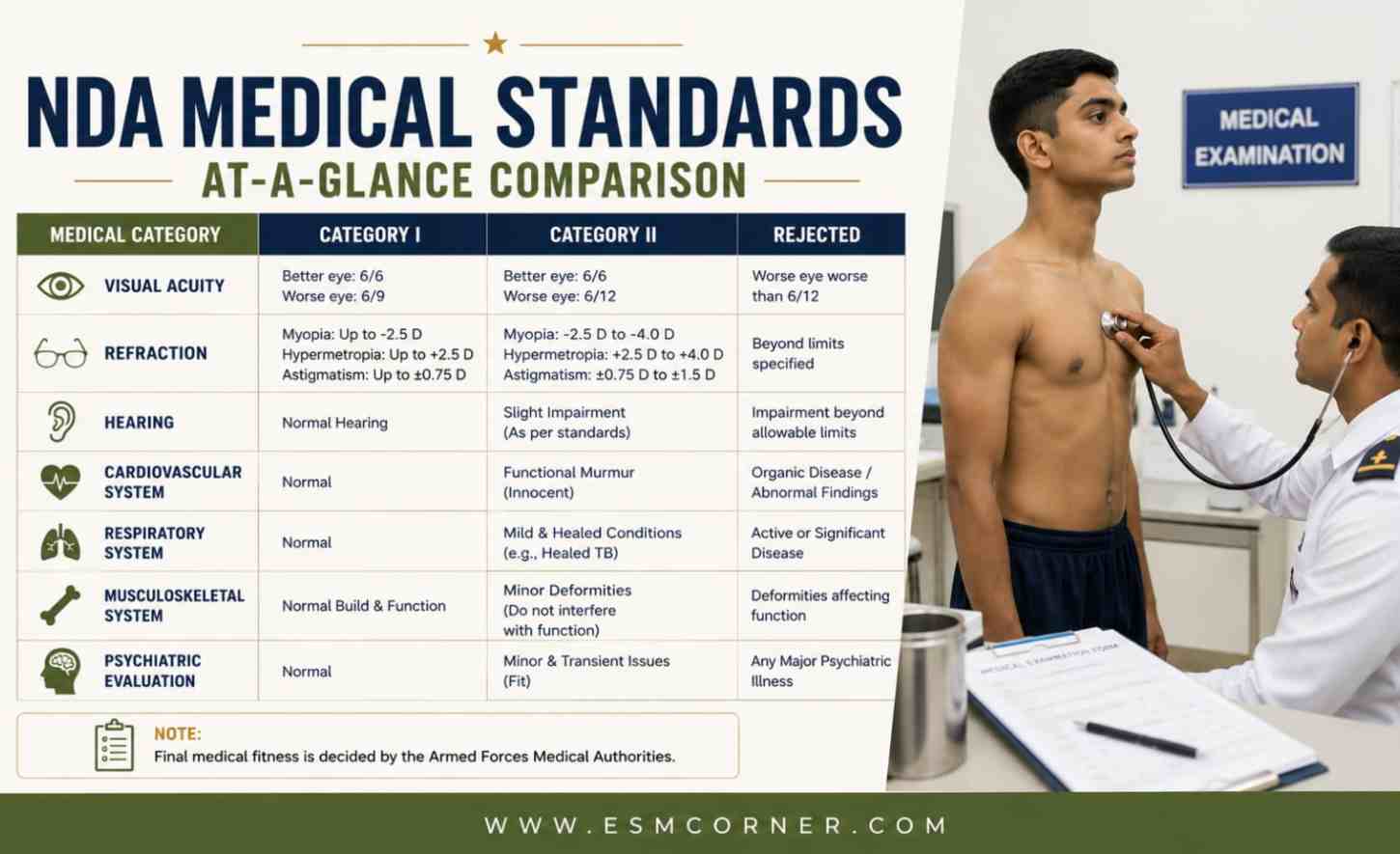
The following comprehensive table outlines key medical conditions, why they are checked, their impact on selection, and preventive advice.
| Medical Parameter | Why It Is Checked | Possible Impact on Selection | Preparation or Preventive Advice |
| Height & Weight Alignment | Assesses physical development and baseline structural load capacity. | Temporary Unfitness if overweight or underweight; permanent if below absolute minimum height. | Maintain a balanced diet, engage in regular core training, and track your body mass index monthly. |
| Visual Acuity & Refraction | Ensures clear operational vision during combat and tactical scenarios. | Permanent Rejection if errors exceed specified diopter limits or if color vision is defective. | Limit unnecessary screen time, use the 20-20-20 rule, and verify your eye prescription early. |
| Spinal Symmetry & Health | Evaluates load-bearing capacity during intense physical training and paratroop drops. | Permanent Rejection for structural scoliosis, severe kyphosis, or fused vertebrae. | Focus on proper lifting posture, regular yoga, and core exercises to keep the spine flexible. |
| Knee & Foot Alignment | Evaluates long-distance running capability and weight distribution. | Permanent Rejection for rigid flat feet or severe structural knock knees. | Use corrective arch insoles for flexible flat feet and perform targeted tracking exercises. |
Crucial Administrative and Appeal Protocols
When reporting for your medical examination, ensuring your paperwork is organized is just as important as physical preparation. You must gather and carry all essential official documents in a clean, systematic file:
- Your official SSB Recommendation Letter alongside the original UPSC NDA Admit Card.
- Valid government-issued photo identification (such as an Aadhaar Card, Passport, or Voter ID).
- Original matriculation and $10+2$ educational certificates to verify your exact date of birth and spelling details.
- Recent passport-sized color photographs matching the official specifications.
- Detailed case summaries, surgical discharge certificates, and official clearance notes if you have a history of permissible corrective surgeries (like an authorized laproscopic appendectomy or a resolved septoplasty).
If you receive a temporary or permanent unfitness notification, it is vital to remain calm and follow the official appeal process carefully. A Temporary Unfitness (TR) status is a manageable delay, not a final rejection. Use the provided 42-day window to follow the recommended medical steps carefully, avoid unverified quick fixes, and report to your designated Appeal Medical Board (AMB) with clear documentation of your recovery.
If you face a Permanent Unfitness (PR) ruling that you believe is inaccurate based on modern diagnostic standards, work with your mentors to file an official appeal through the appropriate military channels within the allowed timeframe. This allows you to have your case reviewed by senior specialists at a primary Command Hospital via a Review Medical Board (RMB), ensuring a fair and thorough assessment.
Conclusion
Conquering the National Defence Academy selection process requires a balanced combination of academic preparation, leadership potential, and physical health. The NDA Medical Test is carefully structured to ensure that future leaders possess the physiological resilience, structural durability, and robust health needed to handle the challenging demands of military life. It is important to remember that these medical evaluations are not designed simply to filter candidates out; rather, they serve to verify that you can complete intense military training safely and maintain a healthy, lifelong career in uniform.
Read also: MILITARY NURSING SERVICE (MNS) COMPLETE GUIDE: ELIGIBILITY, EXAM, SALARY & CAREER
Q1: Can I qualify for the NDA if I currently wear spectacles?
Yes, candidates wearing spectacles can qualify for the Indian Army and Indian Navy wings, provided their refractive error remains within the official limits. The maximum allowable correction is $-2.5 \text{ D}$ for myopia and $+3.5 \text{ D}$ for hypermetropia, and your vision must correct fully to $6/6$. However, the Air Force Flying Branch maintains a strict policy requiring near-perfect natural vision with no tolerance for manifest errors.
Q2: What are the most common reasons for temporary unfitness during the NDA medical exam?
The most frequent causes for a Temporary Unfitness (TR) status include being overweight or underweight according to the official charts, significant earwax accumulation, minor dental cavities, treatable skin conditions, and a mild Deviated Nasal Septum (DNS). These conditions are generally correctable within the standard 42-day window allowed before reporting to the Appeal Medical Board.
Q3: Is color blindness acceptable in any branch of the NDA?
No, color blindness is a permanent disqualification across all branches of the National Defence Academy. The military requires a high standard of color perception (CP-II or CP-III) because officers must be able to reliably identify color-coded signaling flares, complex instrument panels, and night markers during tactical operations.
Q4: How long does the entire NDA medical examination take after the SSB recommendation?
The comprehensive medical examination typically takes between 3 to 5 continuous days at a designated military hospital. During this period, candidates undergo laboratory blood tests, internal imaging, and systematic evaluations by multiple medical specialists before the final board reviews the complete fitness profile.
Q5: Can I undergo LASIK surgery to correct my vision before the NDA medical board?
No, LASIK, PRK, or any other kerato-refractive procedures are completely barred for NDA entry across all three service wings. Because applicants are typically under 20 years old, their vision may still be changing, making laser correction unsuitable at this stage. Advanced diagnostic screening will detect these surgeries, leading to disqualification.
Q6: What is the official dental points system and how can I prepare for it?
The medical board uses a dental points system that requires a minimum of 14 functional dental points out of 22. Points are awarded for matching pairs of healthy, well-aligned upper and lower teeth. You can prepare by visiting a dentist early to treat any active decay, ensure good gum health, and resolve minor alignment issues.
Q7: What steps should I take if I am declared permanently unfit by the initial medical board?
If you receive a Permanent Unfitness ruling, you have the right to file an official appeal within the permitted timeframe. You must obtain a thorough evaluation from a qualified civil specialist to support your case and apply for an Appeal Medical Board (AMB), which will re-examine your condition at a primary Command Hospital.
Q8: How can I safely adjust my weight to meet the official NDA criteria?
To adjust your weight safely, focus on a sustainable approach combining regular physical conditioning with a balanced diet. Avoid extreme crash diets right before the exam, as they can negatively impact your blood test results and energy levels. Instead, aim for a steady, healthy rate of weight change well in advance of the medical board.
For daily defence updates, government notifications, recruitment alerts, welfare schemes, career opportunities, education news, and other important announcements, join our WhatsApp Community. Click here to join our WhatsApp Group.