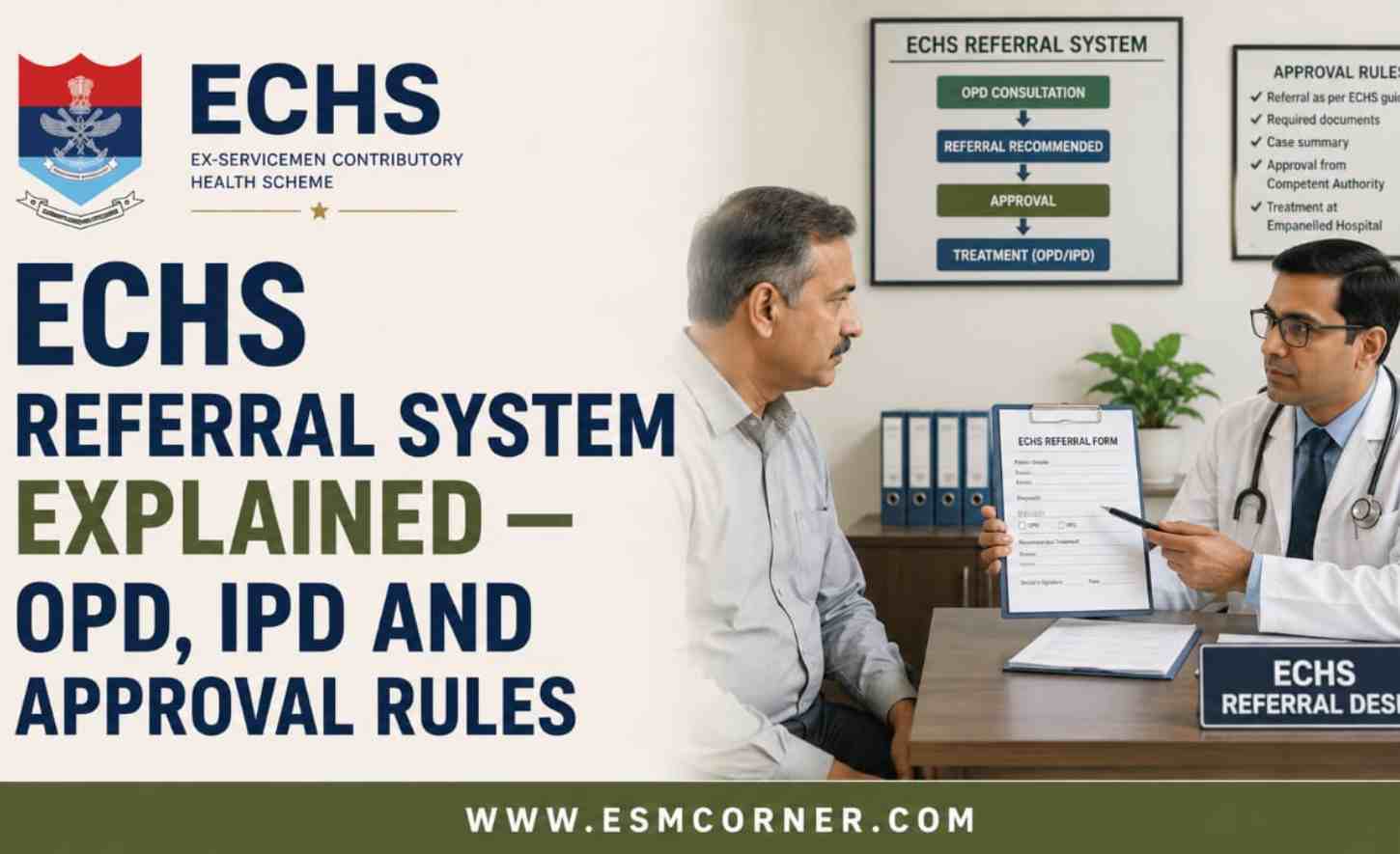


Confusion about ECHS (Ex-Servicemen Contributory Health Scheme) referrals is one of the biggest reasons veterans face delays at empanelled hospitals. This article lists eight facts about how OPD and IPD referrals actually work, based on official ECHS rules, so you know what to expect before your next visit.
- OPD referral is valid for 3 months — An OPD (Out-Patient Department) referral from your Polyclinic covers up to 6 visits and up to 3 specialists, and stays valid for 3 months from the date it is issued.
- An OPD referral cannot be used for admission — If you need to be admitted to a hospital, a separate IPD (In-Patient Department) referral is required. Empanelled hospitals will not admit a patient on an OPD referral alone.
- Beneficiaries aged 70 and above get direct OPD access — Senior ECHS beneficiaries aged 70 years and above can walk into an empanelled hospital for OPD consultation, including certain high-end scans, without needing a prior referral from the Polyclinic.
- Emergency admission does not need a prior referral — During a genuine medical emergency, a beneficiary can be admitted directly to a hospital. The Polyclinic must usually be informed within 48 hours so the case can be processed correctly.
- Chemo and dialysis referrals last longer — Referrals for ongoing treatments like cancer chemotherapy or dialysis have an extended validity of up to 6 months, instead of the usual 3 months given for other referrals.
- A referral is the Medical Officer’s decision, not a right — A referral cannot simply be demanded by the beneficiary. It is given at the discretion of the treating Medical Officer, generally once all options at the Polyclinic have been considered.
- Medicines after an OPD referral are obtained from the Polyclinic — Medicines prescribed during an OPD consultation at an empanelled hospital are collected from the concerned ECHS Polyclinic. They are not purchased directly from the open market, except in emergency situations.
- Outstation referrals are handled by the local Polyclinic — If you are referred to a hospital outside your parent Polyclinic’s area, the outstation Polyclinic and Regional Centre take responsibility for processing that claim.
Most referral confusion comes from not knowing the difference between an OPD referral and an IPD referral, or assuming a referral can be demanded on request. Knowing the validity period and the special rules for senior beneficiaries and ongoing treatments can save you an unnecessary trip back to the Polyclinic. When in doubt, always confirm the referral type with your Polyclinic before visiting an empanelled hospital.
Join our WhatsApp community for the latest pension, ECHS, and veteran welfare updates — tap here to join free.
Frequently Asked Questions
Q1. How long is an ECHS OPD referral valid?
A1. An OPD referral is valid for 3 months from the date of issue and covers up to 6 visits across up to 3 specialists during that period.
Q2. Can I get admitted to a hospital using only an OPD referral?
A2. No, hospital admission requires a separate IPD referral. Empanelled hospitals will not admit a patient using an OPD referral alone.
Q3. Do beneficiaries above 70 need a referral for OPD consultation?
A3. No, ECHS beneficiaries aged 70 and above can directly consult a specialist at an empanelled hospital without a prior Polyclinic referral.
Q4. What happens if I need emergency hospital admission?
A4. You can be admitted directly without a prior referral, but the Polyclinic usually needs to be informed within 48 hours for the case to be processed correctly.
Q5. Why do cancer and dialysis referrals last longer than others?
A5. Because these are ongoing treatments, ECHS gives these referrals extended validity of up to 6 months instead of the usual 3 months.
Q6. Where do I collect medicines prescribed during an OPD referral visit?
A6. Medicines prescribed at an empanelled hospital during an OPD referral visit are collected from your ECHS Polyclinic, not bought in the open market.
Found this useful? Explore more helpful guides in our ECHS Guide collection — tap here to browse.