
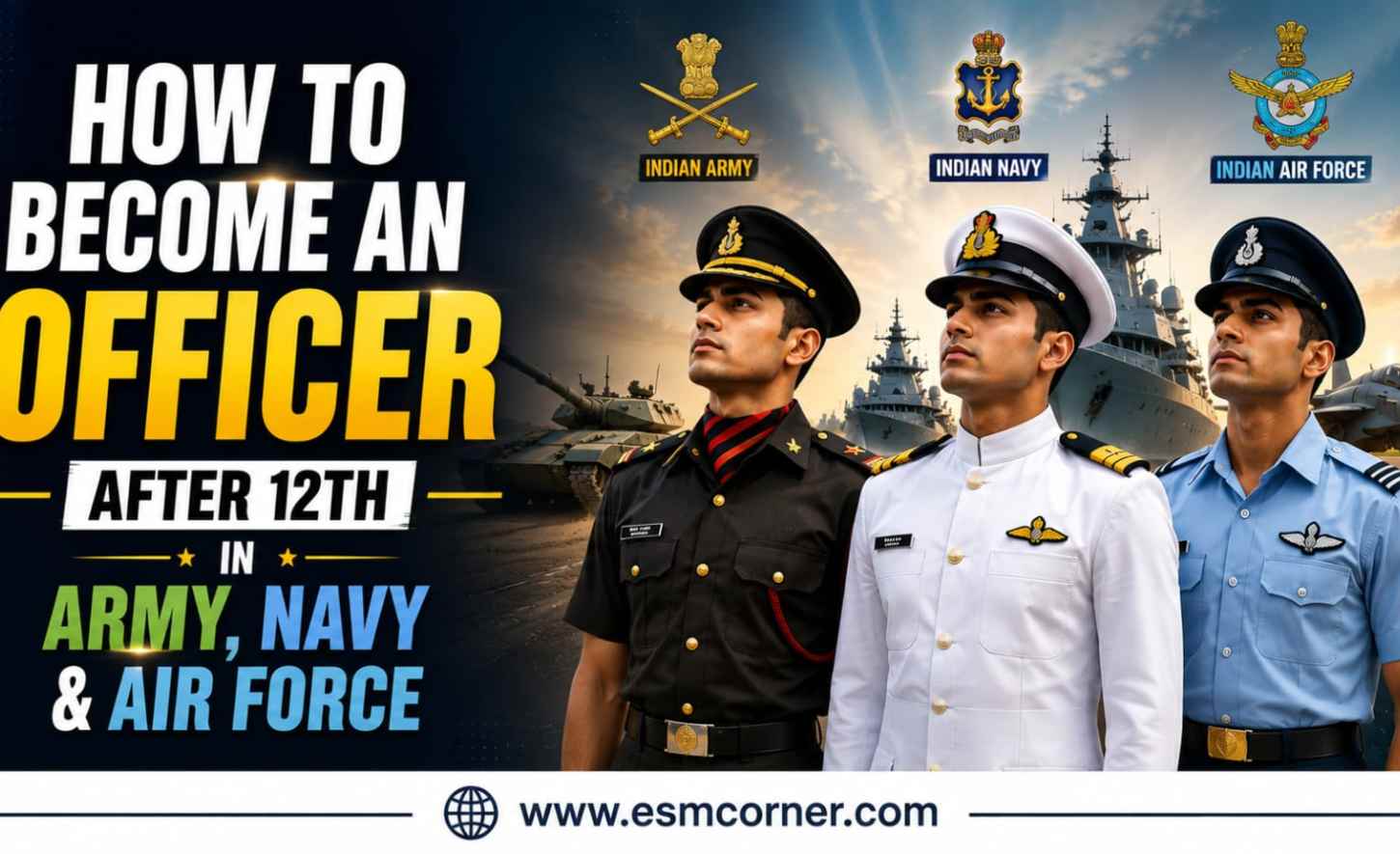
Thousands of students across India dream of wearing the uniform and serving the nation as officers in the Indian Armed Forces after completing Class 12. However, many deserving candidates miss this opportunity—not because they lack the ability, but because they are unaware of the various officer entry schemes, eligibility criteria, and selection process.
If you’re wondering how to become an officer after 12th, the good news is that there are multiple pathways available, including the National Defence Academy (NDA), Technical Entry Scheme (TES), and the Indian Navy’s 10+2 B.Tech Cadet Entry Scheme. Each entry has its own eligibility requirements, selection procedure, and career opportunities.
Becoming a young Lieutenant, Sub-Lieutenant, or Flying Officer is a highly respected achievement, but reaching that position requires proper guidance and a clear understanding of the journey ahead. The good news is that the Army, Navy, and Air Force offer well-defined entry routes for Class 12 students, allowing them to move directly from school into some of the country’s most prestigious military academies. Whether you studied PCM, Arts, or Commerce, there is a pathway designed for you. Let’s understand step by step how this process works.
Why Join Right After 12th Instead of Waiting?
Many students think about completing graduation first and then applying for the armed forces, but joining after Class 12 gives you an early advantage. It helps you gain leadership skills, responsibility, financial independence, and valuable experience ahead of others.
The armed forces also support your higher education, allowing you to earn recognised degrees along with military training. While jawans handle key operational roles, officers are trained to lead teams, make decisions, and command with responsibility.
Starting as an officer after 12th offers a structured career path with opportunities for growth and senior leadership.
Who’s Actually Eligible?
Here’s a myth worth busting immediately — not studying Science doesn’t shut the door on a military career. Your Class 12 stream just decides which branches you can apply to, not whether you can apply at all.
- Educational Stream – PCM students can apply to all three services — Army, Navy, and Air Force. Arts, Commerce, or Biology students can apply for the Army Wing through NDA.
- Medical and Physical Standards – You’ll need to meet requirements around height, weight, chest expansion, and vision. Chronic health issues or major physical deformities can lead to rejection, so it’s worth checking these early.
- Gender Eligibility – Both men and women who meet the age and educational criteria can apply — there’s genuine equal opportunity here now.
Officer Entry Options Right After Class 12
Indian Army
The Army Wing through NDA is the most flexible route since it’s open to students from every stream. You take the NDA written exam (conducted by UPSC), followed by the SSB interview if you qualify.
If you’re a PCM student, there’s also the Technical Entry Scheme (TES) — a direct route that shortlists candidates based on Class 12 marks and JEE Main scores, skipping the written exam entirely and sending you straight to SSB.
Indian Navy
For the Navy Wing through NDA, you’ll need Physics and Maths in Class 12. After clearing the written test and SSB, you complete a four-year degree at the Naval Academy.
There’s also the 10+2 B.Tech Cadet Entry Scheme — a direct path for PCM students with valid JEE Main scores, leading straight into executive or technical branch commissions.
Indian Air Force
The Air Force Wing through NDA also requires Physics and Maths. If you’re aiming for the Flying Branch specifically, you’ll go through the Computerised Pilot Selection System (CPSS) test in addition to the standard SSB. Don’t worry if you don’t clear CPSS though — you can still be considered for Ground Duty roles (Technical or Non-Technical) based on merit.
Quick Comparison of Key Entries
| Entry | Eligibility | Selection Process | Service |
|---|---|---|---|
| NDA (Army Wing) | 10+2 pass, any stream | Written Exam (UPSC) + SSB | Indian Army |
| NDA (Navy & Air Force) | 10+2 with Physics & Maths | Written Exam (UPSC) + SSB | Indian Navy / Air Force |
| Technical Entry Scheme (TES) | 10+2 PCM + JEE Main | Direct SSB shortlisting | Indian Army |
| 10+2 B.Tech Cadet Entry | 10+2 PCM + JEE Main | Direct SSB shortlisting | Indian Navy |
| NDA (Flying Branch) | 10+2 with Physics & Maths | Written Exam + SSB + CPSS | Indian Air Force |
Written Exam or Direct Entry — Which One Should You Aim For?
Honestly, this isn’t really an either-or decision. Written entries like NDA test your grip on Maths, English, and General Knowledge through a standard syllabus. Direct entries like TES or Navy B.Tech skip that and shortlist you straight for SSB based on your board marks and JEE score.
But here’s the catch — direct entries might save you a written exam, but the SSB competition is just as tough either way. The real difference shows up later, in training — direct technical entries lean heavily into engineering degrees, while NDA cadets go through a broader, multi-disciplinary curriculum before their branch gets decided. If you’re serious about this, applying for both written and direct entries genuinely boosts your chances of getting that SSB call.
What Exactly Is the SSB Interview Testing?
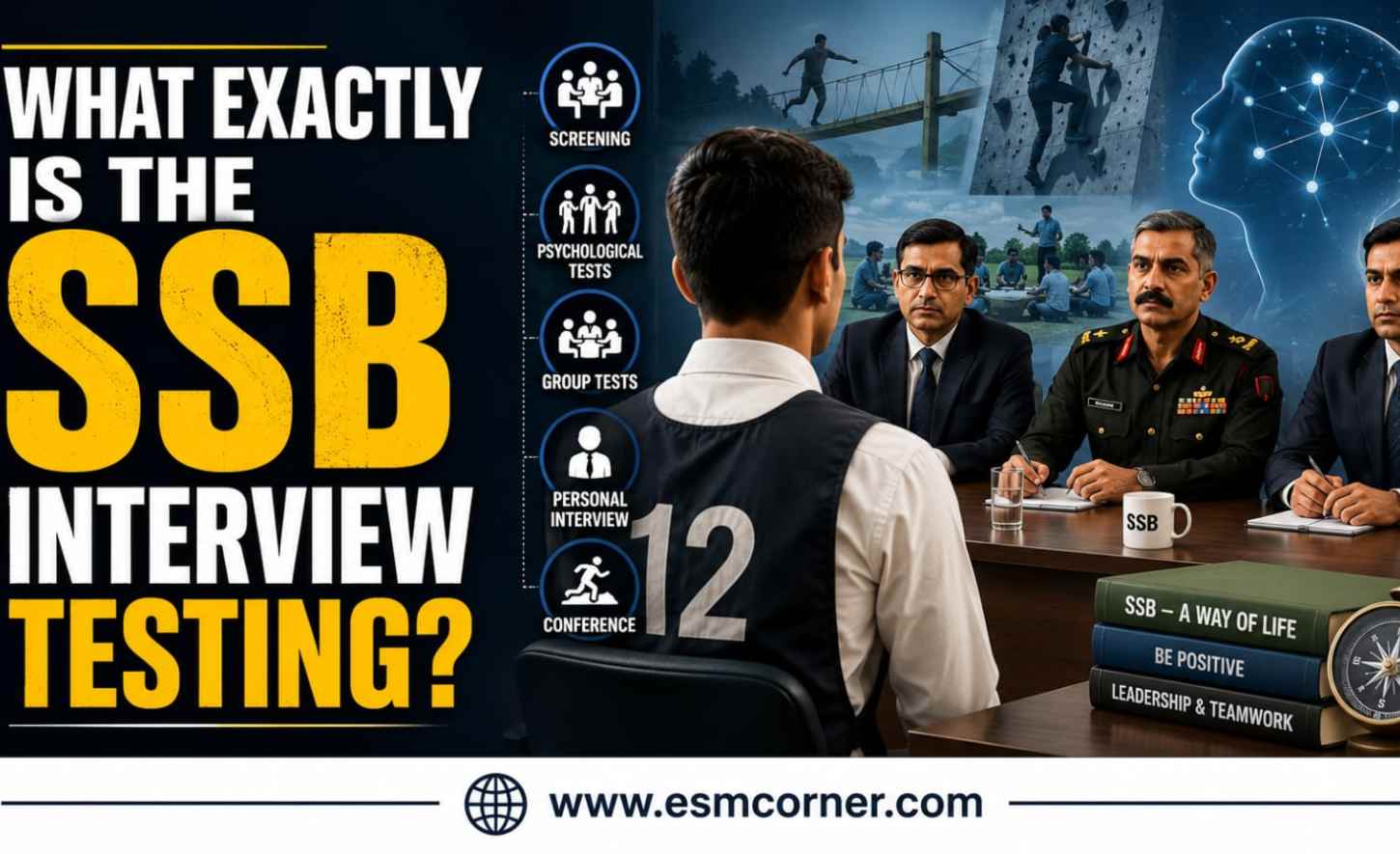
Here’s a common misunderstanding — clearing the written exam or scoring well in Class 12 doesn’t guarantee you a uniform. It just gets you to the real gateway: the 5-day SSB interview. This process evaluates your personality, adaptability, reasoning, and leadership potential through psychological tests, group tasks, and personal interviews.
Assessors look at 15 core Officer Like Qualities (OLQs) — things like sound judgement, decision-making, social adaptability, courage, and stamina. And here’s the thing — you genuinely can’t cram for this overnight. Assessors are looking for real, consistent behaviour, not rehearsed answers. Building these qualities comes from daily habits — self-awareness, staying active in sports or activities, following current affairs, and taking real responsibility in your everyday life.
How Do You Actually Prepare For All This?
Juggling board exam prep with defence exam prep can feel like a lot, but breaking it into phases makes it manageable.
- Academic Prep – Spend around 2 hours daily solving previous years’ NDA Maths papers for speed and accuracy. Work on English grammar, and read the newspaper daily to build vocabulary and general awareness.
- Physical Fitness – Dedicate at least 45 minutes daily to physical training. Aim to run 2.4 km within 12 minutes, along with regular push-ups, sit-ups, and chin-ups.
- Personality and SSB Readiness – Don’t rely purely on coaching institutes or ignore current affairs. Practice public speaking, join group discussions with friends, and build a habit of honest self-reflection so you can talk about your own choices clearly and confidently.
What Happens After You’re Selected?
Once you’re recommended by SSB and cleared by the medical board, you’re placed on the All-India Merit List based on your combined scores. From there, you head to institutions like the National Defence Academy (Khadakwasla, Pune) or the Indian Naval Academy (Ezhimala) for initial training — three years of academics combined with drills, weapon handling, and leadership exercises.
After NDA, you move to your respective service academy — IMA (Dehradun), Indian Naval Academy (Ezhimala), or Air Force Academy (Dundigal) — for one more year of specialised pre-commission training. Once that’s done, you’re commissioned — as a Lieutenant in the Army, Sub-Lieutenant in the Navy, or Flying Officer in the Air Force. From there, it’s a career built on steady growth, job security, ongoing education opportunities, and the genuine honour of leading soldiers.
Conclusion
Securing an officer commission in the Indian Armed Forces directly after Class 12 is a noble and achievable goal, provided you back your ambition with disciplined action. The journey requires a clear understanding of eligibility conditions, early written exam preparation, daily physical exercise, and the deliberate cultivation of strong moral character. Do not wait for exam notifications to begin your preparation; start building your academic foundation, physical endurance, and communication skills today. By focusing on genuine personal growth rather than temporary shortcuts, you will naturally develop the Officer Like Qualities necessary to stand out in the SSB interview. Wear your ambition proudly, remain consistent through challenges, and step forward with confidence toward a legendary career of service to the nation.
read also: NDA ENTRY EXPLAINED — ELIGIBILITY, EXAM, SSB AND TRAINING
FAQ : How to Become an Officer After 12th
Q1.Can I become an officer immediately after 12th?
Yes, eligible candidates can join the Indian Armed Forces directly after Class 12 by clearing entry exams like NDA or direct entries like TES and Navy B.Tech. Qualified candidates undergo structured degree education and military training before receiving their official military commission as junior officers.
Q2.Is PCM compulsory for every entry?
No, PCM is not compulsory for every entry pathway. Candidates from Arts, Commerce, or Biology streams can join the Army Wing through the NDA entry. However, PCM in Class 12 is mandatory for applying to the Navy Wing, Air Force Wing, TES, and Naval B.Tech entries.
Q3.What is the difference between NDA and TES?
NDA is a written exam entry conducted by UPSC for Army, Navy, and Air Force branches covering all streams. Technical Entry Scheme (TES) is a direct entry specifically for the Army, shortlisting PCM candidates based on Class 12 marks and JEE Main scores for direct SSB interviews.
Q4.Can girls join after 12th?
Yes, female candidates can apply for officer entries after Class 12, primarily through the National Defence Academy examination for the Army, Navy, and Air Force wings. Eligible female candidates undergo the exact same written examination, physical standards evaluation, SSB interview process, and academy training curriculum as male candidates.
Q5.Is SSB compulsory?
Yes, clearing the 5-day SSB interview is strictly mandatory for every officer entry scheme in the Indian Armed Forces. Whether you clear a written exam like NDA or get shortlisted directly through high board marks, every candidate must pass the SSB evaluation to receive a final recommendation.
Q6.How difficult is NDA?
The NDA examination is moderately challenging, testing speed, fundamental conceptual clarity, and time management across Mathematics and General Ability. The real challenge lies in the SSB interview and medical evaluations, where selection rates are strictly based on personal merit, psychological fit, and physical suitability rather than fixed quotas.
Q7.What should I prepare first?
Candidates should first focus on mastering their Class 11 and 12 Mathematics and English fundamentals, as these form the bulk of written testing. Simultaneously, build basic daily physical fitness through running and regular exercise while reading current affairs newspapers daily to develop strong situational awareness for the SSB interview.
Q8.Which entry is best after Class 12?
The NDA entry is widely considered the best overall pathway because it offers comprehensive joint-services exposure, diverse branch selections, and a balanced three-year foundational education at Khadakwasla. However, PCM students seeking engineering careers in the military should actively apply for both NDA and direct technical entries simultaneously.
For daily defence updates, government notifications, recruitment alerts, welfare schemes, career opportunities, education news, and other important announcements, join our WhatsApp Community. Click here to join our WhatsApp Group.