

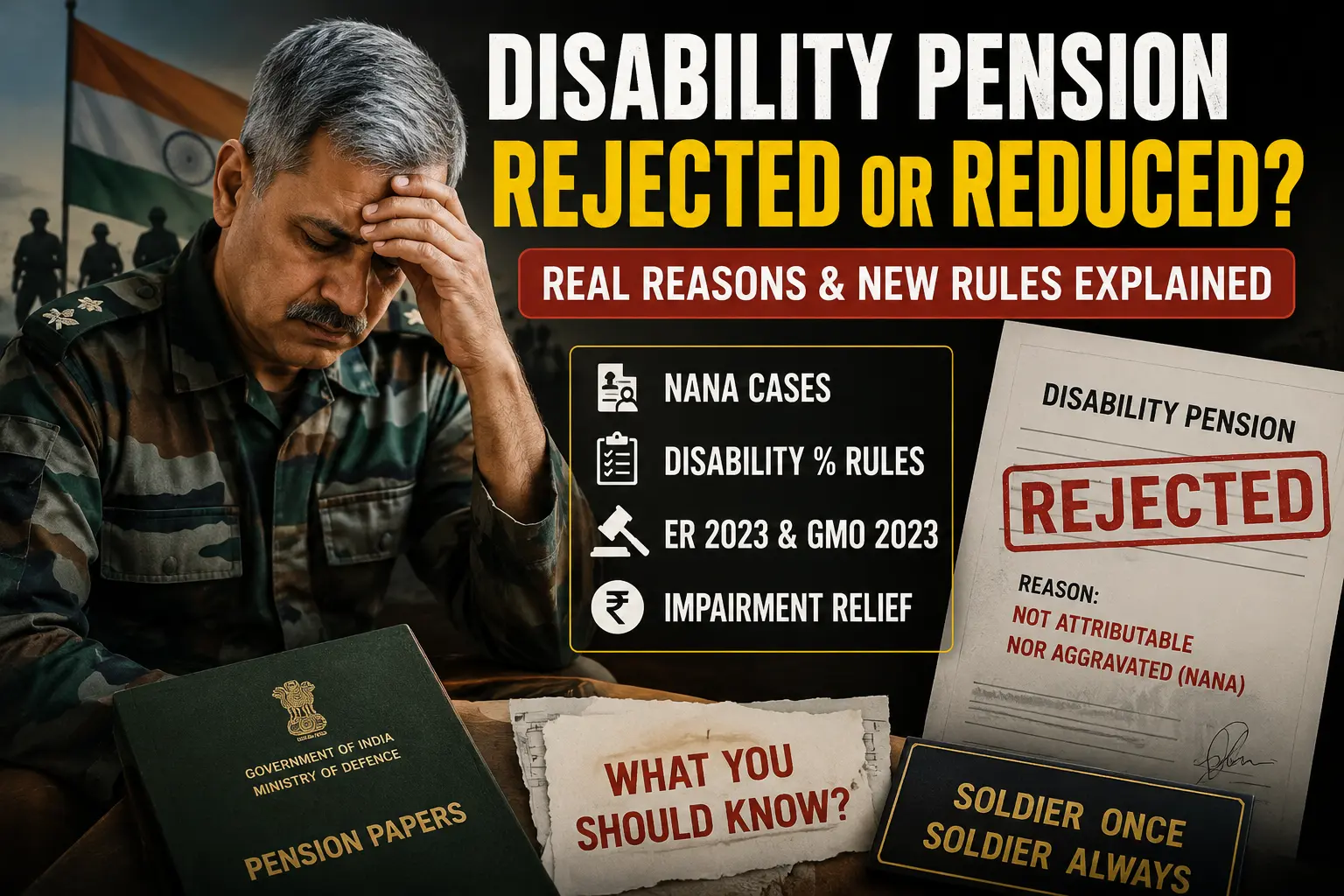
Many defence personnel are shocked when their disability pension is rejected, reduced, or converted into a different category after retirement. Most people think that having a medical problem automatically guarantees disability-pension. That is not correct.
Under the present rules, disability compensation depends mainly on:
- Disability percentage
- Whether the condition is attributable to or aggravated by military service
- Whether the individual is invalided out or retained in service
These decisions are based on medical board findings and the Entitlement Rules 2023 introduced by the Ministry of Defence.
Understanding the Difference Between Disability-Pension and Impairment Relief
One of the biggest changes introduced in 2023 is the term “Impairment Relief”.
Earlier, personnel retained in service despite disability used to receive “Disability Element” after retirement. Under the new rules, this has been renamed as “Impairment Relief”.
However, many people misunderstand this change.
Important Clarification
- Disability Pension applies mainly to personnel invalided out of service
- Impairment Relief applies to personnel retained in service despite disability and later retired normally
The government has clarified that the rate remains the same. Only the terminology has changed.
When Disability Pension Is Granted
Disability pension is generally granted when:
- The disability is assessed at 20% or more
- The condition is attributable to or aggravated by military service
- The individual is either invalided out of service or deemed to have been invalided out on medical grounds
Disability-Pension comprises the following components:
- Service Element
- Disability Element
The Service Element is similar to normal service pension, while the Disability Element depends on the disability percentage.
Disability Percentage and Compensation Structure
Under the present system:
- 76% to 100% disability → full disability component
- 50% to 75% disability → 75% of disability component
- 20% to 49% disability → 50% of disability component
- Below 20% → normally no disability element payable
This is one of the main reasons many claims are rejected or compensation gets reduced.
Read More: Pension Recovery Started? Check Rules, Reasons & Your Rights
Why Disability Pension Gets Rejected
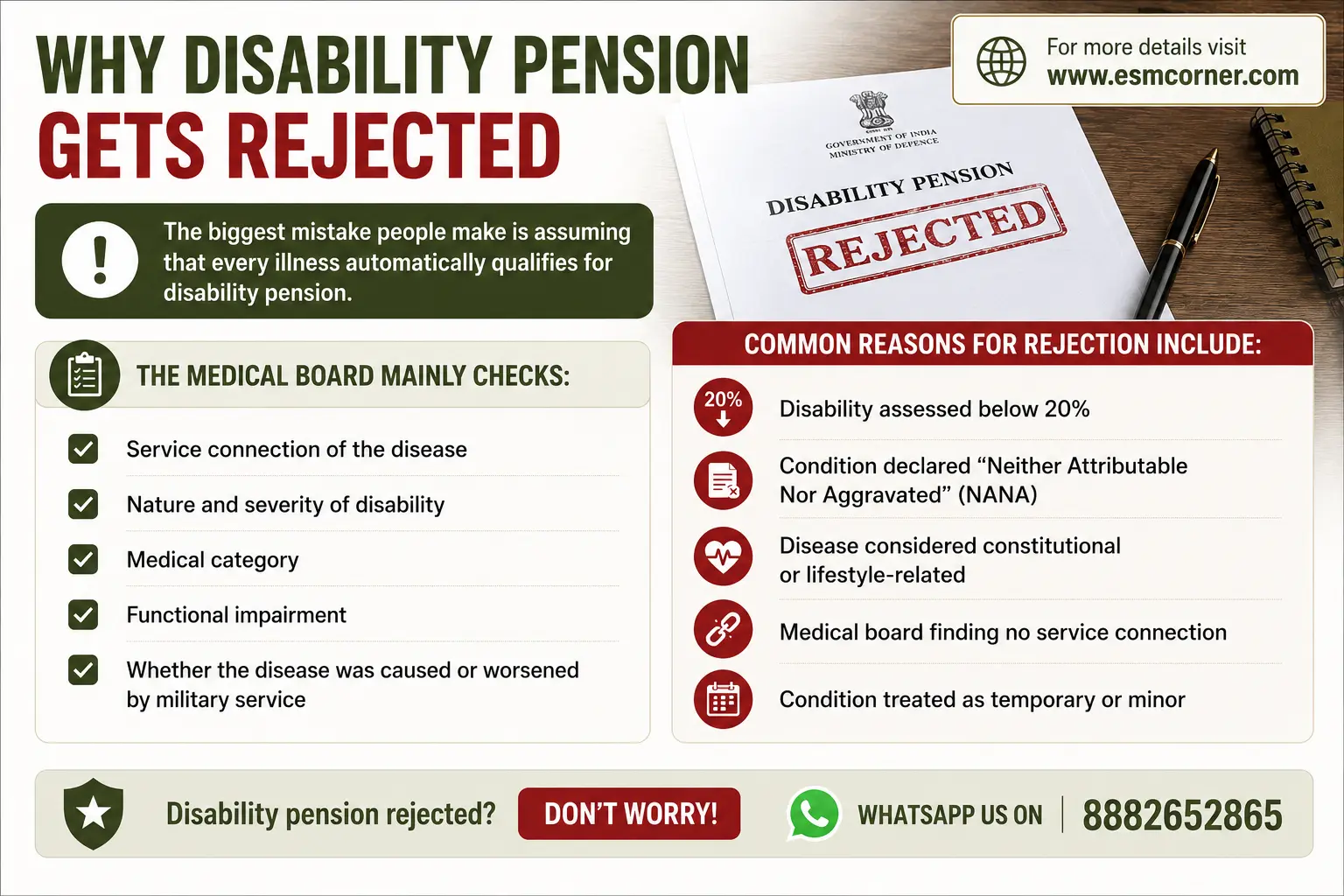
The biggest mistake people make is assuming that every illness automatically qualifies for disability pension.
The medical board mainly checks:
- Service connection of the disease
- Nature and severity of disability
- Medical category
- Functional impairment
- Whether the disease was caused or worsened by military service
Common reasons for rejection include:
- Disability assessed below 20%
- Condition declared “Neither Attributable Nor Aggravated” (NANA)
- Disease considered constitutional or lifestyle-related
- Medical board finding no service connection
- Condition treated as temporary or minor
Why Many Cases Became More Complicated After ER 2023
After the introduction of Entitlement Rules 2023 and GMO 2023, many veterans raised concerns regarding stricter interpretation of diseases and medical conditions.
Some conditions like:
- Hypertension
- Diabetes
- Cardiac diseases
- Lifestyle-related disorders
are now examined more strictly for service connection in certain cases. Veterans’ groups and legal forums have challenged some of these interpretations before courts.
This is why many personnel now face rejection even when they genuinely suffer from serious medical problems.
Understanding “Neither Attributable Nor Aggravated” (NANA)
NANA is one of the most important terms in disability-pension cases.
If the medical board declares a disease as “Neither Attributable Nor Aggravated”, it means:
- The disease was not caused by military service
- Service conditions did not worsen the disease
Once a condition is classified as NANA, disability-pension usually becomes difficult unless the finding is successfully challenged.
What Is Impairment Relief?
Under ER 2023, personnel who continue in service despite disability and retire later may receive “Impairment Relief” instead of traditional disability pension.
Important Conditions
Impairment-Relief generally applies when:
- Disability is attributable to or aggravated by service
- Disability is assessed at 20% or above
- The person is retained in service after Retention cum Impairment Assessment Medical Board
The government has clarified that Impairment Relief is essentially the same as the earlier Disability Element for retained personnel.
Can Disability Pension Rejection Be Challenged?
Yes. Rejection or reduction is not always final.
A person may seek:
- Review Medical Board
- First Appeal
- Second Appeal
- Armed Forces Tribunal remedy, if required
Also Read: ER 2023 & GMO 2023 Disability Compensation Rules Explained
What You Should Check Immediately
If disability pension is rejected or reduced, verify:
- Disability percentage awarded
- NANA classification
- Medical board findings
- Whether the disease was linked to service properly
- Whether the case falls under Disability Pension or Impairment Relief
- PPO and pension sanction details
Understanding the exact reason is critical before filing appeal or review.
Final Understanding
Disability pension decisions are now more technical and rule-based than before. The outcome depends mainly on:
- Disability percentage
- Service connection
- Medical board findings
- ER 2023 and GMO 2023 guidelines
The introduction of Impairment-Relief has also changed how disability compensation is categorized for personnel retained in service.
Many rejected cases are still challengeable, but success usually depends on strong medical evidence, proper documentation, and careful review of medical board findings.
⚠️ Disability Pension Rejected?
Many veterans and serving personnel face rejection due to NANA remarks, low disability percentage, lack of service connection, or incorrect medical board findings. In many cases, the rejection can still be challenged legally and administratively.
WhatsApp us on 8882652865 for Help and Guidance
Q1: Why was my disability pension rejected despite having a medical condition?
A: Having a medical condition alone does not automatically qualify a person for disability-pension. The medical board also checks whether the disease or injury is connected to military service and whether the disability percentage meets the required level. If the condition is declared “Neither Attributable Nor Aggravated” (NANA) or the percentage is assessed below the required limit, disability pension may be rejected.
Q2: What is Impairment Relief?
A: Impairment Relief is a term introduced under Entitlement Rules 2023 (ER 2023). It applies to defence personnel who are retained in service despite disability and later retire normally. Earlier, this benefit was known as Disability Element for retained personnel. The government has now renamed it as Impairment Relief.
Q3: Is Impairment Relief different from Disability Element?
A: Practically, no. The government has clarified that Impairment Relief is broadly the same benefit that was earlier called Disability Element for personnel retained in service. The main change is in terminology and categorization under the new rules.
Q4: What is the minimum disability percentage generally required for disability-pension?
A: Normally, disability should be assessed at 20% or above for disability compensation eligibility. If the disability is assessed below this level, disability element or impairment relief is generally not granted. However, exact entitlement depends on applicable rules and medical board findings.
Q5: What does “Neither Attributable Nor Aggravated” (NANA) mean?
A: NANA means the medical board has concluded that the disease or injury was neither caused by military service nor worsened because of service conditions. Once a condition is classified as NANA, disability pension usually becomes difficult unless the finding is challenged successfully through review or appeal.
Q6: Can disability percentage be reduced during reassessment or review?
A: Yes. Disability percentage may increase or decrease during reassessment depending on medical condition, treatment outcome, and functional impairment. The medical board follows prescribed medical guidelines while reassessing disability percentage.
Q7: Can rejected disability-pension cases be challenged legally?
A: Yes. Rejected or reduced disability-pension cases can be challenged through Review Medical Board, First Appeal, Second Appeal, or Armed Forces Tribunal, depending on the circumstances. Many pensioners receive relief after proper review and medical evidence.
Q8: Does every disease qualify for disability pension?
A: No. Every disease does not automatically qualify for disability-pension. The medical board examines whether the disease is related to military service, aggravated by service conditions, or considered constitutional, hereditary, lifestyle-related, or unrelated to service.
Q9: Why do many lifestyle diseases face rejection nowadays?
A: Under ER 2023 and recent medical guidelines, conditions like hypertension, diabetes, cardiac disease, and some lifestyle-related disorders are being examined more strictly for service connection. In many cases, the medical board may hold that such conditions are not directly attributable to military service unless strong supporting evidence exists.
Q10: What is the role of the medical board in disability pension cases?
A: The medical board is the most important authority in disability-pension assessment. It decides:
Disability percentage
Nature of disease or injury
Service connection
Attributable/aggravated classification
Functional impairment
These findings directly affect disability pension entitlement.
Q11: What documents are important in disability pension cases?
A: Important documents include:
Medical board proceedings
Treatment records
Hospital documents
Service medical history
Specialist reports
Duty-related evidence
Previous medical category records
Strong documentation plays a major role in review and appeal cases.
Q12: Can temporary disability affect pension eligibility?
A: Yes. Temporary or short-term medical conditions may not qualify for long-term disability pension. In some cases, reassessment is done later to determine whether the disability has become permanent or stable.
Q13: Will arrears be paid if disability pension is approved later?
A: In many genuine cases, yes. If disability pension or impairment relief is approved after appeal or review, arrears are generally paid from the eligible date as per sanction orders.
Q14: What should I check first if my disability-pension is rejected?
A: You should first carefully review:
Disability percentage awarded
NANA classification
Medical board findings
Service connection remarks
PPO details
Entitlement category
Understanding the exact reason for rejection is important before filing any appeal.
Q15: What is the biggest mistake people make in disability pension cases?
A: The biggest mistake is filing complaints or appeals without understanding the medical board findings properly. Many people also ignore timelines for review or fail to collect proper supporting medical evidence, which weakens the case further.
👉 Join WhatsApp Group: Join our dedicated WhatsApp group for guidance, updates, real case discussions, appeal process support, tribunal information, and awareness related to Disability Pension rejection matters.

























What is the impairment relief in the case of ACL reconstruction?
Iam disability pensioner. Iam getting pension when I went to AFT. Iam not getting previous pension
Iam disability pensioner. Iam joining in the Army 1984 October. Iam discharge from service 1989 (Medical board out )that time iam not getting any disability pension. After i went to AFT kochi in 2016.Court decide Re assessment medical board after that iam getting disability pension 40%. From 2018 to till today. From 1989 to 2017 iam not getting any pension. What will do. Please advice me sir. Thanking you.