

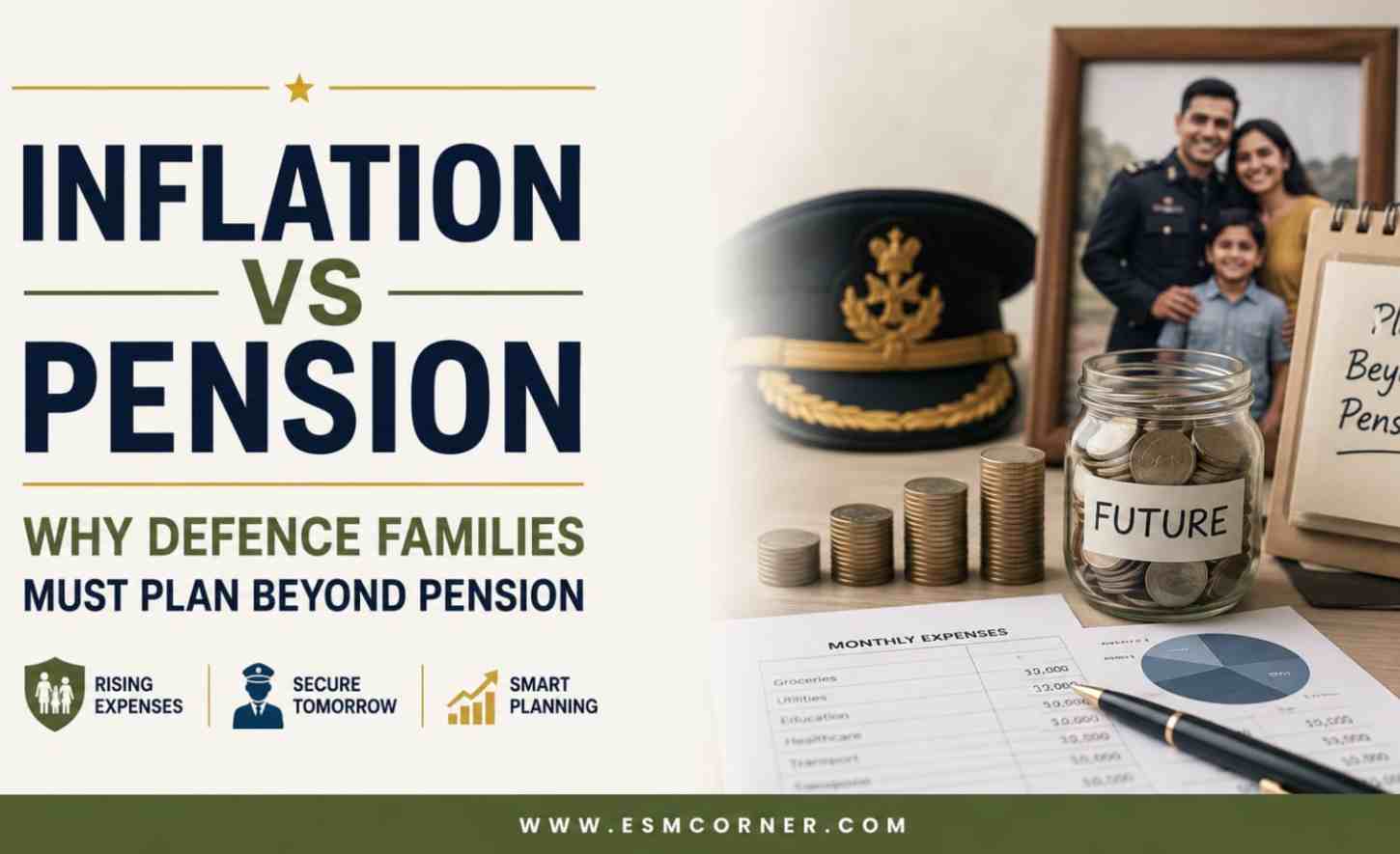
Every retiring soldier, sailor, or air warrior knows one thing for certain — pension will come every month. It is reliable. It is earned after years of hard service. And it brings genuine peace of mind.
But here is a question that very few people ask honestly.
Will that same pension amount feel as comfortable after 15 or 20 years as it does today?
The honest answer is — probably not.
The reason is one word. Inflation.
Inflation silently increases the price of everything around you — groceries, medicines, school fees, fuel, hospital bills — every single year. And over 20 to 30 years of retirement life, this slow rise creates very real financial pressure.
Understanding this early is not about being negative about pension. It is about being honest and prepared.
What is Inflation? Simple Explanation
Inflation simply means prices of goods and services increase over time.
Think about this. Ten years ago, a cylinder of cooking gas cost much less than it does today. A medicine that cost ₹50 earlier may cost ₹120 today. A school that charged ₹3,000 in fees earlier may now charge ₹12,000.
Nothing changed in your lifestyle. But everything became more expensive.
This is inflation at work.
When prices rise and your income stays the same, your money buys less than before. This is called a reduction in purchasing power — and it affects every pensioner in the country, including defence families.
How Inflation Slowly Reduces Pension Value
Imagine a retired Subedar Major receiving ₹35,000 per month as pension today.
He manages his family’s expenses comfortably — groceries, medicines, electricity, and some savings.
Now fast forward 15 years. The pension may have increased slightly. But prices of medicines may have doubled. Hospital charges may have tripled. His grandchildren’s school fees are much higher. The monthly grocery bill has increased significantly.
The same ₹35,000 that felt comfortable today may feel quite tight in 2040.
This is not a scare story. This is basic financial reality that affects every retired family. Pension is important and valuable — but it needs additional support to maintain the same quality of life over many decades.
Why Defence Families Face This Challenge More Than Others
Defence retirement is unique in one important way — it comes early.
Many soldiers, JCOs, and junior officers retire between the ages of 35 and 50. This means retirement life can continue for 35 to 45 more years.
That is a very long time to depend primarily on one income source.
Compare this to a civilian government employee who retires at 60. They have roughly 20 to 25 years of retirement. Defence personnel often have almost double that.
More retirement years means more exposure to inflation. More years of rising expenses. More years of potential financial pressure if additional planning was never done during service.
This is exactly why starting financial planning early — even at age 25 or 30 during active service — makes a massive difference.
Common Financial Mistakes Defence Families Make
These mistakes are not made out of carelessness. They happen because nobody explains these things clearly during service years.
- Depending only on pension — Pension is essential but rarely enough on its own for 40 years of retirement expenses.
- Keeping all savings in a bank account — Savings account interest is usually 3 to 4 percent. Inflation is often 6 to 7 percent. Your money is losing value in real terms.
- Delaying investments — “I will start planning after retirement” is a very costly decision because the best time to invest is during earning years.
- Ignoring medical expenses — Healthcare inflation is even faster than normal inflation. Without preparation, hospital bills can create serious financial pressure.
- Unnecessary loans and heavy spending — EMIs and spending habits during service years reduce the ability to save and invest for retirement.
What Happens to Medical Expenses After Retirement
This is one area that catches many families completely off guard.
During service, ECHS and other facilities provide medical support. After retirement, while some facilities continue, the overall cost of healthcare rises significantly with age.
Common expenses that increase after retirement include regular medicines for blood pressure, diabetes, or heart conditions, diagnostic tests, hospital admissions, emergency surgeries, and long-term treatment for age-related health conditions.
Medical inflation in India has historically been higher than general inflation. A medical emergency without emergency savings can force families to break long-term investments or take loans at exactly the wrong time.
This is why emergency medical savings must be a non-negotiable part of every defence family’s financial plan.
How Defence Families Can Prepare Better
Inflation cannot be stopped. But its impact on your family can be reduced through smart, consistent financial planning.
A practical approach includes:
- Emergency savings — Keep at least 6 to 12 months of expenses in a safe, accessible form at all times.
- SIP investments — Small monthly investments in mutual funds over 15 to 20 years can create significant additional wealth.
- Diversified savings — Do not keep all money in one place. Spread across FD, mutual funds, and savings.
- Controlled spending during service years — Discipline during earning years creates freedom during retirement years.
- Additional income sources — Rental income, SWP from mutual funds, or small businesses can add monthly cash flow alongside pension.
The goal is not to become wealthy overnight. The goal is simply to maintain your family’s comfort and dignity through 30 to 40 years of retirement without financial stress.
Conclusion
Pension is a proud reward for years of sacrifice and service. Nobody should minimise its importance.
But inflation is a silent and patient force. Year after year, it reduces the real value of every fixed income — including pension. And for defence families who retire early and live long, this is a challenge that deserves honest attention and early preparation.
The good news is that the solution is not complicated. Start early. Save regularly. Invest carefully. Build a small emergency fund. Think long term.
A soldier plans every operation carefully before executing. Financial security after retirement deserves the same planning discipline.
READ MORE: BEST CREDIT CARD FOR ARMED FORCES PERSONNEL IN 2026
Frequently Asked Questions
Q1. What is inflation in simple words?
Inflation means prices of everyday goods and services gradually increase over time. Things like groceries, medicines, school fees, fuel, and hospital treatment all become more expensive year after year. As prices rise and income stays the same, money buys less than it used to. This slow reduction in the value of money is what inflation does to every household’s budget over time.
Q2. How does inflation affect defence pensioners specifically?
Inflation affects pensioners because their expenses keep rising every year while their pension income grows only slowly. Medical costs, household bills, children’s education, and emergency expenses all increase with time. Even if pension continues arriving every month, its actual ability to cover rising expenses gradually reduces. Over 20 to 30 years of retirement, this gap between income and expenses can become quite significant for many families.
Q3. Why is pension alone sometimes not enough after retirement?
Pension provides reliable monthly income and is extremely valuable. But inflation, rising medical costs, family responsibilities, and emergency expenses can create financial pressure that pension alone cannot always handle comfortably over 30 to 40 years. Defence personnel retire early, which means they have more years of retirement than most civilians. This longer retirement period makes additional financial planning not just helpful but genuinely necessary.
Q4. Why should young serving soldiers start retirement planning early?
Starting early gives investments more time to grow through compounding. A soldier who starts a small SIP at age 25 will create far more wealth by retirement than someone who starts at 45, even if the later person invests a larger amount. Time is the most powerful financial tool available to young soldiers. Every year of delay during service years reduces the financial strength available during retirement years.
Q5. Which expenses increase the most after retirement?
Medical expenses usually increase the most after retirement. Medicines for chronic conditions, hospital treatment, diagnostic tests, emergency surgeries, and long-term healthcare become major financial responsibilities with age. Healthcare inflation in India has historically risen faster than general inflation. This makes building a dedicated medical emergency fund one of the most important financial priorities for any defence family approaching or entering retirement.
Q6. Can savings accounts protect money from inflation?
Generally no. Savings accounts in India typically offer interest rates of 3 to 4 percent. But inflation often runs at 5 to 7 percent per year. This means money sitting only in a savings account is actually losing real purchasing power every year even though the number in the account looks like it is growing. Long-term financial security requires investments that can grow faster than inflation over time.
Q7. Why are SIPs becoming popular among defence families?
SIPs allow defence families to invest small fixed amounts every month into mutual funds without needing large sums upfront. This disciplined monthly habit, continued over 15 to 20 years, can create substantial additional wealth that helps beat inflation and supports retirement expenses. Many defence families find SIPs practical because the investing happens automatically every month, requiring no active management during busy posting schedules.
Q8. What are the most common retirement planning mistakes?
The most common mistakes are depending entirely on pension, keeping all money in savings accounts, delaying investments until retirement, ignoring the impact of medical inflation, taking unnecessary loans during service, and spending heavily without maintaining regular savings. These habits individually may seem minor but together they significantly reduce long-term financial security. Awareness of these mistakes during service years can prevent serious financial difficulty during retirement years.
Q9. Why is an emergency fund important after retirement?
An emergency fund protects against sudden unexpected expenses like medical emergencies, urgent home repairs, family needs, or any financial crisis that cannot be predicted in advance. Without emergency savings, families are forced to break long-term investments early or take loans at the worst possible time. A good emergency fund of 6 to 12 months of expenses kept in a safe and accessible form provides a financial cushion that protects all other long-term plans.
Q10. How can defence families practically reduce the impact of inflation?
The most practical approach combines several habits together — start investing early through SIP, keep a dedicated emergency medical fund, avoid unnecessary debt, spend with discipline during service years, diversify savings across different instruments, and create at least one additional income source for retirement like rental income or SWP from mutual funds. No single solution is enough. But combining these habits consistently over time creates strong financial protection against inflation’s long-term impact.
For daily defence updates, government notifications, recruitment alerts, welfare schemes, career opportunities, education news, and other important announcements, join our WhatsApp Community. Click here to join our WhatsApp Group.



























I entirely disagree with the POV that medical expenses increase disproportionately after retirement. Cashless healthcare, even post retirement is one of the many service benefits. The grey area is fast changing proceedure and general ignorance of rank and file.
Preventive healthcare is absent for which individual is to be blamed. Excessive consumption of alcohol and failure to moderate life style and food health causes health issues. Sedentary life style and lack of physical activities aggravate risk to health.
With due Respect sir,
I think the issue is being viewed a little too simplistically. Cashless healthcare is certainly a major post-retirement benefit, but availability of a benefit and its practical accessibility are two very different things.
Many veterans live in remote and rural areas where the nearest ECHS Polyclinic can be 100–150 km away. Travelling that distance for every consultation, investigation or minor medical requirement is simply not practical, particularly for elderly veterans and dependants. On top of that, ECHS procedures, referrals and authorisations are not always as simple as they appear on paper. We receive ECHS-related queries almost every day—even from senior and super-senior officers.
And if we say that the individual is to be blamed for increased medical expenses, where does that logic lead? Does it mean that personnel who develop diabetes, hypertension, high cholesterol or other lifestyle-related diseases while still in service are also to be blamed? Many such conditions are influenced by multiple factors, not merely individual negligence.
Yes, personal lifestyle and preventive healthcare matter. But attributing post-retirement medical expenditure simply to the individual ignores ground realities of accessibility, awareness, geography and the practical functioning of the healthcare system.
This point in the article is based on extensive research and regular feedback from veterans and their families. Cashless treatment is a valuable benefit—but “cashless” does not automatically mean accessible, convenient or practical for every veteran.