

Every year lakhs of students appear for NEET hoping to get into a good medical college. But there is one college that stands completely apart — not just because of its academic excellence but because it gives you something no private college ever can.
A career as both a Doctor and an Officer in the Indian Armed Forces.
That college is Armed Forces Medical College — AFMC Pune.
If you or your child dreams of becoming an Armed Forces Medical Officer — Army, Navy, or Air Force — this article is the most important thing you will read today. Every single fact here comes directly from the official AFMC Information Brochure for MBBS Admission 2026. Nothing has been added from outside.
What is AFMC Pune?
Armed Forces Medical College is one of India’s premier medical institutions. Here are the key facts —
- Established in 1948 — initially for postgraduate courses
- MBBS undergraduate wing started on 04 August 1962
- Purpose — to induct trained medical graduates into the Armed Forces Medical Services
- Affiliated to The Maharashtra University of Health Sciences (M UHS, Nashik).
- Recognised by the National Medical Commission — NMC
- Provides training to Graduate, Postgraduate, and Post-Doctoral medical and nursing students
- Offers assured career prospects in the Defence Services
When you join AFMC you are not just joining a medical college. You are entering a world of discipline, leadership, and lifelong service to the nation.
Course Duration
- MBBS course duration — 4 and a half academic years
- Followed by compulsory rotating internship training — 12 months
- Internship is conducted in selected service hospitals recognised by NMC
- Admission is subject to norms prescribed by DGAFMS — Director General Armed Forces Medical Services, Ministry of Defence, Government of India
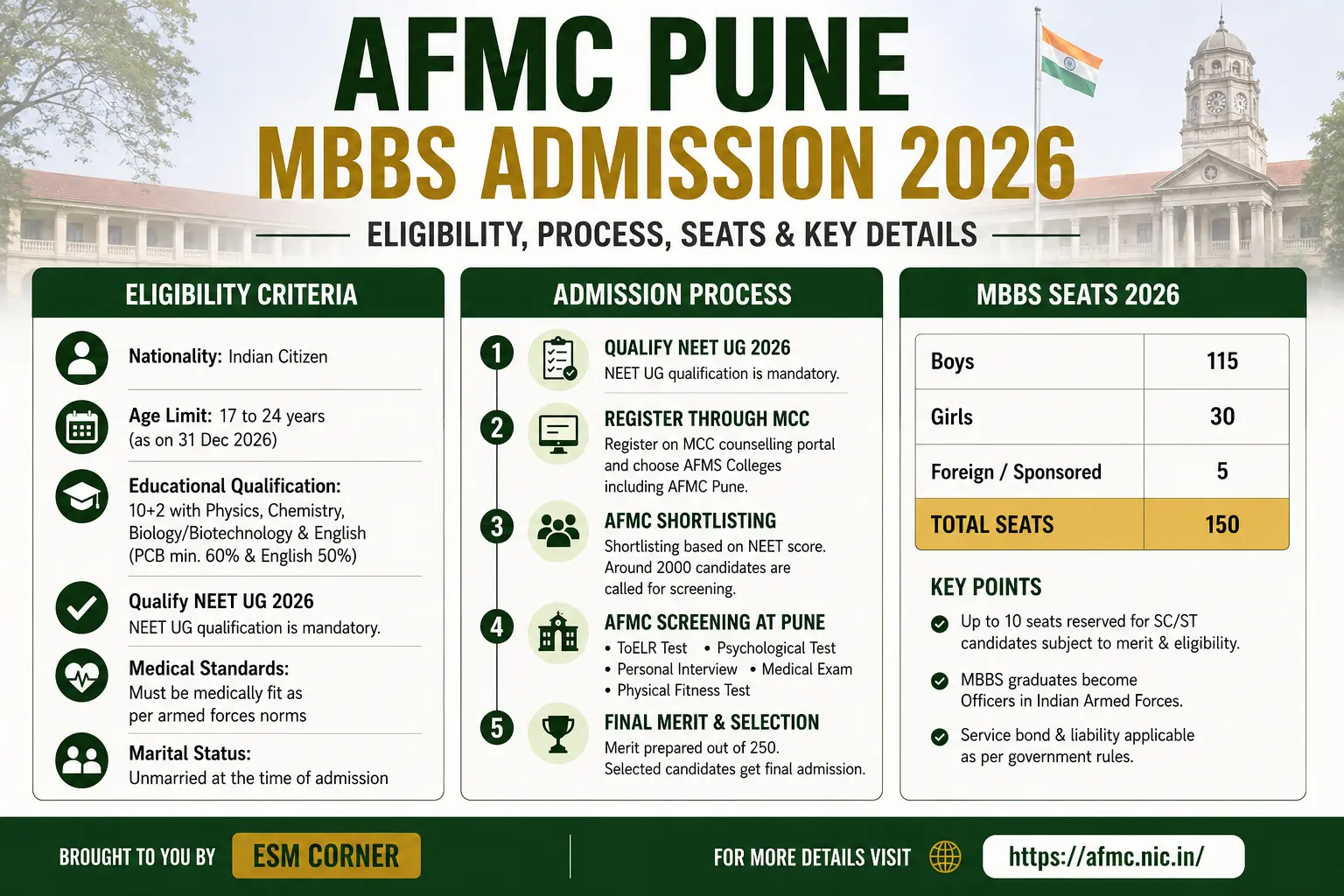
Seats Available — AFMC MBBS 2026
| Category | Number of Seats |
| Total candidates to be selected | 150 |
| Indian Medical Cadets — Boys | 115 |
| Indian Medical Cadets — Girls | 30 |
| Total Indian seats | 145 |
| Government sponsored — Friendly Foreign Countries | 05 |
| SC/ST reserved seats out of 145 | Up to 10 |
Only 145 Indian students get this opportunity every year. Competition is intense. Prepare accordingly.
Who Can Apply — Eligibility Criteria
Please review all the requirements thoroughly. If even a single condition is missed, your application may be rejected.
Nationality
- Must be a citizen of India
- Foreign nationals of Indian origin may apply only after acquiring Indian Citizenship or with a certificate of eligibility from the Ministry of Home Affairs
- This condition does not apply to the 5 government sponsored foreign candidates
Marital Status
- Must be unmarried
- Marriage during the course is not permitted under any circumstances
Age Limit
- Born not earlier than 01 January 2003
- Born not later than 31 December 2009
- Must be at least 17 years old at the time of admission
- Must not have completed 24 years of age on 31 December 2026
Medical Fitness
- Must be medically fit as per standards prescribed by the Government of India Ministry of Defence
Academic Qualification Required
You must have passed Class 12 with the following subjects — Physics, Chemistry, Biology or Biotechnology, and English — all taken simultaneously — in the first attempt only.
Minimum marks required —
| Subject | Minimum Percentage Required |
| Physics, Chemistry, Biology — combined aggregate | 60% |
| English — separately | 50% |
| Each science subject — individually | 50% |
| Mathematics | Must have passed at Class 10 level |
Important — Passing in compartment or in a second attempt makes you ineligible. The first attempt rule is strict and non-negotiable.
Students whose Class 12 result is awaited may apply and appear for the AFMC interview. However final admission will not be given unless the qualifying examination is cleared with the required percentage.
Who is NOT Eligible —
- Candidates who passed with Domestic Science, Domestic Arithmetic, or Lower Mathematics as subjects
- Candidates who passed only a one-year Pre-University or Pre-Degree course
- Candidates who secured the required percentage in a subsequent attempt or compartment examination
The Selection Process — Step by Step
AFMC selection is not just about NEET rank. It is a multi-stage process. Understand each stage clearly.
Stage 1 — Qualify NEET UG 2026
- Qualifying NEET UG 2026 conducted by NTA is mandatory for every candidate
- Without a valid NEET UG 2026 score you cannot apply to AFMC at all
- After qualifying NEET you must separately register on www.mcc.nic.in during the registration window
Stage 2 — Shortlisting for Screening at AFMC Pune
- Approximately 2000 candidates will be shortlisted based on NEET merit
- 1600 boys and 400 girls will be called to AFMC Pune for screening
- Shortlist will be displayed on www.afmcdg1d.gov.in and www.afmc.nic.in
- Request for change of interview date will not be entertained except under exceptional circumstances
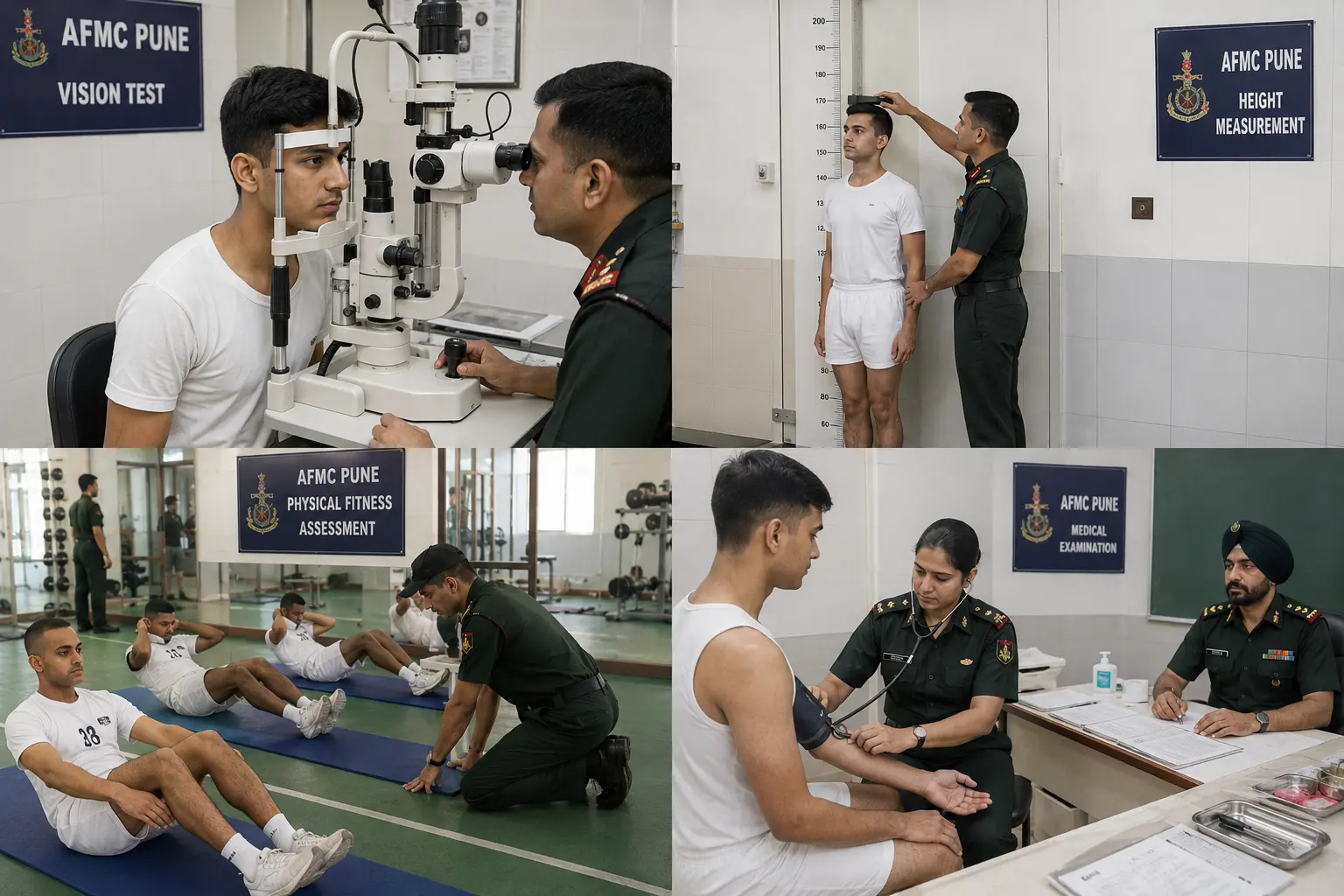
Stage 3 — Screening at AFMC Pune
Screening has four components —
Component 1 — ToELR Test
| Detail | Information |
| Full form | Test of English Language and Reasoning |
| Mode | Computer Based Test — CBT |
| Number of questions | 40 MCQs |
| Marks per question | 2 marks |
| Total marks | 80 marks |
| Time allowed | 30 minutes |
| Negative marking | 0.5 marks per wrong answer |
| Conducted at | AFMC Pune |
How Written Examination Score is Calculated —
NEET UG 2026 score (max 720) + ToELR score (max 80) divided by 4 = Written Examination Score out of 200
Component 2 — PAT — Psychological Assessment Test
- Computer Based Test
- Qualifying examination only
- PAT score is not counted in the final merit list
- You must qualify but marks do not add up
Component 3 — Interview
- Total marks — 50
- Candidates are assessed on core subject knowledge, general awareness, interests, hobbies, and personality
- Special weightage is given for —
- NCC participation at any level
- Sports participation at School, District, State, National, or International level
- Wards of Officers, JCOs, and Other Ranks who are serving, ex-servicemen, or killed in action
Component 4 — Medical Examination
- All shortlisted candidates are subjected to a Medical Board at AFMC Pune
- Conducted as per Armed Forces standards
- Candidates declared medically unfit will not appear in the final merit list
How Final Score is Calculated
| Component | Maximum Marks |
| Written Examination Score (NEET + ToELR divided by 4) | 200 |
| Interview Marks | 50 |
| Final Score Total | 250 |
Stage 4 — Merit List and Admission
- Two separate merit lists drawn — one for boys and one for girls
- Admissions offered only in order of final merit position
- A waiting list is also released along with the merit list
- Wait-listed candidates are called in blocks in order of merit
- Candidates must report strictly by 1400 hours on the day of reporting
- Anyone reaching after cut-off time will not be entertained under any circumstances
- Results displayed on www.afmcdg1d.gov.in and www.afmc.nic.in
Service Liability and Bond — Read This Very Carefully
This is the most critical section. Every student and every parent must understand this fully before applying.
Service Obligation —
- All AFMC MBBS graduates have a compulsory liability to serve as Commissioned Officers in the Armed Forces Medical Services
- Type of commission — Permanent Commission or Short Service Commission — depends on vacancies and is determined by merit-cum-option at final MBBS examination
| Type of Commission | Service Obligation |
| Short Service Commission — SSC | 7 years in AFMS |
| Permanent Commission — PC | Until date of superannuation |
Bond Amount —
- Parents or guardians must sign a bond agreement for Rs 71,00,000 — Rupees Seventy-One Lakhs at the time of admission
- Any candidate withdrawing after 7 days of admission — after 1600 hours — must pay this bond money
Non-Service Liability — NSL Cases —
If a medical cadet is declared NSL due to a medical condition contracted in circumstances beyond their control and for which they did not refuse treatment —
- Bond money need not be paid
- Cost of training must be paid — currently Rs 28,166 per week subject to revision
- NOC for internship is issued only after clearing all dues
- Hostel facility may be permitted at discretion of DGAFMS
Special Concessions and Financial Benefits
The Government provides the following to all service liability cadets — both boys and girls —
| Benefit | Details |
| Rations | Entitled rations and subsidised messing |
| Accommodation | Hostel accommodation and allied services |
| Travel during vacation | AC-3 Tier railway warrants |
| Travel after commissioning | AC-2 Tier railway warrants |
| Book and Equipment Allowance | Rs 6,000 per year |
| Stationery Allowance | Rs 1,680 per year and Rs 210 per month |
| Uniform Allowance | Rs 6,000 in first year — Rs 1,250 per year maintenance in subsequent years |
| Hair Cutting Allowance | Rs 210 per month |
| Washing Allowance | Rs 840 per month and Rs 315 during break |
| Army Group Insurance Premium | Rs 7,200 one-time non-refundable |
| Insurance Cover — Death | Rs 15,00,000 |
| Insurance Cover — 100% Disability | Rs 15,00,000 |
| Insurance Cover — 20% Disability | Rs 3,00,000 |
Note — All above concessions are subject to amendment as per Government orders issued from time to time.
Career Prospects After AFMC MBBS
On completing MBBS from AFMC medical cadets are commissioned as officers in the Army, Navy, or Air Force Medical Services.
Rank Structure for AFMS Officers —
| Rank | When |
| Lieutenant | On commissioning |
| Captain | On completion of internship |
| Major | After 4 years of service as Captain |
| Lieutenant Colonel | After 7 years of service as Major |
| Colonel | By selection |
| Brigadier | By selection |
| Major General | By selection |
| Lieutenant General | By selection |
Additional Benefits for Officers —
- Military Service Pay — MSP
- Non-Practicing Allowance
- Dearness Allowance
- Subsidised accommodation and allied facilities
- Employees are entitled to 60 days of Annual Leave and 20 days of Casual Leave every year.
- Leave Travel Concession — LTC
- Free Medical Services for self and family including dependent parents
- Group Insurance of Rs 75 Lakhs
- Canteen Stores Depot — CSD facility
Postgraduate Opportunities —
- Officers eligible for PG and DNB courses through NEET-PG or NExT examinations
- AFMS institutes have approximately 400 PG seats and 45 Super-specialty seats per year
- Permanent Commission Officers may proceed on 2 to 3 years study leave with full pay for advanced training in India or abroad
Life at AFMC — What to Expect
- College is fully residential — hostel stay is compulsory for all cadets
- Separate hostels for boys and girls within the campus
- All cadets must be members of the attached mess — vegetarian and non-vegetarian food available
- Sports available — cricket, athletics, tennis, squash, hockey, football, volleyball, table tennis, aquatics, gymnastics
- Clubs — music, dance, drama, debate, quizzing, adventure, cycling and more
- Annual Medical Examination compulsory for all cadets
- Medical cadets with service liability entitled to free OPD, IPD, and dental treatment at any service hospital
Vacations —
| Vacation | Duration |
| Summer — May/June | 2 weeks |
| Winter — December/January | 2 weeks |
Medical Standards — Key Requirements
All candidates are examined by a Medical Board at AFMC Pune. Here are the important physical standards —
Height Requirements —
| Category | General | Hills and North East States |
| Male Cadets — Minimum Height | 157 cm | 152 cm |
| Female Cadets — Minimum Height | 152 cm | 147 cm |
Growth allowance of 2 cm is made for candidates below 18 years at the time of examination.
Chest — No minimum circumference specified. Chest expansion must be 5 cm or more.
Visual Standards —
| Standard | Requirement |
| Uncorrected Visual Acuity | 6/36 and 6/36 |
| Best Corrected Visual Acuity | 6/6 and 6/6 |
| Myopia | Not more than minus 3.50 D Sph including max astigmatism plus or minus 2.0 D Cyl |
| Hypermetropia | Not more than plus 3.50 D Sph including max astigmatism plus or minus 2.0 D Cyl |
| Colour Vision | CP II |
LASIK Rules —
- LASIK not permitted below 20 years of age
- Post-LASIK candidates above 20 years may be considered fit if —
- Minimum 12 months have passed since surgery
- Central corneal thickness 450 microns or more
- Axial length by IOL master 26 mm or less
- Residual refraction within plus or minus 1.0 D including cylinder
- Normal healthy retina
- Certificate from the surgery centre specifying date and type of surgery is mandatory
Other Key Medical Conditions —
- Minimum 14 dental points essential — no severe pyorrhoea or advanced caries
- No ear discharge and no perforation of eardrum or nasal septum
- No history of epilepsy or any mental or psychiatric disorder
- No active TB or chronic lung disease
- No kidney disease including glycosuria or albuminuria
- No skin disease
- No active, latent, or congenital STI or HIV infection
- No squint or morbid condition of eye or eyelids
- No enlarged lymph nodes
Medical Board Appeal —
- Candidates declared unfit by Initial Medical Board may appeal to the Appeal Medical Board
- Appeal must be made in person within 24 hours of Initial Medical Board result
- Appeal fee — Rs 40 only
- Decision of Appeal Medical Board is final
- No medical board in any civil or private hospital is recognised
Important Rules for Admission
- Candidates must preserve the NEET UG 2026 admit card till admission is complete
- Original certificates required at the time of screening and admission
- No provisional admission while awaiting qualifying examination results
- If documents are found false at any stage — candidature will be cancelled immediately and fees forfeited
- All disputes fall within the jurisdiction of Pune/Maharashtra only
- Do NOT send any document to AFMC Pune by post
Contact Information
AFMC Pune —
| Detail | Information |
| Postal Address | Officer-in-Charge, Admission Cell, AFMC, Solapur Road, Pune 411040 |
| OIC Admission Cell | 020-29997698 |
| Admission Cell | 020-29950170 |
| Brig Administration UG | 020-26334236 |
| Fax | 020-26334236 |
| oicadmission@gmail.com | |
| Website | www.afmc.nic.in |
Telephone enquiry hours —
| Days | Timing |
| Monday, Tuesday, Thursday, Friday | 8.30 AM to 4.30 PM |
| Wednesday and Saturday | 8.30 AM to 2.00 PM |
Controlling Authority — DGAFMS —
| Detail | Information |
| Postal Address | DG-1D, 5th Floor, A Block, Defence Offices Complex, Africa Avenue, New Delhi 110023 |
| Telephone | 011-24199702 |
| oicexams.afmc@nic.in |
Conclusion
AFMC MBBS 2026 is not just a medical admission. It is a commitment to serve the nation as a doctor and as an officer.
Only 145 Indian students earn this opportunity every year. The selection is tough. The standards are high. The bond is real. But so are the rewards — a prestigious career, financial security, postgraduate opportunities, and the honour of wearing both a white coat and a uniform.
If you meet every eligibility condition, if your family understands the bond commitment, and if you have the discipline and dedication this institution demands — then take the first step.
Qualify NEET UG 2026. Register on www.mcc.nic.in. Prepare for ToELR and Interview. Clear the Medical Board. And earn your place in one of India’s finest institutions.
📘 Click Here to Download the Official Information Brochure – Admission to MBBS Course 2026
Explore more guides, preparation strategies, eligibility details, and officer entry pathways in our Defence Career Guidance section.
Q1: Is AFMC admission tougher than AIIMS admission?
A: Academically AIIMS competition is tougher because of higher NEET cutoffs, but AFMC becomes harder overall because candidates must clear interviews, psychological assessments, military medical standards, and personality evaluation in addition to academics.
Q2: Can a high NEET score guarantee AFMC selection?
A: No. NEET score only helps in shortlisting. Final Armed Forces Medical College AFMC selection depends on ToELR marks, interview performance, psychological assessment, and strict medical fitness standards. Many high-scoring NEET candidates fail during later stages.
Q3: Why is AFMC medical examination considered difficult?
A: Armed Forces Medical College follows Armed Forces commissioning standards, not ordinary civilian college standards. Candidates are checked for physical fitness, vision, hearing, deformities, psychological stability, and overall suitability for military medical service.
Q4: What is the ₹71 lakh bond in AFMC?
A: AFMC cadets sign a ₹71 lakh service liability bond because the government heavily subsidizes medical education, military training, accommodation, and facilities. Candidates leaving service obligations prematurely may face financial liabilities.
Q5: Is hostel compulsory in Armed Forces Medical College Pune?
A: Yes. Armed Forces Medical College is a fully residential institution. All medical cadets must stay inside campus hostels and follow institutional discipline, attendance systems, and structured daily schedules during the course period.
Q6: Does AFMC allow students with spectacles or weak eyesight?
A: Yes, but only within specified vision standards. Corrected vision should reach 6/6 and refractive error limits like myopia and hypermetropia must remain within permitted military limits.
Q7: Can girls join AFMC MBBS course?
A: Yes. Armed Forces Medical College reserves separate seats for girls candidates. For 2026 admissions, 30 seats are allocated for girls within the total Indian cadet intake structure.
Q8: What kind of questions are asked in AFMC interview?
A: AFMC interviews usually focus on personality, communication skills, leadership qualities, awareness, hobbies, confidence, officer-like behaviour, defence understanding, and the candidate’s ability to remain composed under questioning pressure.
Q9: What happens after completing MBBS from AFMC?
A: After MBBS and internship, cadets join Armed Forces Medical Services as commissioned officers in Army, Navy, or Air Force depending upon merit, vacancies, and service allocation policies prevailing at that time.
Q10: Who should avoid joining AFMC?
A: Students who dislike disciplined environments, are unsure about defence service, want unrestricted college life, or are uncomfortable with long-term military obligations should avoid Armed Forces Medical College because the lifestyle and service commitments are demanding.
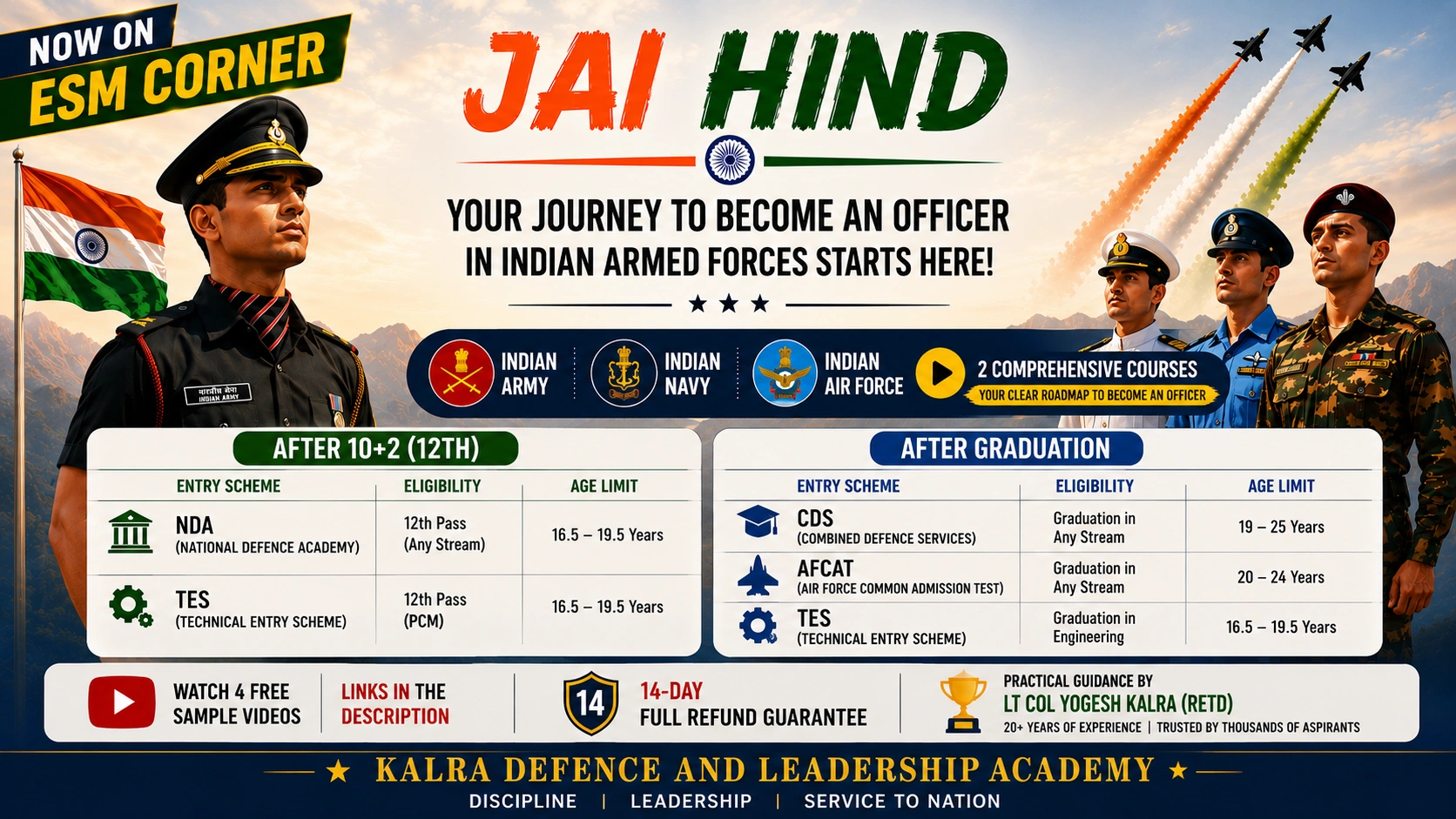
Want to Become an Officer in Indian Armed Forces?
Whether you are preparing for NDA, CDS, AFCAT, TES, SSB Interview, or other officer entries after 12th and graduation, proper guidance can save years of confusion and wrong preparation.
Lt Col Yogesh Kalra has designed practical online guidance courses covering:
• Officer entry pathways
• SSB Interview understanding
• Preparation strategy
• Common mistakes made by aspirants
• Realistic guidance for defence careers
You can first watch 4 FREE sample videos from the links below. If the course does not meet your expectations, a 14-day full refund policy is also available.
👉 Course for Defence Aspirants: https://tinyurl.com/43m67sda




















Thank you very much sir for such a detailed note on afmc.