
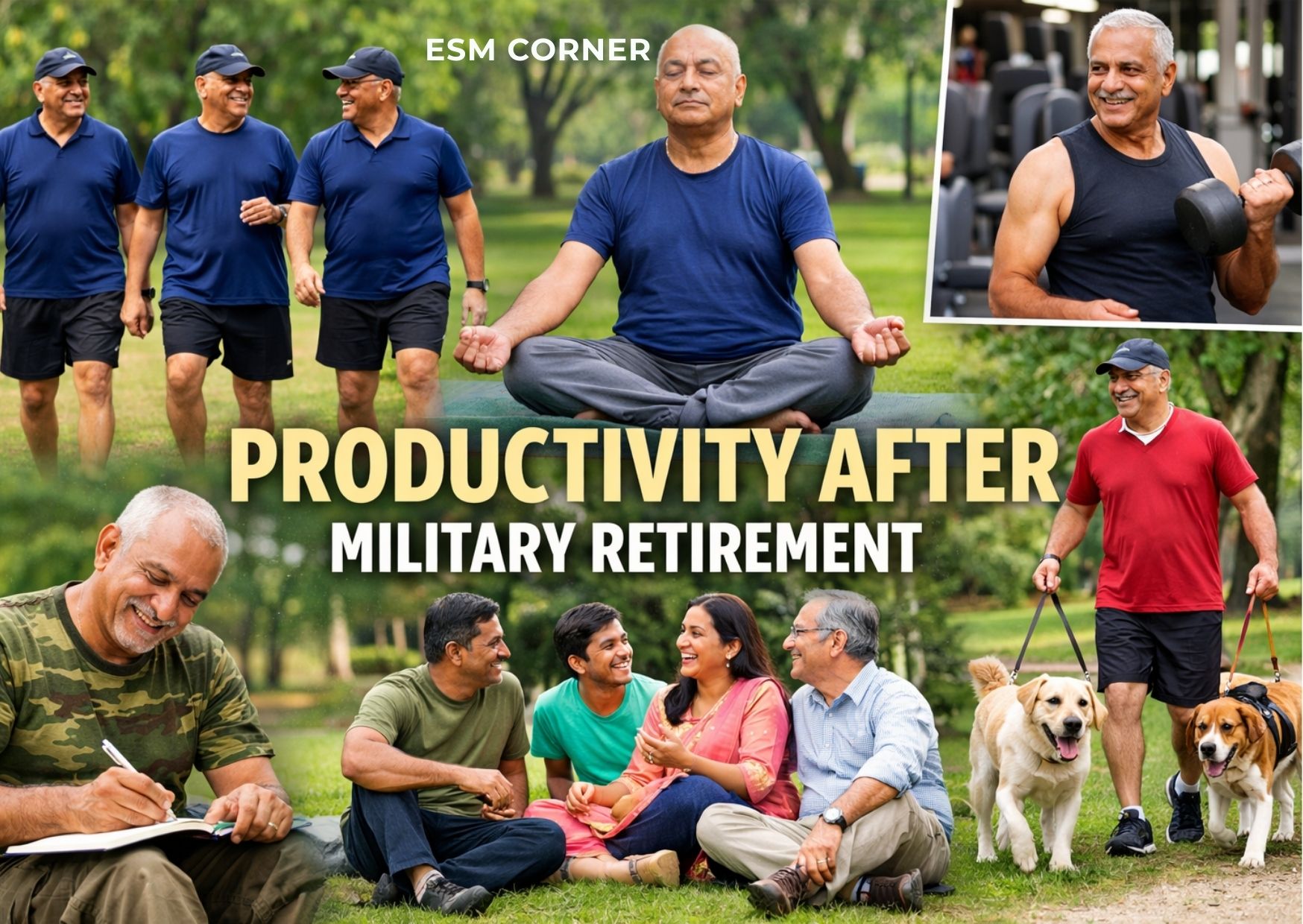
Military retirement is not just leaving a job.
It is leaving a lifestyle.
For years, life had structure: the uniform, the timetable, the unit, the mission. Even difficult days had meaning—because you knew you were useful. You knew you mattered.
Then one day, it stops.
No PT whistle.
No duty roster.
No “Fall in!”
No unit calling your name.
At first, retirement feels like freedom. But slowly, many veterans discover something nobody talks about openly: the silence. And that silence feels heavier than any field area.
In India, military retirement often happens early. That means retirement is not a finish line—it is a second innings. You may have 20–30 years still waiting for you. And deep inside, you already know the truth:
✅ You didn’t come this far just to “pass time.”
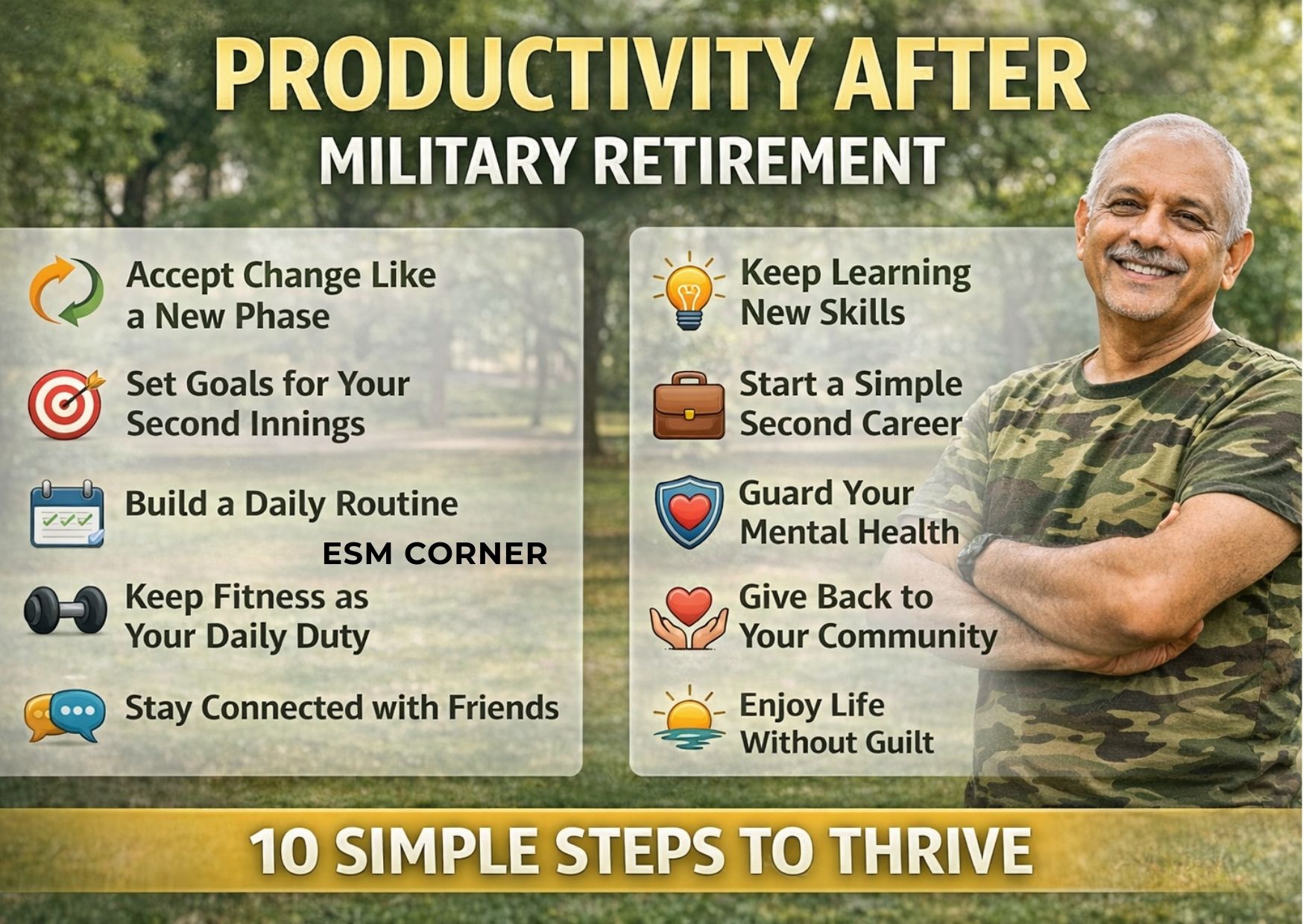
So here are 10 simple steps—not just to stay busy, but to truly thrive.
1) Accept the Change (Don’t Fight Your Own Emotions)
You may not admit it to others, but you feel it.
You miss the uniform.
You miss the system.
You miss the feeling of belonging.
You miss being “someone” in a place where everyone understood you without explanation.
And this is the first lesson of retirement:
Even strong people feel lost sometimes.
So don’t fight that emotion. Don’t shame yourself for it. Instead, accept it like a soldier accepts a new posting.
✅ Say it clearly to yourself:
“This phase is new. It will take time. And that’s okay.”
Because acceptance is not weakness—acceptance is maturity.
2) Create a New Mission (Goals Are Your New Orders)
In the military, you were never without orders. You were never without targets. Your mind was trained to focus.
But in retirement, there is no one giving you a mission. And when the mind doesn’t get a mission, it starts creating worries.
So you must do what you have always done: plan the mission yourself.
Ask yourself:
- What do I want this year?
- What kind of life do I want after 5 years?
- What will make me feel proud when I look in the mirror?
Goals don’t have to be big. They only need to be real.
✅ A goal like “I will stay fit”
✅ A goal like “I will earn ₹10,000 extra”
✅ A goal like “I will learn computers”
These become your new orders.
3) Build a Daily Routine (Because Discipline Needs a Schedule)
The biggest danger in retirement is not lack of money.
It is lack of structure.
When you don’t have a routine:
- mornings become late
- energy becomes low
- days become useless
- nights become sleepless
And slowly, the mind starts feeling heavy.
You are not lazy. You are simply missing structure.
So bring it back.
Not because someone is watching you.
But because your own life deserves discipline.
✅ Wake up at the same time
✅ Walk/exercise
✅ Set 2–3 daily tasks
✅ Keep fixed meal and sleep timings
A routine is not a prison.
A routine is peace.
✍️ Also read: To learn the most important skills veterans must develop to succeed in second innings, read this detailed guide.
4) Treat Fitness Like Duty (Because Health Is Your Real Wealth)
In service, PT was mandatory. After retirement, fitness becomes optional.
And that is where many veterans slowly lose their strength.
One day it’s “I will start from tomorrow.”
Then it becomes “My knees hurt.”
Then it becomes “Now I feel tired all the time.”
But listen carefully:
✅ Retirement is not the time to become weak.
It is the time to become wise.
Your body carried you through postings, exercises, and challenges. Now it deserves care.
Walk daily. Stretch daily. Keep moving.
Even 30 minutes a day can save years of health later.
Fitness after retirement is not about showing off.
It is about staying independent and respected.
5) Stay Connected (Because Loneliness Is a Silent Enemy)
In the unit, you were never alone.
Even if life was hard, you had people around you.
Someone to talk to. Someone to laugh with. Someone who understood your silence.
After retirement, the world changes.
Civilian life is busy. People don’t have time. And slowly, a veteran starts living inside his own head.
And that is dangerous.
✅ Don’t isolate yourself.
Call your old buddies. Meet them. Keep in touch. Join veteran groups. Attend ESM functions. Be around people who speak your language without words.
Because social connection is not a luxury.
It is mental survival.
6) Keep Learning (Because A Soldier Never Stops Training)
Training never ended in the military. You learned new weapons, new systems, new skills.
So why should learning stop in retirement?
If you want to stay productive, you must keep your mind alive.
Learn:
- computers
- online forms
- mobile banking
- communication skills
- a trade skill
At first you may feel:
“Yaar, I am too old for this.”
But truth is:
✅ You are not too old.
You are simply new.
And a veteran has never been afraid of learning.
7) Start a Second Career (Because Purpose Feels Better Than Rest)
Pension gives safety.
But work gives identity.
A retired soldier sitting idle doesn’t feel peaceful. He feels incomplete. Not because he needs money—because he needs purpose.
So don’t wait for one perfect job.
Start small. Start part-time. Start somewhere.
A second career could be:
- security supervisor role
- admin work
- teaching/mentoring
- driving service
- business or CSC work
Even if income is small, your life will feel big.
Because purpose is the real salary.
8) Protect Your Mental Health (Because Battles Continue in New Forms)
Nobody trains soldiers for this part.
Sometimes after retirement you feel:
- anger without reason
- sadness without cause
- irritation at small things
- emptiness even when family is around
And the worst part?
You don’t know how to explain it.
But let me tell you one truth:
✅ Mental struggle is not failure.
Mental struggle is human.
You have fought for the country.
Now fight for your peace too.
Talk to someone. Don’t suppress. Don’t isolate.
If needed, take professional help.
Because the strongest men are not those who suffer silently.
They are those who know when to ask for support.
✍️ Also read: To avoid the most common post-retirement mistakes that reduce motivation and progress, read this article.
9) Give Back (Because Service is Still Inside You)
Even after retirement, the soldier inside you still wants to be useful.
That is why veterans feel good when they help others.
Mentor a youngster. Help a fellow veteran fill documents. Guide a job seeker. Volunteer in school. Support your community.
When you give back, something happens:
✅ Your life feels meaningful again.
✅ Your retirement feels powerful.
Service is not just a job.
Service is identity.
10) Learn to Enjoy Life (Without Feeling Guilty)
This is important.
Many veterans feel guilty when they relax.
They feel:
“I should be doing something.”
“I should not waste time.”
“I should be productive.”
But retirement is not punishment.
Retirement is reward.
You gave years of your youth to duty. You have earned peace.
Spend time with family. Travel. Sit quietly. Read. Pray. Do hobbies.
Balance is not laziness.
Balance is wisdom.
Start Today (Don’t Wait for Perfect Motivation)
You don’t need to fix your entire life in one day.
Start with one step:
- take a walk
- write one goal
- call one friend
- learn one new skill
You have already lived the hardest life.
Now your mission is simple:
✅ Live strong.
✅ Live proud.
✅ Live peaceful.
And you will thrive.
Q1: Why do many veterans feel lost after military retirement?
A: Because military life provides a strong routine, identity, and sense of mission. After retirement, the sudden change and lack of structure can create confusion, silence, and emotional emptiness.
Q2: What is the best way to stay productive after retirement?
A: The best way is to create a daily routine, set clear goals, stay physically active, and keep learning new skills. Productivity improves when your day has structure and purpose.
Q3: How important is a daily routine after retirement?
A: Very important. A routine keeps your mind focused, reduces stress, improves sleep, and prevents the feeling of wasting time. It brings the same discipline of service life into civilian life.
Q4: What should a retired soldier do if he feels lonely or isolated?
A: Stay connected with people—especially fellow veterans. Join veteran groups, attend ESM meetings, meet old colleagues, and engage in social or community activities regularly.
Q5: Can retired defence personnel start a second career?
A: Yes. Many veterans start a second career in government/private jobs, security supervision, training, driving, or small businesses. A second career brings purpose, routine, and extra income.
Q6: How can veterans improve their mental health after retirement?
A: By staying socially connected, maintaining fitness, talking openly with family or friends, and seeking professional support if sadness, anger, or anxiety continues for long. Mental fitness is as important as physical fitness.
Q7: Is it necessary to keep learning after retirement?
A: Yes. Learning keeps the brain active, improves confidence, and opens new job or business opportunities. Even basic skills like computers, mobile apps, and communication make daily life easier.
Q8: Is it okay to relax after retirement, or should one stay busy all the time?
A: It is absolutely okay to relax. A happy retirement needs balance—staying active and productive, but also enjoying rest, hobbies, travel, and family time without guilt.