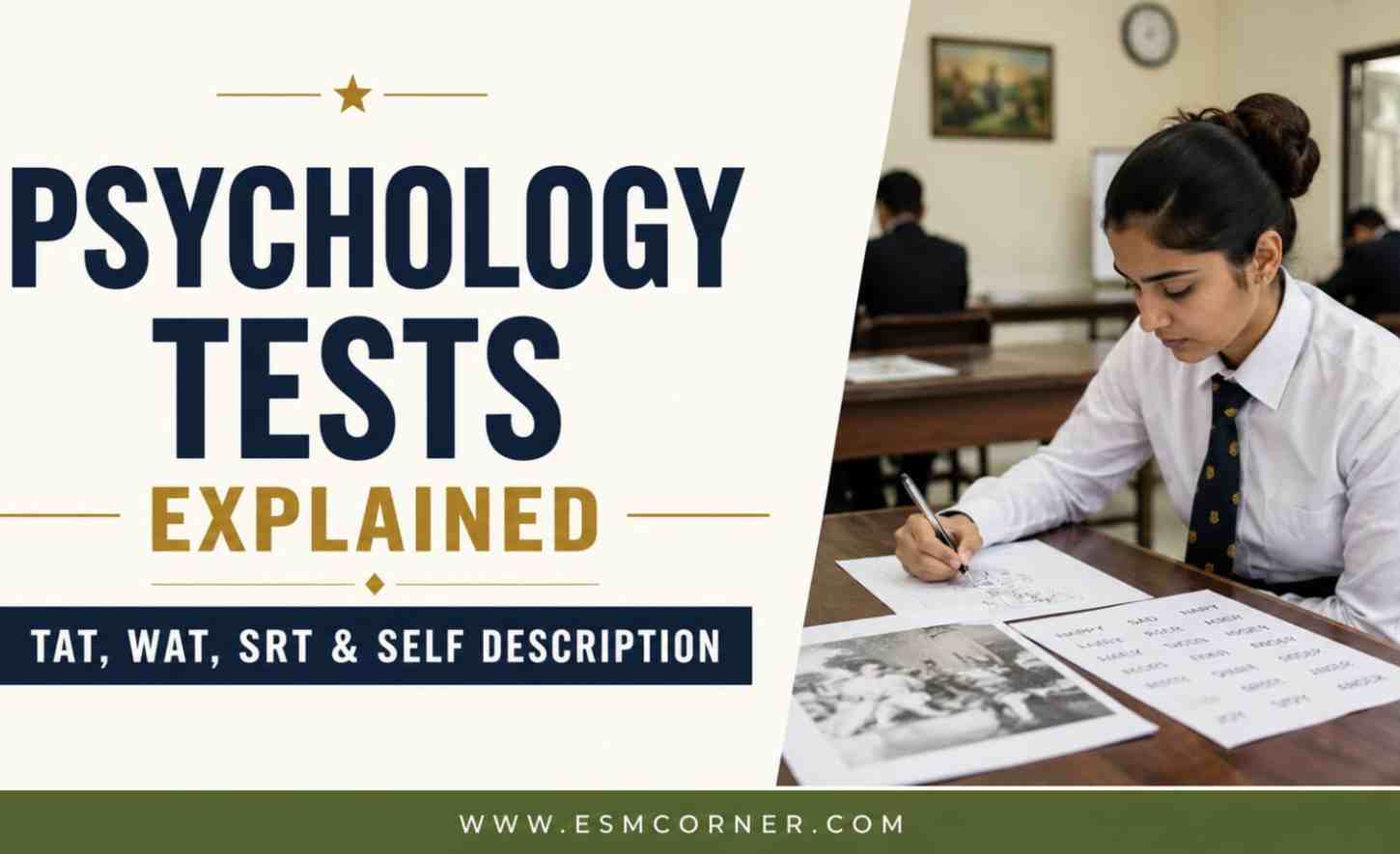
If there’s one stage of SSB that makes candidates the most nervous, it’s the psychology tests. Somehow “psychology” sounds scarier than “interview.” People imagine some mind-reading machine that’ll expose their deepest secrets. Relax — it’s nothing like that. It’s actually a very fair, very logical process. Once you understand what it’s really checking, the fear turns into confidence. Let’s get into it.
Why Psychology Tests Even Exist
Here’s a simple truth: marksheets and physical fitness can’t tell you if someone will stay calm when bullets are flying, or whether they’ll take responsibility when a decision goes wrong. That’s exactly the gap psychology tests fill.
Instead of asking direct questions (which anyone can mug up answers for), the SSB shows you pictures, words, and situations — things that are a little vague, a little open-ended — and sees how you naturally respond. There’s no “correct” answer key here. What matters is whether your response feels real, mature, and consistent.
The Big Idea: Triangulation
Here’s something most guides skip, but it’s honestly the most interesting part. The SSB doesn’t rely on just one person’s opinion of you. Three different assessors are quietly studying you from three completely different angles:
- The Psychologist studies your subconscious mind through what you write.
- The GTO watches how you actually behave in a group, in real time.
- The Interviewing Officer interacts with you directly and evaluates your conscious personality.
Then they compare notes. If your written stories say you’re a calm problem-solver, but in the group task you’re seen panicking and blaming others — that mismatch gets noticed immediately. So the real secret isn’t “performing well” in one test. It’s being consistently yourself across all of them.
What Happens on Test Day
All four tests — TAT, WAT, SRT, and SDT — happen back-to-back in one sitting, with strict timing and barely any breaks in between. This isn’t accidental. The tight schedule is completely intentional — it doesn’t give you enough time to “think up” clever answers. It forces your natural, spontaneous thinking to come out. Basically, the entire format is designed to catch anyone trying to fake it.
Here’s a quick overview of all four before we go deeper into each one:
| Test | What It Looks Like | What It’s Really Checking |
|---|---|---|
| TAT (Thematic Apperception Test) | 11 pictures shown for 30 seconds each, plus 1 blank slide; you write a short story for each | Your imagination, leadership instincts, and how you solve problems mentally |
| WAT (Word Association Test) | 60 words flash for 15 seconds each; you write the first sentence that comes to mind | Your immediate thoughts, reactions, and emotional balance |
| SRT (Situation Reaction Test) | A series of everyday tricky situations; you write short, quick reactions | Your practical, real-world decision-making under time pressure |
| SDT (Self Description Test) | You describe yourself through your parents’, friends’, and teachers’ eyes | Your self-awareness — do you actually know yourself, warts and all |
Test 1: TAT (Thematic Apperception Test)
You’ll see 11 pictures, each shown for just 30 seconds, and then you get time to write a short story for each one. Here’s the twist — the 12th slide is completely blank. Just a white screen. Yes, really.
A good TAT story isn’t complicated. It just needs to naturally flow in three parts:
- What led up to it — a quick, believable backstory.
- What’s happening now — your main character actually doing something about the situation.
- What happens next — a realistic, positive outcome that makes sense, not a magical rescue.
Now, about that blank slide — this is where most people mess up badly. A shocking number of candidates use it to write dramatic stories about army encounters, terrorist attacks, or martyrdom, thinking it’ll impress the assessor. It does the opposite. The psychologist already knows you’re not narrating a real memory here — you’re revealing what’s genuinely important to you. So write about something real: a project you completed, a small community initiative, an academic win, anything that’s actually yours. Authentic beats cinematic, every single time.
Test 2: WAT (Word Association Test)
This one is brutal in terms of speed. 60 words flash on screen one after another, just 15 seconds each, and you write the first sentence that comes to your mind. No time to “think of something impressive.” That’s the whole point — it removes your filter completely.
Here’s something genuinely fascinating: psychologists actually sort your WAT answers into three quality levels, and knowing this changes how you should think about it:
- Weakest level — Common textbook phrases. Writing “Honesty is the best policy” isn’t wrong, but it shows a lack of original thought and feels like a memorized line.
- Red flag level — Overcompensating lines. For “Fear,” writing “An officer never feels fear.” Sounds bold, but assessors instantly recognize this as fake bravado — like you’re hiding something rather than actually being fearless.
- Best level — Genuine, constructive lines. For “Failure,” writing something like “Analyzing failure provides valuable lessons for future success.” This shows real, mature, forward-thinking — exactly what they’re looking for.
The lesson here is simple: don’t try to sound impressive, don’t try to sound fearless. Just write what genuinely, practically comes to mind.
Test 3: SRT (Situation Reaction Test)
You get a bunch of everyday tricky situations, and you write how you’d react — fast, short, and to the point. No essays needed. What they’re checking is your common sense and quick decision-making, not your writing skills.
Test 4: SDT (Self Description Test)
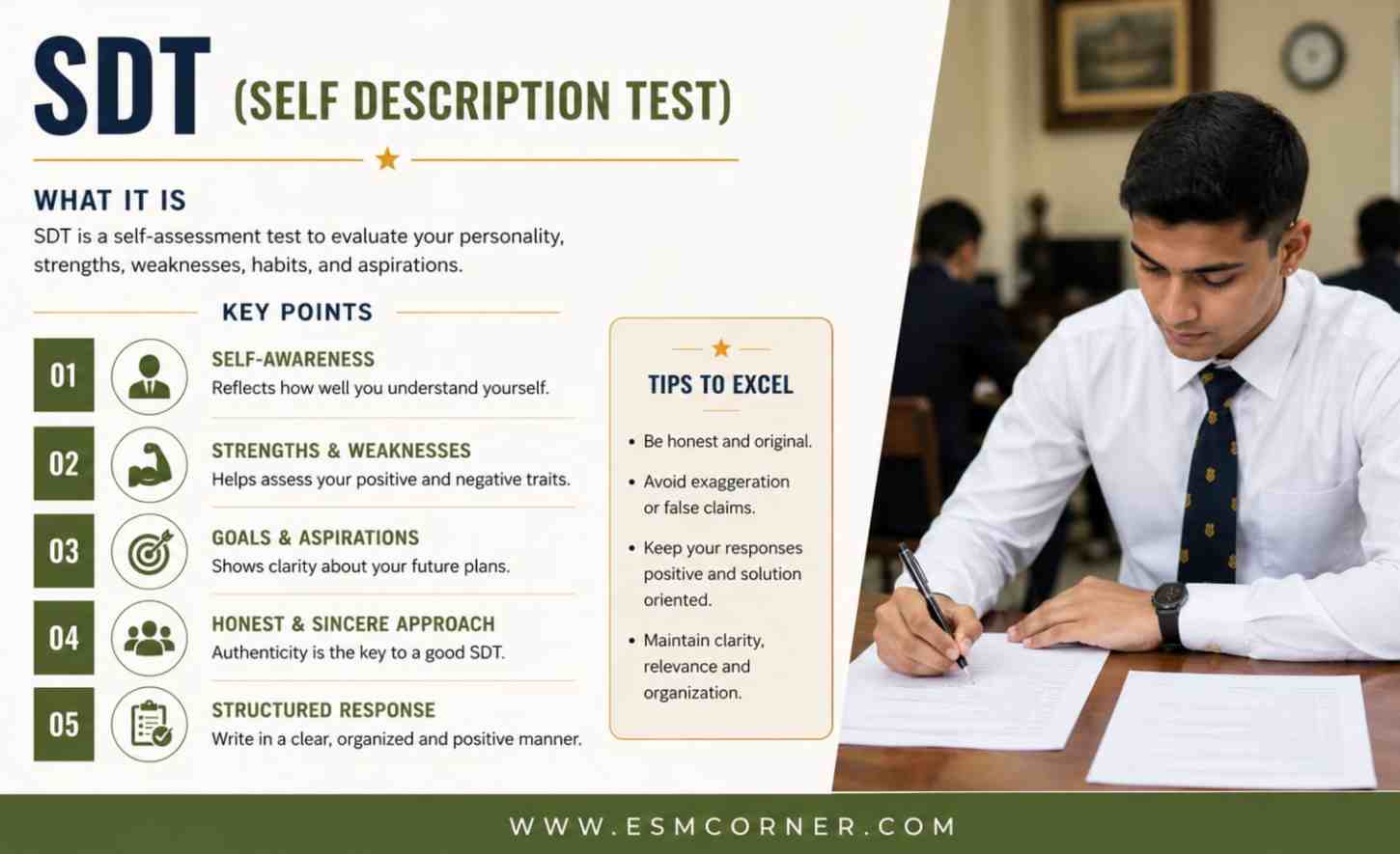
Here you describe yourself — how your parents see you, how your friends see you, how your teachers see you, and what you personally want to improve. This is basically a self-honesty check. And here’s the catch: writing “I have no weaknesses” is actually one of the worst things you can do. Nobody’s perfect, and pretending to be sends up a huge red flag instead of impressing anyone.
Quick Comparison — What Each Test Is Really Checking
- TAT: Your imagination, leadership instincts, and how you solve problems mentally.
- WAT: Evaluates your immediate thoughts, reactions, and emotional balance.
- SRT: Your practical, real-world decision-making under time pressure.
- SDT: Your self-awareness — do you actually know yourself, warts and all?
Common mistake across all four? Trying to appear flawless. Every single test is secretly designed to catch a “too perfect” candidate — because in real life, nobody’s flawless, and pretending to be just looks fake.
They’re Watching More Than Just Your Words
Here’s a detail most people don’t realize — psychologists aren’t only reading what you write. They’re also quietly noticing how you write it. Are you overreacting dramatically to a small, simple problem in your TAT story? That might suggest emotional instability. Are there tons of cut-and-corrections, or shaky handwriting in your WAT and SRT? That can hint at hesitation or forced, coached answers rather than natural thinking. Basically, your handwriting and speed are quietly telling a story too, even when you’re not trying to say anything with them.
Three Habits That’ll Actually Help You
- Stop memorizing “model answers” from prep books. This is probably the single biggest trap candidates fall into. Assessors have read thousands of responses — a copy-pasted, textbook-perfect answer stands out instantly, and not in a good way. Build your own thinking instead, through daily observation and genuine curiosity.
- Manage the clock smartly. In TAT, use your observation time wisely to actually understand the picture before writing. In WAT, write your very first genuine thought — don’t overthink it. In SRT, keep answers short and direct. Speed with clarity beats slow, polished perfection here.
- Be positive, but keep it real. Forced positivity is just as bad as being negative. If a situation is genuinely bad, don’t pretend it’s fine — acknowledge it, then show how you’d practically deal with it. That’s real maturity, not fake cheerfulness.
Conclusion
Don’t treat the psychology tests like an enemy trying to trap you. Think of them more like a mirror — an honest, scientific one — quietly reflecting who you really are. The board isn’t hunting for superheroes or perfect human beings. They’re looking for genuine, grounded young people with a stable mind, a sense of responsibility, and the raw potential to lead others when it actually matters. And that person could very well be exactly who you already are — you just need to let that person show up on paper, instead of trying to write someone else’s story.
read also: OFFICER LIKE QUALITIES (OLQ) – 15 KEY QUALITIES FOR DEFENCE ASPIRANTS
Q1: Can a candidate with an average academic background clear the SSB Psychology Tests?
Answer: Yes. The assessment focuses on practical intelligence, reasoning, emotional resilience, adaptability, and responsibility rather than academic marks.
Q2: What should I do if a TAT picture is extremely hazy?
Answer: Stay calm, observe the scene, identify basic elements, and write a logical, constructive story based on the available visual clues.
Q3: How do I handle negative words in the WAT?
Answer: Avoid forced positivity. Respond with a constructive, realistic, or solution-oriented thought that reflects maturity and balanced thinking.
Q4: Is it acceptable to leave a situation blank in the SRT?
Answer: Yes, if necessary. It is better than writing an unrealistic response, but skipped situations should remain very few.
Q5: How many weaknesses should I write in the SDT?
Answer: Mention two or three genuine, minor weaknesses and avoid serious character flaws like dishonesty, laziness, or poor teamwork.
Q6: Does handwriting quality affect the psychologist’s evaluation?
Answer: Handwriting should be clear and readable. Consistent legibility under time pressure reflects better composure during the assessment.
Q7: Can short-term coaching change core psychological traits?
Answer: No. Coaching explains the test format, but genuine personality traits develop through long-term self-improvement and experience.
Q8: What is the significance of the 12th blank slide in TAT?
Answer: It reveals your natural thoughts, goals, and values by allowing you to create a story without any visual guidance.
For daily defence updates, government notifications, recruitment alerts, welfare schemes, career opportunities, education news, and other important announcements, join our WhatsApp Community. Click here to join our WhatsApp Group.

















Aim of your psychology test in SSB evaluates your subconscious, unconscious and conscious self.
Remain natural, confident , cool and calm during testing and listen to the briefing clearly.
Give practical and pragmatic responses.
I am on the verge of finishing a book on Psychological, GTO and Interviewing Techniques including Conference Procedure which would be out by early next year which would clear all your doubts…..Wishing you success in SSB interviews through hardwork.