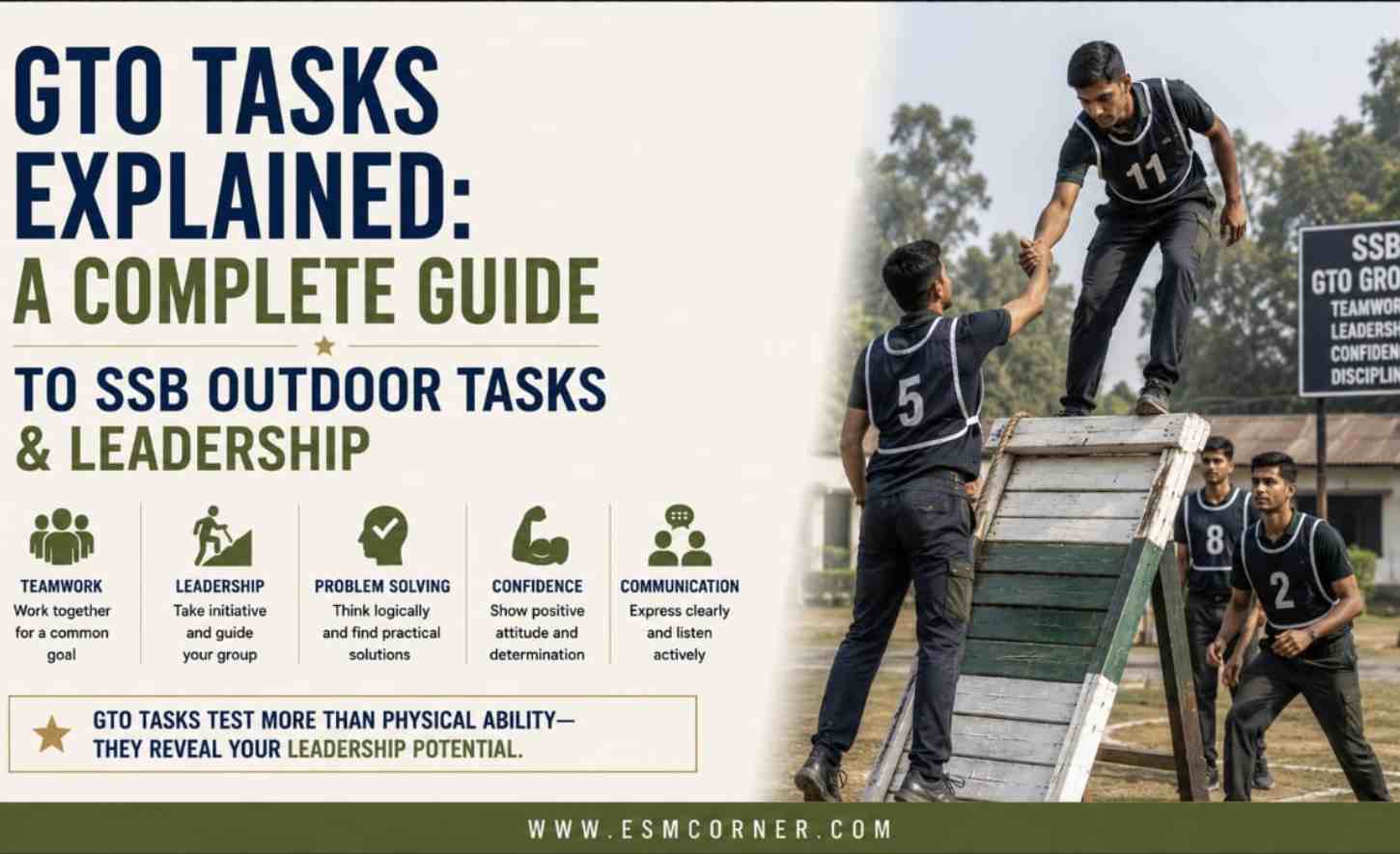
Ask any SSB candidate what scares them the most, and a lot of them will say “GTO ground.” There’s something about running around in the sun, carrying heavy ropes and planks, that makes people think it’s all about muscles and stamina. Here’s the truth that’ll actually calm you down: GTO has almost nothing to do with how strong you are. It’s checking how you think, how you behave with people, and how you handle pressure — while pretending to test your physical fitness. Sneaky, right? Let’s unpack the whole thing properly.
What Is the GTO Actually Watching?
Here’s a simple way to remember it — the GTO judges you on three levels:
- Man to Man — How you deal with individual teammates one-on-one.
- Man to Group — How you contribute and cooperate with the whole team.
- Man to Work — How practically and logically you solve the actual problem in front of you.
Unlike the psychologist who reads your writing, or the interviewing officer who talks to you directly, the GTO simply watches. No questions asked. Just pure observation of how you naturally behave when there’s a task, a group, and pressure — all mixed together. And honestly, that’s what makes it the hardest one to fake.
The Full Lineup — What Happens and In What Order
The tasks move from indoor discussions to intense outdoor obstacles, and finally end with individual tasks. Here’s the complete sequence, one by one:
- Group Discussion (GD) — Your group discusses two topics, usually current affairs or social issues.
- Group Planning Exercise (GPE) — A model of a village or terrain is placed in front of you with multiple problems (fire, flood, injured people, etc.), and your group has to plan solutions together.
- Progressive Group Task (PGT) — Your first outdoor task, where the group crosses obstacles using ropes, planks and drums, in four stages of increasing difficulty.
- Snake Race — A fun but intense race where the whole group carries a long rolled-up canvas (“snake”) through obstacles together.
- Half Group Task (HGT) — Same idea as PGT, but the group is split in half, giving quieter candidates more room to actually contribute.
- Lecturette — You speak alone for 3 minutes on a topic you pick from four options.
- Individual Obstacles (IO) — You attempt 10 different physical obstacles solo, each worth different points.
- Command Task (CT) — You become the “commander” for a bit, pick two teammates, and solve an obstacle made specifically for you.
- Final Group Task (FGT) — The whole group comes back together for one last obstacle, wrapping up the series.
Group Discussion — Don’t Try to “Win” It
First thing to understand: there’s no need to reach a final conclusion in a GD. Nobody’s judging whether your group “solved” the topic. What’s being judged is how you discussed it — did you listen, did you add value, did you stay respectful even when you disagreed?
The biggest mistakes people make here: talking over everyone to be heard, staying completely silent because you’re nervous, or repeating the same point five different ways just to stay in the conversation. None of these help. One sharp, well-timed point beats ten scattered ones.
Group Planning Exercise — Where Overthinking Kills You
This one trips up a lot of “intelligent” candidates, ironically. You get a complicated scenario — a fire here, an injured person there, limited resources — and everyone wants to save everyone using every resource available. Sounds noble, but real emergencies don’t work like that.
The GTO here is checking your reasoning ability and how realistically you use limited time and resources. A common mistake is building an unrealistic plan that tries to solve every single problem perfectly, or completely ignoring the small issues while chasing the big dramatic one. Real leadership is about smart prioritization, not trying to be a superhero who saves everybody.
Progressive Group Task & Snake Race — Teamwork Over Ego
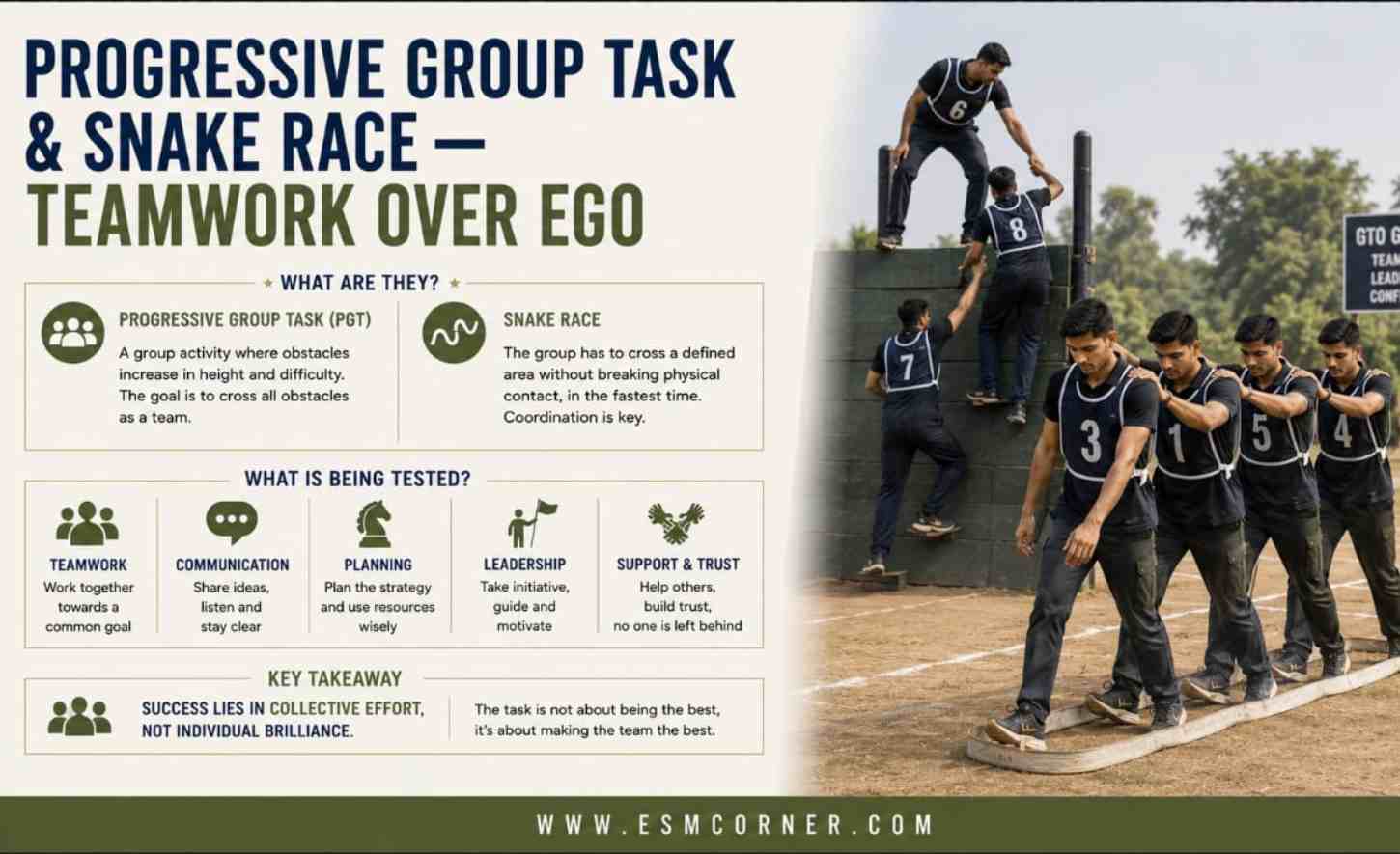
These are physically demanding, yes, but don’t let that fool you — what really matters here is cooperation. A frequent mistake is one or two “strong” candidates grabbing all the equipment and doing everything themselves, while the rest of the group just watches. That’s actually a red flag for the assessors, not a green one. They want to see if you can work with people, share responsibility, and support teammates — not whether you can single-handedly drag a drum across a ditch.
Command Task — Your Moment as a Leader
Here’s where things get personal. You’re made the commander for one obstacle, and you pick two teammates to help you. This task is designed specifically at your difficulty level, so there’s genuinely no “easy” way around it — you have to think and lead.
The biggest trap? Doing all the physical work yourself because you don’t fully trust your subordinates, or worse, being harsh and dismissive with them because you’re stressed. Good leadership here looks like clear instructions, staying calm, and treating your two helpers with respect — even when things aren’t going smoothly.
Lecturette — Three Minutes That Reveal a Lot
You get to pick a topic, prepare for 3 minutes, and speak for 3 minutes. Sounds short, but it says a lot about how you organize your thoughts under pressure.
Keep this simple structure in mind: a short intro, 2-3 clear points in the middle, and a quick conclusion. Common mistakes to avoid: pacing around nervously, speaking too softly, running out of things to say halfway through, or reciting something memorized word-for-word that sounds robotic instead of natural.
Individual Obstacles — Play It Smart, Not Just Fast
Ten obstacles, different point values, fixed time. Most candidates just run around trying to attempt everything randomly. A smarter approach is quickly scanning which obstacles you’re confident about and tackling those first, rather than wasting precious minutes struggling with the hardest one right at the start.
Quick Recap — What Each Task Is Really Testing
- GD & GPE: How effectively you think, structure your ideas, and communicate them.
- PGT, Snake Race & HGT: How well you work with others, not just for yourself.
- Command Task: Your genuine, natural leadership style.
- Lecturette: Your confidence and clarity of expression solo.
- Individual Obstacles: Your planning ability under physical and time pressure.
- Final Group Task: Whether your energy and attitude stayed consistent till the very end.
That last point is honestly underrated — a lot of candidates give their best effort in the early tasks and then quietly fade out by the end, either from tiredness or lost motivation. The GTO absolutely notices that drop. Staying consistent till the final task matters just as much as a strong start.
“I’m Not Loud or Aggressive, Can I Still Do Well?”
Yes, genuinely yes. This is probably the most common worry candidates have, and it’s based on a myth. The GTO series doesn’t favor loud, dominating personalities — it favors substance and reliability.
If you’re naturally quieter, you don’t need to force yourself into shouting matches during GD or GPE. Wait for a natural pause in the conversation, then drop in one well-structured, logical point that actually moves things forward. On the outdoor field, you don’t need to be the loudest voice either — you can stand out simply by being dependable: holding a support structure steady, listening properly, executing your part of the plan smoothly. Over time, your team will naturally start relying on you for direction, without you ever needing to shout for attention.
Conclusion
GTO isn’t secretly a fitness test wearing a fancy name. It’s a window into how you actually behave with people — under pressure, in a team, when things don’t go perfectly. The board isn’t looking for the strongest, loudest, or most athletic candidate in the group. They’re looking for someone dependable — someone whose words and actions match up, who stays calm and cooperative from the very first Group Discussion right down to the last obstacle of the Final Group Task. That’s not something you can fake for two days. But the good news is, if you genuinely have it in you, this is exactly the kind of test where it’ll naturally show.
read also: OFFICER LIKE QUALITIES (OLQ) – 15 KEY QUALITIES FOR DEFENCE ASPIRANTS
FAQ 1: What should I do if my group is aggressive during the Group Discussion?
Answer: Stay calm, avoid shouting, wait for an opportunity, and present clear, logical points that help bring the discussion back to a structured direction.
FAQ 2: How can I show practical intelligence in the PGT?
Answer: Observe available materials, identify stable solutions, and support practical ideas. Focus on teamwork and realistic execution instead of forcing complicated solutions.
FAQ 3: Is speaking first necessary in the Group Planning Exercise?
Answer: No. The GTO values logical and practical contributions throughout the discussion, not the order in which you speak.
FAQ 4: How should I choose helpers for the Command Task?
Answer: Select teammates based on their cooperation, physical ability, and reliability rather than personal friendship or popularity.
FAQ 5: Can I speak Hindi during the Lecturette?
Answer: English is preferred, but if necessary, briefly use Hindi and return to English confidently without losing your composure.
FAQ 6: Does height or weight affect GTO performance?
Answer: No. The GTO evaluates planning, teamwork, and problem-solving. Candidates should use their strengths effectively to support the group.
FAQ 7: What should I do if a teammate breaks the field rules?
Answer: Calmly remind the teammate of the rule and suggest a practical alternative without creating conflict or disrupting teamwork.
FAQ 8: Can average individual performance be balanced by strong teamwork?
Answer: Yes. Strong teamwork, cooperation, and consistent contribution in group tasks are highly valued during the GTO assessment.
For daily defence updates, government notifications, recruitment alerts, welfare schemes, career opportunities, education news, and other important announcements, join our WhatsApp Community. Click here to join our WhatsApp Group.