
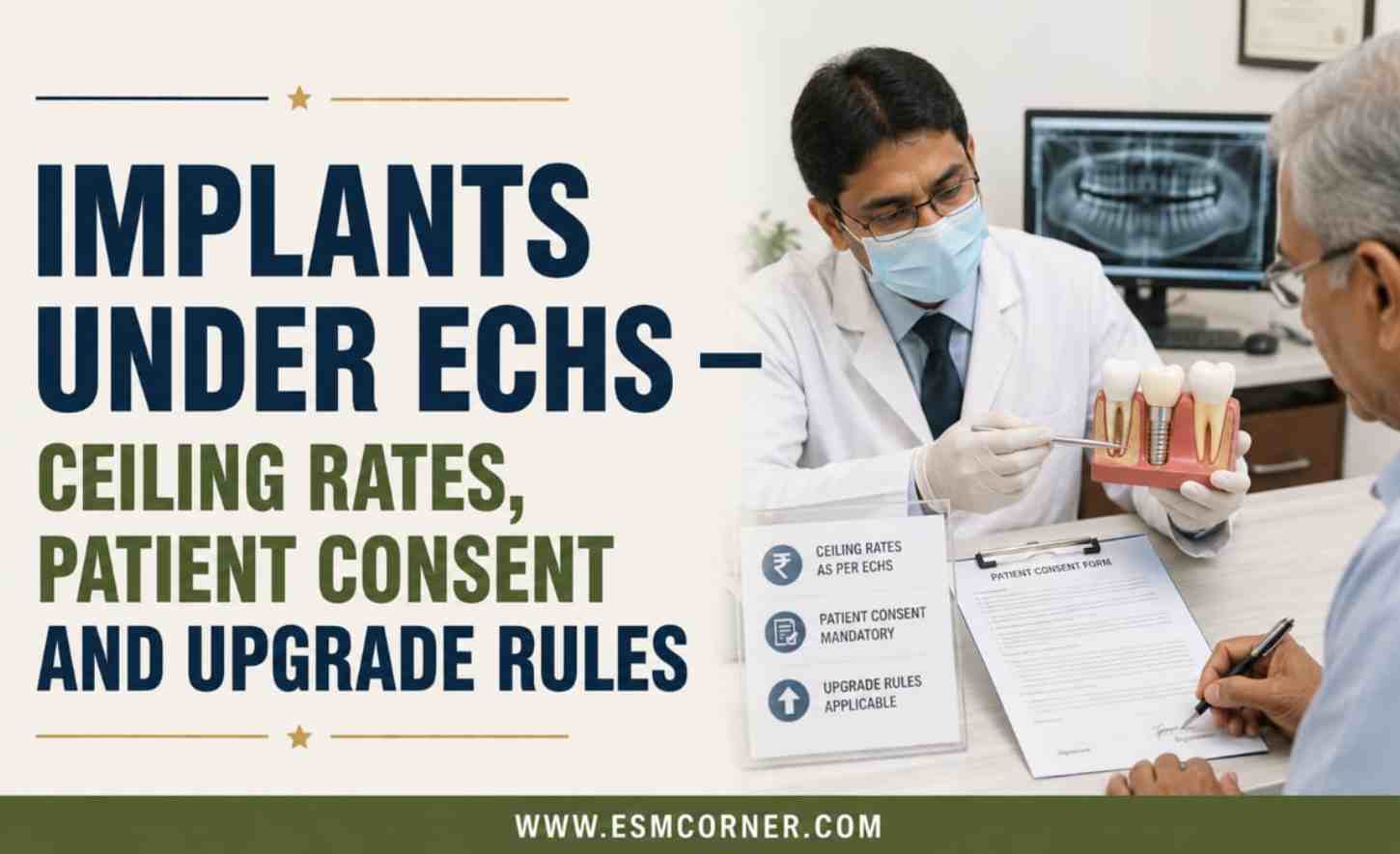
When a defence veteran or their dependent needs a medical implant — a lens after cataract surgery, a stent for a blocked artery, a mesh for a hernia repair, or a heart valve — the cost can run into lakhs of rupees at a private hospital. Under ECHS, implants are covered. But the rules around implants are specific and every beneficiary must know them clearly.
The most common problem with implants is that patients are often offered a higher quality or branded implant at the hospital without being told that ECHS only covers a standard implant up to a ceiling rate. The patient agrees, gets the procedure done, and then discovers at discharge that they have to pay a large amount as the difference. This situation is avoidable if you know the rules before the procedure begins.
This article explains the complete implant policy under ECHS — what is covered, what ceiling rates mean, what happens when you choose a higher implant, and the written consent rule. All facts are strictly from ECHS SOP April 2026.
Are Implants Covered Under ECHS?
Yes. Implants are covered under ECHS. They are reimbursable in addition to the package rate — meaning the implant cost is paid separately over and above the surgical package rate. The implant is not bundled inside the surgery package.
Implants covered under ECHS include lenses, stents, meshes, valves, and similar medical devices used during surgical procedures.
What are ECHS Ceiling Rates for Implants?
The Government of India Ministry of Health has fixed ceiling rates for the majority of implants. These rates are specified in the ECHS and CGHS rate list.
A ceiling rate means — ECHS will reimburse the implant cost only up to this fixed maximum amount. If the implant costs less than or equal to the ceiling rate, ECHS pays the full amount. If the implant costs more than the ceiling rate, ECHS pays only up to the ceiling — the patient pays the difference.
Empanelled hospitals must use listed implants only — meaning implants that are on the approved ECHS and CGHS list.
What Happens With Unlisted Implants?
If a procedure requires an implant that is not on the ECHS and CGHS list — an unlisted implant — the reimbursement is calculated differently.
Unlisted implants are reimbursed based on the actual invoice rate or the NPPA rate — whichever is less. NPPA stands for National Pharma Pricing Authority, which is the government body that regulates prices of medical devices.
This means ECHS will pay the lower of the two amounts — either what the hospital actually paid for the implant as per its purchase invoice, or the price fixed by NPPA for that device.
What if the Patient Wants a Higher Value Implant?
This is where many problems arise. Sometimes a patient or their family member wants a premium or higher quality implant that costs more than what ECHS covers.
Under ECHS rules this is permitted — but with two clear conditions —
First — the patient or their attendant must willingly opt for the higher cost implant. It must be the patient’s own choice, not the hospital’s recommendation to upgrade.
Second — the hospital must obtain a written consent from the patient or their attendant before providing the higher value implant. This written consent must confirm that the patient understands they will pay the difference between the ECHS covered ceiling rate and the actual cost of the higher implant.
The difference in cost is paid by the patient. ECHS pays only up to its ceiling rate. The hospital cannot bill the full cost of the upgraded implant to ECHS.
Drug-Eluting Balloon — Special Rule
A drug-eluting balloon is a specialised cardiac device used in place of a stent in certain procedures. Under ECHS it is payable as per NPPA rates or actual invoice — whichever is less. This follows the same principle as unlisted implants.
What About Dental Implants?
Dental implants are a completely separate matter. As clearly stated in the ECHS SOP April 2026 — dental implants are not allowed for ECHS patients. This is an absolute restriction. No dental implant of any kind is covered or permitted under ECHS regardless of medical need.
Consumables and Guidewires — Included in Package
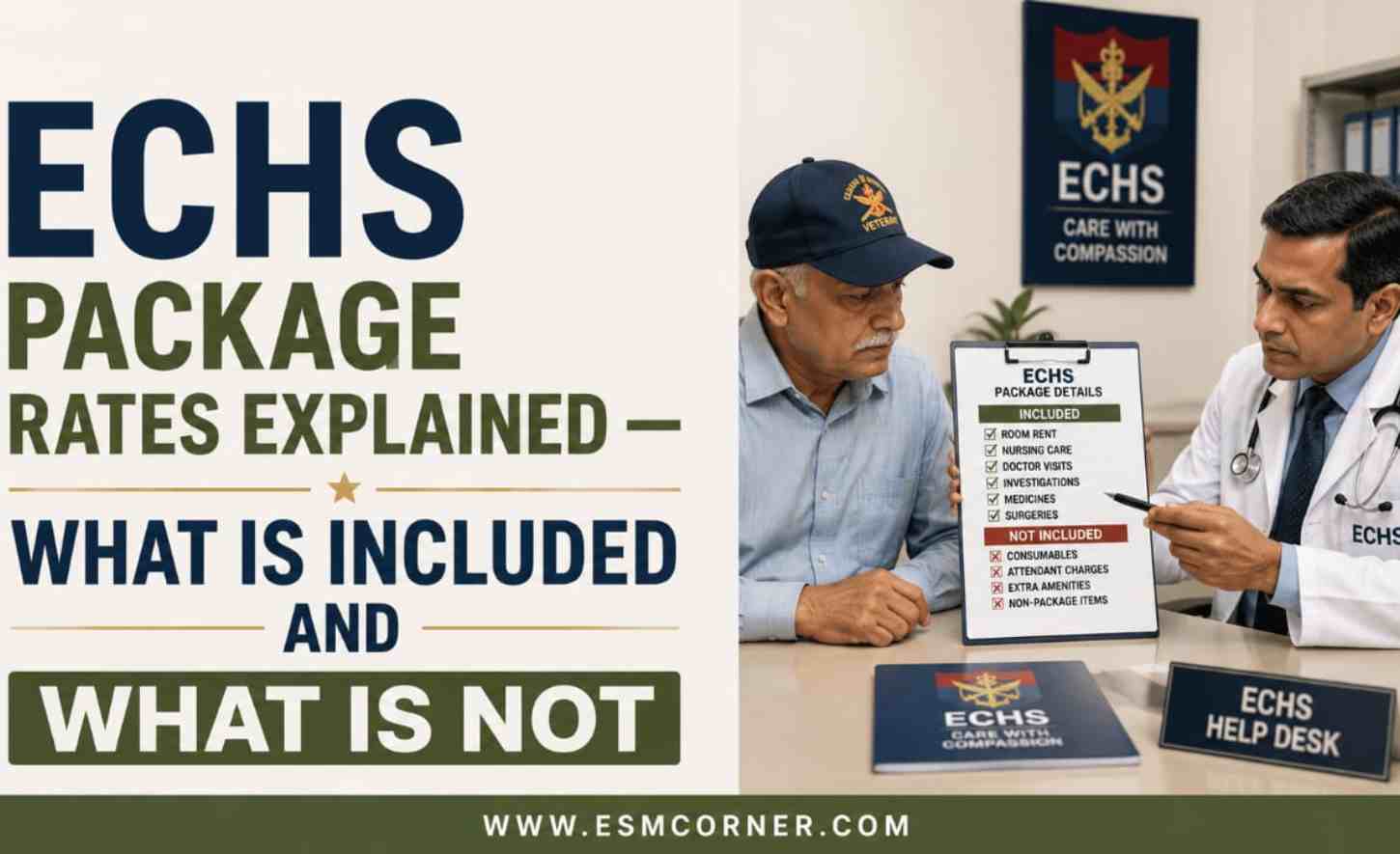
It is important to note that all consumables and medicines including guidewires and catheters used during a procedure are considered inclusive in the package rate. They are not separately billable. Only the implant itself — such as the stent or lens — is reimbursable separately over and above the package.
Common Mistakes to Avoid
Agreeing to a higher value implant at the hospital without understanding you will pay the difference.
Not asking for written confirmation of the implant cost and ECHS ceiling rate before the procedure.
Not knowing that unlisted implants are reimbursed at NPPA or invoice rate — whichever is less.
Assuming dental implants are covered — they are completely not allowed under ECHS.
Allowing the hospital to include guidewires or catheters as separate charges — these are inside the package.
Conclusion
Implants under ECHS are well covered within defined ceiling rates. Listed implants are paid at CGHS ceiling rates. Unlisted implants are reimbursed at NPPA or invoice rate whichever is less. If you choose a higher value implant the difference is yours to pay — but only after giving written consent. Dental implants are not allowed under any circumstance.
Before any implant procedure ask the hospital clearly — is this implant listed under ECHS, what is the ceiling rate, and what will I need to pay if any. Get it in writing before the procedure. That one question protects you from a surprise bill at discharge.
READ ALSO: WHAT IS ECHS AND WHO CAN USE IT?
Frequently Asked Questions
Q1. Are implants covered under ECHS?
Yes. Implants are covered under ECHS and are reimbursable in addition to the surgical package rate. Implants covered include lenses, stents, meshes, valves, and similar medical devices. The implant cost is paid separately over and above the package rate and is not bundled inside the surgery package.
Q2. What are ceiling rates for implants under ECHS?
Ceiling rates are the maximum amounts ECHS will reimburse for an implant as fixed by the Government of India Ministry of Health and specified in the ECHS and CGHS rate list. If the implant costs more than the ceiling rate ECHS pays only up to the ceiling and the patient pays the difference. Empanelled hospitals must use listed implants only.
Q3. What happens if the required implant is not on the ECHS list?
Unlisted implants are reimbursed based on the actual invoice rate or the NPPA rate — whichever is less. NPPA is the National Pharma Pricing Authority which regulates medical device prices. ECHS will pay the lower of the two amounts — either the hospital’s actual purchase invoice or the NPPA regulated price for that device.
Q4. Can a patient choose a higher value implant than what ECHS covers?
Yes. A patient can choose a higher value implant but only under two conditions. First the patient or their attendant must willingly opt for the upgrade — it must be their own choice. Second the hospital must obtain written consent from the patient confirming they will pay the difference between the ECHS ceiling rate and the actual cost of the higher implant.
Q5. What written consent is required before a higher value implant is used?
Before providing a higher value implant the hospital must obtain written consent from the patient or their attendant. This consent must confirm that the patient understands ECHS will cover only up to the ceiling rate and the patient will personally pay the difference in cost. The hospital cannot proceed with the upgrade without this written agreement.
Q6. Are dental implants covered under ECHS?
No. Dental implants are completely not allowed for ECHS patients as per ECHS SOP April 2026. This is an absolute restriction with no exceptions. No dental implant of any kind is covered or permitted under ECHS regardless of the medical reason or the patient’s rank or entitlement.
Q7. Are guidewires and catheters used during a procedure covered separately?
No. Guidewires, catheters, and all consumables and medicines used during a procedure are considered inclusive within the package rate under ECHS SOP April 2026. They cannot be billed separately. Only the implant itself such as the stent or lens is reimbursable separately over and above the package rate.
Q8. What is the rule for a drug-eluting balloon under ECHS?
A drug-eluting balloon used in place of a stent in cardiac procedures is payable under ECHS at NPPA rates or actual invoice — whichever is less. This follows the same reimbursement principle as unlisted implants. The hospital cannot charge more than the lower of the two amounts for a drug-eluting balloon.
Q9. What should a patient ask before agreeing to an implant procedure?
Before agreeing to any implant procedure ask the hospital clearly whether the implant is listed under ECHS, what the ECHS ceiling rate is for that implant, and whether you will need to pay any difference. Ask for this information in writing before the procedure begins. This one step protects you from unexpected charges at discharge.
Q10. Can a hospital use a non-listed implant without informing the patient?
No. Empanelled hospitals must use listed implants as per ECHS rules. If a non-listed implant is used the reimbursement is limited to NPPA or invoice rate whichever is less. If a patient is being offered a higher value or non-standard implant the hospital must inform the patient clearly, obtain written consent, and confirm the amount the patient will need to pay before proceeding.
For daily defence updates, government notifications, recruitment alerts, welfare schemes, career opportunities, education news, and other important announcements, join our WhatsApp Community. Click here to join our WhatsApp Group.