
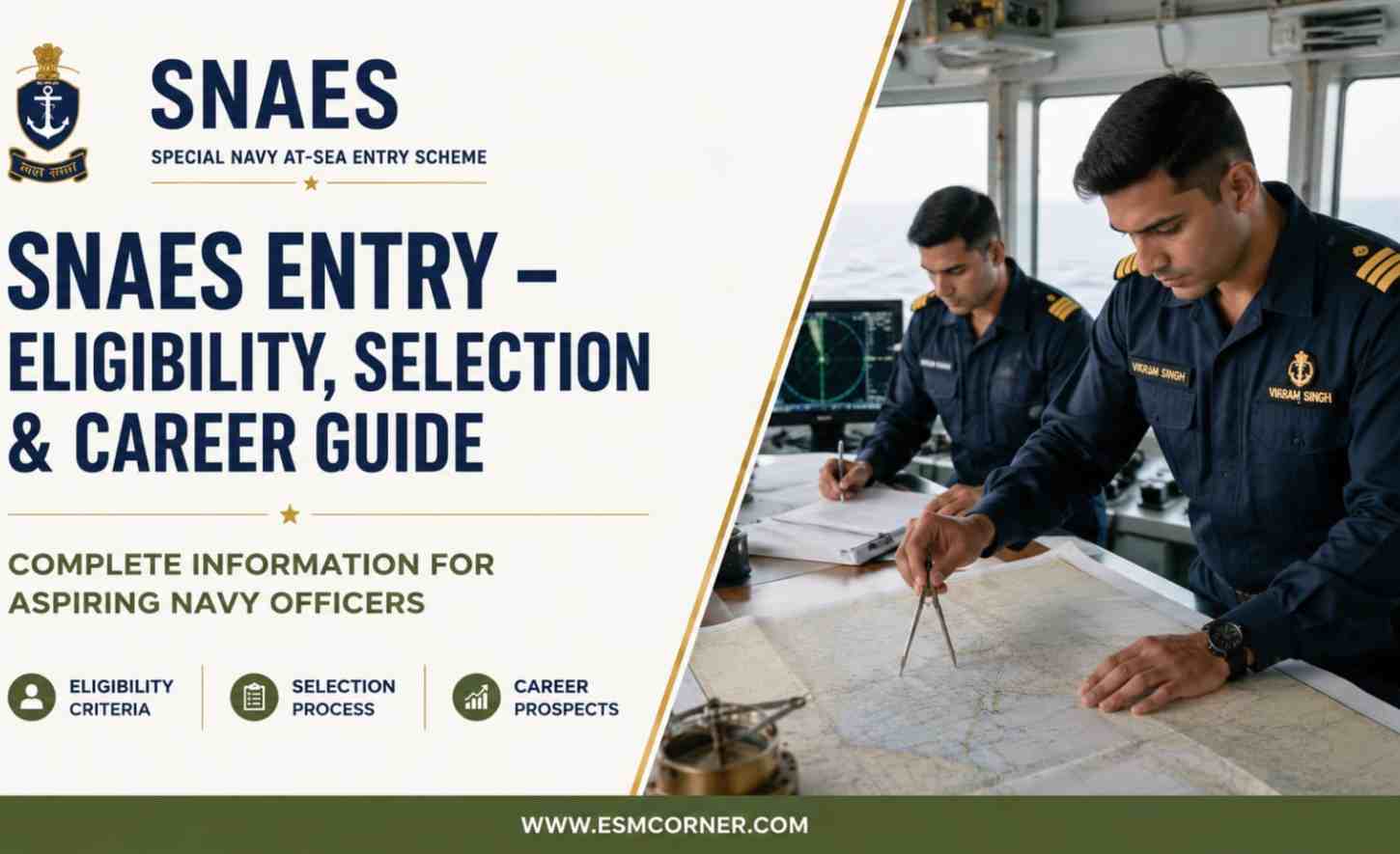
Ask any defence aspirant about entries into the Armed Forces, and you’ll hear the usual names — NDA, CDS, AFCAT. But there’s a genuinely unique pathway hiding inside the Indian Navy’s technical branch that barely anyone talks about: the Special Naval Architect Entry Scheme (SNAES).
This one’s built specifically for engineering graduates who love maritime engineering and structural design. It lets you combine hardcore technical work with the leadership and honour of being a naval officer. And here’s the cool part — officers under this scheme don’t just sail on warships, they actually design, build, refit, and maintain them.
Ever looked at a massive aircraft carrier or a stealth frigate and wondered how something that complex actually gets built? SNAES is basically your doorway into being the person who makes that happen.
If you’re an engineering student trying to decide between a corporate desk job, a core industrial role, or something more meaningful, SNAES gives you a genuinely rare option — keep your technical identity while stepping into serious leadership as a commissioned officer.
So, What Exactly Is SNAES Entry?
It’s a direct officer entry run by the Indian Navy to bring in engineering graduates into the Naval Architecture Cadre of the Engineering Branch. Selection happens through direct application shortlisting or campus visits at top technical institutes — no written entrance exam involved. It’s purely based on your academic record and personality evaluation.
Why does this entry even exist? The Indian Navy is actually one of the few navies in the world that designs and builds its own warships in-house, through the Directorate of Naval Design (DND). To keep that edge, they need officers who genuinely understand fluid dynamics, structural strength, and advanced naval materials — and SNAES is exactly how fresh engineering talent gets funnelled into that world.
What Does a Naval Architect Officer Actually Do?
Think of a Naval Architect Officer (also called a Naval Constructor) as the technical mind behind the entire fleet. Your job covers the full life cycle of a ship — from the first CAD drawing to structural stress analysis, actual construction, sea trials, and ongoing repairs. You’re the one making sure warships stay seaworthy, stable in extreme conditions, and ready to carry modern weapons and sensors.
What makes this entry different? While other Navy technical roles focus on machinery or electronics onboard, SNAES officers are specifically structural and design specialists. You get a genuine mix of engineering research, project management at major shipyards, and hands-on technical work aboard active naval ships. And best of all — no written exam like INET or CDS. Just direct shortlisting straight to SSB, based on your engineering performance.
Who’s Actually Eligible?
Here’s a myth worth clearing up right away — you don’t need a degree specifically titled “Naval Architecture” to apply. Several allied engineering branches qualify too.
Educational Requirement: A B.E./B.Tech with a minimum 60% aggregate, from a recognised university, in one of these streams:
- Naval Architecture & Ship Building
- Mechanical Engineering
- Civil Engineering
- Aeronautical/Aerospace Engineering
- Metallurgical Engineering
- Ocean Engineering & Marine Engineering
Other Basic Requirements:
- Nationality – Must be an Indian citizen.
- Marital Status – Unmarried male and female candidates are eligible.
- Age – Generally between 19.5 and 25 years at the time the course begins.
- Physical Standards – Must meet the Navy’s height, weight, and vision requirements for the Technical Branch.
How Does the Selection Process Actually Work?
- Shortlisting – Applications submitted online (or through campus visits) are screened based on your engineering percentage. Cut-offs depend on total applications and available vacancies. Shortlisted candidates get a direct SSB call-up.
- SSB Interview – A 5-day evaluation at Naval Selection Boards like Visakhapatnam, Bengaluru, Bhopal, or Coimbatore, assessing your intelligence, psychological stability, and group dynamics.
- Medical Examination – Recommended candidates go through a thorough check by a Special Medical Board at designated military hospitals.
- Merit List – A final All-India Merit List, based purely on SSB marks, medical fitness, and available seats.
Quick Look at the Selection Stages
| Stage | Purpose | What’s Tested | Outcome |
|---|---|---|---|
| Academic Screening | Filter by B.E./B.Tech aggregate | Consistent, high academic scores | Direct SSB call-up |
| Stage-I SSB | Basic intelligence and perception | OIR tests, picture narration, group discussion | Qualification for Stage-II |
| Stage-II SSB | Deep psychological and leadership check | Psych tests, GTO tasks, personal interview | SSB recommendation status |
| Medical Board | Physical and clinical fitness check | Health, eyesight, stamina | Fit or Unfit status |
| All-India Merit | Final selection | Combined SSB scores and medical clearance | Joining letter for Academy |
What Does Training Actually Look Like?
Once you’re through, you head to the Indian Naval Academy (INA) in Ezhimala, Kerala, for basic military and naval orientation — drills, physical training, naval law, and leadership. From there, you move into specialised training in naval architecture and warship design.
Once you’re on the job, here’s what your role actually involves:
- Ship Design & Construction – Working with the Directorate of Naval Design to conceptualise the next generation of frigates, destroyers, and submarines.
- Dockyard & Refit Management – Handling hull refits, dry-docking, and damage assessments at naval dockyards in Mumbai, Visakhapatnam, or Kochi.
- Onboard Sea Duty – Serving as a Hull Maintenance Officer aboard active warships, overseeing structural safety and emergency repairs at sea.
- Research & Innovation – Exploring advanced technologies such as stealth designs, drag reduction techniques, shock-resistant structures, and the development of modern composite materials.
- Leadership Duties – Managing large teams of technicians and dockyard personnel while keeping naval projects on schedule.
Where Can This Career Actually Take You?
You start as a Sub-Lieutenant upon commissioning, with a solid pay scale, allowances, medical coverage, and government housing. From there, the career ladder looks like this:
Sub-Lieutenant → Lieutenant → Lieutenant Commander → Commander → Captain → Commodore/Rear Admiral/Vice Admiral (based on merit and selection boards).
SNAES officers usually start under a Short Service Commission (10 years, extendable to 14), with genuine opportunities to convert to a Permanent Commission based on performance and naval requirements.
The Good and The Genuinely Tough Parts
What makes it worth it:
- You get to apply your engineering degree directly to designing genuinely massive, high-stakes defence assets.
- It’s a highly respected, niche role with global shipyard exposure.
- You can even get sponsored for postgraduate studies (M.Tech) at premier institutes like IITs.
What makes it demanding:
- The stakes are real — structural mistakes can compromise a ship’s safety during storms or actual combat.
- The work swings between desk-based CAD design and physically tough dry-dock and sea environments.
How Should You Actually Prepare?
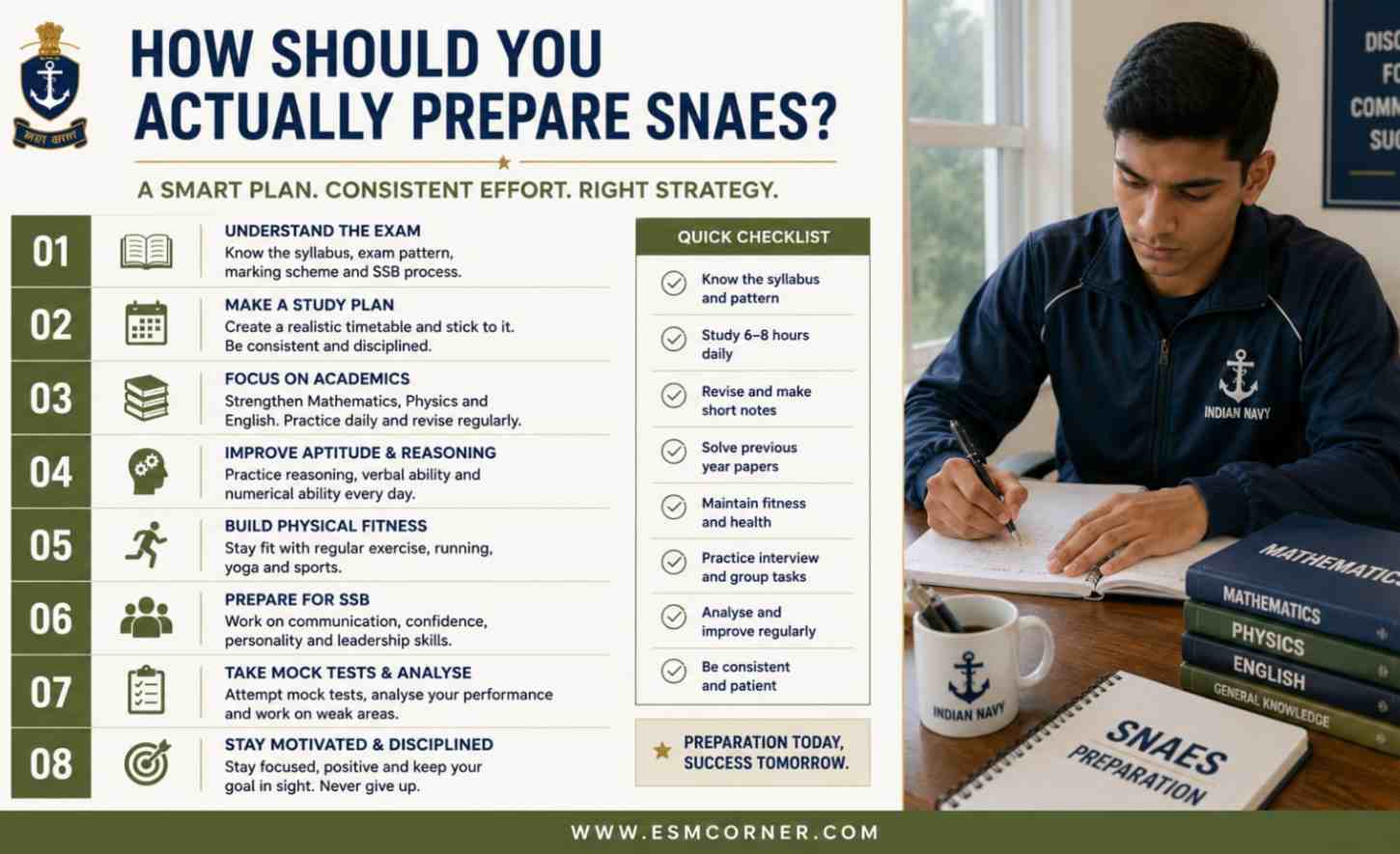
- Keep your academics strong. Since shortlisting is purely based on your B.E./B.Tech percentage, aim to stay comfortably above 65-70%, and avoid letting backlogs pile up.
- Work on your Officer Like Qualities (OLQs). The SSB isn’t looking for a finished military genius — it’s checking your potential across areas like decision-making, adaptability, and teamwork.
- Sharpen your technical and communication skills. Be ready for interview questions on fluid mechanics, strength of materials, and basic ship stability, and practice expressing your thoughts clearly in English.
- Stay physically fit, and be genuine. Regular running, swimming, or basic strength training helps. And here’s an important tip — don’t treat SSB like a theory exam. Assessors are looking for authentic responses, not rehearsed ones.
Conclusion
The Special Naval Architect Entry Scheme (SNAES) represents one of the most prestigious, intellectually fulfilling, and impactful career avenues available to engineering graduates in India today. By combining cutting-edge structural engineering with the timeless honor of military command, it offers young professionals a unique platform to shape the future of the nation’s maritime defense. Instead of spending years behind a routine corporate cubicle, a Naval Architect Officer gets to stand at the forefront of naval design, building warfighting platforms that protect sovereign waters.
READ ALSO: 10+2 TES ENTRY EXPLAINED : HOW PCM STUDENTS CAN BECOME ARMY OFFICERS WITHOUT A WRITTEN EXAM
Frequently Asked Questions
FAQ 1: What is SNAES?
The Special Naval Architect Entry Scheme (SNAES) is a direct officer recruitment program conducted by the Indian Navy to select qualified engineering graduates into the specialized Naval Architecture Cadre of the Engineering Branch.
FAQ 2: Who can apply for this direct naval entry?
Unmarried male and female engineering graduates holding a recognized B.E. or B.Tech degree with at least 60% aggregate marks, meeting the specified age and physical standards, are eligible to apply.
FAQ 3: Which engineering branches are eligible for SNAES?
Disciplines such as Naval Architecture, Mechanical, Civil, Aeronautical, Aerospace, Metallurgy, Ocean Engineering, Marine Engineering, and Shipbuilding are typically eligible based on official recruitment notifications.
FAQ 4: Is there a written exam for SNAES selection?
No, SNAES does not require a written entrance examination; candidates are directly shortlisted for the SSB interview based on their marks obtained in their engineering degree.
FAQ 5: Is the SSB Interview compulsory for all shortlisted candidates?
Yes, passing the 5-day Service Selection Board (SSB) interview is mandatory for all shortlisted applicants to evaluate their psychological profile, intelligence, and leadership potential.
FAQ 6: What are the main duties of a Naval Architect Officer?
Officers are responsible for warship and submarine structural design, stability analysis, construction supervision in shipyards, dockyard refits, damage control, and hull maintenance aboard operational naval ships.
FAQ 7: How should engineering students prepare for SNAES?
Focus on maintaining high engineering marks, mastering core technical fundamentals, improving spoken English, developing Officer Like Qualities, and maintaining physical fitness for the SSB interview.
FAQ 8: What career growth opportunities does SNAES offer?
Officers are commissioned as Sub-Lieutenants and can progress to higher ranks like Commander or Captain, with opportunities for Permanent Commission, sponsored higher education, and specialized project leadership.
For daily defence updates, government notifications, recruitment alerts, welfare schemes, career opportunities, education news, and other important announcements, join our WhatsApp Community. Click here to join our WhatsApp Group.