
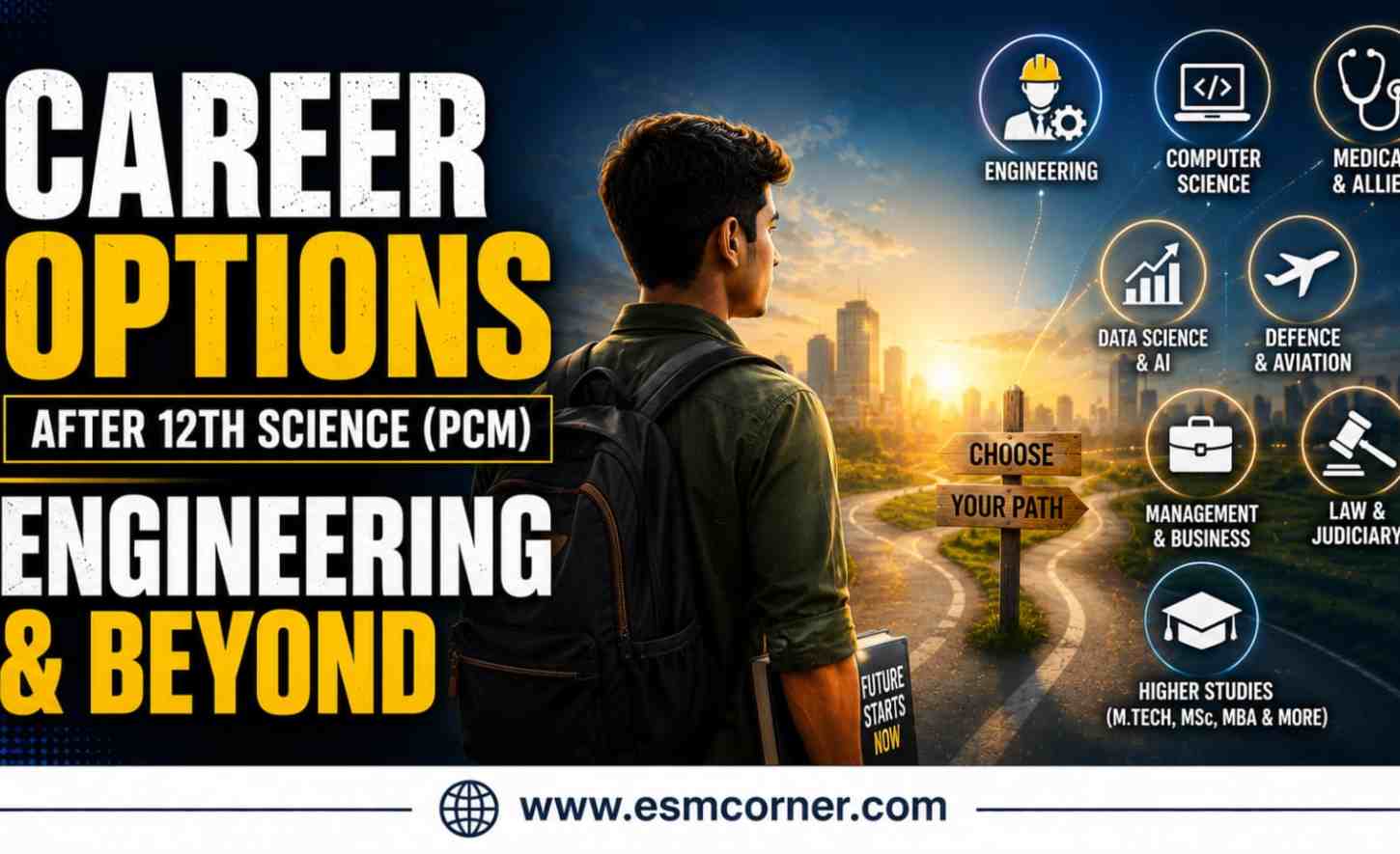
Finished Class 12 with Physics, Chemistry, and Mathematics (PCM), and now everyone assumes you’re headed straight into a four-year engineering degree? That’s one of the biggest misconceptions among students. Many believe engineering is the only career options after 12th PCM simply because of the subjects they studied.
Here’s the truth: PCM is honestly one of the most flexible combinations you could have picked. It opens doors into technology, defence, pure research, management, aviation, data science, design, and even entrepreneurship. This isn’t about following whatever’s trending or picking the course with the loudest ads. It’s about understanding your own strengths and where they can actually take you.
Whether you love solving coding puzzles, designing buildings, flying planes, reading market data, or leading a team — your PCM background already gives you the analytical foundation to do any of it. Let’s walk through what’s genuinely possible.
Why PCM Is Genuinely More Flexible Than People Think
A lot of PCM students are surprised to learn just how wide their options really are. Physics, Chemistry, and Maths don’t just teach you formulas — they train your brain to think logically, break down complex problems, and work with data confidently. That’s exactly the kind of thinking employers in finance, consulting, software, and product design are actively hunting for.
Here’s the real advantage — science students can move into commerce or humanities-related fields fairly easily, while it’s much harder the other way around. So instead of feeling boxed in, you should actually feel like you’re standing in one of the widest, most flexible starting points there is.
Passion or Paycheck — How Do You Actually Decide?
This is the classic dilemma every PCM student faces. Should you follow your interest, or chase the field with the best starting salary?
Here’s the honest answer — treating these as opposites is a mistake. Pick a field purely for the money, and you’ll likely burn out early once the initial excitement fades. Pick something purely out of passion without checking real market demand, and you might struggle to grow later. The smart move is balancing your genuine interests with how viable that industry actually looks long-term. It’s also worth weighing government roles against private sector jobs here — one offers stability, the other offers faster growth, and knowing which one you value more helps a lot.
Is Engineering Still Worth It in 2026?
Yes—but the field has changed significantly. Let’s explore where the strongest career opportunities are today.
Computing and Emerging Tech
Computer Science, IT, AI, Machine Learning, Cyber Security, and Data Science are dominating hiring right now. These fields are all about building software, designing smart systems, protecting digital infrastructure, and making sense of massive amounts of data.
Core Engineering Branches
If physical systems and infrastructure genuinely excite you, these remain solid, foundational choices:
- Electronics & Communication Engineering – Hardware, semiconductors, telecom, and embedded systems.
- Mechanical Engineering – Thermodynamics, automation, and energy systems.
- Civil Engineering – Infrastructure, structural design, and sustainable construction.
- Electrical Engineering – Power systems, grid distribution, and renewable energy.
High-Specialisation Fields
For those who want to work on something genuinely cutting-edge:
- Aerospace & Automobile Engineering – Focuses on aircraft, spacecraft, automobiles, and electric vehicle technologies.
- Robotics & Mechatronics – Involves designing intelligent machines by combining mechanical, electronics, and software systems.
- Chemical, Petroleum & Mining Engineering – Material processing, resource extraction, and large-scale manufacturing.
What If Traditional Engineering Isn’t Really “You”?
That’s completely fine — there are dozens of genuinely rewarding paths beyond a standard engineering degree.
Design and Creative Tech
If you enjoy combining technical knowledge with creativity, Architecture (B.Arch) offers a balance of engineering principles and design. Those interested in digital creativity can explore rapidly growing fields such as UX/UI Design, Animation, and Game Design, where professionals create engaging digital products and user experiences.
Aviation, Maritime, and Defence
For the adventurous, disciplined types:
- Commercial Pilot – Flight training, aviation meteorology, and navigation to fly commercial or cargo aircraft.
- Merchant Navy – Nautical science and marine engineering roles operating international vessels.
- Defence Careers – Entering the Armed Forces through NDA or Technical Entry Schemes (TES), offering leadership and honourable national service.
Pure Sciences and Quantitative Fields
If deep academic curiosity is more your thing, a B.Sc. or Integrated M.Sc. in Physics, Space Science, or Maths can lead you toward research institutions like ISRO or DRDO. And if you enjoy numbers with real-world financial stakes, Actuarial Science and Economics use advanced maths to assess risk in insurance, banking, and global markets.
Management and Entrepreneurship
That analytical thinking from PCM gives you a genuine edge in business too. Courses like BBA/BMS or Hotel Management prepare you for leadership, strategy, and operations roles — or even starting your own venture down the line.
Quick Summary: Top PCM Career Options

| Career Option | Best Course | Ideal For | Future Scope |
|---|---|---|---|
| Software & AI | B.Tech CS / AI | Analytical thinkers into coding and automation | High global demand in tech and enterprise |
| Data & Actuarial | B.Sc. Statistics / Actuarial Science | Strong quantitative minds | Critical roles in finance, insurance, analytics |
| Aviation & Maritime | B.Sc. Nautical Science / Commercial Pilot | Those wanting active, dynamic careers | Steady growth with global trade and travel |
| Defense Forces | NDA / B.Tech Technical Entry | Disciplined students passionate about service | Strong leadership and career security |
| Design & Architecture | B.Arch / B.Des (UX/UI) | Creative minds with structural thinking | Fast growth in digital media and urban development |
Which Entrance Exams Should You Actually Look At?
- Engineering & Tech – JEE Main, JEE Advanced, BITSAT, and state-level CETs.
- Architecture – NATA and JEE Main (Paper 2).
- Defence & Aviation – NDA Entrance Exam, CDAC, and DGCA exams for flying.
- Design & Management – UCEED, NID DAT, and university-specific management entrance tests.
Don’t Forget: Skills Matter As Much As Your Degree
Here’s something worth internalising early — a degree alone isn’t enough to build a strong career anymore. What actually sets you apart is a mix of technical knowledge plus real soft skills — critical thinking, communication, adaptability, and problem-solving. Doing internships, earning relevant certifications, taking part in hackathons, and learning online during college genuinely puts you ahead of the average applicant.
Conclusion
Completing Class 12 with Physics, Chemistry, and Mathematics provides a powerful, highly adaptable educational foundation that extends far beyond traditional engineering classrooms. While computer science and core engineering branches remain excellent options, they represent only a fraction of what is possible with a PCM background. From exploring space technology and managing global supply chains to designing digital user experiences, analyzing financial markets, and serving in the armed forces, your analytical background allows you to pivot into almost any industry.
The key to long-term career satisfaction is avoiding social pressure, short-term trends, or the temptation to blindly follow your peers. Take the time to evaluate your natural strengths, research emerging industry demands, and embrace continuous skill development. Every major professional field values individuals who can break down complex problems and communicate solutions effectively. Trust your preparation, explore your options with an open mind, and choose a path that aligns with your personal vision for the future.
READ ALSO: 10+2 TES ENTRY EXPLAINED : HOW PCM STUDENTS CAN BECOME ARMY OFFICERS WITHOUT A WRITTEN EXAM
FAQ : Career options after 12th PCM
Q1.Is engineering the only viable career option after Class 12 PCM?
No, engineering is just one of many pathways available to PCM students. You can pursue lucrative careers in data science, aviation, merchant navy, defense services, architecture, actuarial science, digital design, quantitative economics, and corporate management based on your personal aptitude and long-term goals.
Q2.Which PCM careers have the highest future growth potential?
Careers in Artificial Intelligence, Data Analytics, Cyber Security, Renewable Energy, Aerospace, and Actuarial Science show exceptional long-term growth. These fields directly address global technological shifts, digital transformation, and complex data-driven decision-making across modern industries.
Q3.Can PCM students prepare for government jobs right after 12th?
Yes, PCM students can sit for several prestigious competitive exams immediately after Class 12. Key options include the National Defence Academy (NDA) exam, Indian Coast Guard entries, Railway recruitment examinations, and various staff selection posts offering early career stability.
Q4.Which main entrance exams should a PCM student target?
Key entrance exams depend on your chosen field. Major tests include JEE Main and JEE Advanced for engineering, NATA for architecture, NDA for armed forces, UCEED for design, and university-specific entrance tests for pure science or management programs.
Q5.Is studying abroad a good option after Class 12 PCM?
Studying abroad offers global exposure, access to state-of-the-art research laboratories, and flexible interdisciplinary curricula. However, students should carefully evaluate tuition costs, scholarship availability, post-study work visa policies, and personal readiness before applying to international universities.
Q6.How should a student choose the right engineering branch?
Select an engineering branch by analyzing your core academic interests rather than current popularity trends. Review the four-year course syllabus, talk to industry professionals, evaluate underlying job roles, and assess whether you prefer software systems, hardware design, or physical infrastructure.
Q7.Which skills are most important for future tech and science careers?
Alongside domain expertise, future careers require strong analytical reasoning, adaptability, programming literacy, data interpretation, and effective communication skills. Employers prioritize candidates who can continuously learn new tools and solve real-world problems in collaborative environments.
Q8.How can a confused Class 12 student make the right choice?
Start by assessing your personal strengths, academic preferences, and daily working style. Research different career options, speak with experienced mentors, avoid falling for unverified myths, and focus on building adaptable skills that support long-term professional growth.
For daily defence updates, government notifications, recruitment alerts, welfare schemes, career opportunities, education news, and other important announcements, join our WhatsApp Community. Click here to join our WhatsApp Group.