Let’s be honest. The moment candidates hear the word “Conference,” their heart rate shoots up like they’re about to face a firing squad. Rumours fly around the dormitory the night before — “Bhai, conference mein sab kuch ek hi minute mein decide hota hai,” “Agar tumne ek galat jawab de diya toh gaya kaam se.”
Sit tight. Almost none of that is true.
I’ve spent over 30 years on the other side of that table — as a Board President, as an Interviewing Officer, and as a Senior Defence Psychologist. I’ve seen thousands of candidates walk in nervous and walk out relieved (or sometimes not so relieved). And in all these years, one thing has stayed the same — the conference is NOT some secret final exam. It’s simply the last chapter of a five-day story that you’ve already written through your Psychology tests, your GTO tasks, and your Interview.
Think of it like this: for five days, three different people have been watching three different versions of you — the you that writes in silence during psych tests, the you that jumps into the mud during GTO, and the you that answers questions one-on-one in the interview room. The conference is just the moment when these three people sit together, compare their notes, and check — “Are we all seeing the same person?”
That’s it. No trick questions designed to fail you. No drama. Just verification.
Why Does This “Triangulation” Thing Even Matter?
Here’s the logic the Army follows, and honestly, it’s quite brilliant.
A single assessor, however experienced, can be wrong. Maybe the Psychologist had an off day. Maybe the GTO misjudged one task. Maybe the Interviewing Officer just didn’t click with your personality. If any ONE of these people decided your fate alone, the system would be unfair and full of bias.
So instead, the Army uses three completely independent lenses:
- Psychologist — studies your subconscious mind through written tests (TAT, WAT, SRT, Self Description)
- GTO (Group Testing Officer) — studies your behaviour in a group, under physical and mental pressure
- Interviewing Officer — studies your conscious mind through direct one-on-one conversation
If all three see the same qualities in you — genuine leadership, honesty, emotional stability, team spirit — that’s when the recommendation happens. This is called Triangulation, and it exists so that no single person’s personal opinion can make or break your future. It’s fair, it’s scientific, and honestly, it’s the reason the SSB process is respected worldwide.
The Army also believes in something called Manasa, Vacha, Karmana — meaning your thought, your speech, and your action should all align. A future officer can’t say one thing, think another, and do something completely different on the battlefield. The conference exists to check exactly this — are you consistent, or are you performing?
What Actually Happens on Conference Day? (Step by Step)
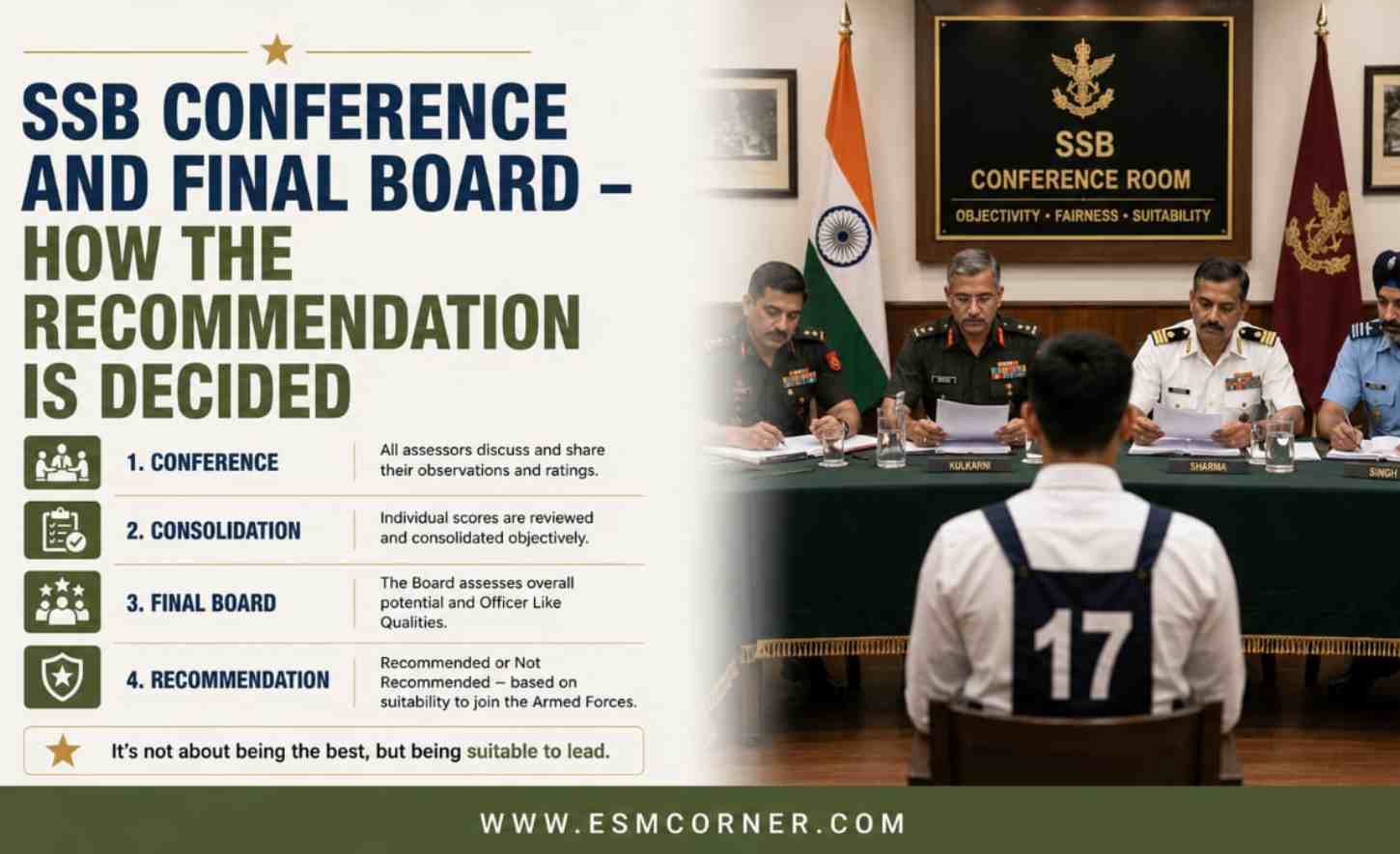
Let’s break the mystery down into simple steps, so you know exactly what to expect and stop imagining worst-case scenarios.
- Report Compilation — Before you even enter the room, your entire five-day dossier is ready. Your Psychologist’s report, GTO’s report, and IO’s report are all compiled — and interestingly, kept confidential from each other until this very day. This stops any one assessor from influencing another’s judgement.
- Board Discussion — The board members sit and go through every candidate’s file. If someone’s performance was consistently strong (or consistently poor), the decision is quick. But for borderline cases — where reports don’t fully match — a deeper discussion happens.
- Your Entry — Chest numbers are called one by one. When your number comes, you walk in, greet the board respectfully, and take your seat. Simple as that. This is actually the only moment in the entire five days when every single assessor is sitting in front of you together.
- The Actual Conversation — The President usually opens with light, simple questions. Nothing filmy, nothing designed to trap you. The whole thing typically lasts just 2 to 10 minutes.
- Result & What’s Next — After everyone’s conference is done, the board finalises the list. Recommended candidates move to medicals. Others get their departure instructions. Either way, this is officially the end of your SSB journey for this attempt.
Inside the Room: What It Actually Looks Like
Picture a semi-circular or U-shaped seating — like a mini panel discussion setup. The President sits right in the centre, with the Deputy President, IOs, GTOs, and Psychologists around. Everyone is in proper uniform.
Despite what horror stories suggest, the mood is professional, not hostile. Nobody’s trying to scare you. A short conference doesn’t mean bad news, and a long one doesn’t mean good news either — it simply means the board already has clarity (short) or needs a bit more discussion to be sure (long). Stay calm either way.
The Questions — And What They’re REALLY Checking
This is the part everyone obsesses over. So here are the most common categories of questions, and — since I’ve sat on that board myself — I’ll tell you exactly what’s being tested behind each one.
“How was your stay? Any suggestions about the food or the accommodation?” Sounds like small talk, right? It isn’t. The board is quietly checking whether you can adapt to average conditions without complaining, and whether you appreciate government resources instead of behaving entitled. A future officer who cribs about food in peacetime is a red flag for how he’ll behave in the field.
“Rate your own performance in Psychology, GTO, and Interview. Where did you underperform?” This one is a personality X-ray. Candidates who claim “sir sab kuch perfect gaya” actually hurt their own case — it shows zero self-awareness. The board wants someone who can honestly say, “Sir, I think I could’ve handled the group discussion task better,” because that shows maturity and the ability to grow.
“Tell me three recent developments on India’s northern border, with your opinion on one.” This checks if you’re actually aware of the world, or if you just crammed static GK the night before. Genuine curiosity about current affairs is something no last-minute mugging can fake.
“If you’re not recommended today, what’s your plan the moment you step out?” This is about resilience. The board isn’t hoping you fail — they’re checking if you have a backup plan while staying mentally strong and still committed to your goal. A candidate who says “sir main phir try karunga, meanwhile yeh kar raha hoon” sounds far more solid than someone who breaks down or gives a vague answer.
The Real Secret: Consistency Wins, Not Perfection
Here’s the honest truth that most coaching centres won’t tell you plainly — the board isn’t looking for a perfect candidate. They’re looking for a consistent one.
If your psych tests showed you as calm and composed, your GTO tasks showed teamwork, and your interview showed the same personality — that consistency is gold. But if there’s a massive contradiction (say, you wrote about being a bold risk-taker in your psych test but froze completely during every GTO task), that mismatch creates doubt in the assessors’ minds.
So don’t try to “perform” a personality during the conference that’s different from how you behaved for the last five days. It won’t work, and honestly, experienced assessors can spot a rehearsed answer from a mile away.
Body Language Tips — Because Yes, It Matters
A few quick, practical pointers before you walk in:
- Walk in with a natural, confident stride — not stiff like a robot, not casual like you’re walking into a canteen
- Greet the board politely and wait — don’t sit until the President invites you to
- Once seated, sit all the way back in the chair, not on the edge like you’re about to run
- Keep your hands resting naturally on your thighs
- Avoid fidgeting, tapping your feet, or slouching — these small things scream “nervous” louder than words ever could
Conclusion
The SSB Conference isn’t some final boss battle designed to trip you up. It’s simply the moment where five days of genuine you — your thoughts, your words, your actions — get checked for alignment.
So stop losing sleep over “what if they ask something tricky.” Focus instead on being the same honest, composed, consistent person you’ve been throughout the process. Because at the end of the day, that’s really all the board is looking for.
Read ALSO: DEFENCE EXAM PREPARATION COURSES
FAQ 1: Why does the SSB Conference compare all three assessments?
Answer: The conference combines the Psychologist’s, GTO’s, and Interviewing Officer’s observations to verify consistency. This ensures the final recommendation reflects the candidate’s complete personality rather than performance in a single test.
FAQ 2: What is meant by a borderline candidate in the SSB Conference?
Answer: A borderline candidate receives mixed assessments from different evaluators. The conference helps clarify doubts through additional interaction before the board reaches a final recommendation based on overall suitability.
FAQ 3: Does the conference test new Officer Like Qualities (OLQs)?
FAQ 1: Why does the SSB Conference compare all three assessments?
Answer: The conference combines the Psychologist’s, GTO’s, and Interviewing Officer’s observations to verify consistency. This ensures the final recommendation reflects the candidate’s complete personality rather than performance in a single test.
FAQ 4: Why does the board ask simple questions during the conference?
Answer: Simple questions help assess confidence, self-awareness, emotional stability, and spontaneous thinking. The board observes how naturally and honestly candidates respond rather than testing factual knowledge alone.
FAQ 5: What should I do if I am asked to rate my own performance?
Answer: Give a balanced and honest assessment. Mention your strengths, acknowledge areas for improvement, and explain what you learned during the SSB instead of claiming perfect performance.
FAQ 6: Why does the board ask about my backup career plan?
Answer: The question evaluates resilience, maturity, and long-term planning. The board expects candidates to remain positive, determined, and prepared for future attempts without showing frustration or disappointment.
FAQ 7: How important is body language during the conference?
Answer: Body language is very important. Calm posture, natural eye contact, polite behavior, and confident communication demonstrate emotional stability, self-confidence, and professionalism before the entire selection board.
FAQ 8: What qualities influence the final recommendation most?
Answer: Consistency, honesty, emotional stability, confidence, teamwork, logical thinking, and genuine Officer Like Qualities across Psychology, GTO, Interview, and Conference collectively influence the board’s final recommendation.
For daily defence updates, government notifications, recruitment alerts, welfare schemes, career opportunities, education news, and other important announcements, join our WhatsApp Community. Click here to join our WhatsApp Group.