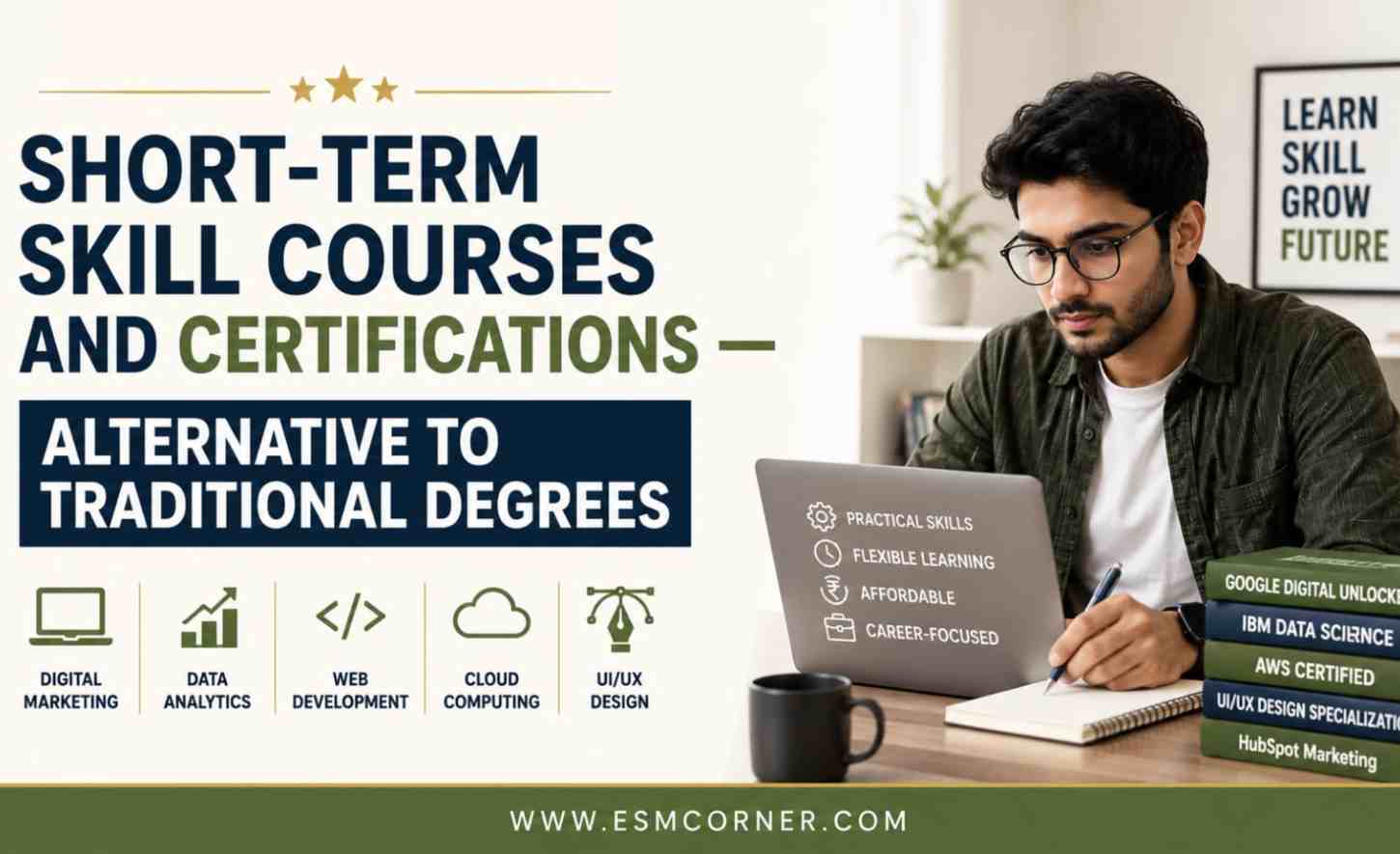
After completing Class 10, Class 12, or graduation, many Indian students face immense pressure from family and society. Everyone tells them that pursuing a traditional three or four-year college degree is the only safe path toward a stable career.
At the same time, top industries are shifting away from plain degree requirements and searching for candidates with practical, job-ready skills like digital marketing, coding, graphic design, data analysis, cybersecurity, video editing, web development, accounting, and professional communication.
This sudden industry shift creates a huge question for young learners: Can short-term skill courses and certifications really become an alternative to a traditional degree?
The real answer is not a simple yes or no. For specialized fields like medicine, law, or civil engineering, a formal university degree remains absolutely essential and mandatory by law. However, for dynamic creative, technology, and business roles, having practical hands-on skills and a proven project portfolio can open employment doors much faster than a generic degree. A piece of paper alone never guarantees a job. This comprehensive guide explains where short-term courses work, where traditional degrees remain necessary, which job-oriented skills are truly worth learning, and how students can make smart, confident career choices for long-term growth.
Understanding Short-Term Courses, Certifications, and Degrees
When planning your career after school, you must understand how different educational pathways function in the job market. Many students waste money on programs simply because they do not know what they are buying.
- Short-Term Skill Courses: Focused training programs lasting from 2 to 6 months designed to teach a specific tool or practical ability, such as video editing or tally accounting.
- Professional Certifications: Structured exams or programs offered by recognized tech giants or industry bodies that test and validate your knowledge in a specific domain.
- Traditional University Degrees: Multi-year academic programs that provide broad theoretical knowledge, foundational concepts, and a formal recognized credential.
Traditional degrees give you an academic background, but they often lack updated practical training. Short-term skill courses fill this gap by focusing entirely on real-world tools that companies use daily.
When Can a Skill Course Work, and When Is a Degree Essential?
Many young students mistakenly believe that a 3-month certificate can completely replace years of college education in every single industry. This is a dangerous misunderstanding that can ruin career planning.
Degrees remain strictly compulsory in regulated fields such as healthcare, legal practice, school teaching, structural engineering, and government administration. In these sectors, employers and government regulations require formal university credentials before you are allowed to practice legally.
On the other hand, skill-based industries prioritize what you can actually do over where you studied. Fields like digital marketing, user interface design, full-stack web development, content writing, social media management, sales, and software testing routinely hire talented individuals regardless of their formal degree background.
Key Job-Oriented Skills Worth Learning Today
If you decide to pursue short-term skill courses, focus on technical, creative, and business abilities that modern companies actively search for every day.
- Technology and Digital Skills: Web development, Python coding, data analytics, cloud computing basic operations, and software quality testing.
- Creative and Business Skills: Graphic design, video editing, digital marketing, search engine optimization, content creation, and basic accounting software.
- Communication and Professional Skills: Business English writing, corporate communication, sales pitch preparation, customer service, and job interview confidence.
Practical Skill Overview
The simple comparison table below provides a quick overview of popular short-term skill choices and their main career benefits.
| Skill/Course | Best For | Main Benefit | Important Point |
| Digital Marketing | Creative & Business Minded Students | Quick entry into growing online businesses | Requires continuous learning as algorithms change |
| Web Development | Problem Solvers & Logic Builders | High demand across all modern tech companies | Portfolio of working websites is strictly required |
| Graphic & Video Design | Visual Thinkers & Content Creators | Excellent freelancing and agency opportunities | Design sense matters far more than software tools |
| Data Analytics Basic | Organized & Detail-Oriented Learners | Helps businesses make smart decisions | Strong logical thinking and basic math are essential |
| Accounting & Tally | Commerce & Finance Aspirants | Immediate office support jobs in local businesses | Practical accuracy is key for hiring |
The True Power of Projects, Portfolios, and Internships
Companies do not pay for certificates hanging on your wall; they pay for your ability to solve real problems using modern tools.
Building practical projects during your learning journey is the best way to prove your worth to prospective employers. Instead of merely listing course names on your resume, build real websites, design sample advertisements, manage test social media campaigns, or analyze open-source datasets.
- Build a Public Portfolio: Host your project work on platforms like GitHub, Behance, or a simple personal website so recruiters can evaluate your actual skills in seconds.
- Seek Entry-Level Internships: Take up short internships or stipend-based apprenticeships to understand workplace culture, team coordination, and real deadlines.
- Start Small-Scale Freelancing: Offer your skills to local small businesses or online clients to gain real-world confidence and client feedback.
- Optimize Your LinkedIn Profile: Display your completed projects, connect with industry working professionals, and actively share your learning journey online.
Online vs. Offline Courses: How to Choose Wisely
Students often get confused between joining a local training institute or enrolling in online learning platforms. Both formats have distinct advantages depending on your learning style.
Offline institutes offer structured physical classrooms, peer networking, direct teacher supervision, and disciplined daily schedules. However, they are usually much more expensive and may have outdated trainers.
Online learning platforms provide flexibility, affordable pricing, and access to top global industry instructors from the comfort of your home. However, online learning demands strict self-discipline, personal time management, and independent problem-solving skills to finish the curriculum successfully.
Before Choosing a Short-Term Course, Ask Yourself
Before spending your hard-earned money or time on any training institute, evaluate these crucial questions carefully:
- What specific job or career role do I want to pursue after this program?
- Is this particular skill currently demanded by companies hiring in my area?
- Will I build real, practical projects during the training process?
- Can I create a professional portfolio using the work done in this course?
- Who is teaching the course, and do they have actual industry experience?
- Can I verify the credibility, student reviews, and track record of the institute?
- What exact practical tasks will I be able to perform independently after completion?
- Can I learn this exact same skill through free or lower-cost online tutorials?
Common Scams and Mistakes to Avoid
The skill education market contains many misleading institutes that make false promises to desperate students. You must remain vigilant and make practical decisions.
- Beware of “100% Job Guarantees”: Reputable platforms offer placement support and interview calls, but no honest institute can guarantee a job without evaluating your performance.
- Avoid Certificate Collecting: Completing ten short courses without creating a single quality project is a total waste of money and time.
- Do Not Ignore Communication Skills: Technical software knowledge without basic professional communication makes clearing job interviews extremely difficult.
- Verify Institute Claims: Always speak directly with past students on social media platforms like LinkedIn before paying admission fees.
Combining Traditional Degrees with Short-Term Skill Courses
The absolute smartest strategy for most Indian students is not choosing between a degree or a short-term course, but combining both strategically.
Pursuing a standard college degree gives you formal academic eligibility, social exposure, campus life, and fundamental theoretical knowledge. Simultaneously enrolling in targeted short-term skill courses during your college years ensures you graduate with job-ready practical abilities.
Conclusion
Short-term skill courses and certifications are not a magic shortcut to overnight career success. They are practical tools designed to build specific abilities quickly. Real career value never comes from collecting paper certificates; it comes from a powerful combination of useful skills, practical projects, a strong portfolio, real work experience, and confident communication.
Do not blindly reject traditional degrees, and do not blindly buy every certificate advertised online. Understand your chosen career field first. If your dream role requires a formal degree, pursue it wholeheartedly.
If your target field values practical execution, focus heavily on mastering relevant tools and showcasing your work publicly. A certificate can help open a job interview door, but your actual ability is what helps you stay in the room and build a lasting career.
READ ALSO: Career in Ai and machine learning – skill and courses guide
Frequently Asked Questions
1. Can I get a job with only a short-term certification?
Yes, in skill-based fields like graphic design, digital marketing, video editing, and web development, companies gladly hire candidates who possess strong practical portfolios, regardless of their formal degree background.
2. Are online certifications recognized by employers in India?
Employers value the practical skill behind the certificate rather than the piece of paper itself. A recognized online certification combined with working project links carries real credibility during hiring.
3. Which short-term course is best after 12th standard?
Job-oriented courses in digital marketing, basic web development, graphic design, content writing, or accounting software like Tally are excellent practical choices for students completing 12th standard.
4. Are short-term courses better than a traditional 3-year degree?
Neither is universally better. Degrees provide essential formal credentials for regulated fields, while short-term courses offer fast, practical job skills for dynamic modern tech and creative industries.
5. How long does it take to learn a job-ready skill?
Most fundamental skill courses require 3 to 6 months of dedicated daily practice, project building, and consistent learning to reach entry-level employment readiness.
6. Do companies prefer a portfolio over a college degree?
In creative and digital technology roles, recruiters consistently review your project portfolio first to verify what real tasks you can execute before checking your educational background.
7. What is the biggest mistake students make with short-term courses?
The biggest mistake is collecting multiple course completion certificates without building personal projects, practicing practical tools independently, or developing basic interview communication skills.
8. Can I learn professional job skills for free online?
Yes, thousands of high-quality tutorials exist on platforms like YouTube and open learning portals. However, paid structured courses offer guided mentorship, organized curriculum, and direct feedback.
For daily defence updates, government notifications, recruitment alerts, welfare schemes, career opportunities, education news, and other important announcements, join our WhatsApp Community. Click here to join our WhatsApp Group.