

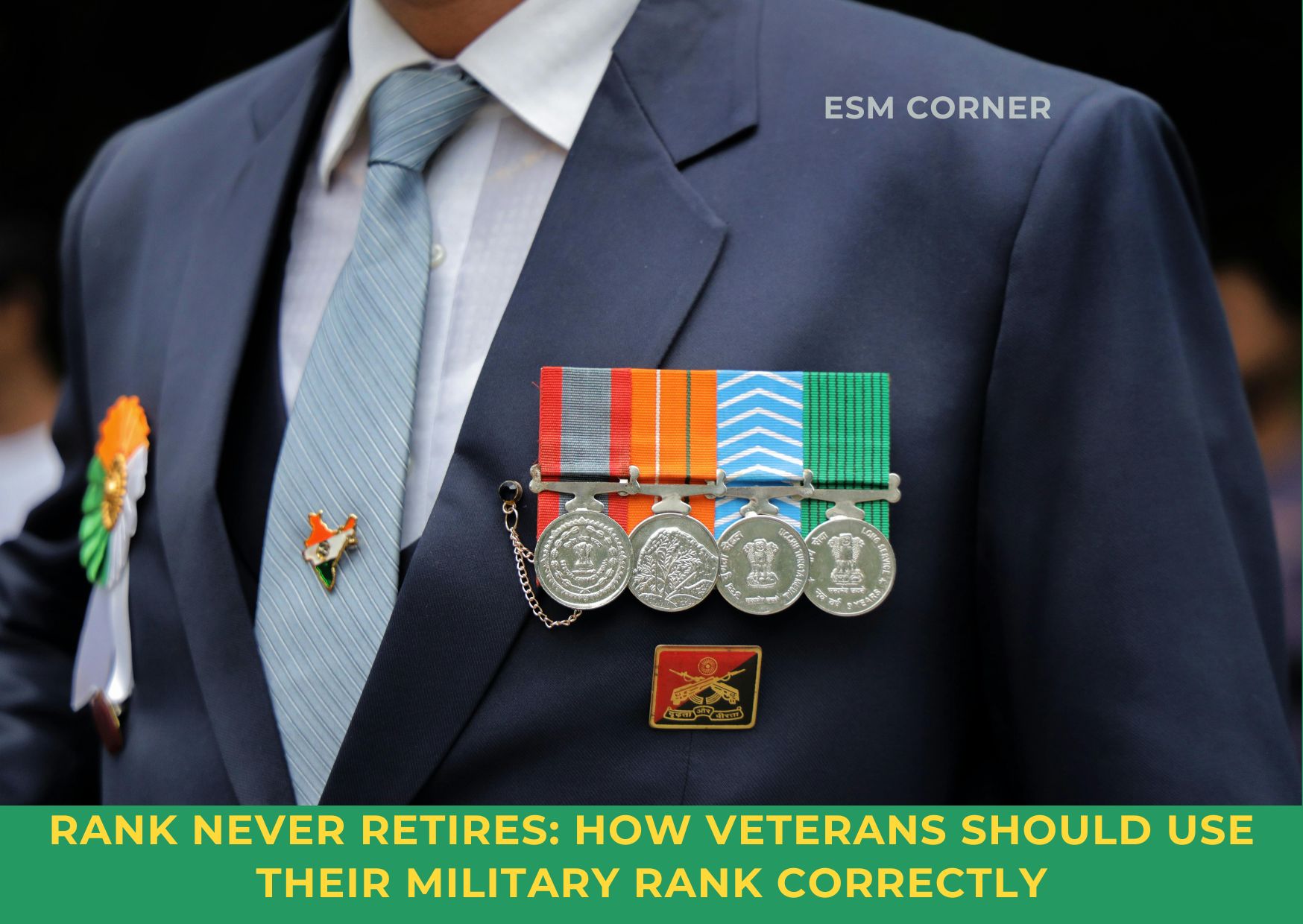
In the Indian Armed Forces, the saying “Rank Never Retires” is more than just a phrase—it is a recognition of a person’s lifelong dedication, service, and identity. A military rank is earned through years of discipline, courage, and commitment to the nation. Even after retirement, a veteran’s rank symbolizes honour, responsibility, and social recognition.
However, it is important to note that not every retired serviceman or woman is entitled to continue using a military rank. Correct usage of military rank is governed by specific rules issued by the Government of India and the Ministry of Defence. Misuse or incorrect presentation of ranks can create confusion and, in some cases, legal implications.
This article explains in detail who can use military ranks after retirement, how to write them correctly, and why it matters—all in simple, layman-friendly terms.
The Origin of “Rank Never Retires”
The principle that a military rank continues beyond active service is rooted in Indian history, military traditions, and legal frameworks. In India, ranks are awarded by the President, the supreme commander of the armed forces. Even after retirement, these ranks continue to represent the veteran’s service and sacrifice.
The expression “Rank Never Retires, the Officer Does” gained prominence following a 2014 Indian Army circular, which formalized how retired officers should use their rank. However, the rules for non-commissioned officers (NCOs), Junior Commissioned Officers (JCOs), and other categories were laid down earlier, notably in the Government of India Ministry of Defence circular dated 27 July 1983 (No F.28(1/82/D(Coord)).
This circular remains the official guideline for retired personnel and is widely referenced in all government and armed forces communications.
Official Guidelines: Government of India, Ministry of Defence, 1983
The MoD circular clarified that only certain categories of retired service personnel are entitled to use military ranks after retirement. The main points are:
Regular or Permanent Commissioned Officers
- Officers who retire with pension and gratuity may use their rank with their full name followed by “(Retd)”.
- Officers who are granted honorary ranks after retirement can indicate the honorary rank in parentheses after their actual rank.
- In conversation, these officers may be addressed by the honorary rank, such as General or Admiral.
Junior Commissioned Officers (JCOs)
- JCOs granted honorary commissioned ranks upon retirement can use the honorary rank with “(Retd)”.
- While serving, they may also be addressed by the honorary rank, e.g., Sub Maj (Hony Lt) B.
Non-Commissioned Officers (NCOs)
- NCOs awarded honorary ranks such as Naib Risaldar or Naib Subedar at retirement may also use the rank with “(Retd)”.
- Ordinary NCOs who do not receive honorary ranks cannot use the rank after retirement.
👉How to change registered mobile number in ECHS online
Other Special Categories
- Master Chief Petty Officers, Chief Petty Officers, and Warrant Officers granted honorary commissioned ranks during or after service are entitled to use them.
- Officers of former State Forces who held regular commissions may use their rank with the state name in brackets.
- Officers and members of Territorial Army (TA), National Cadet Corps (NCC), and Auxiliary Air Force (Aux AF) may indicate their affiliation.
- Reserve officers, including those in the emergency list, may use their rank with specific mention, e.g., Capt F (Reserve) or Lt Cdr D (IN) (Emergency List).
Honorary Commissions Granted by Rulers or Others
- Ex-rulers of former princely states granted honorary commissions may retain their rank, e.g., Major General G.
- Others granted honorary commissions may also use their rank, e.g., (Hony) Major C.
👉 What is the SPARSH PPO number? What do its 12 digits represent?
Rank Usage by Short Service Commission (SSC) Officers
Earlier, retired Short Service Commission (SSC) officers were not authorized to use their military ranks after release, as per guidelines issued in 1983. This long-standing restriction caused dissatisfaction among SSC officers, despite their service under similar conditions and hardships as Permanent Commission officers.
Recognising this concern, the Ministry of Defence (MoD) decided to permit retired SSC officers of the Army to use their military ranks, subject to completion of their mandated service terms and eligibility for Ex-Servicemen status. This decision was officially announced by PIB Delhi on 24 March 2021 . SSC officers typically serve for 10 to 14 years and form the backbone of the Army’s support officer cadre.
The decision removed long-pending dissatisfaction, boosted morale among serving SSC officers, and strengthened the attractiveness of the Short Service Commission. SSC officers must follow the prescribed format for rank usage, including placing “(Retd)” after the full name.

Correct Format for Writing Rank
Following the official guidelines ensures respect and avoids misuse:
- Always place “(Retd)” after the full name, not after the rank.
- ✅ Correct: Col Rajesh Kumar (Retd)
- ❌ Incorrect: Col (Retd) Rajesh Kumar
- Honorary ranks, if any, should be in parentheses following the actual rank.
- Example: Sub Maj (Hony Lt) Vikram Singh (Retd)
For awards such as AVSM, VrC, or other military decorations, these should be written after the rank and before “(Retd)”. Example: Brig A, AVSM (Retd)
👉Occasion for wearing of medals/miniature medals on civil attire by Ex-Servicemen
Why Correct Usage Matters
- Respect and Recognition: Retaining the correct rank acknowledges the individual’s years of service, achievements, and dedication.
- Legal Compliance: Using ranks incorrectly, especially by non-entitled personnel, can be considered misuse and may attract reprimands.
- Psychological Well-being: Veterans often feel a sense of identity and pride associated with their rank, which can aid in smoother integration into civilian life.
- Professional and Social Contexts: Proper usage ensures veterans are recognized appropriately in official documents, business contexts, and social platforms.
Common Mistakes
- Placing “(Retd)” after the rank instead of the full name.
- Omitting “(Retd)” completely.
- Using ranks by non-entitled individuals, such as short service or emergency commissioned officers.
Veteran communities often discuss these norms on platforms like LinkedIn and Facebook, underlining the importance of awareness and proper etiquette.
Practical Examples Across Categories
| Category | Example | Notes |
| Regular Commissioned Officer | Brig A, AVSM (Retd) | Full rank with awards; formal writing |
| Officer with Honorary Rank | Brig (Hony Maj Gen) B, AVSM (Retd) | Honorary rank in parentheses; addressed as General |
| JCO with Honorary Commission | Sub Maj (Hony Lt) C (Retd) | Applies to JCOs granted honorary rank at retirement |
| NCO with Honorary Rank | Honorary Naib Subedar D (Retd) | Only for NCOs granted honorary rank |
| TA Officer | Lt Col E (TA) (Retd) | Territorial Army; specific permission required |
| Former State Forces Officer | Capt F (Retd) (Hyderabad) | State name included for pre-integration forces |
Click here to read the Circular of 1983 by MoD.
Conclusion
The phrase “Rank Never Retires” is not just a tradition—it is a legal right and a cultural recognition. Proper use of military ranks ensures respect for the individual, maintains decorum in official and social contexts, and preserves the honor of the Indian Armed Forces.
Whether you are a retired officer, JCO, NCO, or a member of the Territorial Army, understanding and following the correct format of rank usage is essential. By adhering to these rules, veterans can maintain their identity, dignity, and the lifelong respect they have earned through service to the nation.



An excellent info
There is an other format as below:-
Veteran XYZ
Rank
Veteran Subhash K Bhatia
Wg Cdr/ Lt Col
This should be ok
Any comments
As the rank never retires,so is the Pension entitlement of the pensioner or family as pension is right as ack of past service and is not a baksheesh.
As now gratuity is not deducted if s retiree joins again a govt service.
Similarly a retiree is entitled for pension from the civil job also,joined after retirement.
In the same tune,a pension/ family pension can’t be stopped after retirement or a widower migrates to another country,wher their children are settled.
S legal opinion sought on the issue.
The ESM CORNER Advocate ,though on Whatsapp never replies on the issue.
Sir,
It is submitted that the information mentioned in the article is based on the Government circular issued in the year 1983 and 2021. A certified copy of the said circulars has been sought from the GS Branch, being the originating authority, through RTI.
Once the official copy is received, the article shall be updated accordingly, wherever required, to ensure complete accuracy and authenticity.
Thank you for your valuable observation.
I think a retired officer can also write in another way eg
Veteran Ramkishan Bhatia
Lt Col/Wg Cdr
This explains everything.
Sir,
It is submitted that the information mentioned in the article is based on the Government circular issued in the year 2021. A certified copy of the said circular has been sought from the GS Branch, being the originating authority, through RTI.
Once the official copy is received, the article shall be updated accordingly, wherever required, to ensure complete accuracy and authenticity.
Thank you for your valuable observation.
It’s about those who retired with an Hony rank . Nothing mentioned about other retirees.
Sir,
It is submitted that the information mentioned in the article is based on the Government circular issued in the year 2021. A certified copy of the said circular has been sought from the GS Branch, being the originating authority, through RTI.
Once the official copy is received, the article shall be updated accordingly, wherever required, to ensure complete accuracy and authenticity.
Thank you for your valuable observation.
To my mind suggestion of W/C Jairath is not valid.One should either write: Wg Cdr Jairath (Retd) or Air Veteran Jairath and not both Rank as well as Veteran.Writing Retd after name,itself shows u are a Veteran.