


For every soldier, sailor, and airman serving the nation, the “fauji” life is defined by discipline, sacrifice, and the hope for career growth. However, in the Indian Armed Forces, the organizational pyramid structure is incredibly steep. Not every deserving soldier becomes a Subedar Major or a Master Chief. Because promotions in the armed forces are largely controlled by vacancy availability, cadre limitations, rigid promotion policies, and organizational requirements, many deserving and courageous personnel remain in the same rank for years despite their service and experience. This is where the Modified Assured Career Progression (MACP) Scheme steps in as a vital financial shield against career stagnation.
Introduced following the recommendations of the Sixth Central Pay Commission, the MACP scheme is specifically designed to reduce service stagnation. It ensures that even if your rank remains the same, your financial growth does not stop. It is a system designed to recognize your length of regular service by granting a financial upgradation to the next higher pay level when a regular promotion is delayed due to limited vacancies or organizational constraints. It completely replaced the older ACP scheme to provide more systematic financial progression at fixed career milestones.
The Core Mechanics: How MACP Works
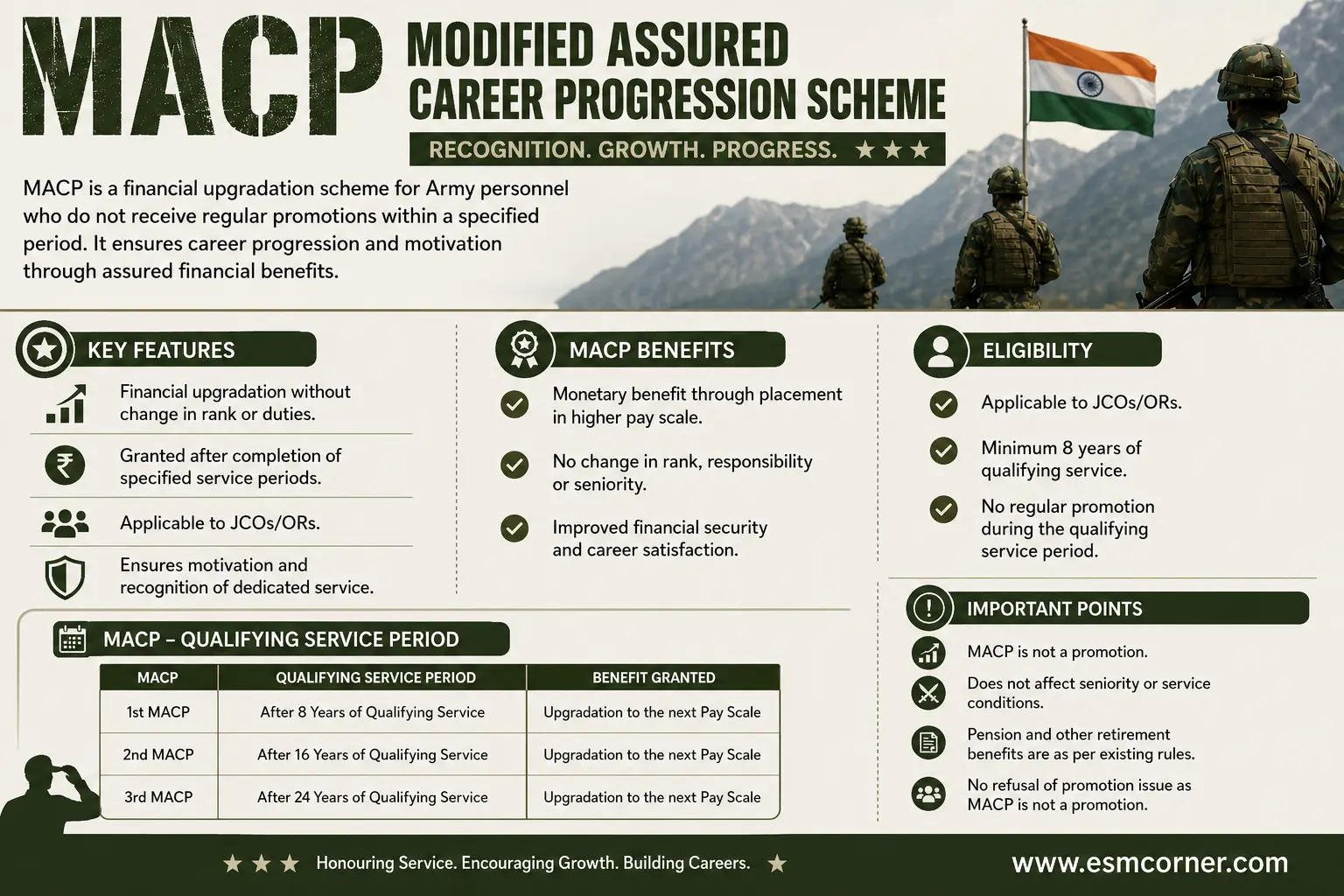
MACP is officially described as a “financial upgradation” granted on a purely personal basis. It is vital to understand that this is not an actual, functional, or rank promotion. You do not change your designation, you do not wear new rank badges or stripes, and your seniority position in your unit remains exactly the same. Your employability, duties, and other service conditions continue to be governed strictly by the actual substantive rank you hold. It is simply a placement in the immediate next higher grade pay of the revised pay hierarchy to ensure your salary keeps growing even if your rank does not.
The scheme became operational on 01 September 2008. If you were eligible for career progression benefits before this date, the old ACP rules applied up to 31 August 2008; anything from September 2008 onwards follows the M-ACP. guidelines.
The “Three Jumps” Rule: 8, 16, and 24 Years
The most important numbers to remember are 8, 16, and 24. These represent the milestones of continuous regular service required to trigger a financial jump counted from your direct entry grade:
- First Upgradation (8 Years): Granted after completing 8 years of continuous regular service if no regular promotion has been earned.
- Second Upgradation (16 Years): Granted after completing 16 years of continuous regular service.
- Third Upgradation (24 Years): Granted after completing 24 years of continuous regular service.
The Intervening 8-Year Rule: Beyond these fixed career markers, the policy states that a financial upgradation is admissible whenever a person spends 8 continuous years in the same grade pay without any promotion.
Essential Rules Every Personnel Should Know
To make the most of this policy and avoid any unexpected financial losses, you must understand the underlying rules that govern eligibility and pay fixation:
- Promotions and Modified Assured Career Progression scheme are Linked: Regular promotions, older ACP benefits, and M-ACP. benefits are all counted together for your career progression. Total career upgradations are strictly limited to three. If a Sepoy is regularly promoted to Naik after 5 years, he uses his first “jump”. He will not get an MACP at 8 years. Instead, if he stagnates as a Naik for 8 continuous years, he becomes eligible for his 2nd MACP at 13 years of total service (5 + 8 years). If he stagnates for another 8 years, he gets his 3rd MACP at 21 years of service (5 + 8 + 8 years).
- The 3% Pay Hike Benefit: At the time of financial upgradation, your pay is raised by 3% of your total pay in the pay band and grade pay drawn before the upgrade, plus you receive the difference in the grade pay. However, if you are later promoted to a rank that carries the same grade pay as your M-ACP., no further pay fixation or increment is given. If the actual promotion carries a higher-grade pay than your MACP, you will only receive the difference in grade pay, with no additional 3% increment.
- No “Stepping Up” for Seniors: A senior personnel cannot claim a stepping up of pay or demand a pay match simply because a junior draws more salary due to an MACP fixation. Because of varying promotion timelines, different M-ACP. dates, or delayed regular promotions within a cadre, a junior may sometimes draw higher pay. The policy legally permits this and treats MACP as purely personal to the individual.
- Terminal Benefits (Pension): This is why veterans must pay close attention. Pay drawn under the MACP scheme is fully taken as the basis for determining all your terminal benefits. This directly affects your Pension, Gratuity, Leave Encashment, and other retirement calculations. Any error or incorrect pay fixation during your service can result in substantial, lifelong financial losses after retirement.
- Mandatory Screening Committee: M-ACP. is never granted automatically based on service length alone. Your service profile, promotion history, eligibility, and records must be thoroughly checked and approved by a duly constituted Screening Committee (consisting of a Commissioned Officer as Presiding Officer and at least two members of higher rank) and verified by the OIC Records.
Situations Where MACP May NOT Be Granted
As per the official administrative instructions and policy FAQs, MACP is not an automatic entitlement. A person may fail to receive or face a delay in getting MACP under the following specific circumstances:
- Refusal of Regular Promotion: If an individual explicitly refuses a regular promotion before becoming entitled to MACP, the financial upgradation will be denied.
- Unwillingness for Promotion Cadre: Refusing or showing unwillingness to attend a mandatory promotion cadre or course is treated as unwillingness for promotion, resulting in the deferment of M-ACP.
- Debarment from Promotion: Being under a period of debarment or restriction for regular promotion will directly affect and delay your MACP eligibility.
- Disciplinary Issues and Punishments: To qualify for MACP, an individual must meet the strict discipline criteria laid down for regular promotions. Adverse disciplinary status or past punishments can make you unfit during screening.
- Failure in the Screening Process: If the Screening Committee or Board finds gaps in your service profile, records, or performance, your MACP may be delayed or denied.
- Maximum Career Upgradations Already Received: Since promotions and MACPs are counted collectively, if you have already completed three total advancements in your career, you are not eligible for further M-ACP..
- Promotion Accepted Later After an Initial Refusal: If you accept a promotion later after a period of refusal, your subsequent M-ACP. will be deferred by the exact extent of the debarment or refusal period.
- Non-fulfilment of Service Conditions: You must complete the exact, unbroken length of continuous regular service required by the policy to be eligible.
- Cases Not Covered Under Regular Service Conditions: Certain categories or structures within the forces may have separate applicability conditions under their respective service rules.
- Incorrect Assumption Based Only on Length of Service: Merely completing 8, 16, or 24 years of service does not automatically guarantee the benefit unless all discipline, screening, and promotional willingness criteria are fully satisfied.
👉Also read: Why Pension Gets Reduced Suddenly?
Final Words
MACP was introduced to give financial relief to Armed Forces personnel who do not get regular promotions for long periods. But many personnel still misunderstand the scheme. The biggest confusion is that people think M-ACP. is an actual promotion, while the policy clearly says it is only a financial upgradation.
The policy also makes it clear that promotion, ACP, and MACP are counted together. Refusal of promotion, unwillingness for cadre, disciplinary issues, and screening conditions can also affect MACP entitlement. Simply completing 8, 16, or 24 years of service does not automatically guarantee MACP.
Because MACP directly affects pay, pension, gratuity, and retirement benefits, every serving personnel and veteran should carefully check:
- Promotion history
- Grade pay
- MACP orders
- Pay fixation
- Pension records
Many financial and pension issues later start because M-ACP. was wrongly calculated or not granted properly during service. Therefore, understanding the policy correctly is very important.

Q1: What is MACP and why was it introduced?
A: MACP means Modified Assured Career Progression Scheme. It was introduced after the 6th Central Pay Commission to reduce service stagnation. Many personnel spend long years in the same rank because promotions depend on vacancies and strict cadre structures. MACP provides financial relief by giving the pay of the next higher rank to those facing long promotional delays, significantly improving pay progression and retirement benefits, though it does not grant an actual rank promotion.
Q2: Is MACP applicable to all three services?
A: Yes, MACP principles apply to eligible personnel across the Indian Army, Indian Navy, and Indian Air Force. While official policy illustrations and examples are mainly based on Army ranks (like Sepoy, Naik, and Havildar) and pay structures for ease of understanding, similar principles apply to equivalent ranks and pay hierarchies across all three services as per their respective service rules.
Q3: After how many years does an employee become eligible for MACP?
A: MACP provides three financial upgradations granted upon the completion of 8, 16, and 24 years of continuous regular service counted from the direct entry grade. Alternatively, the policy states it becomes admissible whenever an individual spends 8 continuous years in the same grade pay without receiving a regular promotion, subject to screening and clear discipline criteria.
Q4: Does MACP mean automatic promotion to a higher rank?
A: No, MACP does not grant actual promotion. The policy explicitly clarifies that MACP does not change your rank, designation, seniority, or appointment, nor does it confer any command authority or allow the wearing of higher rank badges. It is purely a personal financial upgradation that grants a higher grade pay and improved pay fixation during service.
Q5: How are promotion and MACP counted together?
A: Regular promotions, older ACP benefits, and MACP benefits are all counted together towards a strict career maximum of three upgradations. For example, if an individual receives 1 regular promotion and 2 MACP upgradations during their service, their total permissible career progression is complete, meaning they cannot claim any further MACP benefits based on service length alone.
Q6: Can a person still receive MACP after getting one promotion earlier?
A: Yes. Earning a promotion does not cancel future MACP entitlements; stagnation after a promotion is also counted. The policy notes that if a Sepoy is promoted to Naik at 5 years and then faces stagnation for the next 8 years, he becomes eligible for his 2nd MACP at 13 total years of service (5 + 8).
Q7: Does MACP have any impact on pension and retirement benefits?
A: Yes, significantly. The administrative policy states that the upgraded pay fixed under MACP is taken as the direct basis for determining terminal benefits. This directly increases your monthly pension, gratuity, leave encashment, and commutation value. Consequently, any incorrect MACP calculation or missing entry can result in a permanent financial loss after retirement.
Q8: What are the consequences if an employee declines a promotion or refuses the promotional post/cadre?
A: The policy contains strict consequences for refusal. If an individual refuses a regular promotion or is unwilling to attend a mandatory promotion cadre/course, MACP will be denied or deferred. Furthermore, any future MACP stops completely, and the delay period is counted against your eligibility until you formally agree to be considered for regular promotion again.
Q9: Can a junior get more pay than a senior because of MACP?
? A: Yes, the policy legally permits this and states that no stepping up of pay is allowed for a senior merely because a junior draws more pay under MACP. This occurs due to differing promotion timelines, distinct promotion histories, or variations in when individual personnel hit their respective 8-year stagnation marks within their grade pay.
Q10: Is MACP automatically granted after completion of service?
A: No, it is not an automatic right based on service length alone. MACP is only granted after a formal review by a duly constituted Screening Committee. This committee carefully reviews your complete service record, promotion details, annual performance reports, and discipline status to check whether you fulfill the required standards for financial upgradation.
.































Mera promotion aa gya tha mene liya nahi aor 17 sal karke sep me jana chahta hu to mera kitna paisa katega
Dear sir
ESM corner is very important for armed forces personal & family.
My case is same as you explained by you.
But I don’t have part II order of promotion.
I have also taken help of RTI but my concern establishment not supplied part 2 order.
Waiting for Records reply.
Please guide me
Yours sincerely
JLROY
Chief Pharmacy officer
Sir njan 16 varsham 5 masathil shelter appoiment kittathe pension pikkuna oru sep aan njan nk promotion unwilling nalkki enik MACP Cut akkumo
I am a direct jco. I was promoted as sub in 2011 and recived 1st SM MACP in 2019 so can I get 2nd SM MACP in 2027?
I am a direct jco in army. I was promoted as sub in 2011 and recived 1st SM MACP in 2019 so can I get 2nd SM MACP in 2027?